
Chris Dixon wrote "come for the tool, stay for the network" in 2015. Eleven years later, AI has solved the first part.
With AI agents, anyone can now generate a video, a character, or a playable game from a sentence.
The tool is no longer scarce, no longer a differentiator, no longer a moat. This throws the entire weight of the thing onto the second clause. Stay for the network. That is now the whole game.
I helped build what became Facebook's Creator Studio, cold-starting the short-video ecosystem across FB and IG — getting creators to show up and post, and getting the whole supply-and-demand flywheel to spin. That's the lens I keep coming back to: not "what tool did we ship," but "how do you actually get a network to catch.
Watch what's happening right now: Meta just shipped Pocket where you vibe-prompt a playable game, and everyone discovers (hopefully) and plays it the same way they'd watch a video — by scrolling a feed. TikTok is also stuffing instant-play mini games straight into its own feed. And a wave of new "AI-native" game apps is taking the exact same shape.
But for all the noise, the core didn't change. The creation layer did — you used to shoot a video. Now you describe a game using natural language and it creates itself. The distribution layer is the same machine it's been for a decade: the TikTok feed, an algorithm surfacing an infinite scroll one unit at a time.
New way to make content, same old way to find it.
That's what sent me back to rereading these two pieces from 10 and 5 years ago.
Dixon's claim, put simply, was that the most durable consumer products begin as a single-player tool that's useful on day one, then quietly grow a multiplayer network that becomes the real reason anyone stays. The tool is acquisition; the network is the moat.
Five years later, a quieter Chinese essay picked up the same thread and pushed it somewhere more interesting. Writing on his blog in 2020, a product thinker named Rokey mapped the tool landscape onto a simple grid and made a claim I keep returning to: the early tools of the internet grew up inside communities, but the tools of the future would have communities growing up inside them.
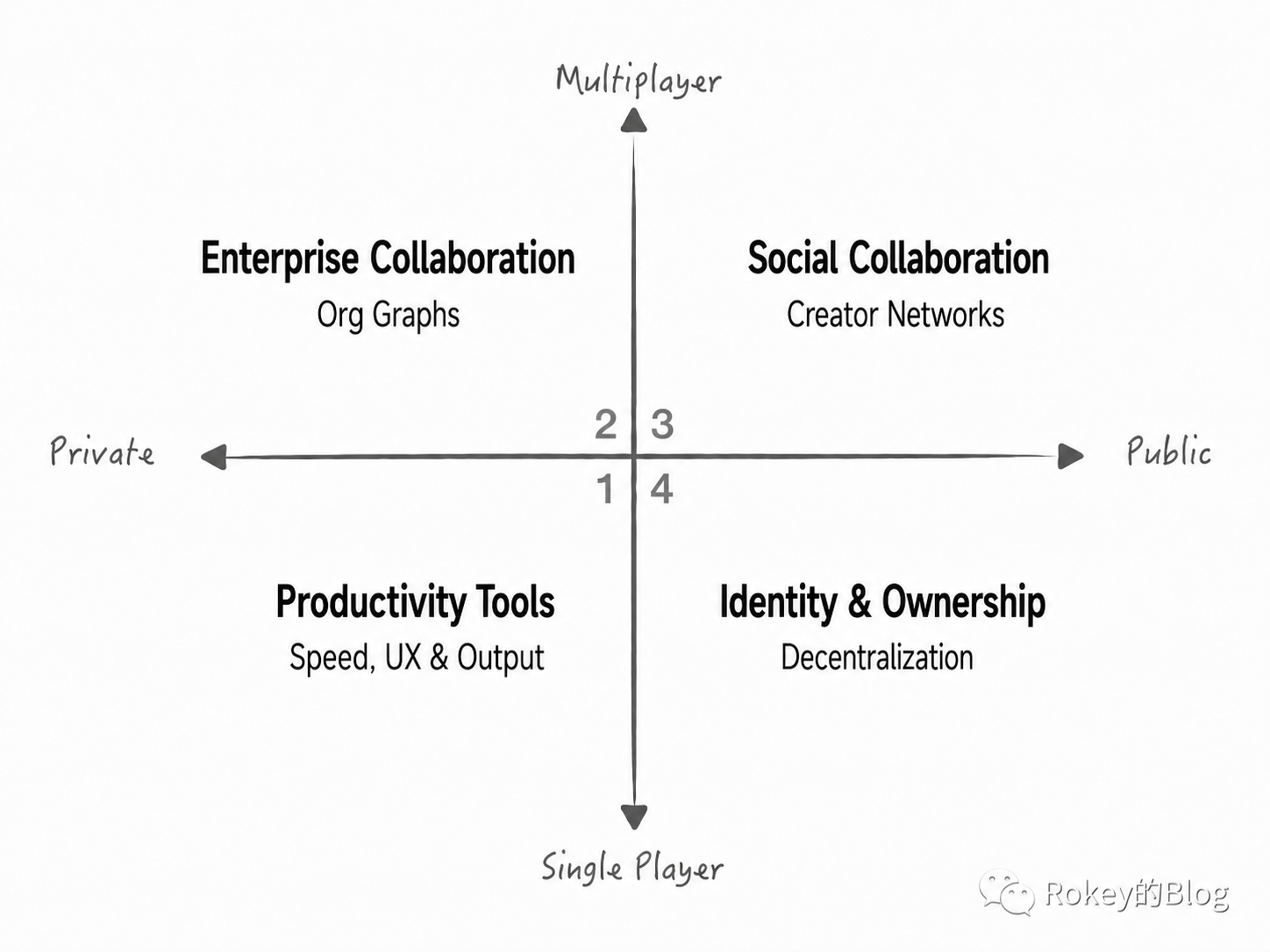
The corner Rokey was most excited about — public, many-player — he coined "creator network," and his real insight was about how one actually forms. You have to own the forkable primitive of your domain. GitHub had the repository. Figma had the canvas. Notion had the template. The primitive is the thing people copy, remix, and build on top of, and re-creation — not just creation — is what quietly turns a tool into a network.
One distinction of his matters enormously now. Some collaboration is only additive: everyone pours into one shared pool (the way they do on Wikipedia, or Community Note on X) and it grows roughly linearly. The rarer, more powerful kind is co-creation plus re-creation — fork, remix, build-on-top — where every artifact becomes the seed of the next one. Only the second kind compounds. Only the second kind is really a network effect. Additive pooling gives you a bigger bucket. Re-creation gives you a machine.
GitHub is the one that actually pulled it off — the repo, forked and built on, is the network.
Here's what nobody had to examine until this exact moment: they told us the network is the prize, but neither told us what shape it takes. For a decade we didn't need to ask, because the answer felt obvious — the feed. The algorithmic, infinite, personalized scroll is the most effective attention machine ever built, and it's the reflex the whole industry is reaching for yet again. But that reflex assumes the feed is the right container for whatever you pour into it.
Can we rethink this?
The feed is the correct shape for exactly one kind of thing: instantly consumable media. Video is a one-second contract — you glance, you get it, you swipe. The algorithm's whole job is maximizing the throughput of frictionless consumption, and for short video it is close to perfect.
But an interactive artifact isn't consumable that way.
A game, a world, a playable gizmo carries an interaction model you have to learn; every swipe drops you into a new contract you never signed. The feed's core mechanic — endless frictionless scroll — is fundamentally at war with a medium that asks for investment. You can't swipe a game the way you swipe a clip. So when you take the thing AI is suddenly brilliant at making — interactive experiences — and pour it into the one container built for passive consumption, you get a mismatch you can feel.
And there's a cost beyond the mismatch: forcing every interactive artifact through feed logic caps what gets made. If only what reads in three seconds survives, you select — at the ecosystem level — for the most trivial mechanics. Real games, even fragmented ones, are built as a sequence of levels, each teaching you slightly more than the last. That's a learning curve, compressed but intact. A feed has no room for it. Optimize distribution for the feed and you're not just picking a bad container — you're flattening what interactive content is allowed to become.
We have spent the last 15 years inventing new ways to make what goes into the feed. The thing nobody's touched is the feed itself — and that's the part actually worth rethinking. The direction I find most compelling, one possible future, not a prediction, is that it evolves into something closer to a theme park.
Now, when I say theme park, I don't mean Disney, though there's plenty to steal from the Imagineers about pacing and how you move people through a space. And I don't mean Westworld either — fully immersive, photoreal, hour-long.
The "theme park" isn't about immersion, or scale, or how long you stay. Playable games like Pocket's gizmos should stay bite-sized. What the theme does is give you context that doesn't need to be rebuilt every time — a world, its characters, the rules you already half-know walking in — so you and the AI get on the same page in seconds instead of starting cold.
That's not possible in today's feed algorithm; and for passive video consumption, it doesn't need to be.
The feed learns what you'll stop on and feeds you more of it, and since every clip is self-contained, there's nothing to carry over anyway. You lose nothing by swiping. But interactive content isn't self-contained. A game is the controls you learned, the world you figured out, the progress you made — and the feed wipes all of it the instant you swipe.
A theme park is the opposite of a scroll in nearly every way that matters. You don't consume it as it rushes past you; you travel to it and move through it. It's authored — someone designed the lands, the pacing, where you slow down and where you gather, the reasons to come back next season. It's persistent — it's still there when you return, and your return means something, because the place picks up where you left off instead of resetting. And it compounds — each visit, each new ride, each shared moment accumulates into something larger instead of vanishing the instant you swipe past it. A feed optimizes for a second of your attention. A theme park asks for your presence, and gives you somewhere to be.
This lands almost exactly on Rokey's distinction. The feed is additive consumption wearing a creation costume — a stream of atomized units, throughput maximized, nothing accruing for you between visits. The theme park is the co-creation-and-re-creation topology made spatial: authored, persistent, social, compounding — the actual shape of a network people stay inside. If you believe, with Dixon, that the network is the prize, and with Rokey, that the prize is built out of the things people remix and inhabit together, then the feed was never the destination. It was the on-ramp we mistook for the place.
Picking the right shape is necessary but nowhere near sufficient. Every shape still has to solve the chicken-and-egg problem from scratch, and that is the part my Creator Studio years won't let me skip — the shape of a network dictates the shape of the ecosystem you need to build under it. A Facebook Group and a Facebook feed are both "networks," but you cold-start them in completely different ways: different seeding, different incentives, different first rituals.
A theme park with no visitors is just an empty lot with nice signage. You need seed builders before volume, a handful of "lands" worth visiting before an algorithm, a first ritual that teaches context instead of just serving content. Get the shape right and skip this part, and you've built a more elegant way to fail.
None of this is settled. Maybe feeds mutate into something stickier and more participatory, and the line blurs. Maybe the scroll wins anyway on sheer distribution, the way it always has, and playable content just gets flattened into something swipeable. Maybe the real future is a shape nobody has drawn yet.
But the question itself is now the whole design problem. AI changed how we make things. It hasn't yet changed how we find them — or gather around them — and that second part in Dixon's passage, is where people working in the intersection of AI, creative, and content need to figure out. Come for the tool is finished. The only question left is stay for the — what exactly??