Chinese Fairyland AI Video Replication: MiniMax-H3 vs SeeDance 2.0 vs Kling
The red hanfu woman on a sea-of-clouds bridge — 2026's hottest "Chinese Fairyland" AI video. We ran it through MiniMax-H3, SeeDance 2.0, and Kling with two first-frame sources. Four real clips, compared head-to-head.
Chinese Fairyland AI Video Replication: MiniMax-H3 vs SeeDance 2.0 vs Kling
In early August 2026, "Chinese Fairyland" AI videos went viral across social platforms — a woman in a red hanfu standing on a stone arch bridge, surging seas of clouds, and golden palace complexes appearing in the distance. The original creator reproduced it with the MiniMax H3 API and shared the full workflow. We ran the same scene through MiniMax-H3, SeeDance 2.0, and Kling on Neta Studio's multimodal gateway, with two reference-frame sources (a Gemini-generated frame vs a keyframe from the original video), for a head-to-head comparison.
The Reference Frames
Two first-frame sources were used. The Gemini-generated frame (left) was created purely from a text prompt. The original keyframe (right) was taken from the viral video, with the bottom watermark cropped out — this gives the model the exact composition of the original.


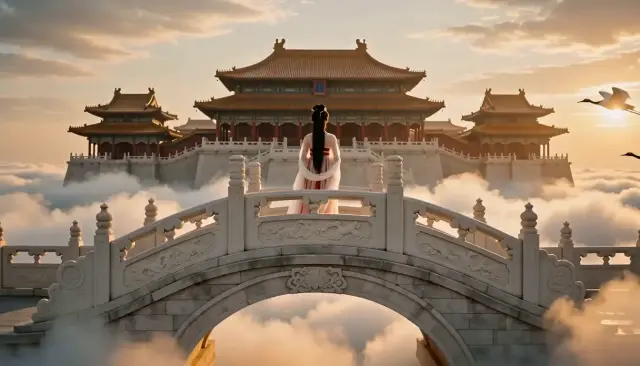
Four Generation Results — Watch the Videos
All four clips below were generated from the text prompts (or prompt + first-frame reference), at 10s / 768P / 16:9. Play them to compare composition fidelity, motion smoothness, and detail consistency.
The Prompts We Used
Here are the exact prompts, so you can replicate or remix them. The text-to-video prompt (MiniMax-H3) describes the full scene; the image-to-video prompts describe only the motion on top of a fixed first frame.
Cost / Status Comparison
| Model | First frame | Cost | Status |
|---|---|---|---|
| MiniMax-H3 | Text-only | $0.68 | ✅ succeeded |
| SeeDance 2.0 | Gemini frame | $3.76 | ✅ succeeded |
| Kling | Gemini frame | $1.26 | ✅ succeeded |
| SeeDance 2.0 | Original keyframe | $3.76 | ✅ succeeded |
Verdict: Which Model Best Replicates Chinese Fairyland?
MiniMax-H3 (text-to-video) offers the best value: $0.68 for a 10s 768P clip, with the composition faithfully reproducing the original — red hanfu woman, stone arch bridge, surging clouds, and golden palace all present — and it needs no reference frame, just one prompt.
SeeDance 2.0 produces the finest detail, but costs 5× more ($3.76), and the first-frame source matters a lot — using the original keyframe gives the composition and mood closest to the source video.
Kling sits in between ($1.26), with natural motion, a good balance of quality and price.
Bonus: The "Fairyland Palace" Scene — Fast vs Refined
Beyond the bridge scene, we also generated a palace-focused variant ("中式仙境仙宫"): flowing sea of clouds, a golden palace complex in the distance, a Kunpeng divine bird bursting out of the clouds in the mid-ground, and three robed immortals chatting under a guest-greeting pine in the foreground. Two versions were produced with Seedance 2.0 — a fast tier with no reference, and a refined tier with 2 style reference frames.


V1 · Seedance 2.0 Fast (No Reference)
Generated from pure text — the prompt asks for flowing clouds, a resplendent palace, a Kunpeng bursting from the sea of clouds, and three immortals under a pine. It delivers all elements at low cost, perfect for validating an idea quickly.
V2 · Seedance 2.0 with 2 Style Reference Frames
The same prompt plus 2 style reference screenshots. The first frame was manually verified: three robed immortals (one man, two women) on a cliff stone platform under a guest-greeting pine, gazing at the golden palace in the mist; the Kunpeng mid-ground. Overall mood and palette sit much closer to the reference material — the better final-delivery choice.
V1 vs V2: What Reference Frames Change
| Aspect | V1 · Fast | V2 · Refined |
|---|---|---|
| Model | Seedance 2.0 Fast | Seedance 2.0 |
| Style reference | None (text-only) | 2 frames (style-aligned) |
| Role | Quick draft, idea validation | Final delivery |
| Resolution | 480P 864×496 | 480P 864×496 |
| Result | All elements present ✓ | All elements + closer to reference ✓ |
Takeaway: when the scene has strong style requirements (palette, atmosphere, architectural detail), style reference frames matter — the content is identical, but V2 matches the intended look far more closely. For quick experiments, the fast tier at 480P is plenty.
The Full Workflow (Replicate It Yourself)
Write the prompt
Describe subject, environment, light, camera. Example: "Chinese fairyland cinematic shot: red hanfu woman from behind on a white stone arch bridge, sea of clouds below, golden palace complex in the distance, warm dusk light, crane gliding."
Generate a first frame (optional)
Use an image model to control composition. A Gemini frame costs about $0.07.
Generate the video
Pick MiniMax-H3 (text-to-video) or SeeDance 2.0 / Kling (image-to-video), set 10s / 768P / 16:9.
Review and refine
Compare fidelity; if unsatisfied, tweak the prompt or swap the first frame.
Why Do It on Neta Studio?
Neta Studio's multimodal gateway aggregates MiniMax-H3, SeeDance 2.0, Kling, Seedance, and more behind one command — no juggling multiple API keys. Generated results upload to the CDN automatically, ready to embed or share.
Generate Your Own AI Video
One prompt, or just say "make me a Chinese fairyland video" — Neta Studio handles it. Free to start, no code.