
How to Use AI for Crime-Drama Worlds — A Step-by-Step Guide with a Real Albuquerque World
Seven steps to a grounded legal-crime world with AI — social-rule scene selection, place-first prompts, costume casting, foreground evidence, two-temperature lighting and the GPT Image 2 vs Krea 2 comparison, proven on four real works from the Better Call Saul world.
How to Use AI for Crime-Drama Worlds
This guide is a working method, not a list of magic words. It assumes you already have a world with rules, or that you are willing to borrow one. Every step is demonstrated on the Better Call Saul world in Neta Studio, using the same four published frames that appear on the world page. By the end you should be able to produce a key visual that belongs to a specific place, not a generic crime poster with a desert filter.
What "Crime Drama" Means to a World Model
Crime drama is a genre of ordinary surfaces under pressure. Unlike fantasy, it cannot hide a mistake behind ornament. The storefront must look leased, the suit must look bought on sale, the foil must look taped up by hand, and the light must come from a tube or a lantern that exists in the room. GPT Image 2 is a good fit because it prefers material facts to mood adjectives. The method below is designed to feed it the facts in the order it uses them.
Before You Prompt: Read the World
Open the world and read the location entry you intend to visualise. The Better Call Saul world has six locations, each with its own palette and social rule. The strip mall is horizontal, bright and performative. The foil house is sealed and symmetrical. HHM is vertical and polished. The courthouse is fluorescent and transactional. The desert is empty and final. Reading first prevents the most common failure: generating a beautiful image that could belong to any crime story rather than this one.
Step 1 — Choose the Scene by Its Social Rule
Pick a location because of what people are allowed to do there, not because it looks good. The strip mall permits a pitch. The foil house permits a withdrawal. The courthouse hallway permits a plea deal in daylight. The desert permits a handover with no witnesses. When the rule is clear, the prompt almost writes itself: the location tells you what the evidence should be.
Step 2 — Establish Place and Scale First
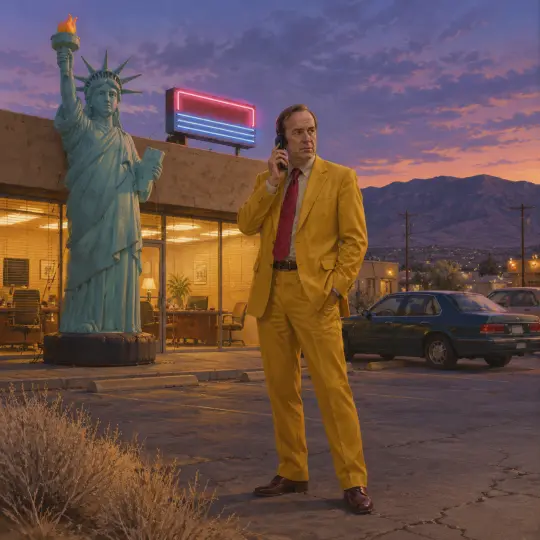
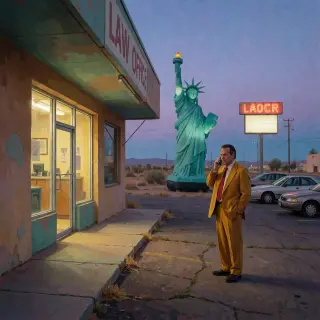
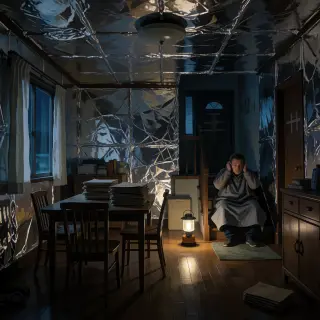
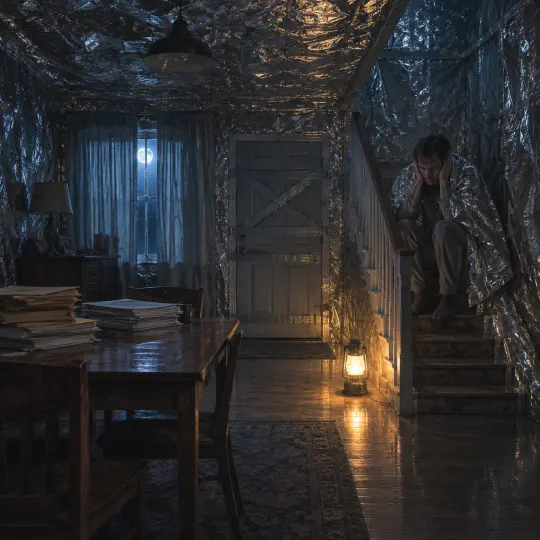
The first clause after the medium should fix the place. "A cheap strip-mall law office at dusk in Albuquerque" gives the model a canopy, a plate-glass window, a parking lot and a light direction. "A dark suburban house at night with every wall lined in crumpled silver foil" gives it a staircase, a corridor and a source of artificial light. Without that clause the model defaults to a generic cinematic backdrop, and every later clause has to fight it.
Step 3 — Cast by Costume, Not by Face
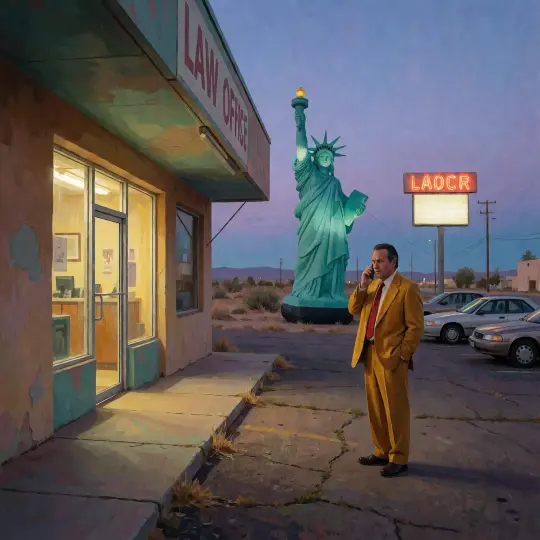
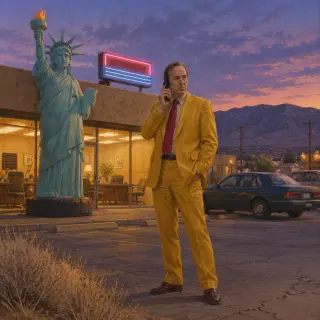
Do not describe a likeness. Describe a garment and a posture. "A middle-aged man with slicked-back dark hair in a loud mustard-yellow suit and a red tie, standing with one hand in his pocket, face turned three-quarters away" gives the model everything it needs and nothing it can get wrong. Costume also does narrative work: a suit that bright above a cracked parking lot is the entire premise of a man who has decided that appearance is the product.
Step 4 — Put Evidence in the Foreground
Every crime frame needs one object that implies an action already underway. A flip phone still at his ear. A lantern with the wick low. A stack of legal files that has been read more than once. Place the object close to the camera, give it contact shadow, and let it sit slightly off-centre so it creates a triangle with the person and the horizon. This is the single highest-leverage clause in the whole prompt.
Evidence bank for this world: flip phone, burner phone face-down, a stack of legal files, a settlement binder, a camping lantern, a silver space blanket, a car-wash token, a cold cup of coffee, a duffel bag, a parking stub, a coin collection in a velvet case, a neon tube with no letters.
Step 5 — Light With Two Temperatures
GPT Image 2 lights evenly unless you stop it. Name one key and one fill with different colour temperatures. Strip mall: neon tube as key, warm office window as fill. Foil house: one lantern as key, cold moonlight through a curtain gap as fill. Courthouse: overhead fluorescent as key, daylight from a window as fill. The warm source is almost always the ordinary world, and placing it at the edge of the frame is what makes the crime feel like a choice.
Step 6 — Lock the Palette
Write the palette as three named colours, not as a mood. "Mustard, oxblood, foil silver" is usable; "gritty and cinematic" is not. For this world the palette is deliberately narrow: the strip mall is mustard and neon red, HHM is walnut and glass, the foil house is silver and blue, the desert is ochre and bone. If you change the palette, you change whose story the audience is watching, so change it on purpose.
Strip-mall palette: mustard, neon red, beige stucco, one black shape. HHM palette: walnut, cream, glass green, one steel pen. Foil-house palette: silver, cold blue, varnished brown, one amber lantern. Desert palette: ochre, bone, faded sky, one dark car.
Step 7 — Ban Text, Then Compose
Add "no text, no logos, no watermark, restrained film grain" to every prompt. Signage is the fastest way to break the documentary illusion, because a misspelled word is instantly visible even at thumbnail size. Compose for the crop you actually need: 3:2 for a page hero, 2:1 for a share card, 1:1 for a social tile. Generate the widest version first and crop inward; never generate tight and hope to expand.
The Full Prompt Template
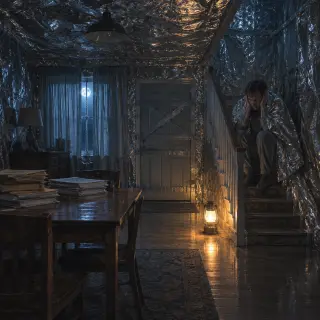
Semi-realistic painterly legal-crime key visual, cinematic wide shot. PLACE: [cheap strip-mall law office at dusk in Albuquerque / dark suburban house at night with foil-lined walls]. SCALE: [a plate-glass window, an inflatable Statue of Liberty and cracked asphalt / a staircase, a dining table and a sealed front door]. SUBJECT: [a middle-aged man with slicked-back dark hair in a loud mustard-yellow suit and red tie with a flip phone at his ear / a thin man in a grey space blanket sitting on the stairs with his hands over his ears]. EVIDENCE: [a neon tube with no legible letters / a camping lantern and a stack of legal files]. LIGHT: [violet dusk, neon red and blue, ochre stucco, cold teal shadow / cold blue moonlight through a curtain gap, one warm lantern]. NEGATIVE: no text, no logos, no watermark, restrained film grain.
Keep the order. GPT Image 2 weights early clauses more heavily than late ones, so a place clause that arrives after the costume clause will lose to the costume. The template is also a checklist: if you cannot fill a bracket with a concrete noun, the scene is not ready to generate.
Troubleshooting: Six Failures and Their Fixes
| Symptom | Cause | Fix |
|---|---|---|
| Car-advert gloss | No weather or imperfection | Add dust on paint, a scuffed bumper, flat high cloud, cracked asphalt. |
| Video-game look | No material constraints | Add wool weight, foil creases, wet concrete, chipped paint, visible seams. |
| Stock-photo emptiness | No evidence object | Add one foreground object with contact shadow and a human silhouette at the edge. |
| Character-poster drift | Face is too central | Turn the face away, widen the frame, describe posture and suit instead of features. |
| Office reads as a showroom | Too few lived-in nouns | Add stacked files, a crooked blind, a water stain, a plastic chair, a dead plant. |
| Foil house reads as a disco | Coloured light on reflective surfaces | Add "crumpled kitchen foil, taped seams, no coloured lights, one camping lantern". |
GPT Image 2 Against Krea 2 on the Same Brief
The same two briefs were run through Krea 2. The difference is consistent and useful. GPT Image 2 gives you a document: the inflatable statue has seams and a rubber base, the parking lot has real cracks, the foil has individual creases and the lantern light has contact shadow. Krea 2 gives you a poster: compressed values, a lavender sky, a diagonal canopy, a symmetrical foil room and a small figure carrying the emotion. Use GPT Image 2 when the frame must survive a crop; use Krea 2 when the frame must stop a scroll.
Building a Consistent Cast
A world is not a single image. It is the same people in different rooms, and the audience has to recognise them without a face. The solution is a costume signature and a posture signature, written down as atoms. Jimmy is a mustard suit, a red tie and one hand in his pocket. Kim is a dark blazer, a folder held against her chest and a straight back. Chuck is a space blanket, bare feet and hands over his ears. Mike is a windbreaker, a stillness and a look aimed slightly past the camera.
Costume signature
One garment and two colours per character. Repeat it across every location and the model will keep the cast legible.
Posture signature
A stance, a hand position, a direction of gaze. Posture survives a change of model better than a face does.
Object signature
Jimmy's flip phone, Kim's folder, Chuck's lantern, Mike's coffee. An object can identify a character in a wide shot.
Publishing the Result
Publish each frame as a work of the world, with its prompt and model attached. A published work is a permanent share link that inherits the world's atoms, appears in the world gallery and can be remixed. The four frames in this guide are published works from the Better Call Saul world, which means you can open them, read the briefs and compare them without trusting a screenshot.
Generate
Run the six-clause template at the ratio you need.
Select
Keep the frame that answers a question before the caption does.
Attach
Publish it as a work of the world, with prompt and model recorded.
Compare
Run the same brief on the other model and publish both.
Fork
Let someone else change an atom and generate the next frame.
A Worked Example: Two Frames, One World
The strip-mall frame was built from five nouns: canopy, plate glass, inflatable statue, neon tube, flip phone. The foil-house frame was built from five different nouns: foil panel, lantern, staircase, legal file, space blanket. Both prompts use the same six-clause order and the same negative clause. That is the whole method. The world supplies the nouns; the template supplies the order; the model supplies the material. Everything else is iteration.
Explore the World
The world is public and the four key visuals are live. Fork it, change one atom, and generate the frame you actually want to see: the inside of the duffel bag, the moment before the door opens, the look on the face that the neon is hiding. Then publish it next to the originals and let the comparison do the arguing.
Put This Guide to Work
Four published frames, two models, one world — the next frame is yours to make.