
How to Use GPT Image 2 for Akira Anime Key Visuals — A Working Guide
Seven steps from a world atom to a published Akira key visual: choose one impossible gesture, write six clauses, keep the cel materials honest, and compare two models on the same brief. Worked examples from the Neo-Tokyo 2019 world.
Why Neo-Tokyo Needs a Visual Grammar
An Akira key visual is not a cyberpunk mood. It is a city that was rebuilt on top of the thing that destroyed it, and a generation that has been told to look forward. That means the visuals cannot be fog and floating neon. They have to look like infrastructure with one rule removed: a highway that leads directly to the crater it was built to hide, a stadium that glows above the ruins, a hospital corridor where the furniture has stopped agreeing with gravity.
This guide is the method that produced four published frames in the Neo-Tokyo 2019 world with GPT Image 2 and Krea 2. It is written so you can run it on that world or on your own, and it assumes no special plugins — only a prompt, a model and a place to publish.
What You Need Before You Prompt
Four things should exist before you type anything. Without them, the prompt becomes a mood board and the model has to invent the movie.
A world with atoms. Named characters, named locations and a stated visual style. One location. The specific road, stadium, corridor or bar you are visualising, with its own objects. One operation. The single law you are breaking — lift, suspend, detonate, frame. One witness. The person whose scale tells the audience how to feel about the geometry.
Step 1: Read the World Before You Write
Open the world and read the location card, not the prompt history. The card already contains the nouns that make the frame specific: the elevated highway has guardrails, overhead gantries, lane paint and a checkpoint; the Nursery has gurney wheels, an IV stand, fluorescent tubes, a teddy bear and a sealed elevator with no public floor number. Those nouns are the difference between Neo-Tokyo and generic neon city.
For the two frames in this guide, the nouns came directly from the world: wet asphalt, sodium lamps, stadium truss, searchlights and a red jacket for the highway; torn cotton, bare feet, a bent gurney, a monitor hanging by its cables and a child’s teddy bear for the awakening. Nothing in the prompt was invented that the world did not already contain.
Step 2: Choose One Impossible Gesture
The single most common failure in this genre is asking for two impossible things at once. A city that lifts, floods, glows and explodes is not an Akira frame; it is a screensaver. Pick one verb and let the rest of the image stay ordinary. The ordinary part is what makes the impossible part legible.
Lift for scale and politics: a road above a crater, a stadium above a ruin. Suspend for the body: a corridor, a gurney, a child. Detonate for climax: a crater rim, a shockwave, a skyline that stops being a skyline. Frame for theme: a very small rider against a very large institution. Flood for time pressure: a lower ward where the neon has no horizon.
Ask a second question before you commit: does this operation change the architecture, the body or the light? A lift changes architecture. A suspension changes the body. A detonation changes the light and the horizon. Choosing the category first tells you where to spend your prompt detail.
Step 3: Build the Six-Clause Brief
The template has six clauses and a fixed order. It is deliberately boring, because a fixed structure is what makes two generations comparable. If you rewrite the template for every model, you are measuring your own adjectives instead of the outputs.
Medium and genre
1980s theatrical anime key visual, hand-painted cel animation, cinematic wide shot. Lock the rendering system first.
Place
Name the real infrastructure and the real building type: elevated concrete highway, floodlit Olympic stadium on a crater rim, sealed hospital corridor.
Subject
One person, one vehicle or one body, with a posture and an object. A rider with one hand off the bars; a boy with one palm planted on the floor.
Operation
One broken law, stated as a fact: the stadium sits on the crater it hides, the corridor has lost gravity, the arm has become a pressure vessel.
Physics and light
Wet asphalt reflecting sodium lamps, steam from vents, red emergency light against cold fluorescent tubes, torn curtains lifted by pressure.
Negative clause
No text, no watermark, no logos, no modern glossy rendering — the four words that remove most cyberpunk drift.
Step 4: Set Size and Quality
Generate the composition cheaply and the detail expensively. A landscape frame at medium quality answers the only question that matters early: does the operation read? Once it does, re-render at high quality in the final ratio. For a world cover, 1536x1024 landscape is enough; a share card wants 1024x1536 vertical; a gallery tile can be 1024x1024.
Do not upscale a weak composition. The highway either reads at thumbnail size or it does not, and no amount of resolution will add a stadium that was never planted on the crater.
Step 5: Generate, Inspect, Re-render
Inspect in a fixed order. First the operation: can you name the impossible thing in one second? Second the witness: is there a human scale, and does their posture agree with the physics? Third the material: do the asphalt, the cotton, the steel and the glass each behave like themselves? Fourth the negative clause: is there any text, logo or modern gloss that broke the 1988 look?
If it fails, fix one thing per re-render. Changing five clauses at once teaches you nothing about which one worked. The frames in this guide took two passes each: the first to prove the operation, the second to correct the witness scale and remove a stray glow.
A Worked Example: The Elevated Highway
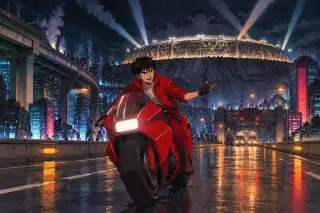
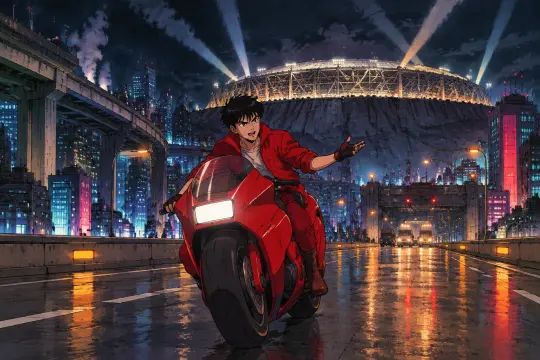
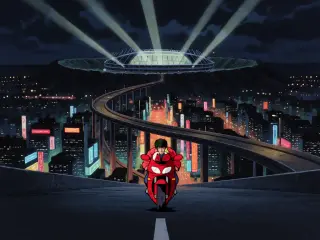
The brief: a Neo-Tokyo elevated highway at night, a rider in a red jacket coming toward camera, the Olympic Stadium floodlit on the crater rim behind him. The lift is chosen because it is the most legible political gesture in the canon — a road is a direction, and a road that ends at a stadium built over a crater is a sentence about what the city has decided to remember.
Prompt. 1980s theatrical anime key visual, hand-painted cel animation with hard specular highlights and dense hand-painted backgrounds, cinematic wide shot: Neo-Tokyo at night in 2019, a rebuilt megacity of elevated concrete highways and neon canyon streets standing on the crater of the old capital; a nineteen-year-old gang leader in a bright red jacket rides a red sport motorcycle down the elevated highway toward camera, lean and cocky, one hand off the bars; behind him the floodlit Neo-Tokyo Olympic Stadium rises over the crater rim, searchlights sweeping the clouds; steam from vents, wet asphalt reflecting sodium orange and cyan neon, distant military checkpoint lights, a vast dark sky; 1980s anime film cel, visible paint texture, strong rim light, high contrast, dramatic perspective, epic scale, no text, no watermark, no logos.
A Worked Example: The Awakening
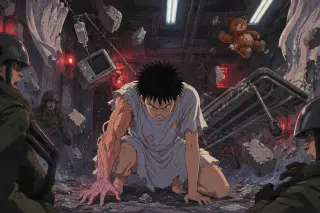
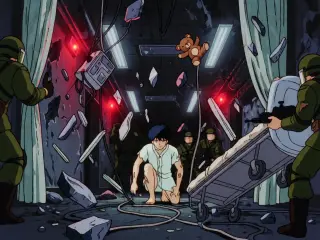
The brief: Tetsuo in a wrecked corridor under the hospital, one arm swollen with psychic pressure, debris suspended around him, soldiers at the edges of the frame. The suspension is chosen because it tests the body instead of the city. A corridor exists to contain a single direction; take that away and the figure becomes the only stable object in the frame.
Prompt. 1980s theatrical anime key visual, hand-painted cel animation with hard specular highlights, cinematic interior: Tetsuo Shima, a pale sixteen-year-old in a torn white hospital gown, crouched in the center of a wrecked military laboratory corridor beneath the hospital; his right arm is swollen with veined psychic energy, a halo of broken concrete, glass and medical equipment floating around him, wires and torn curtains lifted by pressure; red emergency lights and cold fluorescent tubes, soldiers in riot gear frozen at the edges of the frame, one gurney overturned, a shredded teddy bear drifting; 1980s anime film cel, visible paint texture, deep shadows, strong rim light, claustrophobic composition, no text, no watermark, no logos.
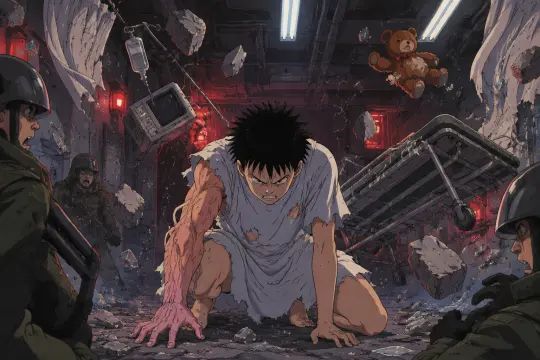
Notice what is absent from both prompts: no mention of cyberpunk, no mention of dystopia, no colour-grading language. Those words encourage haze, purple light and floating islands. The operation — lift, suspend — is what actually produces the image.
Comparing Models Fairly
Run the identical brief through both models at the same size, publish both, and let the comparison stand. GPT Image 2 is the document: it protects architecture, contact and material, which makes it the better choice for store pages, thumbnails and anywhere the frame will be cropped. Krea 2 is the poster: it protects gesture, silhouette and colour block, which makes it the better choice for a hero image or a feed card.
Publishing the Result
Publish each frame as a work of the world, with its prompt and model attached. A published work is a permanent share link that inherits the world’s atoms, appears in the world gallery and can be remixed. The four frames in this guide are published works from the Neo-Tokyo 2019 world, which means the comparison is not a claim in a blog post — it is a set of assets anyone can open.
Generate
Run the six-clause template at the ratio you need.
Select
Keep the frame that answers a question before the caption does.
Publish
Attach prompt and model, publish it as a work of the world, and copy the share link.
Compare
Put the two models side by side in the world gallery and let the next person fork the better one.
Seven Rules That Keep Frames Out of Cyberpunk
These are the rules that survived four generations and two models. They are all negative rules, because the genre is defined by what you refuse to add.
1. One operation per frame. 2. No purple haze, no lens flares, no floating holograms. 3. Real infrastructure: guardrails, lane paint, gurneys, checkpoints. 4. A witness at human scale, usually with their back to us or their hands on the floor. 5. Materials first: wet asphalt, painted steel, cheap cotton. 6. Neon is an accent, never the subject. 7. No text, no logos, no watermark.
The corollary is worth stating plainly: if the frame needs a caption to explain what is impossible, the prompt described an atmosphere. If the frame explains itself at thumbnail size, the prompt described an operation. That is the whole guide compressed into one test.
Explore the World
The world is public and the four key visuals are live. Fork it, change one atom, and generate the frame you actually want to see: the inside of the crater at street level, the stadium before the lights come on, the look on Kaneda’s face when he decides to keep riding. Then publish it next to the originals and let the comparison grow.
Put This Guide to Work
Four published frames, two models, one world — the next frame is yours to make.