
How to Use GPT Image 2 for Anime Esper Key Visuals — A Working Guide
Seven steps from a world atom to a published esper key visual: pick one impossible event, write six clauses, keep the materials honest, and compare two models on the same brief. Worked examples from the Mob Psycho 100 world.
Why Esper Stories Need Ordinary Rooms
A psychic story is not about magic. It is about a person who can do something impossible and would prefer not to. That means the visuals cannot be all lightning and floating cities. They have to look like a place where someone still has homework, a part-time job and a rent problem, and then one law of physics quietly stops applying.
This guide is the method that produced four published frames in the Mob Psycho 100 world with GPT Image 2 and Krea 2. It assumes no special plugins: a prompt, a model, a world and a place to publish.
What You Need Before You Prompt
Four things should exist before you type anything. Without them the prompt becomes a mood board and the model has to invent the show.
A world with atoms. Named characters, named locations and a stated visual style. One room. The specific yard or office you are visualising, with its own objects. One event. The single impossible thing you are going to show. A destination. The surface the frame will live on: world cover, share card, gallery tile, article header.
Step 1: Read the World Before You Write
Open the world and read the location card, not the prompt history. The card already contains the nouns that make the frame specific: Salt Middle School has a cracked concrete yard, orange classroom windows and a bike rack; the Spirits and Such office has a fake plant, a rotary phone, a bowl of salt and a wall of certificates nobody checks. A model cannot infer those from the phrase psychic office, and a reader can tell immediately when you have.
For the two frames in this guide, the nouns came directly from the world. Nothing in the prompt was invented that the world did not already imply. That is the cheapest consistency trick available.
Step 2: Choose One Impossible Event
The most common failure in this genre is asking for two impossible things at once. A schoolyard that floats and glows and rains and has a portal is not a key visual; it is a screensaver. Pick one gesture and let the rest of the image stay ordinary.
Lift for a 100% moment. Float for a spirit in a room. Grow for a landmark that should not exist. Freeze for a moment of shock. Each produces a different composition, and mixing them produces mud.
Ask a second question before you commit: does the event change the architecture, the body or the light? A lift changes the objects. A float changes the room’s social logic. A grow changes the skyline. Choosing the category first tells you where to spend your prompt detail.
Step 3: Build the Six-Clause Brief
The template has six clauses and a fixed order. It is deliberately boring, because a fixed structure is what makes two generations comparable. If you rewrite the template for every model, you are measuring your own adjectives instead of the outputs.
Medium and style
Anime key visual in a bold-line comic style. Thick contour lines, flat cel colour, two hard value steps, minimal texture.
Character
Age, hair, eyes, expression and wardrobe. For Mob: fourteen, bowl cut, dull round eyes, flat mouth, black gakuran, gold buttons.
Place
Name the real room or yard and its objects. Cracked concrete, vending machine, bicycle, orange windows, one flat comic cloud.
Event
One broken law, stated as a fact. Desks, tiles and a bicycle lifting in a slow radial explosion, dust suspended, shadow unchanged.
Light and palette
Deep indigo sky, orange windows, cold blue-white light, long hard shadows. Or fluorescent beige, teal upholstery, neon through glass.
Negative clause
No text, no logo, no watermark, no photorealism, no PBR, no heavy paint, no gradient.
Step 4: Set Size and Quality
Generate the composition cheaply and the detail expensively. A portrait frame at medium quality answers the only question that matters early: does the event read? Once it does, re-render at high quality in the final ratio. For a world cover, 1536x1024 landscape; a character poster, 1024x1536; a gallery tile, a square.
Do not upscale a weak composition. The lift either reads at thumbnail size or it does not, and no amount of resolution will add a spatial relationship that was never composed.
Step 5: Generate, Inspect, Re-render
Inspect in a fixed order. First the event: can you name the impossible thing in one second? Second the scale: is there a body or a familiar object that tells you how big it is? Third the materials: do wool, concrete, plastic and chrome each behave like themselves? Fourth the negative clause: did any text, logo or glow creep in? Fifth the face: is it still the character, or has the model made him cute?
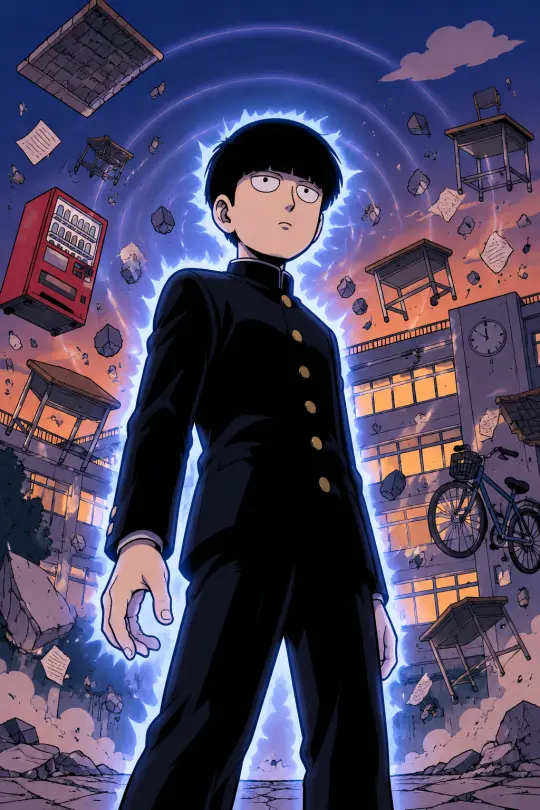
If it fails, fix one thing per re-render. Changing five clauses at once teaches you nothing about which one worked. The frames in this guide took two passes each: the first to prove the event, the second to correct the face and remove a stray glow.
A Worked Example: The 100% Schoolyard
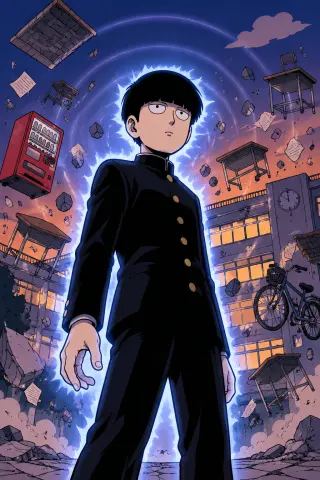
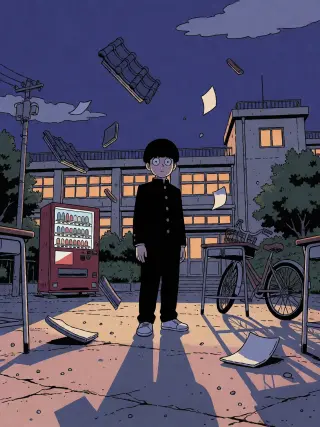
The brief: Mob at one hundred percent in the Salt Middle School yard, with school furniture lifting around him. The lift is chosen because it is the most legible impossible gesture in the world: a schoolyard is a floor, and taking the objects off it turns the whole image into a statement about restraint.
Prompt. Anime key visual in a bold-line comic style: a fourteen-year-old Japanese boy with plain bowl-cut black hair, dull round eyes and a black gakuran with a high collar and gold buttons, standing alone in the cracked concrete courtyard of a public middle school at dusk; a cold blue-white psychic ring distorting the air; roof tiles, a vending machine, school desks, a bicycle and loose papers floating upward in a slow radial explosion; dust suspended; long hard shadows on the concrete; orange classroom windows and a deep indigo sky with one flat comic cloud; thick black contour lines, flat cel-shaded colour, two hard value steps, no text, no logo, no watermark.
A Worked Example: The Consultation Office
The brief: the cramped second-floor office at night, with Reigen, Mob and Dimple in the same room. The event is a single floating spirit, which is chosen because it tests the room rather than the sky. An office exists to be ordinary; put one impossible thing in it and the comedy becomes architecture.
Prompt. Anime key visual in a bold-line comic style: the cramped second-floor office of a small psychic consultation business at night; a middle-aged blond con man in a light grey suit and loosened tie behind a cluttered desk with a fake potted plant, a rotary phone, a stack of unopened mail, a bowl of salt and a wall of framed certificates; a calm fourteen-year-old boy in a black gakuran standing by the window holding a mop; a small green evil spirit with a wide grin floating cross-legged above a worn sofa; fluorescent ceiling light, water stains, cardboard boxes, a neon sign and a train line beyond the glass; thick black contour lines, flat cel-shaded colour, muted beige and teal palette, no text, no logo, no watermark.
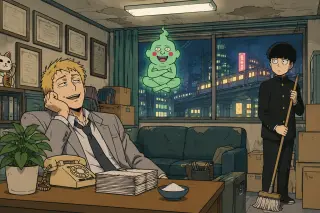
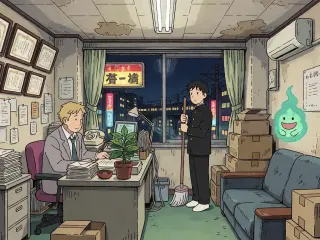
Notice what is absent from both prompts: no mention of a mood, no mention of surrealism, no colour grade. The word dreamy would have produced glow and haze. The event — lift, float — is what actually produces the image.
Comparing Models Fairly
Run the identical brief through both models at a matched ratio, publish both, and let the comparison stand. GPT Image 2 is the document: it protects architecture, contact and material, which makes it the better choice for covers, store pages and anywhere the frame will be cropped. Krea 2 is the poster: wider gesture, flatter colour, more air, faster to iterate. Neither is universally better; the surface decides.
The Five Mistakes That Cost the Most
These are the failures that survive a second look, which makes them the expensive ones.
Asking for an aura
It pulls in glow, particles and a different franchise. Describe what the power is doing to the furniture instead.
No witness
A floating object with no human scale is abstract. Put a body in the frame, even if it is small.
Cute drift
The model gives the boy big eyes and a blush. Repeat the face clause verbatim and remove any adjective that implies charm.
Text contamination
Signage invents itself. Say no text, keep signs abstract, and check the corners before publishing.
Too many events
Two impossible things read as noise. One gesture per frame, stated as a fact.
Publishing the Result
Publish each frame as a work of the world, with its prompt and model attached. A published work is a permanent share link that inherits the world’s atoms, appears in the world gallery and can be forked. The four frames in this guide are published works from the Mob Psycho 100 world, which means you can open them, read the briefs and compare them without trusting a screenshot.
Generate
Run the six-clause template at the ratio you need.
Select
Keep the frame that answers a question before the caption does.
Attach
Publish it as a work of the world, with prompt and model recorded.
Compare
Publish the sibling model output next to it and link both.
A Checklist You Can Reuse
Before you generate: world read, one room chosen, one event chosen, destination ratio known. While you prompt: style first, face second, room nouns third, event as fact fourth, light palette fifth, negative clause last. After you generate: event, scale, material, contamination, character. Before you publish: crop test, prompt attached, model recorded, share link copied.
That is the whole method. It is not glamorous, and it will not make a bad world interesting. What it will do is make the tenth frame as legible as the first, which is the only real test of a generator workflow.
The world is public and the four key visuals are live. Fork it, change one atom, and generate the frame you actually want to see: the Divine Tree at street level, the Seventh Division base, the rooftop lunch scene, or a Reigen-only frame with no powers at all. Then publish it next to the originals and let the comparison grow.
Put This Guide to Work
Four published frames, two models, one world — the next frame is yours to make.