
How to Use GPT Image 2 for Calendar World Key Visuals — A Step-by-Step Guide
A practical guide to generating calendar-world key visuals with GPT Image 2 — from reading a world's atoms to publishing a frame that survives the crop. Worked end-to-end on Everwhen, with four published examples.
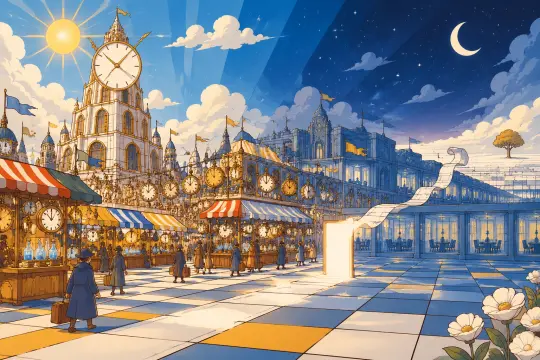
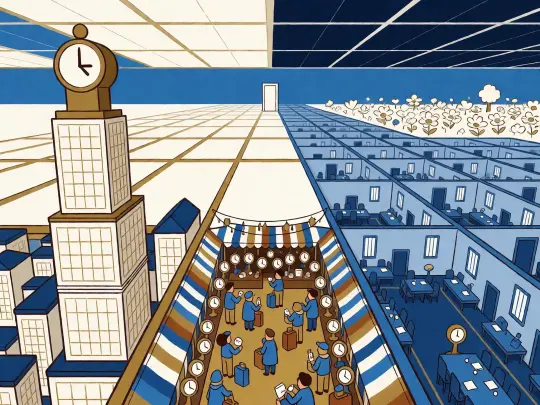
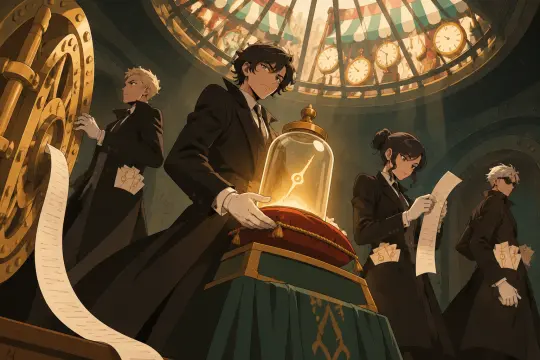
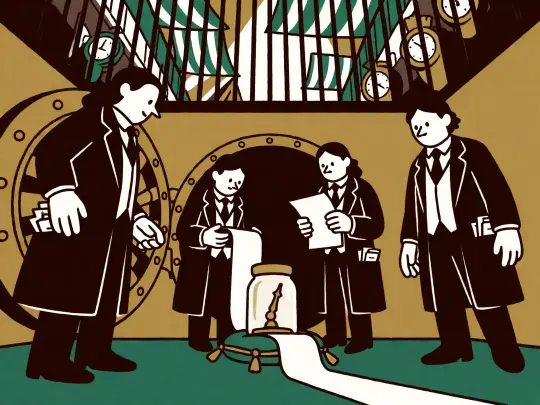
Make a Calendar World Key Visual
GPT Image 2 is a text-to-image model that rewards a specific, ordered brief. A calendar world is a hard subject because it is architectural, social and rule-bound at the same time: the grid has to recede, the crowd has to stand on it, and the rules have to be visible as objects rather than explained in a caption.
This guide is the method behind the four published works from Everwhen, an original calendar cosmology on Neta Studio. It runs from reading the world's atoms to publishing a frame that survives the crop, with both models side by side at every step.
Quick Answer: The Six-Clause Frame
Write every calendar prompt as six ordered clauses: medium and genre, scale object, subject, physics and props, light and palette, negative clause. Keep the whole brief under 120 words. Long prompts do not fail because the model cannot read them; they fail because the clause that mattered gets buried under adjectives.
| Clause | Question it answers | Example |
|---|---|---|
| Medium | What rendering system? | flat-block storybook illustration |
| Scale | What fixes the camera? | a city built on a calendar grid |
| Subject | Who carries the frame? | four members of the Decline |
| Props | What proves the rule? | a jar holding a golden clock-hand |
| Light | Who is paying for the room? | hard daylight through a grate |
| Negative | What must not appear? | no interface, no buttons, no logos |
Step 1 — Read the World Before You Prompt
Do not start from a blank prompt box. Start from the world's atoms. Everwhen has 23 of them: seven characters, six locations, six events and four factions. Each card is a constraint you can put in the prompt instead of inventing one, and constraints are what make a frame feel like a place.
- Character — Minute, a thirty-minute coffee event with a countdown ticket she refuses to read.
- Location — the vault beneath the Time Zone Bazaar, brass door, green baize, one grate of daylight.
- Event — the Daylight Coup, the annual theft of the hour the clocks shift takes away.
- Faction — the Decline: formal black and white, white gloves, stacks of declined invites.
This is also where consistency comes from. The palette, the outline logic and the social hierarchy are already decided by the world, so you only have to decide the camera. Swap the world and the same six clauses produce a completely different frame; keep the world and every frame belongs to it.
Step 2 — Cast One Entry Against Scale
The subject is the measuring instrument. A thirty-minute coffee event standing in a four-hundred-year meeting hall tells you the scale of the bureaucracy. A nine-foot all-day event at the top of a tower tells you the scale of the law. A white doorway with no face tells you the scale of the threat. Pick the Entry that makes the architecture legible.
For calendar work, the costume is the duration. A short event should look overstretched and slightly temporary. An all-day event should look like it has nowhere to be. A declined invite should look like paper that has been folded and refolded. These details let a viewer read time without a caption.
Step 3 — Choose the Location Grammar
Four location types cover the genre, and each demands a different composition. Choose the location before you write the prompt, because the location decides the camera, the palette and the light.
The Grid — flat, legible, bounded
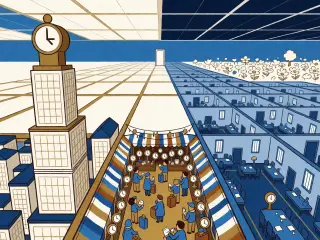
The Grid is the default arena: right angles, identical doors, fluorescent light humming in the key of C, no windows and no clocks. Shoot wide and level. The horror is repetition, so let the repetition fill the frame and put one figure off-centre to break it.
The Margins — blank, soft, horizon-heavy
The Margins are the opposite composition: white paper ground, a clean straight horizon, paper flowers, and one idea of a tree. Negative space is the subject. Put one small figure at the edge and resist the urge to fill the middle with architecture.
The other two grammars are the Bazaar (dense, vertical, warm — awnings and hanging clocks in the top third, merchants in the bottom) and the Spire (stacked, monumental — shoot up, and make the numberless clock the brightest thing in the frame).
Step 4 — Light It Like a Bureaucracy
Calendar lighting is economic, not decorative. Every light source should imply who is paying for the space. Fluorescent panels mean the Blue Order is hosting. Amber lamps mean someone is delaying something. Brass glow means all-day time, which nobody is paying for and everybody owes.
- Fluorescent white — administered time: flat, slightly green, almost no shadows.
- Amber and warm dust — delayed time: the Snooze Quarter, the Bazaar at closing, any avoided decision.
- Brass and bronze — all-day time: low, warm, and always a little too bright for the hour.
- Paper white with no shadow — the Margins and TBD: not a source at all, an absence of one. Never add a gradient here.
Step 5 — Render Wide, Crop Late
The published crop is rarely the rendered crop. Render at 1536×1024 or wider, keep the horizon in the middle third, and crop to the card afterwards. A square render forces you to choose between the tower and the crowd; a wide render lets both exist and lets the crop decide.
| Model | Working size | Best for |
|---|---|---|
| GPT Image 2 | 1536×1024 | hero frames, crowds, texture, store pages |
| Krea 2 | 1024×768 | thumbnails, cards, silhouettes, flat graphic covers |
Step 6 — Compare Models, Publish Both
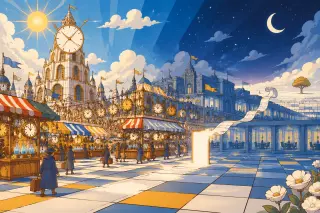
Run the identical brief through GPT Image 2 and Krea 2. GPT Image 2 gives you the structured, populated version; Krea 2 gives you the graphic, thumbnail-proof version. Publish both as works attached to the same world, and the pair becomes a reference for the next person instead of two orphaned images.

Common Mistakes and Fixes
- Mentioning the product. Words like "calendar app", "planner" or "dashboard" pull the model toward UI. Describe the world, never the software.
- Filling the Margins. The blank country works because it is blank. If your prompt adds architecture there, you have deleted the only place in the world that is not scheduled.
- Unbounded clocks. Give every clock one rule — "all stopped at nine minutes past" — or they will multiply into noise.
- Too many subjects. One Entry carries a frame. Four work only when each has a job. Seven become a crowd with no story.
- Explaining instead of showing. Never write "the meeting is oppressive". Write "identical doors, no windows, fluorescent light in the key of C".
Most "bad" calendar generations are not model failures. They are brief failures: a missing clause, a product word, or a subject that cannot measure the architecture. Read the prompt back and ask which clause is doing the least work, then cut it.
A Worked End-to-End Example
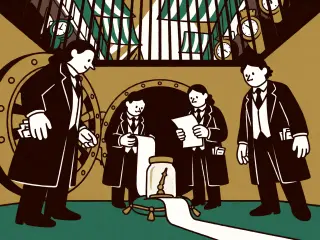
Here is the full loop on one frame, from atom to published work. The atom pair is the Daylight Coup plus the vault beneath the Time Zone Bazaar; the Entry is a member of the Decline; the job is a heist at the exact moment it succeeds.
Read the atoms
The Daylight Coup: the annual theft of the missing hour. The vault: brass door, green baize, one grate of daylight above.
Write the six clauses
Flat-block storybook illustration; a vault under a market; four members of the Decline; a lit jar and one receipt; hard daylight and one warm glow; no UI, no logos.
Render GPT Image 2 wide
1536×1024, quality high. Check that all four figures have a job and the receipt starts at the door.
Run Krea 2 on the same text
1024×768. Check that the frame still reads as a heist without faces or texture.
Publish the pair
Attach both to Everwhen with captions that name the atom, the model and the difference. The caption is part of the work.
Where to Go Next
Once the six-clause brief is automatic, the interesting work begins: choosing atom pairs that contradict each other. Put the all-day event in the thirty-minute event's slot. Put TBD at the door of the Standing Meeting. Put the Decline in the Snooze Quarter, where nobody can decide anything. The world supplies the pressure; the brief only supplies the camera.
Start Creating
Six clauses, two models, four published works — now render the frame only you would choose.