
How to Use GPT Image 2 for Cyberpunk World Key Visuals
A three-lesson workflow for turning world cards into key visuals: the city from a roof, a replicant portrait, and the rooftop ending.
How to Use GPT Image 2 for Cyberpunk World Key Visuals
This guide teaches the model through a world. Instead of a list of magic phrases, you get three lessons — a city, a character and a rooftop — each built from a card, a beat and a camera. By the end you should be able to write a cyberpunk key visual prompt in about four minutes and repair it in one pass.
It assumes no prior experience with image models and no encyclopaedic knowledge of Blade Runner. You need the world’s cards, GPT Image 2, and one decision per lesson: what is happening in the next ten seconds.
What You Need Before You Start
The world cards
Blade Runner: The Empathy Test has 8 characters, 6 locations, 6 events, 4 factions and 3 rules. You do not need all of them. You need one card, plus one rule that constrains it.
GPT Image 2 access
Text input is enough. Reference images are supported but not required for any lesson here.
Two frame sizes
1536×1024 for places and two-shots, 1024×1536 for single figures. Decide before you write, because the crop is part of the composition.
One exclusions line
“No text, no logos, no watermark.” Paste it every time. It prevents most of the boring failures.
Understand the World’s Visual Grammar
The three rules are also three image instructions. Learn them once and you stop describing the setting from scratch.
The grammar also has a colour rule: sodium and neon for the human world, one cold cyan or blue emission for the machine. Wet asphalt, warm amber practicals, magenta signage — then a cyan that does not come from the sky. If your image has no artificial cold light, it is a crime scene, not a cyberpunk scene.
Build the Prompt in Five Layers
Five layers, each doing a different job. If you only remember one thing from this guide, remember the order.
[style] Cyberpunk [shot type] key visual, high-contrast neon digital painting, [aspect]: [subject + costume + prop]; [foreground]; [middle ground]; [background]; [weather]; [key light + fill light]; [palette anchors]; [camera height]; no text, no logos, no watermark.
Lesson 1: Los Angeles from the Roof
Read the card
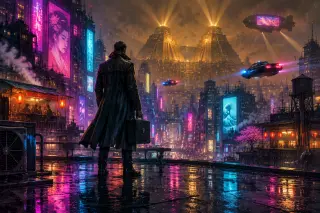
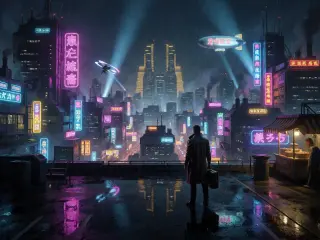
Los Angeles, November 2019: a rain-drowned vertical city of neon, steam, noodle stands and blimp light, ziggurat towers above permanent smog.
Choose the argument
One person is small inside a city that was not built for people. This is a scale decision, not a mood decision.
Write five layers
Neon digital painting; a blade runner with a briefcase, back to camera; wet roof and puddles; street canyon with stalls and spinners; ziggurats, smog and blimp; warm rain; magenta key plus amber fill; low camera, wide.
Generate at 1536×1024
Check the silhouette first, then the three planes, then the props. A beautiful image with a wall of lights is a failed establishing shot.
Repair one clause
If the city is flat, name the foreground object. If the figure is lost, raise the contrast of the coat against the street. Do not rewrite the whole prompt.
The GPT Image 2 result is a three-plane scene: rooftop, canyon, skyline. The Krea 2 result on the same prompt is a flatter poster with a bright blimp and two gold verticals. Both are valid. The GPT version explains the place; the Krea version sells it at a glance.
Lesson 2: A Replicant Portrait
Read the card
Roy Batty: platinum-haired Nexus-6 combat model, black trench coat, pale scarred face, animal eyes, a nail through one hand. The nail is the story; do not lose it.
Choose the beat
Not a fight. The moment after one, when he is tired and still standing. A character portrait is a pressure state, not a pose.
Write five layers
Neon digital painting; Roy in a black coat, nail through the left hand; rain, steam, a neon sign behind; cold cyan rim and warm amber fill; low camera, portrait.
Generate at 1024×1536
Check the hand first, then the face, then the coat. Hands are where the model hides its failures.
Repair the tells
If the scar disappears, name its position. If the nail becomes jewellery, describe it as “a nail driven through the palm, blood at the entry”.
The trap with this prompt is beautification. GPT Image 2 will make a dying man look like a cover model. Add “exhausted, not serene; rain on the face; no glamour lighting” and check at full resolution. The card’s word is “animal eyes” — if the eyes are calm, the portrait is wrong.
Lesson 3: Tears in the Rain
Reduce the beat to four facts
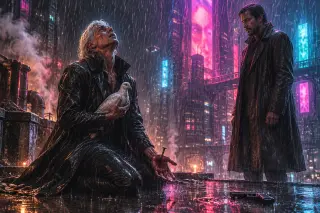
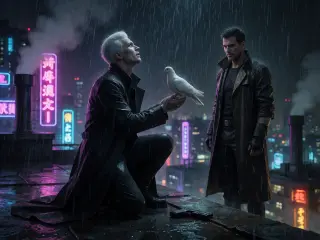
A dying replicant kneels. He holds a white dove. One hand is pierced by a nail. A blade runner watches, disarmed.
Stage the room
A rain-soaked rooftop ledge. Put the pistol in a puddle between them. The gun is the truce.
Write five layers
Neon digital painting; two men, one kneeling with a dove; wet ledge, vent pipes, neon below; warm night rain; magenta key and cyan rim; low camera, wide two-shot.
Generate at 1536×1024
Check the dove, the nail and the gun in that order. If any of the three is missing, the scene is a generic rainy argument.
Compare with Krea 2
The Krea version will be more symmetrical and more graphic. Keep it as the poster; keep the GPT frame for the story page.
This is the lesson where GPT Image 2’s detail matters most. A rooftop scene is a stack of small facts — a dove, a nail, a gun, a scar, rain on a coat — and a model that drops one of them turns a specific ending into a mood. If the first result is beautiful but empty, add the missing fact as its own clause and run it again.
Iterating Without Losing the World
Reading a Failed Generation
GPT Image 2 vs Krea 2: Which for Which Shot
- City establishing shotGPT Image 2. It builds foreground, canyon and skyline as separate planes and fills the street with believable props. Krea 2 flattens the same scene into bands and loses the geography.
- Character portraitGPT Image 2 for the detailed version, Krea 2 for the graphic version. Run both from the same prompt; use the GPT one to check costume logic, the Krea one for the cover.
- Social media cropKrea 2. Strong centred silhouette, two or three values, readable at small size, and about five times cheaper per image.
- A scene with a small crucial objectGPT Image 2. It will hold the nail, the dove, the snake scale or the scar. Krea 2 tends to simplify the object into a shape and lose the story.
Publishing and Reusing
Publish the image with the card it came from, not as a standalone picture. A viewer who can open Roy’s card, read the nail and the coat, and then see the rooftop image will understand why it looks the way it does. That link between text and image is the difference between a world and a gallery. Keep the non-affiliation note with any reuse, and do not present generated frames as official stills.
Checklist Before You Publish
Questions About This Workflow
How long should one image take?
About twenty minutes once you know the world: three minutes choosing the argument, four writing the layers, five generating on both models, five repairing one clause, three filing the result back into the card. The first image takes longer because you are learning the palette.
Do I need to prompt in English?
Both models were tested in English and the clause order assumes English weighting. If you write in another language, keep the style clause first and the exclusions last; the middle layers are more forgiving than the ends.
Should I always generate both models?
For a hero image, yes. The comparison is the cheapest quality check you have: if both models miss the same clause, the prompt is wrong; if only one misses it, the model is wrong for the job. For a quick variation, Krea 2 alone is enough.
Use the guide on the real world
The cards, the images and the comparison are all in one place. Generate your first key visual — or open the studio and pick a scene the guide does not cover.
Blade Runner is an independent, fan-built world in Neta Studio and is not affiliated with Alcon Entertainment, Warner Bros. or the rights holders of the film. Every character, place, event, faction and rule here is an editable world material rather than canonical text. The four key visuals on this page were generated inside this world with GPT Image 2 and Krea 2 from two identical prompts. Open the studio to read every card.