
How to Use GPT Image 2 for Dark Fantasy ARPG Key Visuals
Six clauses, two models, four published frames. A practical guide to rendering dark fantasy ARPG key visuals that hold up at full bleed and at thumbnail size.
Write Your First Dark Fantasy ARPG Prompt
Start with the world, not the adjectives. One place, one witness, two lights.
GPT Image 2 is unusually good at dark fantasy ARPG key visuals, but only if you stop writing mood prompts and start writing scene briefs. This guide is the exact process behind four published Wraeclast frames — two scenes, each run through GPT Image 2 and Krea 2 on identical text. It covers what to put in the prompt, what to leave out, which settings matter, and how to read the result when it comes back.
Quick Answer: Six Clauses, Two Models, Four Frames
Write the prompt in six clauses — medium, place, witness, price of magic, light, negative. Render at 2048×1152 with quality set to high. Run the identical prompt through Krea 2 at 1024×576 as a comparison. Publish both frames as works so the pair documents what each model did with the same brief. That is the whole method; the rest of this page is the reasoning and the failure modes.
| Clause | Job | Example |
|---|---|---|
| 1 Medium | Lock the rendering system | Semi-realistic painterly digital painting |
| 2 Place | Name one location and its rule | The Twilight Strand, a wreck-line refuge |
| 3 Witness | One figure by role and costume | A branded exile in salt-soaked rags |
| 4 Price | Show what magic costs | An ember virtue gem at the wrist |
| 5 Light | Two sources, named and directed | A lantern against storm-grey |
| 6 Negative | Close the frame | No text, watermark, logo or border |
Step 1 — Lock the Medium Before the Subject
The first clause is not decoration; it is the contract. If you open with a subject, the model chooses a rendering style for you, and it will usually choose something glossier and more illustrative than a dark fantasy ARPG wants. Open with "cinematic dark fantasy key visual, semi-realistic painterly digital painting" and the rest of the prompt is interpreted inside that contract.
Weak: a dark fantasy knight on a beach, epic, highly detailed, 8k

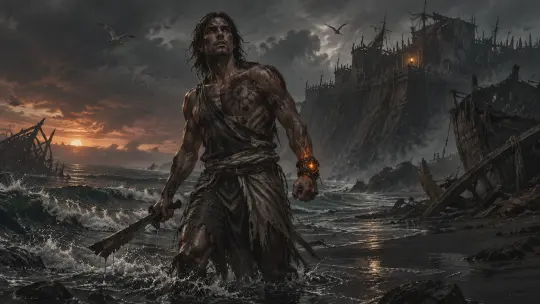
Strong: Cinematic dark fantasy key visual, semi-realistic painterly digital painting. A branded exile wades out of black surf onto wet black sand, a broken blade in one fist...
Step 2 — Build the Place as Geography, Not Decoration
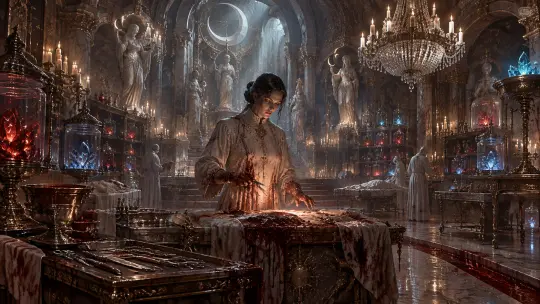
A place in a key visual is a set with an entrance, an exit and a rule. The Twilight Strand works because it has a shore, a wreck-line and a fortress on a cliff — three depths the eye can travel through. Lunaris Temple works because it has a nave, an operating floor and a shelf wall. If your location only has adjectives, the model will fill the frame with fog.
- Give the place a job. Refuge, surgery, market, tomb, mine. The job determines the props.
- Give it three depths. Foreground witness, midground action, background world.
- Give it one vertical. A cliff, a chandelier, a colonnade — something that establishes height.
- Give it a flaw. Broken hulls, warm drains, hanged men. The flaw is what makes it Wraeclast instead of fantasy.
Step 3 — Cast a Witness, Not a Hero Pose
The figure in the frame is a witness, not a mascot. Specify role, costume and posture; never specify an emotion. "A branded exile in salt-soaked prison rags, broken blade in one fist, wading" gives the model a body to render. "A sad hero" gives it a mood and no information, and the result is a generic pose with a generic face.
Notice what the model inferred from the costume: the rags are tied with rope, the chest carries a brand, the blade is notched rather than clean. None of those were spelled out. They are the model's reading of "branded", "salt-soaked" and "broken". That is why material nouns matter more than emotional adjectives.
Step 4 — Price the Light
Dark fantasy lighting is an economy, not a filter. Every warm source in the frame should have an owner and a cost: a lantern means someone is still awake and burning oil; chandeliers mean a church with money; gem-light means someone paid in flesh. Name two sources at most and let them argue.
- Exterior: one warm practical (lantern, cookfire) against a cold sky. The warm point is the human claim on the landscape.
- Interior: candle chandeliers plus a cold gem-blue or daylight shaft. Warm above, cold below, or the reverse.
- Never three. A third source flattens the frame into illustration and destroys the shadow that makes the place feel cold.
- Name the direction. "Lit from below", "rim light", "shaft from a high window" — direction is what makes light readable.
Step 5 — Name the Physics
Key visuals fail when nothing in the frame has weight. Add contact, reflection, spray, drag and bend. A blade drips into the surf. A gown soaks dark at the hem. Gem jars catch highlights on the glass, not on the stone. These small physical facts are what let a viewer believe the set is real before they have read a single story beat.
- Contact: feet in water, hands on a table, cloth on stone.
- Reflection: wet sand, polished marble, glass jars — one reflective surface per frame is enough.
- Drag: wet cloth hangs, chains pull, banners bend.
- Residue: salt, blood, ash, bile. Residue is the cheapest way to make a place feel used.
Step 6 — Close the Frame with a Negative Clause
The last clause is the one models forget first. End every prompt with "No text, no watermark, no logo, no border." If the image is intended for a store page, the model will otherwise try to invent a title, a rating badge or a decorative frame. Removing those in post is more expensive than spending nine words to prevent them.
The Full Prompt, Annotated
Cinematic dark fantasy key visual for the world of Wraeclast [medium + canon]. The Twilight Strand at dusk: a branded exile wades out of black surf onto a shore of wet black sand, a broken blade in one fist, salt-soaked prison rags clinging to the body [place + witness]. Behind, the ribs of shipwrecked hulls and a palisade fortress built from wrecked ships (Lioneye's Watch) stands on the cliff, one lantern burning in the mist [geography + light]. Storm-churned sea, cold spray, gulls, distant thunderheads [physics + weather]. Faint ember-orange glow of a virtue gem at the exile's wrist [price of magic]. Semi-realistic painterly digital painting, gothic survival atmosphere, desaturated charcoal, sea-green and rust palette, dramatic rim light, deep shadows, 16:9 theatrical composition, sharp foreground detail, atmospheric depth [style contract]. No text, no watermark, no logo, no border [negative].
Read the annotations as a checklist, not as prose. Every clause is doing a different job, and if you remove one the frame loses a specific kind of information. Remove the place and you get generic fog. Remove the price and you get free magic. Remove the negative and you get a fake title.
Reading the Two Models' Output
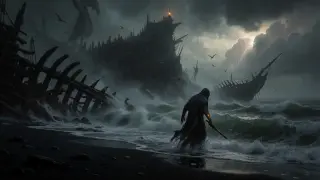
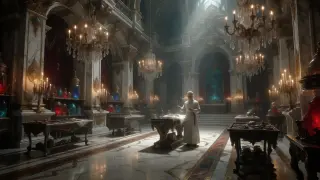
The same prompt through Krea 2 produces a different but equally valid answer. Where GPT Image 2 stages the landing as a close-up, Krea 2 stages it as a coastline. Neither is a failure; they are two readings of the same brief, and knowing which one you need is the actual skill.
| If the frame needs… | Use | Why |
|---|---|---|
| A face, hands or equipment | GPT Image 2 | Prop fidelity and costume continuity |
| Weather, scale, a title plate | Krea 2 | Atmosphere-first, fast, cheap |
| A published comparison | Both | The pair is more informative than either frame |
Iterating Without Starting Over
The biggest waste in image work is rewriting the whole prompt to fix one clause. Change one thing at a time and keep a written record of what each change did. Four or five controlled passes will teach you more than fifty random ones.
Change one clause
If the frame is too soft, strengthen the physics clause. If it is too busy, cut the prop list. Never change three things at once.
Keep the seed stable where you can
A fixed seed turns a prompt edit into a controlled experiment instead of a new lottery ticket.
Compare at thumbnail size
Shrink both candidates to 25%. The one that still reads is the one that will work on a store page.
Write the finding
One sentence: "adding 'from below' fixed the surgeon's face". That sentence becomes reusable knowledge.
Publish the pair
Keep the failed and successful frames together; the difference is the tutorial.
Publishing and Comparing
A key visual becomes useful when it is attached to a world and can be found again. Publish each frame as a work with a descriptive title — location, moment, model — and link it back to the world that produced it. Then the comparison is not a tweet; it is a durable reference you can point to the next time someone asks which model to use.
Mistakes That Cost You the Frame
- Writing a mood instead of a scene. "Dark and epic" is not a brief.
- Two locations in one prompt. The model builds a diorama instead of a poster.
- Forgetting the negative clause. You get a fake logo in the corner.
- Asking Krea 2 for 2048 pixels. It clamps to 1024 and your composition changes.
- Judging at 100% zoom. Crop tests are the only honest test for a key visual.
Frequently Asked Questions
- Do I need reference images? No. All four frames in this guide were generated from text alone.
- How long should the prompt be? Long enough to cover six clauses — usually 120 to 180 words. Longer is fine; vague is not.
- Can I use the same recipe for other genres? Yes. Swap the medium clause and the place logic; the six-clause skeleton holds.
- Should I publish both models? If you are comparing, yes. If you are shipping, publish the winner and keep the other as an internal reference.
Try the Recipe on Wraeclast
Four published frames, one world, two models — write the next clause yourself.
Fork the world, pick a different atom — the Belly of the Beast, the Vaal Ruins, the Western Forest — and run the same six clauses. The recipe is portable; the canon is what makes it specific.