
How to Use GPT Image 2 for Death Stranding Key Visuals — A Working Guide
Seven steps from a world atom to a published Death Stranding key visual: choose one impossible gesture, write six clauses, keep the weather and the load honest, and compare two models on the same brief. Worked examples from the Death Stranding world.
Why Post-Stranding America Needs a Visual Grammar
A Death Stranding key visual is not a grey apocalypse mood. It is a country rebuilt on top of the thing that erased it, and a generation that has been told to keep connecting. That means the visuals cannot be fog and floating ruins. They have to look like infrastructure with one rule removed: a highway that is now a river, a walled city that glows through timefall, a beach where the sea has returned a whale, a corridor where a dead man has been looking for his child for thirty years.
This guide is the method that produced four published frames in the Death Stranding world with GPT Image 2 and Krea 2. It is written so you can run it on that world or on your own, and it assumes no special plugins — only a prompt, a model and a place to publish.
What You Need Before You Prompt
Four things should exist before you type anything. Without them, the prompt becomes a mood board and the model has to invent the movie.
A world with atoms. Named characters, named locations and a stated visual style. One location. The specific ridge, city, port or shore you are visualising, with its own objects. One operation. The single law you are breaking — carry, connect, surface, strand. One witness. The person whose scale tells the audience how to feel about the landscape.
Step 1: Read the World Before You Write
Open the world and read the location card, not the prompt history. The card already contains the nouns that make the frame specific: the drowned highway has guardrails, lane paint, overhead gantries and half-sunk containers; the Beach has black sand, whale bone, rusted containers, a drowned bus and coils of umbilical cable. Those nouns are the difference between Death Stranding and generic apocalypse.
For the two frames in this guide, the nouns came directly from the world: wet rock, sodium lamps, cargo tower, odradek scanner, pod glow and floodlights for the ridge; whale skeleton, wet sand, containers and cable for the Beach. Nothing in the prompt was invented that the world did not already contain.
Step 2: Choose One Impossible Gesture
The single most common failure in this genre is asking for two impossible things at once. A country that floods, glows, collapses and sends ghosts after the living is not a Death Stranding frame; it is a screensaver. Pick one verb and let the rest of the image stay ordinary. The ordinary part is what makes the impossible part legible.
Carry for scale and labour: a cargo tower on a living back, a pod against a chest. Connect for politics: a terminal at the far end of a walled city, a network that only extends by footprint. Surface for horror: the dead where the living gather, tar rising through paving. Strand for theme: two figures on a shore at a distance no living person should reach. Frame for scale: a very small courier against a very large institution.
Ask a second question before you commit: does this operation change the architecture, the body or the light? Carrying changes the silhouette. Surfacing changes the ground. Stranding changes the horizon. Choosing the category first tells you where to spend your prompt detail.
Step 3: Build the Six-Clause Brief
The template has six clauses and a fixed order. It is deliberately boring, because a fixed structure is what makes two generations comparable. If you rewrite the template for every model, you are measuring your own adjectives instead of the outputs.
Medium and genre
Cinematic film still, psychological science-fiction drama, 85mm lens, shallow depth of field, fine film grain, desaturated palette. Lock the rendering system first.
Place
Name the real infrastructure and the real building type: a drowned elevated highway, a walled Knot City on a crater rim, a black volcanic shore.
Subject
One person, one load, one posture, with an object. A hooded porter with a cargo tower and a pod; a figure in a dark coat with one hand in a pocket.
Operation
One broken law, stated as a fact: the highway is now a river, the dead surface where the living gather, the city is a wall with a heart.
Physics and light
Timefall streaking the air, grass ageing where drops land, sodium terminal lamps, floodlights hazed by fog, a thin seam of horizon light.
Negative clause
No readable text, no watermarks, no logos, no clean post-apocalypse styling — the four words that remove most apocalypse drift.
Step 4: Set Size and Quality
Generate the composition cheaply and the detail expensively. A landscape frame at medium quality answers the only question that matters early: does the operation read? Once it does, re-render at high quality in the final ratio. For a world cover, 1536x1024 landscape is enough; a share card wants 1024x1536 vertical; a gallery tile can be 1024x1024.
size 1536x1024 landscape for the ridge, 1024x768 for the poster cut, 1024x1536 for a vertical card. quality high only for the frame that has already proved its composition. format PNG for the archive, WebP for the page. rule never upscale a weak brief; a courier either reads at thumbnail size or the frame is decoration.
Step 5: Render Both Models on the Same Text
Run the identical brief through GPT Image 2 and Krea 2. Do not rewrite the prompt between models, and do not re-roll for style. The only variable should be the model and the aspect ratio its parameters allow. That is what makes the comparison useful rather than decorative.
Step 6: Publish Both Frames Into the World
Publish each frame as a work of the world with its prompt and model recorded. The four frames in this guide are published works with live share links, which means anyone who opens the world can inspect the comparison — and fork the brief instead of reverse-engineering the picture.
Step 7: Decide in Public
Compare the two frames at thumbnail size, then keep both. The losing frame is the best argument for the winning one. If the story is still readable at 400 pixels wide, the poster model won. If the story needs the pod glow and the half-sunk containers, the document model won. Neither answer is permanent; it depends entirely on what the frame has to survive.
Worked Example A: The Ridge
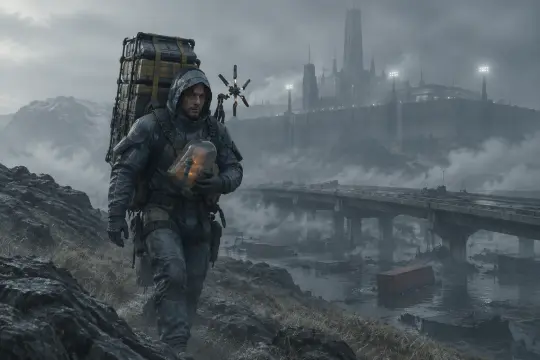
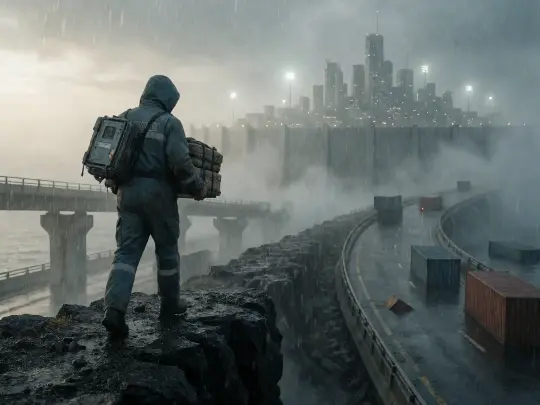
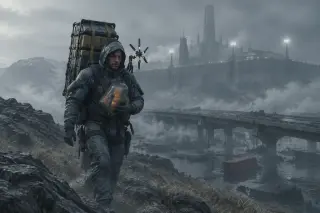
The ridge is the establishing shot of the whole world. A road is a direction. Put a walled city at the end of it and the image becomes an argument about where the country thinks it is going. The trick is to keep everything on that road: lane paint, guardrails, overhead gantries, container stacks, wet reflections and a checkpoint with actual vehicles.
Working prompt. Cinematic film still, psychological science-fiction drama, 85mm lens, shallow depth of field, fine film grain, desaturated palette, unretouched skin. A lone porter in a weathered blue-grey Bridges uniform, hood up, a folded mechanical odradek scanner on his shoulder, walks a narrow ridge of black rock above a drowned highway, carrying a tower of strapped cargo and a bridge baby pod against his chest; behind him a walled Knot City rises out of fog, floodlights hazy, a ruined overpass and shipping containers half-sunk in black tar; timefall rain streaks the air, grass ageing to grey where the drops land, cold flat overcast side light from the left, no fill, hard shadow, joyless grey and teal tones, epic scale, no readable text, no watermarks, no logos.
GPT Image 2 answered with a road you could walk: the lane markings continue under the ridge, the guardrail catches the lamp light, the city is planted on real rock rather than floating in a skybox, and the containers sit in actual water. The frame reads as a job being done, which is the emotional core of the whole world.
Worked Example B: The Beach
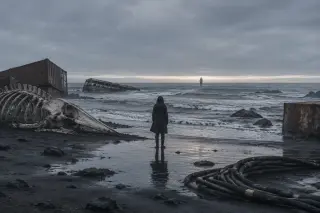
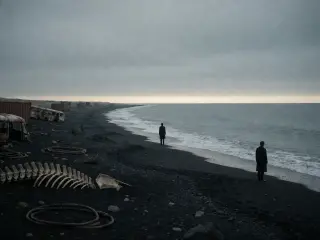
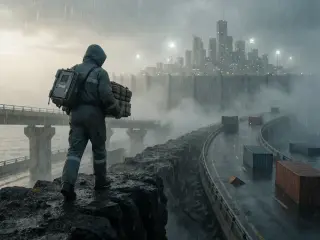
The Beach is the harder frame because it contains two people, a prop, a creature and a single flat shoreline — four things that can all collapse into a blur at once. The trick is to give each body a fixed relationship to the architecture of the shore, and to keep the horizon low and narrow.
Working prompt. Cinematic film still, psychological science-fiction drama, 85mm lens, shallow depth of field, fine film grain, desaturated palette. A vast black volcanic beach under a flat pewter sky, a lone figure in a dark coat stands at the water's edge, very small against an ocean of slate-grey tar; the shoreline is littered with beached things — a whale skeleton, rusted cargo containers, a drowned bus, coils of umbilical cable — and far out a second figure stands perfectly still, facing away; a thin seam of pale light along the horizon, cold overcast light, wet reflective sand, oppressive stillness, muted charcoal and bone palette, no readable text, no watermarks, no logos.
The word very small is doing most of the work. It implies scale, distance and helplessness, which is exactly what separates a Death Stranding frame from a superhero frame. The whale skeleton is the second signal: it is enormous, dead and clearly returned by something, so the audience instantly understands that the shore is a place where the sea gives things back.
The Load Is the Story
Death Stranding is the only major post-apocalyptic setting where the protagonist is defined by what he carries. That makes load the single most important compositional element in the frame. A cargo tower tells the viewer the job is hard. A pod tells them the job is personal. A scanner tells them the job is dangerous. If any of those three is missing, the image is a landscape with a person in it.
- Cargo towerStraps, bags, boxes, a frame that sits above the shoulders and breaks the skyline. It should look like it could fall, and like the porter has done this a thousand times.
- Bridge baby podA glass-and-metal capsule at the chest, warm light inside, mounted on the suit. It turns a courier into a parent and a delivery into a promise.
- Odradek scannerA folded mechanical star on the shoulder, four or five arms, blue light at the tips. It tells the viewer the world is being sensed, not just walked through.
- Weather-beaten suitBlue-grey fabric, taped seams, scuffed boots, reflective strips, gloves. Materials should look like they have been repaired, never like they were issued this morning.
Weather as a Character
Timefall is not a mood. It is the reason the world is organised the way it is: why people live behind walls, why deliveries matter, why a single exposed minute is a risk. In a prompt, weather has to be physical — rain that streaks the air, beads on fabric, pools on the road and ages grass to grey where it lands. A grey overlay is not weather; it is a filter.
Rain streaks the air and catches the light. Ground is wet, reflective and uneven. Vegetation ages visibly where drops land — green to grey, fresh to brittle. Fabric darkens and clings. Distance softens through fog and haze. If you can remove the rain and the frame still works, the weather was decoration.
The Shore Is the Theme
Every Death Stranding story eventually arrives at the Beach. It is where the dead wait, where the living should not be able to stand, and where the whole question of connection becomes literal: two figures on the same shore, separated by a distance that is not only physical. That is why the Beach is the best test of any model. It has almost no architecture to hide behind — only sand, sky, horizon and scale.
When you prompt the Beach, resist the urge to fill it. The emptiness is the subject. Add one creature, one piece of human wreckage and one impossible second figure, then stop. The moment the shore is busy, the dread is gone and you are shooting a music video.
Palette as Level Design
The world runs on four palettes and each one tells the audience where they are. Charcoal and slate blue for the ridge. Sodium orange and floodlight white for the Knot Cities. Cold operating-theatre white for Bridges interiors. Bone, tar and a thin horizon light for the Beach. Colour is the level indicator; the audience learns to read it within two frames, which means a prompt can spend fewer words explaining the location.
Common Failures and Fixes
Most failed Death Stranding prompts fail for one of four reasons, and each has a specific repair. None of them requires a better model; they require a more concrete sentence.
Apocalypse drift: ash, gas masks and ruins — add psychological film still, 85mm, overcast, and name the municipal infrastructure. Hiking-brochure blur: a beautiful trail with no threat — add timefall, a scanner, a pod and one walled city. Superhero pose: the porter stands heroically on the skyline — specify load, posture and contact with the rock. Empty shore: a beautiful beach with no story — add whale bone, containers, cable and a second figure at an impossible distance.
Detail or Atmosphere: Choosing a Model
Choose GPT Image 2 when the frame must survive a crop: store pages, thumbnails, UI cards, reference sheets, anything where architecture and material need to stay legible at small sizes. Choose Krea 2 when the frame is doing emotional work: a hero image, a share card, a poster where the gesture and the colour block matter more than the bolts on the guardrail.
The practical rule is to generate the establishing shot on both models and let the smaller crop decide. If the story is still readable when the image is 400 pixels wide, the poster model won. If the story needs the pod glow and the half-sunk containers, the document model won.
Working With the World's Characters
A key visual is strongest when it carries one character's position. Sam is the load; Amelie is the broadcast; Cliff is the search; Fragile is the wager; Higgs is the door; Deadman is the procedure; Bridget is the debt; Die-Hardman is the mask. Pick one position and the frame stops being a landscape and becomes a scene.
Five Prompts You Can Adapt
These are complete opening clauses, each aimed at a different part of the world. Paste one in, add the location and the negative clause, and you have a frame that belongs to the same story as the four published works above.
Publish, Then Argue
A key visual that lives only in a downloads folder is a dead end. Published as a work, it inherits the world's atoms, appears in the world gallery, and becomes available for remixing. It also makes the prompt auditable: anyone can see which model, which brief and which scene produced the frame, which is the only honest way to compare two models.
The four works here are not a portfolio. They are evidence. Each one names a location, a model and a clause, and each one can be forked into a different story about the same country.
Start From the World as It Stands
The rain is falling, the scanner is folded, and the four published works are already loadable with their prompts. Take the brief you like, change one card, and see what the machine does with it.
Build Your Own Death Stranding Frame
Four published key visuals, one world, two models — your turn to add the next frame.
Death Stranding is an independent, fan-built world in Neta Studio and is not affiliated with Kojima Productions or the rights holders of the series. Every character, place, event and faction here is an editable world material rather than canonical text. The four key visuals on this page were generated inside this world with GPT Image 2 and Krea 2 from two identical prompts. Open the studio to read every card.