
How to Use GPT Image 2 for Fullmetal Alchemist Key Visuals
A five-lesson workflow for turning a diesel-and-steam alchemical world into key visuals: the sentence, the planes, the hands, the light and the absence.
How to Use GPT Image 2 for Fullmetal Alchemist Key Visuals
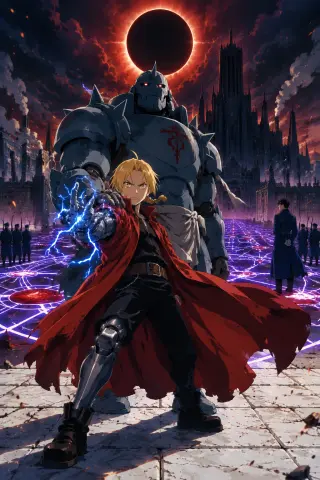
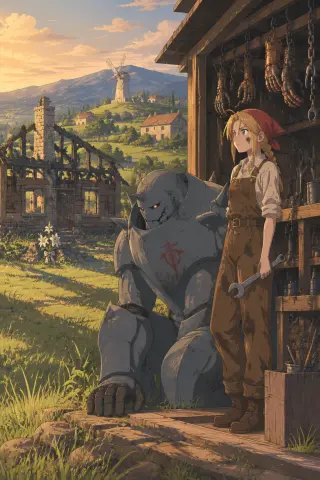
Five lessons, taken from four published works: how to write a world sentence, block a scene in three planes, direct the hands, argue with light, and render an absence. The subject is a diesel-and-steam alchemical country in 1914 — red coats, steel limbs, a hollow suit of armour, an eclipse over a white-stone capital and a village where the grass has grown back over a burnt house.
Every example comes from the published Fullmetal Alchemist world on Neta Studio: two prompts, each run unchanged on GPT Image 2 and Krea 2, with the real settings and the real share links. You can follow the lessons on that world or on one of your own.
Lesson 1 — Write the world in one sentence
Before you write a prompt, write the sentence the world would say if it had one chance. Not a synopsis, not a list of characters: a single claim that makes the setting argue with itself. For this world it is simple. A country runs on a law that says nothing comes free, while its rulers build a nation-sized circle to buy godhood with the souls of every citizen. Every image that follows has to be evidence for that sentence.
Find the contradiction
The sentence must contain two things that cannot both be true for long. Here: a law of fairness and a state built on theft.
Choose the public image
Pick the one picture a citizen would recognise: the eclipse, the Führer’s balcony, the train station, the burnt house. The key visual is a public image, not a private one.
Choose the private image
Pick the one picture only the characters would know: a workbench, a kitchen table, a gravestone with lilies. You will need both to make a set.
Write the style lock
One sentence about medium, line and shadow that you will paste into every prompt unchanged. Without it, the set drifts.
The sentence that produced four images
“A country runs on a law that says nothing comes free, while its rulers build a nation-sized circle to buy godhood with the souls of every citizen.”
That sentence gives you the eclipse (the circle in the sky), the plaza (the circle under the stones), the armour (the bill already paid), and the burnt house (the bill paid at home). It does not give you a plot, which is correct: a key visual is not a synopsis.
Lesson 2 — Block the scene in three planes
GPT Image 2 is at its best when the prompt describes depth. Block every scene as foreground, middle and background before you describe the mood. If you cannot name what is in each plane, the model will invent a flat poster, and you will blame the model for your missing blocking.
The eclipse frame, blocked
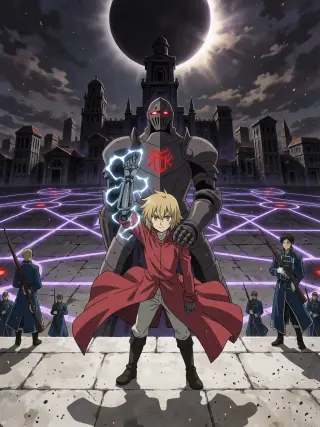
The Promised Day image works because the planes are doing different jobs. The foreground is the circle, so the viewer reads the crime before the hero. The middle is the pair, so the viewer reads the debt before the fight. The background is the eclipse and the towers, so the viewer reads the deadline before either. Nothing in the frame is decorative, which is why the image survives being looked at for more than three seconds.
Lesson 3 — Direct the hands
Hands are where anime prompts fail, and in this world they are also where the story lives: a clap, a glove, a wrench, a seal, a rifle strap. Give every visible hand a job and say which hand is visible. The model will still make mistakes, but it will make fewer when the hand has a purpose.
- The clap Both palms together, fingers straight, no circle needed. Describe the spark as coming from the space between the palms, not from the gloves.
- The snap One gloved hand, thumb and middle finger, a spark at the fingertip. Say which hand and where the elbow is, or the arm will bend the wrong way.
- The wrench A heavy tool held low, wrist turned, other hand steadying the work. Mechanics hold tools like weights, not like wands.
- The seal A blood-red array painted on armour, not engraved. Describe it as flaking at the edges so it reads as paint rather than a logo.
- The rifle Both hands on the weapon, muzzle down, strap across the chest. Soldiers in this world are always carrying something heavier than they look.
The arm is the story
Edward’s automail is the most important prop in the set. It has to read as steel, not as a glove: segmented plates, a visible joint, a seam at the shoulder, a weight that pulls the coat. When the arm is raised, the coat should lag behind it. That single detail tells the viewer the limb is heavy, which tells them the price was real.
Lesson 4 — Light as argument
Light is not decoration in a political world; it is an argument about who is allowed to be seen. Two light plots carry almost every scene here. Backlight from the eclipse makes the figures silhouettes and the circle the only source of colour — good for power, bad for faces. Low golden sun from the side makes the grass warm and the burnt house tender — good for grief, bad for threat. Choose one per image and do not mix them.
- Eclipse backlightThe subject is rim-lit and the ground is dark; the circle supplies the only saturated colour. Use it when the image is about the state.
- Golden-hour side lightLong hard shadows across grass, warm skin, dust in the air. Use it when the image is about the people the state has already spent.
- Glacier bounceCold blue from snow, flat and shadowless, no warm accent. Use it for Fort Briggs, where honesty is a military doctrine.
Two light plots, two meanings
Put the eclipse image and the village image side by side and the set starts to argue with itself. The first says the country is a machine and the boy is a component. The second says the machine has already been through this house and left the grass to grow. Neither image states the argument; the light does. That is what a set is for.
Lesson 5 — Render absence
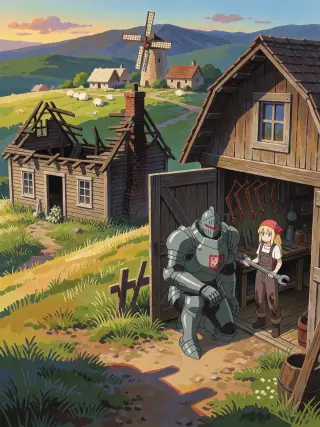
The hardest image in the set has no villain and no action: a burnt house, lilies, a kneeling armour, a mechanic with a wrench. Absence is hard because there is no face to carry the feeling. The trick is to give the empty space a job. The roof is missing, so the sky is in the house. The chimney still stands, so the house is still a house. The lilies are fresh, so someone still comes.
Remove the person who should be there
Decide who is missing and leave a trace of them: a tool, a flower, an empty chair, a coat on a hook.
Keep one vertical
A chimney, a doorframe, a windmill. The vertical gives the eye a scale and makes the missing roof legible.
Put life at the edge
Grass in the floorboards, sheep on the ridge, a bird on the beam. Life at the edge keeps the image from becoming a ruin postcard.
Let someone be repairing something
A mechanic with a wrench turns grief into labour. The viewer understands that the survivors are still working, which is the emotional point.
The one-pass repair method
When an image is almost right, do not rewrite the prompt. Pick the single worst thing and fix only that. Regenerating with five changes will lose the composition you liked, and you will not know which clause caused the improvement. One pass, one fix, then stop.
- If the hands are wrong Add one sentence about what each visible hand is holding, and remove any hand that has no job.
- If the face drifted Add a reference image and repeat the silhouette facts: hair, eyes, height, coat. Do not add more adjectives.
- If the circle is flat Describe it as light coming up through the stone toward a named landmark, with the perspective direction stated.
- If the palette is muddy Cut the palette to three colours and name them. “Clean local colors, one cold blue accent, no warm bounce” is a fix; “more vibrant” is not.
Keeping a series consistent
If you need the same face or the same plaza across scenes, use a reference image and keep the silhouette facts identical. Do not rely on the model remembering a character from a previous prompt. Treat every generation as a new shoot with the same actor, the same costume and the same lighting plot. The style sentence is the contract; the reference is the actor.
The two-work comparison method
Run both models on the same prompt, with the same aspect request and the same exclusions. Do not tune one prompt for one model; that destroys the comparison. Generate the cheap pass first, choose the composition, then rebuild the chosen frame in the more expensive model. Publish the pair together, because the difference is the useful part: one model explains the place, the other compresses it into a poster.
Checklist before you publish
- Does the image explain the place? A viewer should be able to say where the foreground, the subject and the background are without being told.
- Is the story in the hands? Every visible hand should be holding, touching or signalling something. No decorative hands.
- Is there exactly one light idea? One key, one fill, one mood. If you cannot name them, the image is lit by accident.
- Is the text gone? Check the blackboard, the posters, the shopfronts and the corner of the frame. Regenerate if any lettering survives.
- Does it match the set? Compare it side by side with the previous image. If the line weight or the colour temperature has drifted, the style lock slipped.
- Is the share link real? Publish the work and open the share URL. The image on the page should be the exact file you approved, not a re-render.
Questions about this guide
- How long should a prompt be? Long enough to cover the seven clauses, short enough to debug. The eclipse prompt is about 150 words. If yours is 300, you are probably writing the novel instead of the shot.
- Do I need the same seed for a series? No. Use the same style sentence and the same silhouette facts. Seeds are useful for small variations, not for continuity across scenes.
- Can I use Krea 2 for the final image? Yes, if you want a flatter poster look. It is faster and cheaper, but it does not accept reference images and is weaker at legible detail.
- What should I publish first? Publish the pair: the same prompt in both models. The comparison is the most useful thing you can show another creator, and it proves the prompt rather than the luck.
- Can I use these prompts for my own world? Yes. Keep the seven clauses and the style lock; change the place, the costume and the light. The skeleton is the reusable part.
Put the guide to work
Five lessons, four published works and one world that needs another frame. Open the studio and generate the scene you can already see.