
How to Use GPT Image 2 for Tactical Dark Fantasy Key Visuals
A step-by-step guide to tactical dark fantasy key visuals with GPT Image 2: read the world, choose the transaction, write six clauses, compare against Krea 2, and publish the work with its prompt.
What You Will Make
This guide walks through generating a tactical dark fantasy key visual with GPT Image 2, using The Ashen Crown as the worked example. You will write a brief with six clauses, render one world frame and one location frame, compare the result against Krea 2 on the same sentence, and publish both works with their prompts.
Before You Start
You need a world with a rule, not just a mood. Write down four things before you open the generator: what the magic costs, who is allowed to use it, who is punished for touching it, and where the law is visible in architecture. In The Ashen Crown those answers are years of life, the nine marked houses, markless hands branded for touching relic steel, and a gatehouse built over a sealed god.
- A world card with name, genre, era and tone.
- One law phrased as a sentence a character could break.
- One price with a unit you can photograph: years, names, blood, memory.
- One location where the law and the architecture disagree.
Step 1 — Read the World Before You Prompt
Open the world and read the cards in order: rules first, then characters, then locations, then events. The order matters because it prevents the most common failure in AI world-building: a beautiful frame that has no argument. When you know that kindling costs years and that the ninth bell is silent, the next prompt almost writes itself.
For The Ashen Crown the two key sentences are simple. A mark lets its bearer wake a relic; every waking draws on the god under Vael and is paid in years. The second sentence is what makes the first interesting, and it is the sentence most prompts leave out.
Step 2 — Choose the Transaction
A transaction is the smallest unit of plot: somebody gives something up and somebody records it. Pick one per frame. A coronation with a missing shard. A gate lit from beneath. A reader comparing a roll to a palm. If you cannot state the transaction in one sentence, the frame is not ready.
Step 3 — Write the Six Clauses
The recipe is the same one used for the four published works on this page. Write it in this order and do not add a seventh clause until the first six are reliable.
Format
Anime cel-painted tactical dark fantasy key visual, cinematic 16:9. The style is a promise about edges and shadows; state it first.
Place
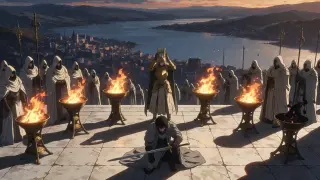
The white-stone terrace of Hearthfall above a lake-city at dusk. One place, described as architecture, with a rank structure you can see.
Actor and record
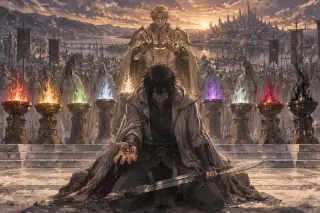
A young mercenary captain kneels with a broken sword; his right palm is open to show a black spiral mark around an amber point. The mark is the record.
Crowd
Hooded priests, bannermen of the nine houses, ranks of spear levies receding into ash. Posture and rank, not a headcount.
Material
Ash grey, bone white, ember orange, dawn gold, slate blue. Bronze braziers, salt-stained wool, wet basalt, chipped gold leaf.
Light and negatives
Nine braziers are the only key light; the ninth is cold. Close with no text, no letters, no watermark, no logo, no UI.
Step 4 — Render the World Frame
Render the coronation brief at 1536×1024 with quality high. Read the result in this order: silhouette, nearest prop, crowd, far plane, light. If the nearest prop is not legible, the frame fails regardless of how good the sky looks. In the GPT Image 2 version the mark is the nearest object and the broken sword lies across both knees, so the frame passes.
If the mark is missing, do not add more adjectives. Move the hand closer to the camera in the sentence: "his right palm turned up in the foreground, the black spiral mark filling the lower third". GPT Image 2 responds to spatial instructions more reliably than to emotional ones.
Step 5 — Render the Location Frame
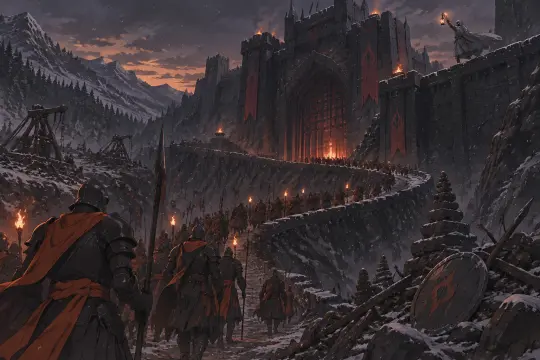
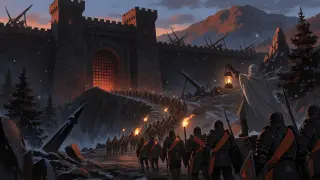
The second frame tests the opposite skill. Write a place that explains the world without a character in the foreground. The Ember Gate brief does this with three depth cues: a switchback with a real gradient, a column strung along it at different distances, and a scout small enough on the rampart to make the gate feel enormous. The glow sits under the road, not inside the fortress, because the fire is the prisoner and the road is the lid.
Step 6 — Run the Comparison
Send the identical sentence to Krea 2 at 2048×1152. The point is not to find a winner; it is to find out which clause the brief is failing to communicate. If Krea 2 loses the mark and the road, the clauses are doing their job and GPT Image 2 is simply more literal. If both models lose the mark, the clause is badly written.
- Same prompt, same ratio, no reference images — otherwise the comparison is not about the model.
- Score four things: prop legibility, crowd separation, depth, silhouette at thumbnail size.
- Publish both when the comparison is the content; publish one when the frame is the content.
- Keep the losing frame as evidence of what the brief failed to say.
Step 7 — Fix the Frame, Not the Model
Most bad tactical fantasy renders are prompt problems disguised as model problems. A missing prop means the prop was not placed spatially. A muddy night means two light sources. A generic crowd means the crowd was described by number instead of posture. Rewrite the clause and re-render once; only then consider switching models.
The most useful fix in this genre is to add a witness. A frame with an actor and a record but no witness reads as propaganda. Put a small figure at the edge — a scout, a reader, a child — and the same image becomes a scene someone is watching.
Step 8 — Publish the Work
Publish each render as a work attached to the world, with the prompt and the model recorded. The share page is the useful artifact: it lets a reader see the exact sentence that produced the frame and fork the world that produced the sentence. That is the difference between a portfolio image and a piece of world-building.
Prompt as proof
A work page carries the prompt, the model and the world. The sentence is the evidence that the image was designed, not stumbled into.
Comparison as content
Two models on one brief is a better article than one polished render. It teaches the reader how to read the frame.
Fork as distribution
A reader who forks the world inherits the rules and the works. Your argument travels with the assets.
Prompt Template You Can Reuse
[anime cel-painted tactical dark fantasy key visual, cinematic 16:9]. [One institution as architecture: a white terrace above a lake-city, nine bronze braziers, the ninth cold]. [Actor and record: a grey-coated captain kneels in the foreground, broken sword across his knees, right palm open showing a black spiral mark around an amber point]. [Crowd by posture: hooded priests, ranked bannermen, spear levies receding into ash]. [Material and palette: ash grey, bone white, ember orange, dawn gold, slate blue; salt-stained wool, wet basalt, chipped gold]. [One light: the nine braziers; one direction; no text, no letters, no watermark, no logo, no UI].
Common Mistakes
Checklist Before You Publish
- The transaction can be stated in one sentence.
- The nearest prop is legible at thumbnail size.
- One light source is clearly dominant.
- The crowd has at least three distinct postures.
- The palette is named and limited to five colours.
- The negative list is present and closed.
- The prompt and model are stored with the work.
- The frame links back to the world that produced it.
Frequently Asked Questions
- How long should a prompt be? Long enough for six clauses, short enough that you can point to the clause that failed. The published Ashen Crown prompts are under 200 words.
- Should I use a reference image? Only for palette or costume continuity. Four works here used none, which is why the comparison is fair.
- Why does Krea 2 look more like a poster? It flattens and simplifies by default. That is a strength for thumbnails and a weakness for evidence.
- Can I use the same prompt for a character portrait? Change the format clause to "character key visual, portrait" and keep the material, light and negative clauses.
- What is the best ratio? 16:9 for world and location frames, 2:3 or 3:4 for characters. Decide before rendering.
- How do I keep a series consistent? Keep the palette, light rule, material list and clause order identical; change only the actor and the record.
Next Steps
Once the two frames hold together, extend the set. The coronation gives you the crowd, the mark and the crown. The gate gives you the road, the column and the scout. The next frame should give you the inside of the argument: the Hall of Nine Seats, the empty ninth chair, the bellwarden's rope. Same palette, same one-light rule, new transaction.
Put the Guide to Work
Open the world, take the six clauses, and render the room where the law is paid for.
The four works in this guide are published from The Ashen Crown and keep their prompts. Fork the world, change the clause you disagree with, and publish the frame that proves your version.