
How to Use GPT Image 2 for Underwater Sci-Fi Key Visuals
A practical guide to prompting GPT Image 2 for ocean-planet and underwater science-fiction key visuals: the six-clause prompt, the water column, leviathan scale, color logic and the second pass with Krea 2.
How to Use GPT Image 2 for Underwater Sci-Fi Key Visuals
Underwater science fiction is a difficult brief for any image model because the subject is not an object. It is a medium: light that bends, color that disappears with distance, particles that hang in the water, and a surface that may or may not be in frame. GPT Image 2 is unusually good at this when the prompt treats water as architecture. It is unusually bad at it when the prompt treats water as a mood.
This guide is the method behind four published frames in the Subnautica: 4546B world. It is written for key visuals — the single image that sells a setting — rather than for concept thumbnails.
Do not prompt the ocean. Prompt the room the ocean is filling — its ceiling, its floor, its light source, its visibility, and the one body that proves how big it is.
What Makes an Underwater Frame Different
On land, distance is measured by objects getting smaller. Underwater, distance is measured by contrast disappearing. That single physical fact changes how a frame has to be built: the foreground needs a strong value, the middle distance needs a readable silhouette, and the background needs to fade into a named color rather than into grey.
It also means the light source matters more than the subject. Surface light produces god rays and caustics. Bioluminescence produces local color with no fill. Lava produces warm uplight and silhouettes. Pick one dominant source per frame and let it explain everything else.
The Six-Clause Prompt
Every frame in this set used the same six clauses. The wording changes, the structure does not. Write them in order; the model weights the early clauses more heavily.
1. Medium and ratio
Stylized semi-real 3D game key visual, 16:9, clean geometry, semi-realistic material detail, non-photographic surfaces. This prevents the default drift into photography.
2. The layer
At the surface, just below it, on a shelf edge, inside a vault. The layer determines the light, the palette and how much of the frame can be read.
3. The water column
Surface swell or ceiling, god rays, caustics, particle density, visibility distance, and the color of the water at near, middle and far distances.
4. The place, from nouns
Pink coral, purple creepvine, white sand, torn hull plating, ribbed alien arches, floating ion cubes. Five to seven nouns, no adjectives doing the nouns' work.
5. One body and one fact
A lone diver chest-deep beside a lifepod; a tiny figure at a rail with a scanner raised. Then the fact: the ship is still burning, the shield is still holding.
6. Exclusions
No text, no logos, no interface elements, no HUD, no depth readouts, no watermark. Underwater prompts attract fake instrumentation; ban it explicitly.
Clause One: Lock the Medium
“Cinematic underwater scene” gives you a photograph with a blue grade. “Stylized semi-real 3D game key visual” gives you geometry with volume. The difference matters because a game key visual has to imply a playable space: edges that could be walked, surfaces that could be touched, a camera height a player could occupy.
Add “non-photographic surfaces” and “controlled local color.” Without them, the model renders skin with pores and coral with subsurface scattering, and the image stops looking like a world and starts looking like a nature documentary.
Clause Two: Build the Water Column
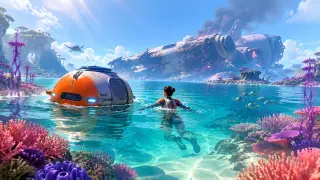
Name four things: the surface relationship, the light, the particles and the visibility. “Shallow turquoise lagoon, volumetric god rays, caustics on white sand, deep ocean blue beyond the reef shelf” is a complete water column. It tells the model where the camera is, what is lighting the scene and how far it can see.
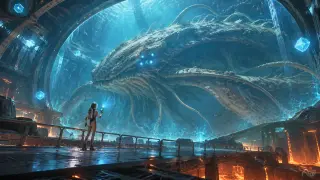
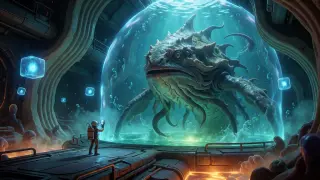
For deep scenes, replace the surface with a ceiling: “a vault of dark metal and pale ribbed arches, floating ion cubes, a shallow pool of glowing turquoise water, lava light bleeding through floor seams.” The logic is identical — the camera is in a room, and the room has a top, a bottom and a light.
Clause Three: Put One Body in Frame
One human body is a ruler. It tells the viewer how big the lifepod is, how deep the water is and how small the survivor is relative to the problem. Two bodies turn a survival scene into a conversation; five turn it into a crowd. For key visuals, one is almost always right.
Specify what the body is doing, not how it feels: chest-deep in water, one hand on the hatch, scanner raised, standing on a walkway. Pose is information. Emotion is the viewer's job.
Clause Four: State the Event as a Fact
“Dawn in the Safe Shallows, the Aurora still burning on the reef.” “A leviathan behind an ion shield, a diver at the rail.” These are facts, and facts are stageable. “Epic underwater battle” is a mood, and moods produce posters with no spatial logic.
A fact also gives you a free narrative: something has already happened, and the image is the aftermath. That is why the strongest frame in this set is the quiet one — a lifepod, a diver and a burning ship — rather than the monster.
Clause Five: Name Colors, Not Lenses
Color names survive the translation into light. “Saturated teal and cyan, coral pink accents, pale sky, lava amber through the floor” gives the model a palette it can distribute. Lens language — 35mm, anamorphic, shallow depth of field — mostly gives you a filter and a vignette.
Keep the palette small. Two dominant colors and one accent is enough for an underwater frame; more than that and the bioluminescence starts competing with the coral, and the image loses its depth cues.
Clause Six: Ban Text and Interface
This clause saves more images than any other. Underwater scenes invite the model to add depth readouts, warning labels, suit telemetry and lens marks. All of them date the image instantly and none of them survive a crop. Write the ban into every prompt, including variations.
Working With GPT Image 2 Specifically
GPT Image 2 rewards specificity and punishes vagueness with more detail rather than less. If the prompt is thin, it fills the frame with particles, fish and surface texture. If the prompt is precise, it spends its detail budget on the things you named. That is the opposite of models that simplify when confused, and it changes how you iterate.
It also handles dry spaces inside wet ones exceptionally well. The containment vault, the inside of a lifepod, the air pocket under an ice shelf — these are the shots that make an ocean world feel engineered rather than painted. Ask for them deliberately.
Where GPT Image 2 Fails and How to Patch It
The failure modes are consistent enough to plan for. None of them require post-processing if you catch them in the prompt.
Particle overload
Too much suspended matter, especially in bright water. Patch: “clear water, low particle density, visibility thirty meters.”
Crowded midground
Unrequested fish and coral fill the composition. Patch: “one school in the middle distance, no other fish, clean midground.”
Wrong creature anatomy
Extra fins, merged tendrils, eyes in the wrong place. Patch: describe the silhouette and the eye count, then accept stylization.
Flat caustics
Caustic patterns painted onto vertical surfaces. Patch: name the receiving surfaces — “caustics on white sand only.”
Inconsistent scale
A diver the size of a submersible. Patch: name the height relationship and put both objects on the same ground plane.
A Second Pass With Krea 2
Krea 2 is the fastest way to find a composition. Give it the same six clauses, generate eight to ten frames, and judge only silhouette and readability. It will move the camera, simplify the geometry and occasionally invent a better staging than the one you described.
Then take the winning composition back to GPT Image 2 and rewrite it as a precise physical brief. Keep the nouns and the fact; drop anything the sketch invented that does not belong in the canon. The two-model pass is how the published pairs in this guide were made.
Checklist Before You Publish
Five checks catch almost every bad underwater key visual before it reaches a page.
Is there a layer?
Can you tell where the camera is in the water column — surface, sunlit, twilight, dark, or inside a dry room? If not, the frame has no physics.
Is there a witness?
Find the human body, the vehicle or the doorway that proves the scale. If the creature fits entirely in frame with nothing normal beside it, it is a diagram.
Is there exactly one fact?
State what has just happened in one sentence. If you need two sentences, the frame is trying to be two images.
Is the palette three colors?
Two dominant, one accent. More than that and the depth cues collapse into noise.
Is the interface gone?
Zoom to 100 percent and look for readouts, labels, watermarks and lens marks. Regenerate rather than retouch.
Put the Guide to Work
The six clauses, two models and four finished frames — run the same brief inside 4546B.