AI RPG Generator — Describe an RPG, Get a Playable 3D World
Make your own ai rpg generator
Describe an RPG in one sentence and get a playable 3D world with characters, quests and turn-based combat. Free to try — no engine, no download, no code.
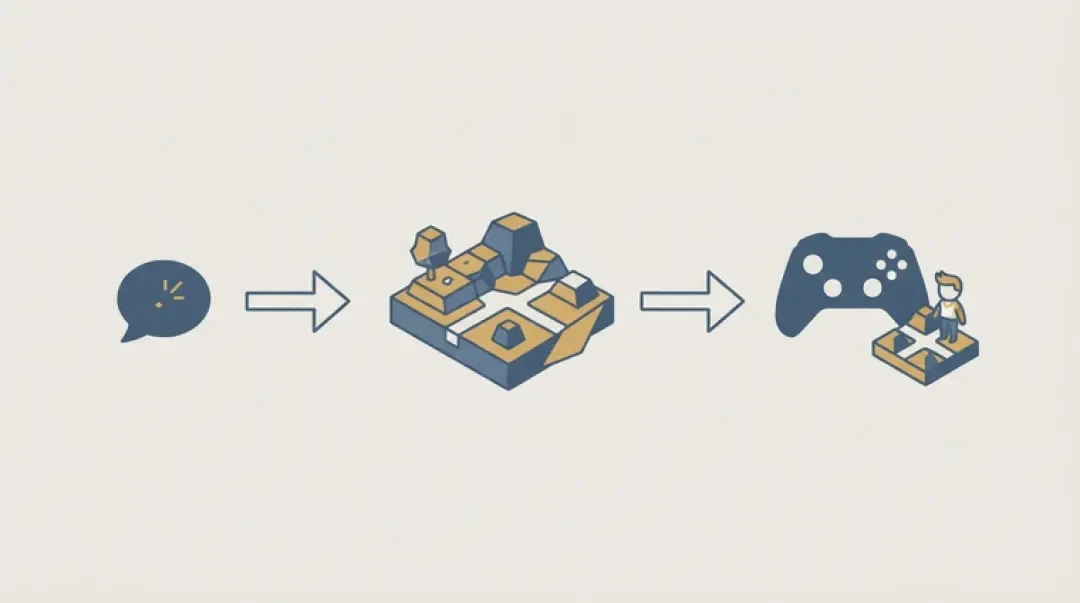
An AI RPG generator takes a written description and returns a playable 3D world: terrain you walk on, a camera you control, characters that stand on the ground, a quest with a completion state, and turn-based combat with an initiative order. At Neta Studio the input is one or two sentences in plain English. The output runs in the browser on Three.js. There is no engine to install, no project folder to version, and no code to write.
This page covers what the generator produces, where it breaks, and how it differs from two tools people confuse it with: generators that write RPG source code, and generators that write RPG story text. Both are useful. Neither one hands you a world you can walk around in.
Describe an RPG, Get a World You Can Walk Into
The promise is one sentence long: describe the RPG you want and you get a walkable 3D world back. Not a code scaffold, not a folder of prompts, not a design document you still have to build. The description resolves into geometry, a spawn point, a cast, a quest objective, and a combat loop. You can then open the result in the 3D game builder and change any part of it by hand.
A description that works names a place, a tone, and one rule the player has to live with. Take this shape: a flooded temple on a cliff, quiet and ruined, where every enemy is asleep until you step on a stone. That gives the generator a terrain type, water and cliff and interior floor, a cold desaturated palette, a sparse population of slow creatures, and a mechanic it can bind to a proximity trigger. Four fields, all of them checkable.
A description that fails is broad and unbound. A big RPG with lots of quests has no terrain to select, no cast to place, and no trigger to bind. The generator resolves to a default flat plane, a default capsule with a default walk cycle, and an empty quest log. The failure mode is boring output rather than an error message, which is exactly why it is worth spending thirty seconds tightening the sentence before you press generate.
Play the Output
The games on this page, The Cyclops' Island and Mini World, were made the same way you are about to make one: a written description, a generated first pass, then edits in the builder. No hand-written shaders, no imported character packs, no external engine underneath.
That is the line between a world generator and a text generator. A text generator returns prose and you keep reading. Here you get a camera you can move, a collider that stops you at the wall, an NPC that says something different when you come back into the room, and a combat round that resolves in a defined order. All four are verifiable in under a minute: walk into the wall, leave and re-enter the room, start a fight, and walk off the edge of the map.
Play long enough and you will find the seams, which is the point of putting the output in front of you rather than describing it. Generated scenes are small on purpose. A quest giver may stand further from the quest location than a hand-authored layout would put them. A turn order with many combatants reads as a long vertical list. Those are builder edits, not recompiles.
What an AI RPG Generator Actually Makes
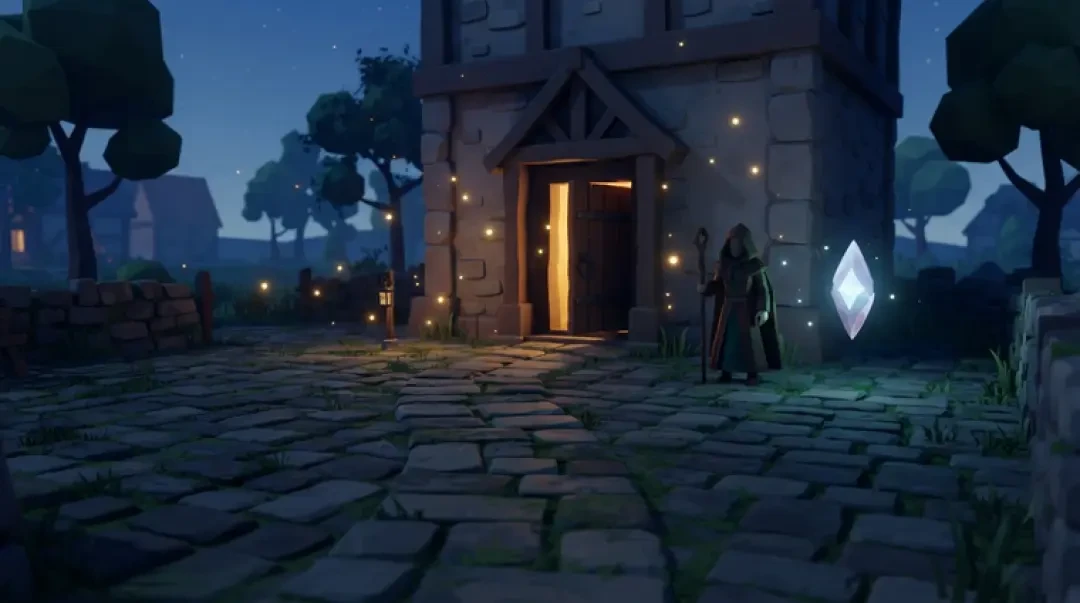
The first output is a world: low-poly terrain tiles, a sky, a directional light, props, and a defined playable boundary. It is a scene, not a continent. The footprint is roughly what you can cross on foot in a couple of minutes, which is the size that stays responsive in a browser tab without a loading gate between areas. Terrain, water, and prop layers are kept separate so you can delete one without breaking the other two, and props come from a shared low-poly set so the draw-call count stays predictable as you add.
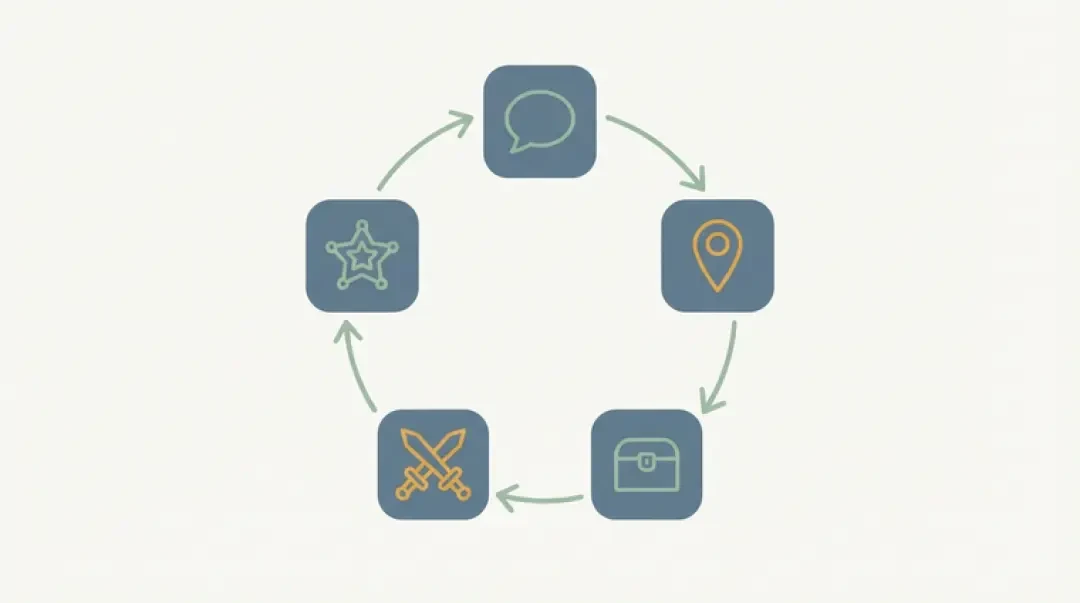
The second output is a story skeleton: a premise, one objective, a location for that objective, a completion condition, and a reward. That is a quest in the mechanical sense, something the runtime can check and mark done. It is not a branching screenplay. If your RPG needs forty hours of nested side plots, the generator gives you the frame for the first one and a clear place to attach the rest.
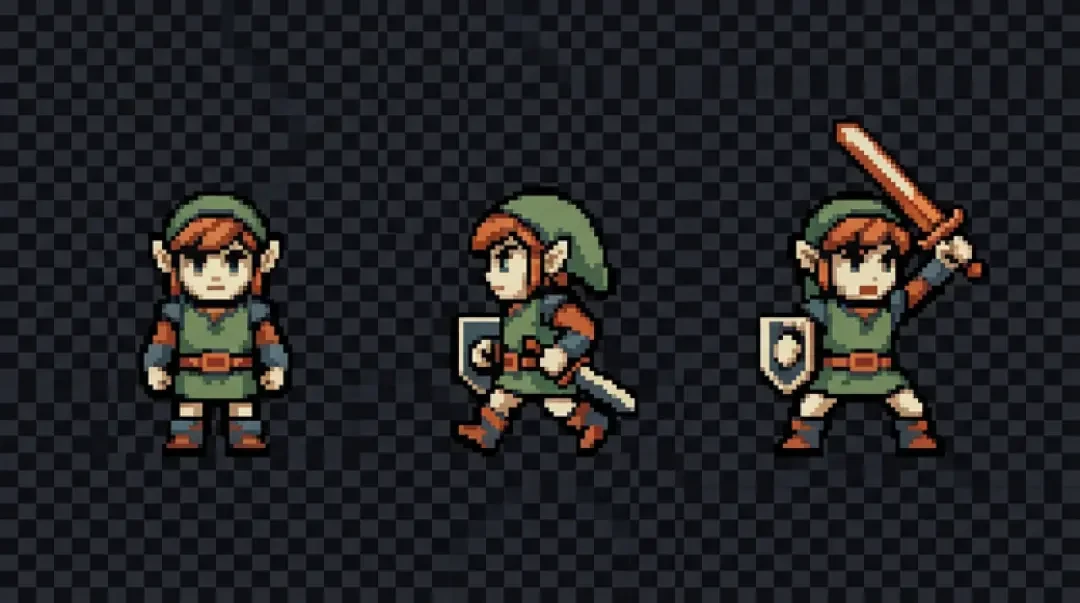
The third output is a cast. Each named character gets a stat block, a sprite, an idle and a walk animation, a placement in the world, and at least one dialogue line. Sprites come from Agent Sprite Forge, which produces directional frames from a written description. Budget matters here: every named character is a sprite request and a collision body, and three well-defined characters read better in a first scene than twelve interchangeable ones.
The fourth output is a combat loop: turn-based, with an initiative order, a small action menu, a damage formula, and enemy behaviour simple enough to read on the first turn. You get a working round, meaning attack, defend, one special with a cooldown, and a resolution step. You do not get a hundred skills. Status effects, multi-target actions, and party swaps are edits you make after the loop already works.
Be precise about scale: this produces a playable first scene, not a sixty-hour JRPG. That is not a limitation to apologise for. The first scene is the only place where every system has to work at the same time, terrain, collision, camera, cast, dialogue, quest state, and turn order. Once that scene holds, a second area is content work. Until it holds, a second area just doubles the number of broken things you have to debug.
How It Works
The pipeline has four stages and one gate. A description becomes a low-poly component. The component is validated. Validated components are placed into a world. The gate is validation, and it exists because generated 3D content rarely fails by looking wrong. It fails by colliding wrong: a mesh with a hole in it, an inverted normal that makes the surface invisible from outside, a collider that sticks out past the visible silhouette, or a footprint that does not sit on the tile grid and leaves a one-tile gap you fall through.
Placement is a separate pass for the same reason. Terrain goes down first, then water and paths, then props, then characters, then quest markers. Characters placed before paths end up standing in a river. Quest markers placed before terrain end up floating over a cliff edge, and a marker the player cannot reach is worse than no marker at all.
01
Parse the description into typed fields: biome, mood, cast size, core mechanic, camera mode.
02
Resolve each field into a component spec: polygon budget, material set, collider primitive, footprint in tiles.
03
Generate the low-poly component geometry and its collision hull from that spec.
04
Validate the component: closed mesh, outward normals, collider within tolerance of the visible silhouette, footprint aligned to the tile grid.
05
Reject and regenerate on failure with tighter constraints, rather than shipping the component and hiding the problem behind a texture.
06
Place validated components into the world in ordered passes: terrain, then water and paths, then props, then characters, then quest markers.
07
Run the placement checks: spawn point reachable to every quest marker, no overlapping colliders, no character standing inside geometry, clear camera sight lines at the spawn.
AI RPG Generator vs AI Code Generator
Most tools that advertise AI for RPGs hand back source code. You get a Unity or Godot script, a Phaser scaffold, or a Python text engine with a parser and a state machine. These are real tools and they do real work, but they are shaped differently. The output is files. You still need a machine that runs them, a build step, and enough of the language to fix the parts that arrive broken.
The difference is code-out versus world-out. With code-out, the artifact is text and the deliverable is a program you have to assemble and deploy. Iteration is edit, build, run, and every cycle costs you a compile. With world-out, the artifact is a running scene and the deliverable is the same object. Iteration is drag a tile, press play. There is no build step between your decision and the result, which is why generated worlds get tuned in minutes instead of sessions.
You asked for a game, not a codebase. That is the whole argument. If you wanted to reason about inheritance hierarchies and frame budgets, you would already be writing the engine rather than reading about a generator.
Code generation still wins in one place, and it is worth saying plainly: systems-heavy projects with unusual rules that no template covers. Free-form skill trees, a custom economy, deterministic replay. When the interesting part of your RPG is the mathematics rather than the space, generated source is easier to extend arbitrarily than generated geometry.
- Code outYou receive source files. You need a runtime, a build step, and enough of the language to debug it. Iteration is edit, build, run.
- World outYou receive a running scene. Iteration is drag a tile, press play. The artifact and the deliverable are the same object.
- Where code generation still winsUnusual rule systems, custom economies, deterministic simulations, and anything you intend to port into an existing codebase.
- Where world generation winsGetting a scene in front of a player today so you can judge the space, the pacing, and the combat loop before committing to a structure.
When the Story Matters More Than the World
Terrain prompts and story prompts are different surfaces. If you already have a world, or you mainly need text you can paste into an NPC, write the story on its own. Story generation also scales further than world generation does: a premise and a dialogue line cost nothing to produce and produce nothing to debug.
Three things a story generator should return. A premise with a constraint the player cannot remove. A twist that changes a rule of the world rather than revealing a hidden fact. And an NPC line that carries subtext instead of exposition. The three prompts below are short on purpose; long prompts give the model room to invent a setting you did not ask for and cannot use.
Premise: a place and a rule
Prompt: Write a one-paragraph RPG premise set in a lighthouse town where the tide never goes out. Include one rule of the world the player cannot change, and name the town.
The constraint is the part that matters. A premise without a rule gives you a setting; a premise with a rule gives you something the combat and quest systems can hook into.
Twist: change a rule, not a fact
Prompt: Give me three twists for this premise where the twist changes a rule of the world instead of revealing a hidden character. One sentence each, no betrayals, no chosen ones.
A twist that reveals someone was a traitor is a fact, and it costs you a cutscene and a rewrite. A twist that says healing items make enemies stronger is a rule, and it hooks into a system you already have. Rule twists are cheaper to build and harder for the player to see coming.
NPC line: subtext over exposition
Prompt: Write four lines for an innkeeper who knows the player will not survive the night. She never says it directly. Each line under twenty words, no more than twelve words if you can manage it, and no line may mention death.
Line length is a real constraint in a dialogue box, and it is a useful one. Short lines force the model to imply rather than explain, which is the difference between an NPC and a signpost.
Free, and No Sign-up to Try
Generating a world and walking it is free, and you do not need an account to start. Open the builder, type the description, press generate, and you are in the scene with a camera and a character. Nothing to download, no engine installer, no sign-up wall between the sentence and the first playable minute.
An account is what persists things. Saving a world, keeping a cast between sessions, and publishing a world you want to send to someone else all need an identity to attach to. Trying it does not.
The limits sit on generation, not on play. Producing a new first pass is rate limited so the queue stays fair for everyone using it, and the exact numbers live in the builder because they change. This page will not quote a quota it cannot keep. What is not metered is the part you do most: walking your world, moving tiles, rewriting dialogue, rebalancing the damage formula, and starting the combat loop again to see whether the change landed. Unlimited is a precise word in that sense and only in that sense.
AI RPG Generator vs RPG Maker
RPG Maker is a mature 2D engine with a database-driven editor, and it is good at the thing it was built for. It is also a desktop application that starts from an empty project, an empty database, and an empty map. The comparison below is about shape, not quality: which tool gets you to a playable scene first, and which one asks more of you before the first frame runs.
If you are choosing between a generator, a traditional engine, and a hand-rolled build, the engine guide on this site walks through the tradeoffs in more detail than a comparison table can.
| Aspect | AI RPG Generator (Neta Studio) vs RPG Maker |
|---|---|
| Platform | Browser for both authoring and play; the project lives in the builder. RPG Maker is a desktop application with a project folder on disk. |
| Code required | None to generate, place, or play. RPG Maker needs no code for a basic scene either, but anything beyond its defaults leans on script events and plugins. |
| 2D or 3D output | Low-poly 3D geometry on Three.js, with a free-moving or fixed camera. RPG Maker is 2D sprite-based with tile maps. |
| Time to first playable | One sentence, one generation, press play. RPG Maker: install, new project, database entries, a map, an event, then test play. |
| Starting point | Your written description, resolved into validated components. RPG Maker starts from an empty database and an empty map. |
| Sharing | A world runs from a link in the browser. RPG Maker exports a build or requires the runtime it targets. |
Walk into the world it belongs to
The only way to judge a generator is to walk the output. Open one: The Cyclops' Island is an isometric 3D game whose level, goal and obstacle were all described in a sentence before anything was built. Every world on this site was published the same way, as a page anyone can open.
FAQ
What is an AI RPG generator? +
A tool that takes a written description and returns a playable game scene rather than text or source files. At Neta Studio that means low-poly terrain, a controllable camera, placed characters, a quest objective with a completion state, and a turn-based combat round, all running in the browser.
Is it better than RPG Maker? +
It depends on the output you need, not on which tool is newer. RPG Maker gives you deep control over a mature 2D database-driven engine. A generator gets you to a playable 3D scene with no project setup and no database entry work. Pick by the format you intend to ship.
Can it make 3D? +
Yes. The output is real 3D geometry rendered with Three.js: meshes with collision hulls, a camera, lighting, and layered terrain, water, and prop sets you can edit separately. It is low-poly on purpose, because that keeps the draw-call count and the load time predictable in a browser tab.
Can it write the story? +
It writes story at scene scope: a premise, one objective with a location and a completion condition, a reward, twists that change a rule of the world, and dialogue lines for named characters. It does not produce a branching script for a full campaign, and treating it as though it does is the fastest way to be disappointed.
Who owns the output? +
The terms of service that apply to your account govern that, not a landing page, so read them rather than trusting a summary. The two points worth checking before you invest time are whether generated assets can be used outside the builder and whether commercial use requires an account.
Is there a free one? +
Yes. Generating a world and walking it in the Neta Studio 3D game builder is free and needs no account. New generation passes are rate limited so the queue stays fair, and the current limits are shown in the builder because they change.
Can I make an anime RPG? +
You can steer toward it through palette, silhouette, and tone in the description, and Agent Sprite Forge produces directional sprite frames from a written character description. Be realistic about the ceiling: the output is low-poly, so anime style translates into colour and proportion choices, not into hand-drawn character art.
Can it make a text-based RPG? +
Not as its main output. This produces a 3D world with a camera and colliders, so a text-only parser game is a different tool. If you want a text RPG, the story surface can produce the premise, the twists, and the NPC lines, but a text engine is where those belong.
How many worlds can I make? +
Playing and editing what you have already generated is not metered, so you can iterate on a world as long as you like. Generating brand-new first passes is rate limited, with the current allowance shown in the builder rather than quoted on a page that cannot keep a changing number accurate.
How is it different from AI Dungeon? +
AI Dungeon generates prose turn by turn and the world exists as text. Here the world exists as geometry: a camera, collision, placed characters, quest state, and an initiative order for combat. One produces a story you read; the other produces a scene you walk through and can edit tile by tile.
Back to the 3D Game Builder
All 31 finished 3D worlds, games and scenes live on one page — every one of them playable.