
AI Scene Generator — Cinematic Crime-Drama Scenes from a World Brief
The AI scene generator turns a world brief into a frame with a place, a subject, evidence and a light source — not a floating character on a gradient. Proven on the Better Call Saul world with four published key visuals from GPT Image 2 and Krea 2.
Generate a Scene
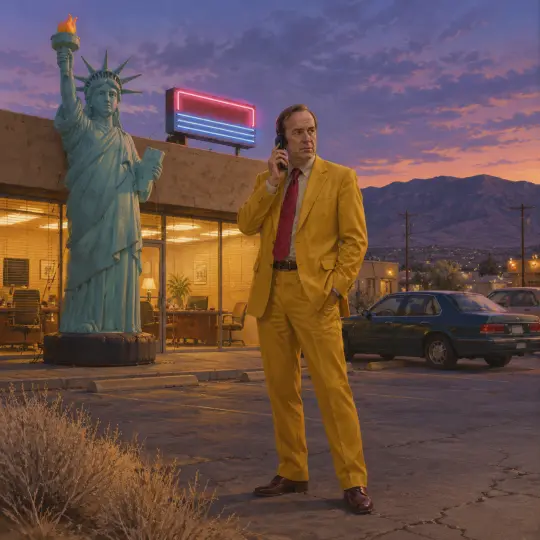
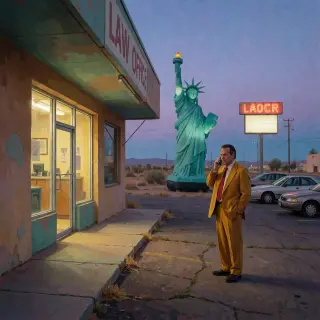
From one world brief to a strip-mall dusk — a lawyer, an inflatable monument, a neon tube and a parking lot — rendered by GPT Image 2
What Is an AI Scene Generator?
An AI scene generator is a text-to-image workflow that produces a moment, not a subject. A character generator gives you a person on a background. A scene generator gives you a place with rules, a person who is slightly out of place in it, an object that implies what just happened, and a light source that explains the mood. The difference is not style. It is information density: a scene can be read for story, while a portrait can only be read for identity.
This page is about the scene-first method, tested end to end on the Better Call Saul world in Neta Studio. Every frame below was generated from a world atom, published as a work of that world, and compared across two models under an identical brief.
What Makes a Scene, Not an Image
A scene has four load-bearing parts. A place that would exist without the character. A subject whose costume tells you their relationship to that place. An evidence object that implies an action already in progress. A light source that is physically motivated by the place. Remove any one of them and the image collapses into a stock photo or a character poster.
The test is simple: cover the person with your hand. If the remaining frame still tells you what kind of story this is, you have a scene. If it becomes an empty background, you have a portrait with set dressing.
The Test World: Better Call Saul
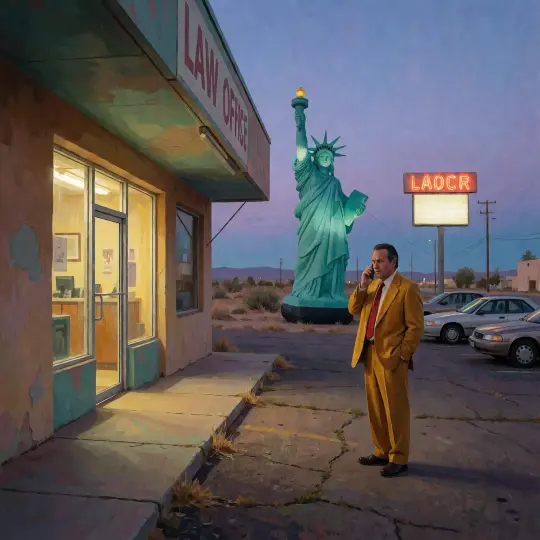
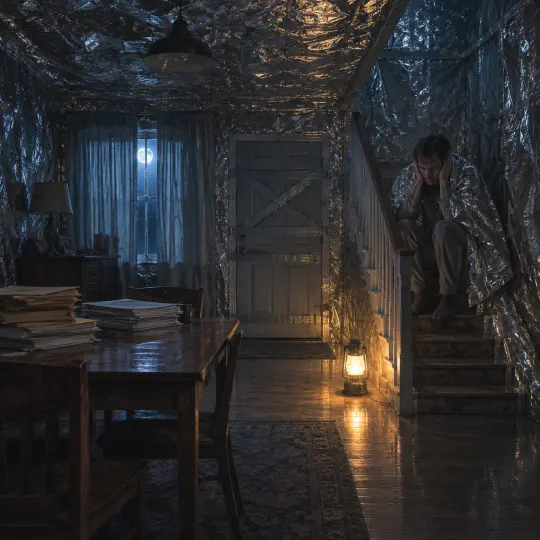
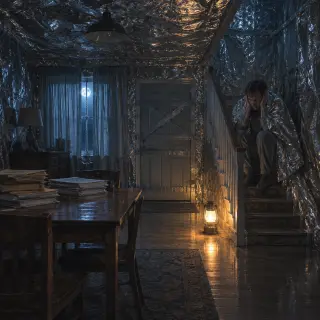
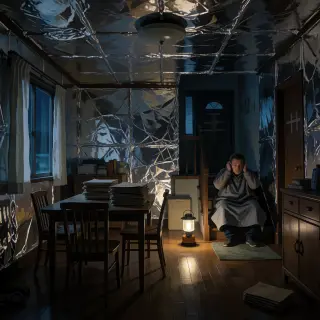
Everything here was rendered against a real canon: the Better Call Saul world in Neta Studio. Eight characters, six locations, six events and four factions, all editable. The two scenes used for this test define the visual range of the genre: the strip-mall law office at dusk, where the story is horizontal, cheap and performative, and Chuck's foil-lined house at night, where the story is sealed, symmetrical and psychological. If a model can hold both, it can hold the world.
What GPT Image 2 Does Well in This Genre
Material honesty. Wool reads as wool, asphalt as asphalt, foil as foil. Atmospheric recession. A desert horizon steps back at a believable rate instead of collapsing into a backdrop. Foreground evidence. A flip phone, a stack of files or a lantern sits in the frame with weight and contact shadow. Architecture. A storefront has a canopy, a door and a reason to exist. Interior light. A lantern pools on varnished boards instead of glowing in mid-air. Small text control. If a sign is required, GPT Image 2 is the model most likely to spell it; for this genre the safer choice is still to ban text entirely.
Scene Anatomy: Subject, Place, Evidence, Light
Write the scene in four passes, in this order: place, subject, evidence, light. Each pass should add one concrete noun and remove one vague adjective. If a clause could apply to any crime story, it is not doing work. If it could only apply to this world, it is.
Place
A cheap strip-mall law office at dusk in Albuquerque; a dark suburban house with foil-lined walls.
Subject
A middle-aged man with slicked-back dark hair in a loud mustard suit and red tie; a thin man in a grey space blanket on the stairs.
Evidence
A flip phone at his ear and a neon tube with no letters; a camping lantern and a table stacked with legal files.
Light
Violet dusk with neon red and blue; cold blue moonlight through a curtain gap against one warm lantern.
Step 1 — Name the Place Before the Person
Most failed scene prompts start with a character. Start with the place instead, because the place decides the composition. "A cheap strip-mall law office at dusk" gives you a canopy, a plate-glass window, a parking lot and a light direction. "A man in a suit" gives you a portrait. Once the place is fixed, the person becomes a scale object rather than a subject, and the frame starts behaving like a story rather than a headshot.
Step 2 — Cast by Costume, Not by Face
Do not describe a likeness. Describe a garment and a posture. "A middle-aged man with slicked-back dark hair in a mustard-yellow suit and a red tie, standing with one hand in his pocket, face turned three-quarters away" gives the model everything it needs and nothing it can get wrong. Costume also does narrative work: a loud suit in a cheap parking lot is the entire premise of a man who has decided that appearance is the product.
Step 3 — Put One Piece of Evidence in the Foreground
A scene needs one object that implies an action already underway. A flip phone still at his ear. A lantern on the floor with the wick low. A stack of legal files that has been read more than once. The object should be close enough to have texture and far enough from the subject to create a triangle of attention: object, person, horizon. Without it the image is a landscape; with it, the landscape becomes a scene.
Step 4 — Light the Lie, Not the Room
A scene generator will happily light everything evenly, which is the fastest way to lose the genre. Name one key source and one fill, and give them different colour temperatures. In the strip mall, the key is a neon tube and the fill is a warm window. In the foil house, the key is one lantern and the fill is cold moonlight through a curtain gap. The temperature contrast does the moral work: the warm light is the ordinary world, and it is always just outside the room where the decision happens.
Step 5 — Lock the Palette
Write the palette as three named colours, not as a mood. "Mustard, oxblood, foil silver" is usable; "gritty and cinematic" is not. For this world the palette is deliberately narrow: the strip mall is mustard and neon red, the firm is walnut and glass, the foil house is silver and blue, the desert is ochre and bone. If you change the palette, you change whose story the audience is watching, so change it on purpose.
Step 6 — Ban Text and Logos
Crime drama is full of signage: office signs, product packaging, police cruisers, menus. Models still misspell short words, and a misspelled sign destroys the documentary illusion faster than any anatomical error. Add "no text, no logos, no watermark" to every prompt, then crop or composite any signage you actually need. GPT Image 2 is better at text than most models, but "better" is not "reliable", and the genre cannot afford a visible error.
The Reusable Scene Template
Legal-crime scene, semi-realistic painterly realism, cinematic wide shot. PLACE: [cheap strip-mall law office at dusk / foil-lined suburban house at night]. SCALE: [inflatable Statue of Liberty and cracked asphalt / staircase and stacked legal files]. SUBJECT: [a man with slicked-back dark hair in a mustard suit and red tie with a flip phone / a thin man in a grey space blanket with his hands over his ears]. EVIDENCE: [a neon tube with no letters / a camping lantern and a stack of files]. LIGHT: [violet dusk, neon red and blue, ochre stucco / cold moonlight and one warm lantern]. NEGATIVE: no text, no logos, no watermark, restrained film grain.
Keep the order. Early clauses are weighted more heavily than late ones, so a place clause that arrives after the costume clause will lose to the costume. The template is also a checklist: if you cannot fill a bracket with a concrete noun, the scene is not ready to generate.
Render and Publish Workflow
Open the world studio, copy the atom you want to visualise, write the four-pass scene brief and generate. Publish each frame as a work of the world with its prompt and model recorded. The four frames on this page are published works with live share links, which means the comparison can be inspected rather than taken on faith.
Copy the atom
Open the strip mall or the foil house in the world and copy its nouns into the place clause.
Write four passes
Place, subject, evidence, light. Keep every clause concrete and every object physical.
Generate at the right ratio
Use a wide frame for the strip mall and a taller frame for the staircase. Square is for social; 3:2 is for pages.
Publish as a work
Attach the image, prompt and model to the world so the frame inherits the canon.
Compare and iterate
Run the identical brief on Krea 2, publish both, and let the comparison decide which surface each image serves.
Explore the World
Start with the wide shot. It defines the palette, the scale and the social logic that every later frame will inherit. For this world, the easiest first scene is the strip mall at dusk; the most useful second scene is the foil house at midnight. Publish both, then compare models on the same brief.
Create Your Own Scene
Four published frames, two models, one world — the next scene is yours.