Daily Word Puzzle — A New Free Wordle-Style Challenge Every Day
Make your own daily word puzzle
A new five-letter puzzle every day: six guesses, the same answer for everybody, and one free letter if you need it. Playable in the browser, no signup, no download, with a spoiler-free share line.
A daily word puzzle on this page is five letters, six guesses, and one answer per calendar day. The same answer for every player who has rolled over to the same date. You type, you submit, tiles resolve to green, yellow or grey, and after six rows the board stops accepting input and shows the result. No signup, no download, no interstitial between you and the first keystroke. The board is the first screen, not a hero panel with a Play button under it.
What follows is a description of the artefact and the reasoning behind it, including the one rule that differs from the format you already know: after three wrong guesses you may take a single revealed letter, and the share line records whether you did. It also covers the archive, the share encoder, and the four systems you need to ship your own version inside the 3D game builder or anywhere else with a keyboard and a canvas.
Today's Puzzle (Live)
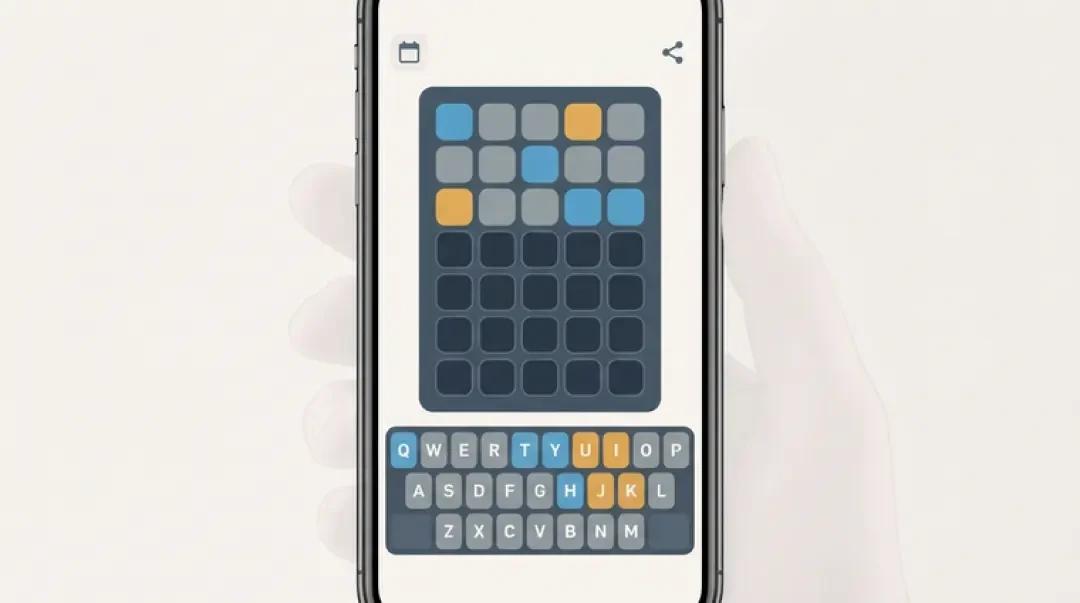
The board is already interactive when the page finishes loading. Six rows of five tiles sit centred; empty tiles carry a 1px neutral border, the active row is the only one with a focus ring, and a caret tracks the cursor across it. Above the board: the date, a puzzle number derived from that date, and one theme line — either a category, or the words no theme today. Below the board: a three-row on-screen keyboard with Enter and Backspace on the bottom row, each key dimming once its letter has been eliminated as grey. There is no modal in front of the grid and no start button to dismiss.
Submitting is two operations in a fixed order. First, validation: the entry is uppercased, checked for exactly five A–Z characters, then looked up in the word list. A rejected entry shakes the row, clears it, and does not consume a guess — the row counter only advances on a word that exists in the dictionary. Second, scoring: the row fills left to right with a short stagger, and each tile resolves to one of three states. Green means the letter is in the answer at that exact index. Yellow means the letter is in the answer but not at that index. Grey means the answer has no remaining copy of that letter after greens and earlier yellows have been accounted for.
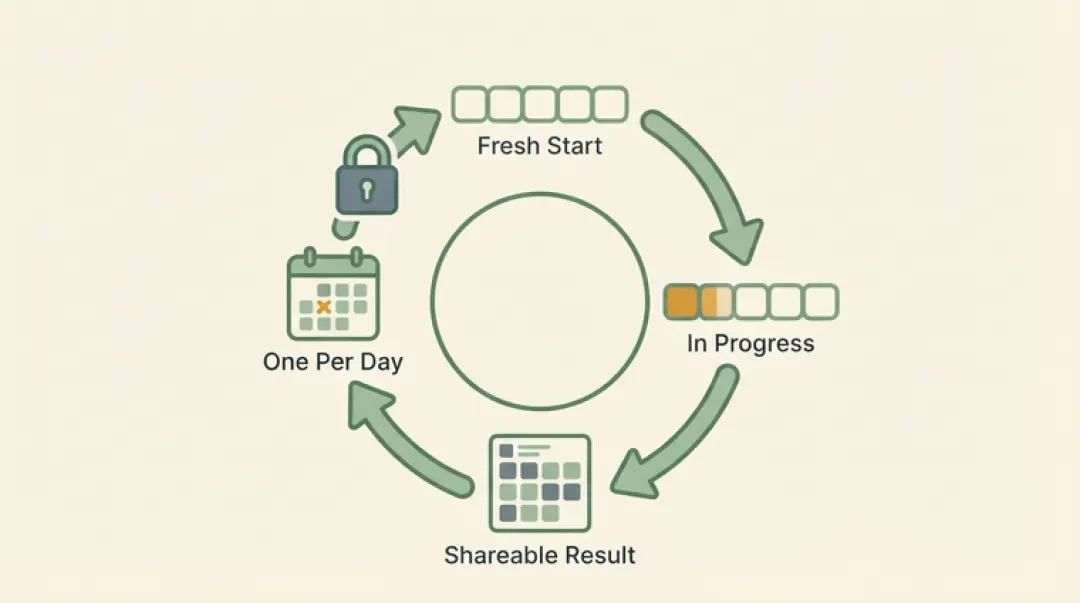
The answer does not change on reload. The puzzle index is derived from the local date, the answer is fetched by that index rather than drawn at random, and the day's state — rows submitted, tile colours, whether the halfway letter was taken — is written to local storage under a key that includes the day index. Refresh mid-solve and you get the same board, the same answer, the same filled rows. The only thing that resets is the caret position and any half-typed letter.
Why the daily word puzzle renders before anything else
The layout decision is that the first interaction should be a keystroke, not a navigation. Everything above the fold is state the player needs: the date, because it tells you which puzzle you are solving; the puzzle number, because it is the first token in the share line; the theme line, because it tells you whether today's answer is drawn from a narrower category. The keyboard is rendered on-screen rather than assumed, because a meaningful share of traffic arrives on a phone, and a puzzle that silently requires a hardware keyboard loses those players at row one rather than at the result.
How to Play: Six Guesses, Three Colours, One Ceiling
You get six submissions against one hidden five-letter word. The board stops accepting input when all five tiles in a row are green, or when the sixth row has been scored. Win and loss are the same event from the interface's point of view: the sixth row resolving. On a loss the answer appears in the result panel rather than being rewritten onto the board, so the grid you share still matches the grid you saw.
Repeated letters are scored per occurrence, not per letter. The scorer runs two passes: first it marks every green and removes that answer character from a pool; then it walks the remaining guess letters left to right and marks yellow only if the pool still holds a copy, consuming it. Worked example — answer ELDER, guess EERIE. Pass one marks green on the first E and removes it. The pool is now L, D, E, R. Pass two: the second E is yellow, because the pool's E sits at index 4; R is yellow, because the pool's R sits at index 5; I is grey; the fifth E is grey, because the only remaining E was consumed two tiles earlier. One letter, three different colours in a single row. That output is correct, and a single-pass scorer will get it wrong.
A green tile locks a position, not a letter. It tells you the answer holds that character at that index. It does not tell you the character appears once — a green A at index 3 and a yellow A in a later row are compatible, because the answer can hold two A's. It also adds nothing about the other four positions of the row it appeared in beyond the colours already shown. Players who read green as this letter is settled stop looking for the second copy and stall on rows five and six.
01
Choose letters, not words. The frequent letters in five-letter answers are E, A, R, O, T, L, S, N, I and C. An opening row should test five of them, not five letters you find aesthetically pleasing.
02
Spread them across five distinct positions. SLATE places S at 1, L at 2, A at 3, T at 4, E at 5 — five common letters, five different slots, and a vowel in the middle where it constrains the most.
03
Do not double a letter on row one. A duplicate spends a tile that could have tested an untested letter, and duplicates are rarely the binding constraint on an opening.
04
Read the row as a constraint set, not a score. Each grey removes a letter from every future guess. Each yellow removes one index for one letter. Each green fixes one index.
05
Pick row two to cover the most frequent letters the first row did not touch, keeping any green in place. If row one returned two greens, row two tests three new letters.
06
By row four you should be solving from the constraint set rather than proposing words and hoping. If you are still guessing at row five, the earlier rows were spent badly.
The Halfway Letter (What Makes This One Different)
After the third row resolves without a solve, one button appears below the keyboard: take the halfway letter. It reveals a single letter of the answer, at a position chosen when the puzzle was generated rather than when the button is pressed. Every player who takes it on a given day receives the same letter in the same position. It can be taken once, it cannot be undone, and it is not offered on rows one or two — you have to have spent three guesses first.
The obvious alternative is a difficulty selector: easy mode hands you a letter from the start, hard mode withholds it. That splits the audience into two boards producing two incomparable sets of scores, doubles the streak semantics, and turns every rules question into a question about which mode the asker was in. The halfway letter keeps one board. Everyone solves the same five letters against the same answer; some players finish with an extra constraint and some do not, and the difference is recorded rather than hidden.
A hinted score is not comparable to an unhinted one. That is stated plainly rather than papered over. If you take the letter, your result carries the flag — 4 out of 6 with the hint marker, not 4 out of 6 clean — in the share line and in the result panel. A hint that makes the score not comparable is the point: the alternative is a hint that quietly makes two different puzzles look like one, which is worse for the player who did not use it.
Why a daily word puzzle should not have difficulty settings
Difficulty is a property of the player, not of the board. Once you ship two boards, the archive has to say which one each past answer belonged to, the streak has to be per-mode, and the share line needs a mode token that most readers will ignore. A mercy rule avoids all of it: the artefact stays fixed, the assist is opt-in, and the only new state is a boolean that fits in the share string.
Yesterday's Answer & the Archive
Directly under today's board, collapsed by default, sits the archive: the last seven answers, each with the date it was live. It is a list, not a set of playable boards. You cannot open yesterday's grid and submit six guesses into it, because a second attempt at an already-scored day makes the streak meaningless and turns the archive into a practice mode with a calendar attached.
Today's answer is never in that list. The archive is generated by walking the index backwards from today minus one and stopping after seven entries, so the current index is excluded by construction rather than filtered out afterwards — a filter is the kind of thing that gets reordered in a refactor and leaks the answer. The list rolls forward at local midnight, at the same moment the board resets.
- The design reasonIf you miss a day — travel, a late shift, a dead battery — what breaks is the routine, not the vocabulary. Reading yesterday's answer costs nothing and gives you a reason to return to today's board. Handing you a replay of yesterday would satisfy the same curiosity and destroy the daily constraint in the process.
- What the archive is forIt is a record and a recovery path. It answers the question what was it, so the miss does not sit unresolved, and it stops there. Practice belongs in a different mode with a different board, not in the historical record.
| Date | Answer |
|---|---|
| Yesterday | CRANE |
| Two days ago | MOUTH |
| Three days ago | PILOT |
| Four days ago | BREAD |
| Five days ago | SHINY |
| Six days ago | VAPOR |
| Seven days ago | LUNCH |
Why One Puzzle a Day Beats Unlimited Rounds
A single board is a bounded session. It ends. When the sixth row resolves, there is nothing left to do today, and the interface stops offering — no play again button, no next round, no score multiplier. The session length is fixed by the format rather than by how long you are willing to keep clicking, which is why the result panel is a terminal state and not a loop.
Endless practice mode does a different job. It is where you learn the scoring rules, test whether SLATE or CRANE is a better opener for you, and recover from a bad day without spending tomorrow's puzzle. It is also where the share loop dies, because a result from a board nobody else played is not a comparable result. The daily board is the thing you talk about; practice is the thing you do alone.
| Property | One puzzle a day | Endless practice mode |
|---|---|---|
| Session length | Bounded: six rows, then a terminal result panel | Unbounded: continues until the player leaves |
| Who plays the same board | Every player on the same local date | Nobody; each run is drawn separately |
| Result comparability | Direct — same answer, same rules, hint flag recorded | None — a 3/6 on one draw says nothing about another |
| Share value | High; the reader can check their own result against it | Low; the reader has no matching board |
| Failure mode | A miss costs a day of the habit | Difficulty drift; the player optimises for volume, not accuracy |
| Suits | Players who want a fixed daily ritual and a comparable score | Players learning the rules or testing openings |
A Share Line With No Spoilers
The share string is generated from the board state, not typed by the player. It contains the puzzle number and date, the score out of six, a hint flag when the halfway letter was taken, and the grid of coloured squares in row order, top to bottom, left to right. Nothing else. A four-row solve with the hint looks like this:
Daily Word Puzzle #412 · 4/6 · hint used — followed by four lines of five squares each, grey then yellow then green across the rows in the order you played them. The grid is the score; the score is the grid header.
What it deliberately omits: the letters of any guess, the theme, and the position of the revealed halfway letter. The colours in the grid are already a constraint set — that is unavoidable and it is what makes the format worth reading — but publishing which index the mercy letter occupied would hand the reader a free green tile. The hint is marked as used, never as located.
The etiquette point
Paste the block. Do not describe your guesses. A message that reads I got it on four, I started with SLATE and the middle letter was R hands the answer to anyone three rows in, and it does it in a channel where the block would have been perfectly safe. The block exists so you do not have to make that judgement call under time pressure.
- Included: puzzle number and dateSo the reader can tell whether they are looking at today's board or a backlog.
- Included: score out of sixA single number, comparable across players, readable before the grid.
- Included: hint flagOne marker indicating the halfway letter was taken. No position, no letter.
- Included: the colour gridFive squares per row, in play order. Decoded from the stored tile states, never hand-edited.
- Excluded: everything textualNo guessed words, no answer, no theme line, no revealed letter, no index. A reader can see the shape of your solve and nothing they could paste into a solver.
Build Your Own Version of This Puzzle
A Wordle-shaped game is small. Four systems, and only one of them is genuinely easy to get wrong. Thematic reskins are mostly a matter of swapping the word list and the tile art; the scoring function and the answer path are where the bugs live.
Two failure modes are worth naming before you start. The first is a themed word list that is too short. A sixty-word theme is brute-forceable in six guesses by anyone who knows the category, and the theme line above the board becomes a spoiler rather than a hint. Keep a themed list in the hundreds of entries, or drop the theme line when it is not. The second is an answer that rotates per refresh. If the word is redrawn on each load, the share line stops describing a shared artefact, the streak stops meaning anything because a player can reload into an easier word, and local storage keyed by day index will restore five guesses against a different answer — producing tile states no scorer would ever output. Derive the index from the date, take the answer by index, and never call a random function on the answer path.
Shipping a daily word puzzle in the 3D game builder
The 3D game builder is a general scene builder, and a word puzzle is a UI scene: one canvas, a tile grid, an input layer, and a result panel. Agent Sprite Forge covers the tile and keyboard art if you want it to be something other than flat rectangles. The scoring logic is a few dozen lines of JavaScript and does not touch the 3D pipeline at all. If you want the result screen to be a place rather than a panel, Mini World and The Cyclops' Island are the shipped examples of how much a scene can carry around a small piece of logic.
- Word listA JSON array of five-letter uppercase strings, deduplicated, no proper nouns, no plurals ending in S unless you want them. Load once, build a Set for membership checks. Keep answers and guesses in separate lists if you want to accept more words than you are willing to serve.
- ValidatorRuns before scoring. Reject anything that is not five A–Z characters, then reject anything not in the Set. A rejection must not increment the row counter, or players lose guesses to typos and blame the game.
- Two-pass scorerGreens first against the answer, then yellows against a consumed pool. Single-pass implementations return the wrong colours on repeated letters in exactly the ELDER/EERIE case above, and the bug only shows up on a small fraction of rows, which is why it survives testing.
- Share encoderMap the 6×5 tile states to a compact string — one character per tile, three values plus empty — and decode at render time. Store the codes, not the emoji; emoji in a save file is a migration problem waiting for a Unicode update.
More Daily Games Like Wordle
The daily-games collection is the index for everything on this site that resets at midnight. Four destinations in it are relevant if you arrived for the word puzzle.
- The daily games collectionThe parent list: every game here with a date-derived board, one entry per format, so you can pick a second daily habit without hunting through the site.
- Fixed-board number gamesSame structure as this puzzle — a bounded number of attempts, a single answer per day, scored per position — with digits instead of letters, which makes the constraint set easier to reason about and the opening move less forgiving.
- Spatial puzzlesDaily boards where the answer is an arrangement rather than a word, so the share line describes a shape instead of a colour grid.
- The Wordle-alternatives listA curated list of other daily word formats, each with one line on what it changes about the rule set, so you can tell at a glance whether it is a variant or a reskin.
- Mini World and The Cyclops' IslandIf you want the daily habit to end in a place rather than a panel, both are built in the 3D game builder and show what a small rule set looks like once it has a scene around it.
Walk into the world it belongs to
Today's answer is already loaded above. The next step is the one that makes a word game worth playing twice: give it a place to live, so the puzzle you build is a page with a link that a class or a group chat can open at the same time. Every world on this site started as one written description and ended as a page someone could play.
FAQ
Is the daily word puzzle free? +
Yes. The board, the halfway letter, the archive and the share line are all on the page with no payment step, and there is no ad placed between rows.
Do I need an account? +
No. Progress and streak are stored in your browser's local storage under a key that includes the day index. Clearing site data clears them, and there is no profile on a server to restore.
Does the word change if I reload? +
No. The answer is looked up by a date-derived index rather than drawn at random, and your submitted rows are restored from local storage, so a refresh returns the same board with the same rows filled in.
Can I play yesterday? +
Not as a board. The archive lists the last seven answers with their dates, read-only. There is no way to submit guesses into a past day, because a second attempt at a scored day breaks the streak.
Is the halfway letter cheating? +
It is a documented assist, not a cheat — it is offered by the interface, once, after three guesses, and it is the same letter in the same position for everybody that day. It is flagged in the share line so a hinted score is never presented as a clean one.
What happens to my streak? +
A day counts when you solve the board before local midnight; a missed day resets the count to zero. A day solved with the halfway letter still counts as solved and is flagged separately, so the streak and the hint record never contradict each other.
Can I share without spoiling? +
Yes — paste the generated block. It carries the puzzle number, the score out of six, the hint flag and the colour grid, and it omits the letters, the theme and the position of the revealed letter. Do not add commentary about your guesses on top of it.
Can I make my own daily puzzle? +
Yes. It needs four systems: a word list, a validator that runs before scoring, a two-pass scorer that handles repeated letters, and a share encoder. The 3D game builder can host the scene, and Agent Sprite Forge covers the tile and keyboard art.
Back to the 3D Game Builder
All 31 finished 3D worlds, games and scenes live on one page — every one of them playable.