
GPT Image 2 Anime Esper Key Visual Generator — Psychic Power Without the Glow
A GPT Image 2 workflow for anime esper key visuals: floating schoolyards, deadpan espers and cramped exorcism offices rendered with real material logic. Built and proven on the Mob Psycho 100 world with four published works.
What This Generator Is For
This is a GPT Image 2 workflow for anime esper key visuals: the kind of frame where a teenager in a school uniform is standing very still and the room around him has stopped obeying physics. It is tuned for psychic stories that are comic and domestic rather than cosmic — a city that does not believe in espers, a business that exorcises ghosts for rent money, and a power that is measured in feelings rather than levels.
Why the Usual Anime Prompt Fails
The default anime prompt produces a glossy, over-lit character with a coloured aura and no location. It is a portrait of a power, not a scene. For this genre that is fatal, because the story is about restraint: the point of Mob is not that he can lift a building, it is that he would rather not.
A generator needs an event and a place before it needs a mood. The event can be small: a desk three centimetres off the ground, a spirit sitting cross-legged above a sofa, a bowl of salt on a laminate desk. The place can be municipal: a public school, a rented office, a train line. Once those exist, the audience supplies the unease.
Why GPT Image 2 for This World
GPT Image 2 is the strongest choice when the frame has to survive inspection. It holds architecture, contact, material and shadow, and it follows a long brief without dropping the last clause. For a world built on ordinary rooms, that reliability matters more than expressive flourish.
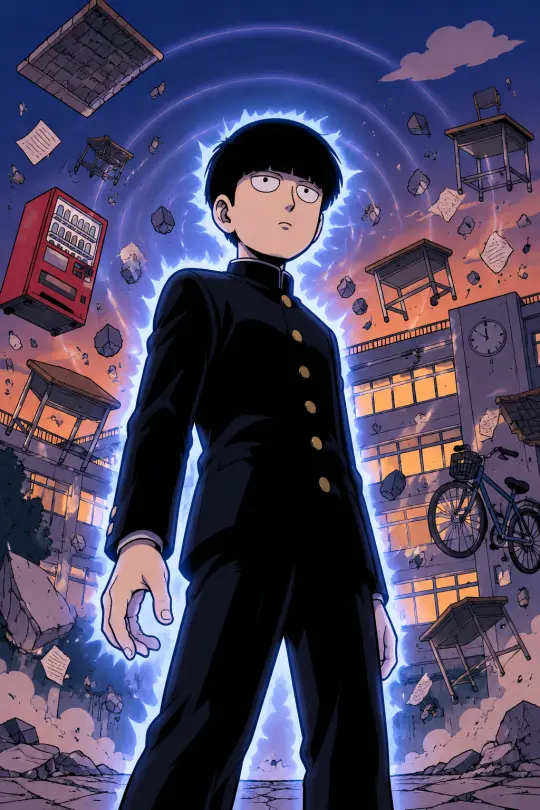
The Six-Clause Prompt Template
The template is deliberately boring. A fixed order is what makes two generations comparable, and what keeps the tenth frame in the same world as the first. Each clause answers a question the model would otherwise answer for you.
Style lock
Anime key visual in a bold-line comic style. Thick black contour lines, flat cel-shaded colour blocks, two hard value steps, minimal texture.
Character spec
Age, hair, eyes, expression and wardrobe. For Mob: fourteen, bowl-cut black hair, dull round eyes, flat mouth, black gakuran with high collar and gold buttons.
Place spec
A specific schoolyard or office, with the objects that prove it. Cracked concrete, orange windows, a vending machine, a bicycle, a water-stained ceiling.
Event spec
One impossible thing, stated as fact. Desks, roof tiles, a bicycle and a vending machine lifting in a slow radial explosion; or a green spirit floating above a sofa.
Light and palette
Cold blue-white against deep indigo and orange windows; or fluorescent beige, teal upholstery and neon through glass. Keep the shadow hard.
Negative clause
No text, no logo, no watermark, no photorealism, no PBR, no heavy paint, no gradient. This is the clause that saves the flat style.
Clause One: Lock the Style Before the Subject
If the style arrives late in the prompt, the model starts rendering a photograph and then tries to paint over it. State the rendering system first: bold-line comic, thick stable outer contours, simpler interior lines, flat high-readability local colour, compact hard-edged shadow, clean matte fills.
Clause Two: Specify the Face, Not the Feeling
Anime models default to a marketable face: big eyes, a highlight, a small blush, a soft jaw. Mob’s face is the opposite — dull round eyes, a flat mouth, no blush, no highlight, no reaction. The prompt has to say that explicitly or the model will make him cute, which destroys the joke.
Clause Three: Build the Room Out of Nouns
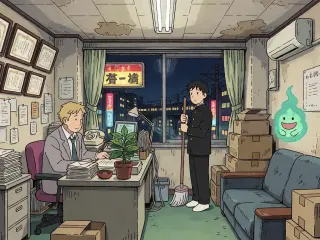
A location prompt should read like an inventory. For the office: a cramped second-floor room, a cluttered desk, a fake potted plant, a rotary phone, a stack of unopened mail, a bowl of salt, a wall of framed certificates, a water-stained ceiling, a worn sofa, cardboard boxes, a flickering sign outside, a train line through the window.
Clause Four: One Impossible Thing
The event clause is where most prompts overreach. Two impossible things in one frame read as noise. Choose one gesture and let everything else behave. A radial lift is good for a character poster; a single floating spirit is good for an interior; a tree growing through a city block is good for a wide establishing shot.
State the event as a fact, not a wish. “The air is distorted into concentric rings” is a fact. “An overwhelming psychic aura surrounds him” is a wish. The first gives the renderer a shape; the second gives it permission to improvise.
Clause Five: Light Is a Palette Decision
This world has two lighting regimes. The exterior is dusk: deep indigo sky, one flat comic cloud, orange windows, cold blue-white psychic light, long hard shadows. The interior is fluorescent: beige walls, teal upholstery, a green cast, neon through glass, a single warm desk lamp.
Clause Six: The Negative Clause Is Not Optional
Every prompt in this world ends with the same four refusals: no text, no logo, no watermark, no photorealism. For a flat-cel style, add no PBR, no heavy paint, no gradient, no bloom. The negative clause is what keeps GPT Image 2 from rendering a beautiful photograph of a boy who is supposed to be a drawing.
Size, Quality and Aspect Ratio
Choose the surface before you choose the size. A world cover is 1536x1024 landscape. A character poster is 1024x1536 portrait. A gallery tile is square. A share card is portrait but tighter, so the subject has to be centred and the event has to survive a crop.
The Four Published Examples
These are the reference outputs for this workflow. Two prompts, two models, four works. The prompts are published with the works, so the comparison is reproducible rather than rhetorical.
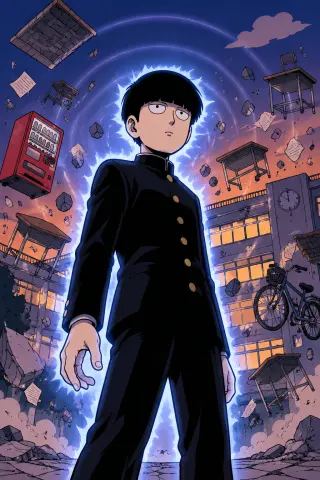
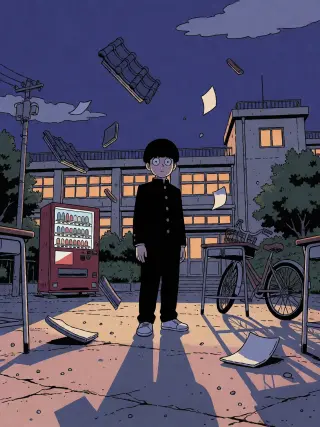
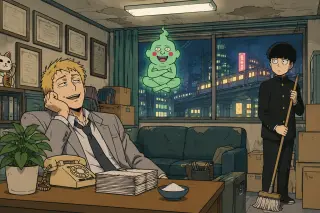
Inspecting a Result
Inspect in a fixed order, and stop at the first failure. One: can you name the event in a second? Two: is there a human scale? Three: do the materials stay separate? Four: did any text or glow sneak in? Five: does the face still look like the character rather than a generic anime child?
Event
Name the impossible thing without reading the caption. If you cannot, the composition is not done.
Scale
Find the body or the object that tells you how big the event is.
Material
Check wool, concrete, plastic, chrome and paper. If two of them merge, re-render with more nouns.
Contamination
Look for text, logos, bloom, gradient and stray glow. Any of these means the negative clause needs work.
Character
Compare the face to the character card. If it has become cute, the world has become a different show.
When to Use Krea 2 Instead
Use Krea 2 when you need ten ideas in the time it takes GPT Image 2 to make three, or when the frame is going to be seen at postage-stamp size and the silhouette is the only thing that matters. It is also better at the deadpan wide shot, because it is willing to let the subject get small.
Publishing and Measuring
Publish every keeper as a work of the world, with the prompt and model attached. A published work gets a permanent share link, appears in the world gallery and can be forked. That is also how you build a comparison that a reader can verify: two works, one brief, two answers.
Create Your Own Frame
Four published frames, two models, one world — the next one is yours.