GPT Image 2 Cel-Shaded Platformer Key Visual Generator — Bright Kingdom Covers from One Prompt
Use the GPT Image 2 cel-shaded platformer key visual generator to create bright kingdom covers: mushroom houses, green pipes, white castles and volcanic horizons, with prompts grounded in a real 25-atom world. One prompt, a readable map, a cover-ready poster.
Generate a Cel-Shaded Platformer Key Visual
From one prompt to a banner-ready cel-shaded platformer key visual — a kingdom of pipes and mushroom houses, a castle under an airship, a volcano on the horizon, rendered by GPT Image 2
What Is the GPT Image 2 Cel-Shaded Platformer Key Visual Generator?
It is a GPT Image 2 workflow tuned for cel-shaded 3D platformer covers: bright storybook kingdoms, mushroom-roofed houses, green warp pipes, floating question blocks, white castles and volcanic fortresses, all rendered with hard-edged toon shading and clean local color. The prompt does the styling; a Neta Studio world supplies the canon. That combination is what separates it from a generic image generator — the model is only half the system, and the world is the other half.
Why Use GPT Image 2 for Platformer Covers
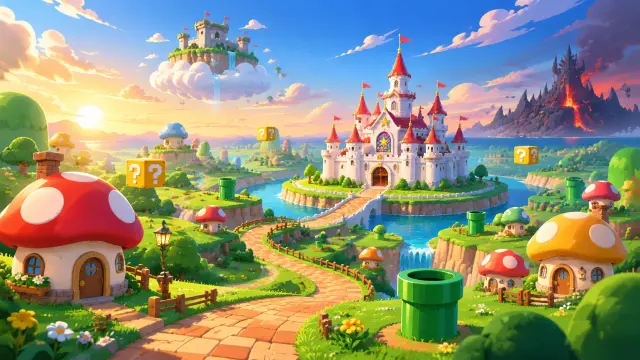
GPT Image 2 is unusually good at spatial information. Give it a foreground, a mid-ground and a horizon and it will keep them separate: the mushroom houses stay in front, the castle stays across the moat, the volcano stays far away. That is exactly what a platformer key visual needs, because a platformer is a map before it is a mood.
It is also strong at material separation: brick, grass, stone, water and metal all read as different surfaces without turning photoreal. For a cel-shaded look that matters, because the style depends on flat local color and discrete shadow steps rather than texture noise.
The trade-off is speed and cost. GPT Image 2 is slower than lightweight models, and it can refuse character-heavy prompts that drift too close to a known franchise. The workaround is simple: stage the world as an environment, then use Krea 2 for the character beat.
The World Behind the Generator
The test world is The Mushroom Kingdom — 25 atoms across characters, locations, events, factions and rules. Princess Peach rules from a castle that guards the Power Stars; Bowser's Koopa Troop keeps trying to take it; green pipes connect the plains, the caverns, Sky Land and the volcano. The world key visual below was generated from that canon as a pure establishing shot, which is why every landmark is in the right place.
What Makes a Cel-Shaded Platformer Key Visual Read
Three things, in order. First, a clear ground plane: the viewer must know where the floor is and which way is forward. Second, vertical punctuation: pipes, blocks, towers and beanstalks that break the horizon and suggest traversal. Third, a destination: a castle, a star, a flag, a doorway — something the eye wants to reach. Add a scale marker and you have a cover. Miss the ground plane and you have a fantasy illustration that happens to be green.
World clause
Say what the place is in one sentence: “A bright storybook kingdom at golden hour: mushroom-roofed houses, a brick path, a white castle across a moat.”
Camera clause
Place the layers: “Wide panoramic establishing shot, foreground houses, mid-ground castle, distant volcano, cloud island overhead.”
Style clause
Name the shading model: “Fully modeled anime game environment, discrete toon value steps, hard-edge cel shading transitions, clean vibrant local colors, ambient occlusion, low-texture game surfaces.”
Negative clause
Remove the noise: “No text, no letters, no logo, no watermark, no UI, no people.”
Real Outputs from the Generator
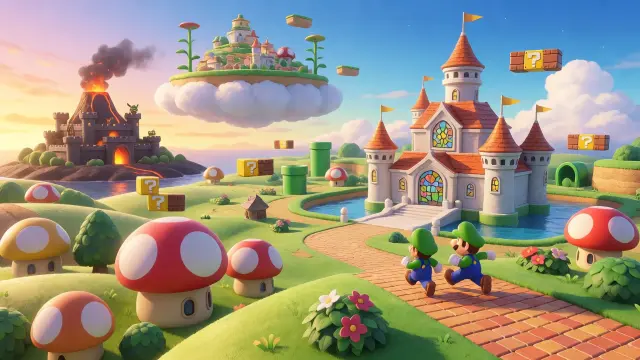
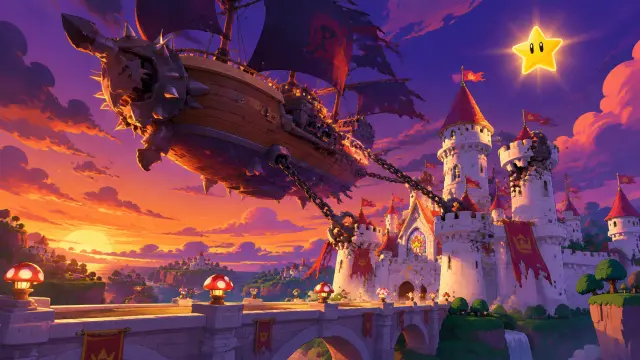
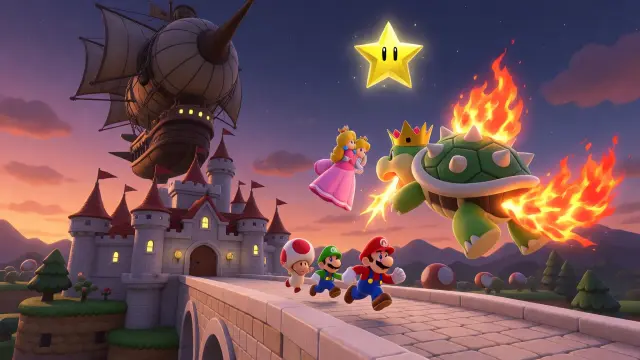
Four works were generated from the world: a world key visual and an event key visual, each rendered by GPT Image 2 and Krea 2 from the same prompt. The GPT pair is the detail-first read — architecture, horizon, environmental storytelling. The Krea pair is the expression-first read — characters in frame, poster composition, warmth. All four are public works of the world.
Prompt Anatomy
Here is the actual structure that produced the world visual, annotated:
- Subject: “Key visual for an original cel-shaded 3D platformer game world.”
- Setting: “A single wide panoramic establishing landscape at golden hour with no characters.”
- Foreground: “Sunlit rolling green hills and round mushroom-shaped houses, a winding brick path.”
- Mid-ground: “A gleaming white storybook castle with stained-glass windows and a moat.”
- Props: “Floating yellow question blocks and green warp pipes scattered across the plains.”
- Background: “A cloud island with a small fortress drifting in the blue sky, a dark volcanic fortress on a black island in the far distance with lava glow.”
- Style: “Discrete toon value steps, graphic highlights, environment-colored shadow tinting, hard-edge cel shading transitions, ambient occlusion, game lighting with cel banding, low-texture game surfaces.”
- Negative: “No text, no letters, no logo, no watermark, no UI, no people.”
Model Comparison: GPT Image 2 vs Krea 2
GPT Image 2 wins on information density: more layers, sharper architectural logic, a horizon that reads as distance rather than backdrop. Krea 2 wins on energy: it will put a body in the frame and make the poster feel like a still from the opening sequence. Both are useful, and the comparison is the point. Run the same prompt on both, publish both, and let the world's canon decide which one is on-model.
The Kidnapping Event Cover
Event covers are where GPT Image 2 earns its place. The kidnapping brief is the world's turning point: an airship over the castle at dusk, chains locked onto the towers, torn banners, a Power Star in a violet sky. Asked for the scene with no characters, GPT Image 2 still tells the whole story through environment — the crime has already happened, and the bridge is empty because the hero has not arrived yet. That is a harder and more useful image than a crowd of poses, because it gives the copy room to breathe.
Choose a world → Write the four-clause prompt → Render with GPT Image 2 → Compare with Krea 2 → Publish both as works
Use Cases
Storefront capsules and banner art for platformers and adventure games. Pitch-deck covers that need to communicate a whole world in one frame. Press kits and social cards for a world-building project. Mood boards for a 3D art team that has not started production. Tabletop campaign covers. And fan-world posters that need to feel like an official key visual without borrowing one.
Who It Is For
Indie studios that need a cover before the art pipeline exists. Solo developers who can write a world but cannot model one. Art directors who want a fast, on-canon first pass to react to. Writers building a visual bible. And anyone who has a bright kingdom in their head and wants to see it rendered in the correct visual language on the first try.
Limitations
GPT Image 2 is slower and more expensive than lightweight models, and it does not do motion well — action poses often need several attempts. It can refuse prompts that resemble a known franchise too closely; staging the world as a pure environment is the reliable workaround. Text rendering is not its strength either, so never ask for a title in the image. And a generator cannot invent canon: if the castle needs three towers, say three towers, or edit the world's atom before you render.
Frequently Asked Questions
- What exactly does this generator make? A single cel-shaded key visual — world establishing shot or event cover — from a text prompt grounded in a world's canon.
- Do I need a 3D scene? No. The cel-shaded look comes from the prompt and the model, not from a render pipeline.
- Why does the world visual have no characters? Character-heavy prompts can trip similarity filters, and an empty establishing shot is more useful for copy and layout anyway.
- Can I run the same prompt on another model? Yes — that is the built-in comparison. Krea 2 is the recommended second model.
- Can I publish the result? Yes. On Neta Studio every render can be published as a public work of the world with its own share URL.
Start Creating
Fork The Mushroom Kingdom, run the four-clause prompt through GPT Image 2, then run the same prompt through Krea 2 and compare. The world ships with 25 atoms and four published key visuals, so you can start from a working cover instead of a blank page.
Start Creating
Generate your cel-shaded platformer key visual with GPT Image 2 — cover-ready, canon-consistent, published as a work.