
GPT Image 2 Dark Fantasy ARPG Key Visual Generator — Wraeclast Tested
A GPT Image 2 workflow for dark fantasy ARPG key visuals: black shores, wreck-line fortresses and marble surgical cathedrals rendered with real material logic. Built and proven on the Wraeclast world with four published works.
Generate a Dark Fantasy ARPG Key Visual with GPT Image 2
One sentence, six clauses, one frame. Start from the GPT Image 2 dark fantasy ARPG generator and build a poster that survives the crop.
What This Tool Page Covers
This is a working page for GPT Image 2 as a dark fantasy ARPG key visual generator. It covers the model's real settings, the six-clause prompt recipe, two worked examples from a published world, the places where the model breaks, and an honest comparison against Krea 2 on identical briefs. Every image on this page is a published work from the Wraeclast world, not a demo render.
- Model: GPT Image 2, text-to-image with optional reference images.
- Best at: prop-dense interiors, costume continuity, hands and instruments, small narrative objects.
- Weak at: speed, cheap iteration, graphic silhouette-first compositions.
- Use it when: the frame will be inspected, cropped, printed or used as a store page hero.
What GPT Image 2 Does Better Than Anything Else Here
GPT Image 2 is not the fastest image model available, and it is not the most stylistically expressive. What it does better than the alternatives is obey a long, specific brief. When you write "surgical instruments laid out on trays, glass jars of glowing virtue gems in red and blue lining the shelves, warm blood-dark drains in channels across the polished floor", it renders those as three separate, countable things. That is exactly the skill a dark fantasy ARPG frame needs, because the genre sells credibility through equipment.
- Countable props. Instruments, jars, sockets, buckles and blades survive at full resolution.
- Costume continuity. Material and wear persist across a frame: salt-soaked rags stay salt-soaked.
- Legible staging. Foreground witness, midground action, background world — the model respects the plan.
- Long prompts. Six clauses and a negative clause do not confuse it; they focus it.
The Model's Real Settings
| Parameter | Value used here | Notes |
|---|---|---|
| size | 2048×1152 | 16:9 theatrical; multiples of 16, 512–3840 per side |
| quality | high | Worth it for prop-dense frames; low quality smears instruments |
| reference images | none | All four Wraeclast works are text-only |
| aspect | 16:9 | Matches store pages, trailers and visual-novel backgrounds |
The Six-Clause Recipe for Dark Fantasy ARPG Frames
Medium and genre
"Cinematic dark fantasy key visual, semi-realistic painterly digital painting." Locks the rendering system before content.
Place with a rule
One named location: the Twilight Strand, Lunaris Temple, the Belly of the Beast. Say what the place is for.
Witness
One figure by role and costume: a branded exile, a thaumaturgist, an acolyte. Posture, not emotion.
Price of magic
The material evidence of thaumaturgy: gem-inlay, glass jars, warm drains, scars, prosthetic lattice.
Light and weather
Two sources at most, named precisely. A lantern in mist. Chandelier candlelight plus cold gem-blue.
Negative clause
"No text, no watermark, no logo, no border." Last line, every time.
Worked Example 1: The Twilight Strand
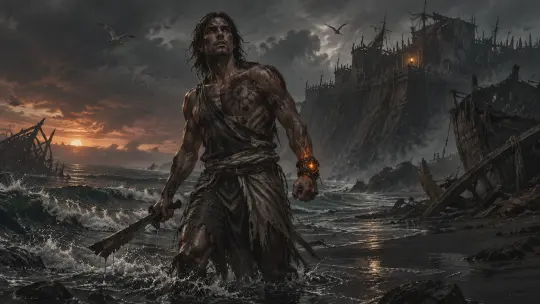
The first test is the world's front door. The brief asks for three planes in one frame — a body in the surf, a beach of black sand, a fortress on the cliff — plus one warm accent at the wrist. It is a composition problem disguised as a mood prompt, which is why it separates models so cleanly.
What worked: the surf breaks around the knee instead of behind it, the blade drips into the frame, the rags have weight, and the fortress stays readable without competing with the face. What to watch: at 2048 wide the model will happily add a second wreck or a third gull — cut those in the prompt if you want a clean silhouette for a crop.
Worked Example 2: Lunaris Temple
The second test is the opposite skill. No weather, no horizon — just a marble hall with too many objects and one emotional centre. This is where prop fidelity matters, because the frame only works if the viewer believes the room is used: instruments laid out, jars filled, drains warm.
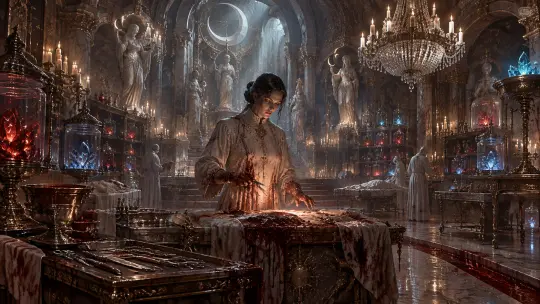
What worked: the model understood that "surgical cathedral" means both church and operating theatre, and rendered the contradiction instead of resolving it. The gem jars read as inventory; the chandeliers read as money; the surgeon reads as the calmest person in the room. What to watch: gold filigree can multiply into noise at small sizes — if the frame is going to be a thumbnail, reduce the ornament clause.
Where GPT Image 2 Breaks
- Typography. It will try to render a title if the brief implies a poster. Keep the negative clause and add type after.
- Extreme stylisation. Flat vector, heavy ink and cel-shading fight its detail bias. Use a different model for those.
- Speed. It is the wrong tool for twenty exploratory thumbnails. Block the composition with Krea 2, finish with GPT Image 2.
- Crowds. More than five or six figures and faces begin to repeat. Keep the crowd as silhouettes.
- Very small props. Below roughly 900 pixels wide, instruments merge into texture. Raise resolution or cut the prop list.
None of these are fatal. They are budget lines. If you plan the frame around what the model reliably does — materials, equipment, staging, costume — the failures stay at the edges of the image instead of in the centre.
GPT Image 2 vs Krea 2 on Identical Briefs
Both Wraeclast prompts were run through both models with no edits. The pattern is consistent across the two scenes: GPT Image 2 builds the room, Krea 2 builds the weather.
| Criterion | GPT Image 2 | Krea 2 |
|---|---|---|
| Exterior scene | Character-first close-up | Landscape-first wide |
| Interior scene | Prop-dense and countable | Light-led and spacious |
| Speed | Slow | Fast |
| Cost | Higher per frame | Low |
| Best use | Final hero, store page, print | Exploration, mood, trailer plates |
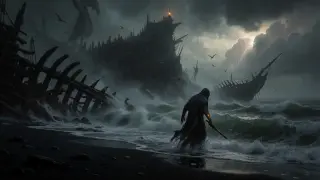
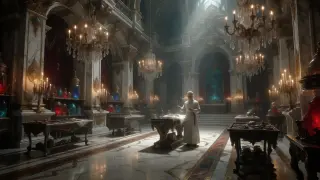
The honest conclusion: GPT Image 2 wins any frame that will be inspected, and loses any frame that has to be produced in five minutes. Publish both when you can, because the comparison is more useful to your audience than a single perfect render.
Prompt Hygiene Checklist
- One place, one witness, one moment.
- Three palette colours and one accent, written as words, not hex codes.
- Two light sources maximum, each with a direction.
- Material nouns instead of adjectives: linen, iron, marble, salt, bile, gemstone.
- Negative clause last, every single time.
- Resolution at least 1536 wide if the frame contains equipment.
From Frame to World
A key visual is not the end of the pipeline; it is the proof that the world is coherent enough to render. Once the four Wraeclast frames existed, the same atoms could generate a playable prologue, a faction poster or a location background without rewriting the brief.
Frame → Store page
Use the GPT Image 2 exterior as the hero and the interior as the second scroll panel. They share a palette, so the page reads as one product.
Frame → Trailer plate
Use the Krea 2 locations as wide plates behind titles, then cut to GPT Image 2 character frames for the beat that needs a face.
Frame → World canon
Publish both models' answers side by side. The pair becomes the visual reference for every later render of that location.
Cost and Iteration Budget
The practical workflow that keeps quality high without burning budget is to spend cheap frames on exploration and expensive frames on conclusions. Krea 2 is fast and inexpensive enough to block ten compositions; GPT Image 2 should be reserved for the two or three that survive.
| Stage | Model | Frames |
|---|---|---|
| Composition block | Krea 2 | 8–12 quick passes |
| Detail pass | GPT Image 2 | 2–3 high-quality frames |
| Comparison publish | Both | The pair, unchanged |
Frequently Asked Questions
- Is GPT Image 2 good at dark fantasy? Yes, when the brief is material and specific. It is weaker at pure stylisation and graphic poster design.
- What size should I use? 2048×1152 for hero frames, 1536×864 for fast drafts. Anything narrower than 1024 loses equipment detail.
- Can I use the same prompt in Krea 2? Yes, but drop the resolution expectation to 1024×576 and expect a mood-first interpretation.
- How do I keep a world consistent? Keep the atom descriptions fixed and vary only the moment. The location's palette and politics should never change between frames.
Build Your Own Dark Fantasy Frame
Take the six-clause recipe, point it at a world with real atoms, and publish the frame that survives the crop.
The Wraeclast world is open: fork it, swap the witness, keep the fortress on the cliff, and see what GPT Image 2 does with a brief that has a history behind it.