GPT Image 2 Dark Fantasy Generator — Tenebrist Key Art From a World, Not a Prompt
A dark fantasy generator built on GPT Image 2 and Krea 2, wired into a world that already holds the cast, the palette and the four rules.
GPT Image 2 is a general image model that becomes a dark fantasy generator when you give it a world instead of a mood. Asked for "dark fantasy art", it gives you a smooth, well-lit painting with a monster in it. Given a place, a cast, a light source and a style contract, it produces something you could use as a location plate or a character key visual — the kind of frame that makes a campaign look like it already exists.
Everything below was generated inside the Goblin Slayer world on Neta Studio: four published works, two prompts, two models (GPT Image 2 and Krea 2), same size, no post-processing. The world supplies the canon and the style contract; the model supplies the decisions. This page is the working manual for that division of labour.
| Quick facts | |
|---|---|
| Tool | GPT Image 2 dark fantasy generator |
| World | Goblin Slayer — 25 atoms, tenebrist painterly style |
| Models compared | GPT Image 2 (detail-first) vs Krea 2 (poster-first) |
| Outputs | 4 published works at 1024×1024 |
| Best at | location plates, character key visuals, scene aftermath |
| Weak at | legible text, symmetrical heraldry, crowd scenes |
| Price band | GPT Image 2 from $0.04/image; Krea 2 $0.01/image |
What GPT Image 2 Does With Dark Fantasy
The model has three habits that matter here. First, it treats a prompt as a scene brief: if you mention wet stone, a torn banner and a body, it will render all three and put them in a believable depth order. Second, it resolves materials — plate armour reads as metal, torchlight reads as fire, and it will happily give you six different kinds of shadow in one frame. Third, it varies composition between runs, so the fourth image is often much better than the first.
The habit that hurts is beautification. Left unconstrained, GPT Image 2 drifts toward a cinematic poster: the armour gets cleaner, the faces get prettier, the mud turns into a texture. In a dark fantasy world that is a canon error, not a taste error. The fix is not "make it grittier" — it is a style contract that names the value structure, the number of colours and the light direction before the subject is mentioned.
Why a World Beats a Prompt
A one-off prompt produces an image. A world produces a set. The difference is that the world already contains the decisions a prompt has to re-litigate every time: who the characters are, what they wear, what the light is like, which colours are allowed, and what the place looks like from three angles. In this case the world holds 7 characters, 5 locations, 5 events, 4 factions and 4 rules, plus a visual style with a named palette.
- Canon the cast, their kit and their relationships — no need to re-describe the helmet every render
- Place frontier town, farm, forest, watchtower, canal city — each with a distinct silhouette
- Style contract tenebrist painterly: one light, large darks, four colours, broken edges
- Register grim, practical, unsentimental — a negative prompt in plain language
- Consistency the same atoms feed every image, so a set looks like one world
The Prompt Skeleton That Survived Four Renders
The structure below is what produced both comparisons. It is deliberately front-loaded: style first, then place, then light, then cast, then the negative list. If you put the subject first, the model commits to a composition before it knows what register it is in.
Style contract → place and time → light source → cast block (silhouette, then clothing, then prop) → aftermath detail → negative list (no text, no watermark, no logo). Keep the total under about 180 words; longer prompts start losing the earliest constraints, and the earliest constraint is the style.
The literal style sentence used for all four works: "Dark tonal digital painting in a tenebrist painterly style: large dark shapes, broken ink-like edges, thick-thin brushwork, a single restrained light direction, compressed dark values with deep indigo, blood red, jade green and bone white." That sentence is doing the job a shader would do in an engine. It is the most important line in the prompt and it should never move.
The World Prompt, Verbatim
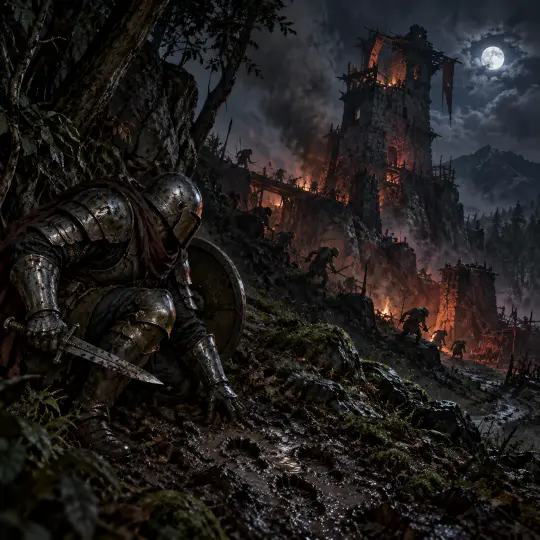
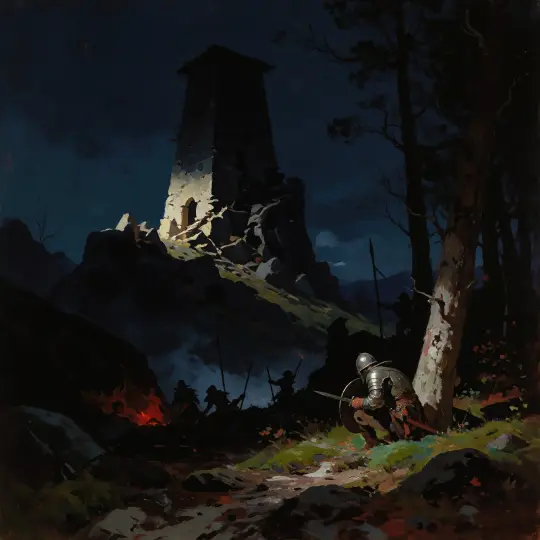
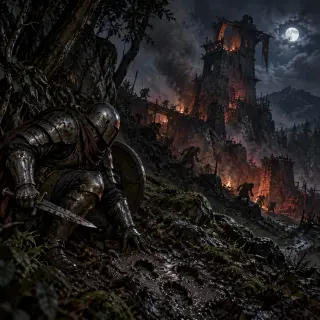
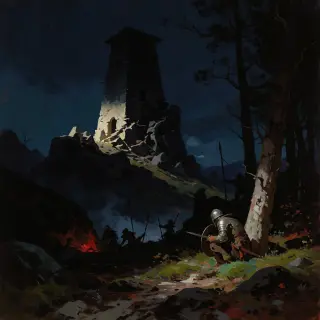
Dark tonal digital painting in a tenebrist painterly style: large dark shapes, broken ink-like edges, thick-thin brushwork, a single restrained light direction, compressed dark values with deep indigo, blood red, jade green and bone white. A frontier watchtower at night, half collapsed into a hillside, its stone throat lit from below by goblin cookfires and smoke; in the foreground a silver-ranked adventurer in battered plate and a sealed round helmet, crouched at the treeline with a short sword and small round shield, reading tracks in the mud; crude goblin spears and small silhouettes moving between the rocks behind him; wet moss, mud, cold moonlight, one red ember glow; muddy boots and counted bodies, no heroism, cinematic wide composition, epic dark-fantasy frontier scale, no text, no watermark, no logo.
Two things carry this frame. The first is the phrase "lit from below by goblin cookfires" — it gives the tower an internal light source, which stops the building from becoming a black shape. The second is "reading tracks in the mud", which gives the foreground figure an action instead of a pose. Remove either and the image collapses into a dark landscape.
What Came Back: GPT Image 2 vs Krea 2
The same prompt, the same 1024×1024 canvas, two models. This is the comparison that makes the tool useful: not which image is better, but which decisions each model makes when the prompt runs out of instructions.
| What each model decides | ||
|---|---|---|
| Composition | GPT Image 2: layered depth with a clear foreground, midground and background. Krea 2: a single diagonal and a large negative sky. | |
| Cast | GPT Image 2: renders the goblins as small, specific figures. Krea 2: reduces them to spear silhouettes. | |
| Light | GPT Image 2: multiple sources, each justified by a prop. Krea 2: two sources — the moon and the fire — and no apology. | |
| Material | GPT Image 2: wet plate, mud, moss, smoke. Krea 2: flat planes of colour with painterly edges. | |
| Failure mode | GPT Image 2: over-renders detail until the dark loses weight. Krea 2: drops required props to keep the silhouette. | |
| Best use | Location plate, scene art, anything with a cast. Krea 2 for covers, posters and thumbnails. | |
| Cost | From $0.04 per image at 1024. | $0.01 per image at 1024. |
The Character Prompt, Verbatim
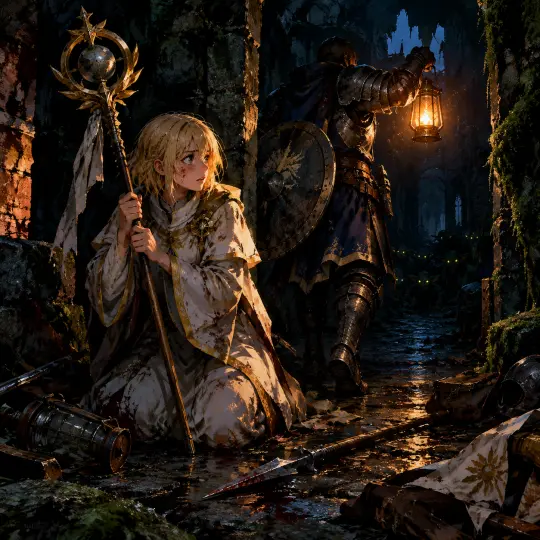
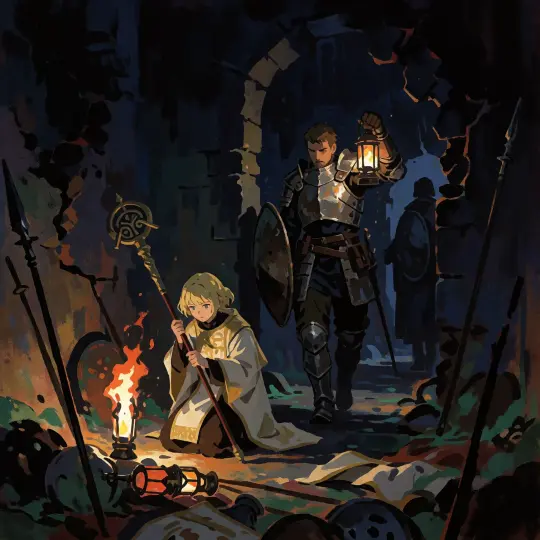
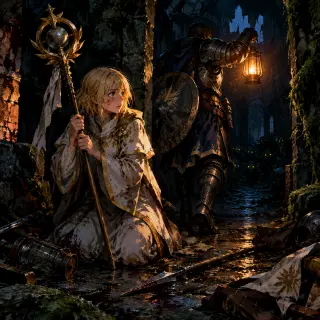
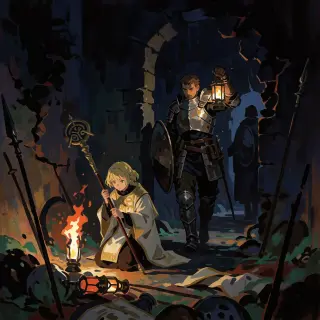
Dark tonal digital painting in a tenebrist painterly style: large dark shapes, broken ink-like edges, thick-thin brushwork, a single restrained light direction, compressed dark values with deep indigo, blood red, jade green and bone white. Inside the ruined watchtower after an ambush: a fifteen-year-old priestess with short blonde hair in white and gold vestments, kneeling in torchlight and clutching a staff crowned with the Earth Mother's symbol, her face streaked with fear and resolve; broken spears, scattered novice gear and a fallen lantern around her; a tall armored adventurer in battered plate steps past her into the dark corridor holding a raised lantern, his round shield forward; goblin eyes glinting beyond the firelight, wet stone, jade-green moss; tense, intimate, cinematic vertical character poster, no text, no watermark, no logo.
Character briefs are harder than location briefs because they ask for a relationship, not just a subject. This one asks for three things at once: a survivor on the floor, a specialist walking past her, and the aftermath that connects them. GPT Image 2 renders all three. Krea 2 renders the arch, the torch and the girl, and lets the second figure become a shape — which is not a failure, it is a different poster.
Sizes, Quality and Cost
| Use | Size | Notes |
|---|---|---|
| World key visual | 1024×1024 or 1536×1024 | Keep the sky empty; the tower needs negative space |
| Character key visual | 1024×1024 | One prop, one light, one relationship |
| Poster / cover | 1024×1536 | Leave the top third quiet for a title you will add later |
| Comparison pair | 1024×1024 | Same size on both models, or the comparison is not fair |
Post-Check: Eight Failures to Look For
A dark image is easy to like and hard to read. Check every render against this list before you publish it — all eight have appeared in real generations from this world.
- The darks swallow the subject — add one warm source inside the frame and ask for separated value planes.
- The armour looks clean — name the damage: dented pauldron, torn strap, mud to the knee.
- The face is too pretty — say "weathered, unidealised, visible exhaustion" and remove beauty words.
- Two light sources disagree — pick the fire or the moon, and move the other one out of frame.
- The goblins read as generic orcs — specify small, wiry, mismatched kit, crude spears, no uniforms.
- The tower has no scale — put a figure, a ladder or a bird in the frame and say how big it is.
- Text appears in the image — add "no text, no runes, no banners with writing" to the negative list.
- The set does not match — re-issue the style contract at the start and generate the missing frame again.
From Image to World Asset
The point of generating inside a world is that the output is not a file, it is an atom. Each of the four works is linked to this world, shareable by URL, and reusable as a reference for the next generation. That is the loop that makes a set look coherent after ten images instead of three.
Pick the atom
A location, a character or an event. One atom per image; two atoms per image is how sets drift.
Write from canon
Use the atom’s description, not your memory of the source. The world is the brief.
Generate the pair
Run GPT Image 2 for the scene and Krea 2 for the poster. Keep both; publish the comparison.
Check the eight
Run the post-check list. Regenerate rather than retouch — the style contract is easier to fix than a face.
Publish and link
Attach the image to the world so the next prompt inherits it as a reference.
Prompt Library
Five reusable briefs for this world. Each one is a style contract plus a place plus a light plus a cast block — the same skeleton, different subject. Copy them and change one clause at a time.
FAQ
Generate dark fantasy from a world
Open the Goblin Slayer world, pick an atom, and run the prompt skeleton. The style contract is already loaded — generate GPT Image 2 for the scene and Krea 2 for the cover.
GPT Image 2 + Krea 2, one world
Four published works, two models, one style contract — the exact prompts are on this page.