
GPT Image 2 Death Stranding Key Visual Generator — Timefall, Cargo and the Beach
A GPT Image 2 workflow for Death Stranding key visuals: drowned highways, walled Knot Cities and black shores rendered with real weather, real load and real distance. Built and proven on the Death Stranding world with four published works.
Generate a Death Stranding Key Visual
One brief, two models, four published frames: a hooded porter above a drowned highway and a black shore where the sea has returned everything.
What Is the GPT Image 2 Death Stranding Key Visual Generator?
This is a working recipe for GPT Image 2, not a wrapper with a logo on it. It turns a world brief into a poster for a post-Stranding story: a country rebuilt one knot at a time, a rain that ages whatever it touches, a courier carrying a tower of cargo across a road that is now a river. The output is a single frame that can open a world page, a store card or a share link — and still read after it has been cropped.
What It Generates
The generator is tuned for five operations that cover most of the genre. Each one is a verb rather than a mood, which is why a single model can render all of them without a style change. Because the operations are concrete, they survive translation into an image: a prompt that asks for a carried load produces a load; a prompt that asks for dread produces grey fog.
Carry a tower of cargo across a ridge above a drowned road. Connect a terminal at the far end of a walled city. Surface the dead where the living gather, and let the tar show it. Strand two figures on a beach at a distance no living person should reach. Frame one small courier against a very large institution, because scale is the whole argument.
Why GPT Image 2 for Post-Stranding America
Death Stranding is a material problem disguised as a metaphysical one. The ridge only works if the rock looks wet. The cargo only works if the straps look tight. The pod only works if it looks like a device with a heartbeat. The Beach only works if the sand looks like wet ash and the bone looks like it has been in the sea. GPT Image 2 is unusually good at this kind of physical continuity: it keeps objects identical across an impossible event, and it understands that a place is a set of surfaces before it is a mood.
It also handles the overcast film-still look without turning it into a filter. Ask for 85mm, shallow depth of field, fine grain and flat cold light and it produces something that looks photographed, not something that looks like a video game screenshot with a grey overlay. That distinction is the difference between a Death Stranding key visual and a generic apocalypse.
Model Settings That Matter
Only three settings change the outcome for this genre: size, quality and format. Size decides whether the composition is a poster or a social card. Quality decides whether the fine architecture survives a crop. Format decides whether the file drops into a page without conversion. Iterate at low quality and only spend high quality on the frame that has already proved its composition.
size 1536x1024 for a landscape poster, 1024x1536 for a vertical share card, 1024x1024 for a gallery tile. quality high for hero frames that will be inspected, medium for iteration. format PNG for archival frames, WebP for page assets. rule do not upscale a weak composition; a courier either reads at thumbnail size or the frame is decoration.
The Prompt Formula
Every frame in this world uses the same six clauses in the same order. Change the nouns; keep the structure. That is what makes a series look like a series instead of six unrelated images, and it is what makes a model comparison meaningful.
Medium and genre
Cinematic film still, psychological science-fiction drama, 85mm lens, shallow depth of field, fine film grain — locks rendering before content.
Place
A real piece of infrastructure: a drowned elevated highway, a walled Knot City on a crater rim, a black volcanic shore.
Subject
One person, one load, one posture. A hooded porter with a cargo tower and a pod; a figure in a dark coat at the water's edge.
Operation
Exactly one broken law: the highway is now a river, the dead surface where the living gather, the city is a wall with a heart.
Physics and light
Timefall streaking the air, grass ageing where drops land, sodium terminal lamps, floodlights hazed by fog, a thin seam of horizon light.
Negative clause
No readable text, no watermarks, no logos, no clean post-apocalypse styling — the clause that keeps the frame in this world.
Example 1: The Ridge
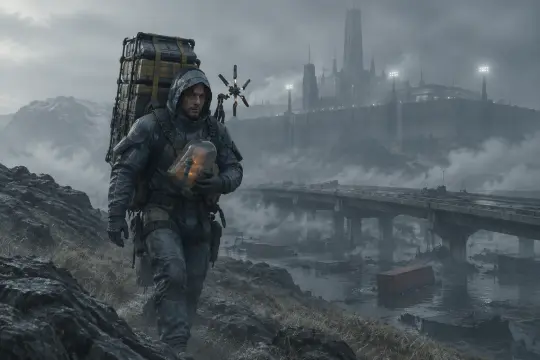
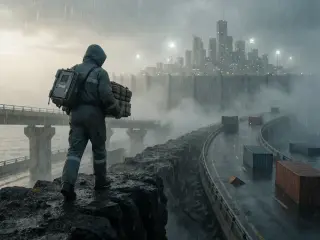
The ridge is the easiest establishing shot in the world and the hardest one to keep from looking like stock apocalypse. The fix is specificity: name the load, the road, the city, the weather and the porter's posture. A road is a direction; a city is a destination; a scanner is a reminder that the country is still being mapped. Put all three in one frame and the image has politics without a caption.
Prompt. Cinematic film still, psychological science-fiction drama, 85mm lens, shallow depth of field, fine film grain, desaturated palette, unretouched skin. A lone porter in a weathered blue-grey Bridges uniform, hood up, a folded mechanical odradek scanner on his shoulder, walks a narrow ridge of black rock above a drowned highway, carrying a tower of strapped cargo and a bridge baby pod against his chest; behind him a walled Knot City rises out of fog, floodlights hazy, a ruined overpass and shipping containers half-sunk in black tar; timefall rain streaks the air, grass ageing to grey where the drops land, cold flat overcast side light from the left, no fill, hard shadow, joyless grey and teal tones, epic scale, no readable text, no watermarks, no logos.
Example 2: The Beach
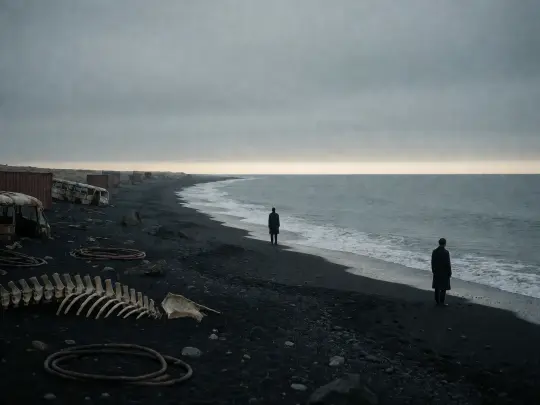
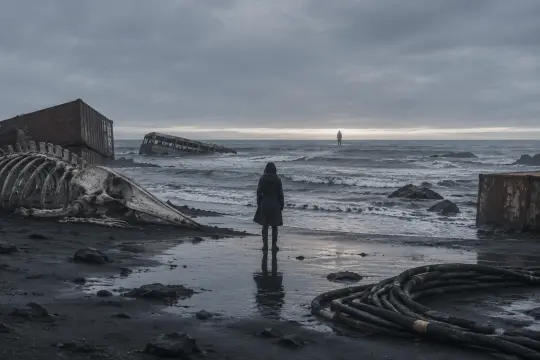
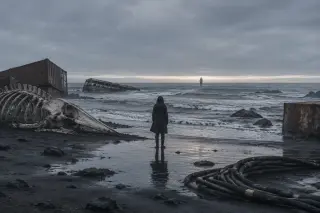
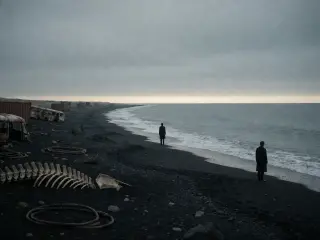
The Beach tests space. A shoreline is a container built around one direction; remove that direction and the human figure becomes the only stable object. The prompt must specify contact — feet on wet sand, coat hanging heavy, a second figure at a distance no living person should reach — or the model produces a couple on a holiday beach, which belongs to a different franchise. The shore should look littered by the sea, not decorated by a set designer.
Prompt. Cinematic film still, psychological science-fiction drama, 85mm lens, shallow depth of field, fine film grain, desaturated palette. A vast black volcanic beach under a flat pewter sky, a lone figure in a dark coat stands at the water's edge, very small against an ocean of slate-grey tar; the shoreline is littered with beached things — a whale skeleton, rusted cargo containers, a drowned bus, coils of umbilical cable — and far out a second figure stands perfectly still, facing away; a thin seam of pale light along the horizon, cold overcast light, wet reflective sand, oppressive stillness, muted charcoal and bone palette, no readable text, no watermarks, no logos.
GPT Image 2 vs Krea 2
The same two briefs were also run through Krea 2. The difference is consistent across both scenes. GPT Image 2 gives you a document: correct street furniture, plausible reflections, dust that behaves like matter, fabric with weight, water that sits in the right places. Krea 2 gives you a poster: a wider gesture, cleaner silhouettes, fewer values, and a composition that survives a very small crop.
Use the comparison as a decision tool rather than a scoreboard. If the frame will be inspected — a world page, a reference sheet, a store card with a zoom — GPT Image 2 is doing more work per pixel. If the frame will be seen for half a second in a feed, Krea 2 is doing more work per glance.
What GPT Image 2 Gets Right
Three strengths matter for this genre. First, physical continuity: an object keeps its identity across an impossible event. Second, perspective agreement: the highway converges correctly, so the walled city feels like it is at the end of the road rather than pasted behind it. Third, restrained rendering: the overcast look stays photographic without becoming a filter, and the rain stays an accent rather than a fog.
Where it needs help: it will sometimes add a second impossible operation if the prompt implies one, and it can soften very fine architectural detail in small crops. Both are prompt problems, not model problems — the first is solved by naming one verb, the second by generating at the final ratio and inspecting the thumbnail before you commit.
Lighting the World
Death Stranding has one dominant light and one dominant time of day: flat cold overcast, from the side, with no fill. Everything else is practical light — terminal lamps, floodlights, a pod glow, a beacon, a burning horizon. That combination is what makes the world feel municipal and abandoned at once: the sun is gone, but the infrastructure is still on.
- Overcast side lightOne soft source from the left, hard shadow on the right, no fill. It makes skin and rock read as the same material and keeps the palette desaturated.
- Practical lampsSodium-orange terminal lamps, white floodlights, a blue scanner, a warm pod glow. These are the only saturated colours in the frame, which is why they guide the eye.
- TimefallRain is a physical event: it streaks the air, beads on fabric, pools on the road and ages grass to grey where it lands. Never render it as a screen-space overlay.
- Horizon lightOn the Beach, a thin seam of pale light along the horizon is the only bright element. Keep it low and narrow; a bright sky turns dread into a sunset.
Composition Rules for Couriers
The genre is built on one compositional idea: a person with a load against a country that does not care. Every rule below serves that idea, and every one of them can be verified at thumbnail size.
Load above the horizon. The cargo tower should break the skyline so the viewer sees the weight. City behind, never beside. The destination should be further down the road, not next to the courier. One warm light. The pod, the terminal or the beacon — pick one and let it be the only saturated colour. Wet ground. Reflections tell the viewer the world is physical. No eye contact. Back three-quarters or full back; a clear face turns the frame into a portrait.
Render and Publish Workflow
Open the world studio, copy the atom you want to visualise, write the six-clause brief and generate. Publish each frame as a work of the world with its prompt and model recorded. The four frames on this page are published works with live share links, which means the comparison can be inspected by anyone who opens the world — not just by the person who ran the generation.
Copy the atom
Open the drowned highway or the Beach in the world and copy its nouns into the place clause.
Write the brief
Medium, place, subject, operation, physics and light, negative. Keep every clause concrete.
Render both models
Run the identical brief through GPT Image 2 and Krea 2 at the final ratio. Do not rewrite the prompt between models.
Publish the work
Attach prompt and model, publish both frames to the world, and let the share links carry the comparison.
Why Publish to the World
A key visual that lives only in a downloads folder is a dead end. Published as a work, it inherits the world's atoms, appears in the world gallery, and becomes available for remixing. It also makes the prompt auditable: anyone can see which model, which brief and which scene produced the frame, which is the only honest way to compare two models.
The four works here are not a portfolio. They are evidence. Each one names a location, a model and a clause, and each one can be forked into a different story about the same country.
Prompt Library: Three Openers
If you are starting cold, these three openers map onto three different jobs. Each one is a full first sentence, so you can paste it into the generator and then add a location and a negative clause.
Explore the World
Start with the wide shot. It defines the palette, the weather and the social logic that every later frame will inherit. For this world, the easiest first frame is the ridge above the drowned highway; the most useful second frame is the Beach at body level. Publish both, then decide which one belongs on the page — and keep the other as the argument for why.
Create Your Own Frame
Four published frames, two models, one world — the next one is yours.