
GPT Image 2 Dishonored Character Generator
A documented GPT Image 2 workflow for Dishonored-style character key visuals: the six-clause prompt, the real settings, the failure modes, the cost per usable frame, and four published renders from a GPT Image 2 vs Krea 2 comparison on identical briefs.
Render a Dishonored Character in One Pass
Paste the six-clause brief, choose a vertical frame, and GPT Image 2 returns a character key visual with materials, props and light already resolved — then send the same sentence to Krea 2 for the poster version.
GPT Image 2 as a Dishonored Character Generator
This is a documented workflow, not a demo. Every number below comes from the actual runs that produced the four works on this page: one 1024×1536 character frame and one 1536×1024 location frame on GPT Image 2, each repeated unchanged on Krea 2.
The short version: write the brief as a camera instruction, not a synopsis. Name the costume and props, name the room, name the two lights, name the style engine, and close with the same negative clause every time. GPT Image 2 will do the rest — including details you did not ask for and cannot use.
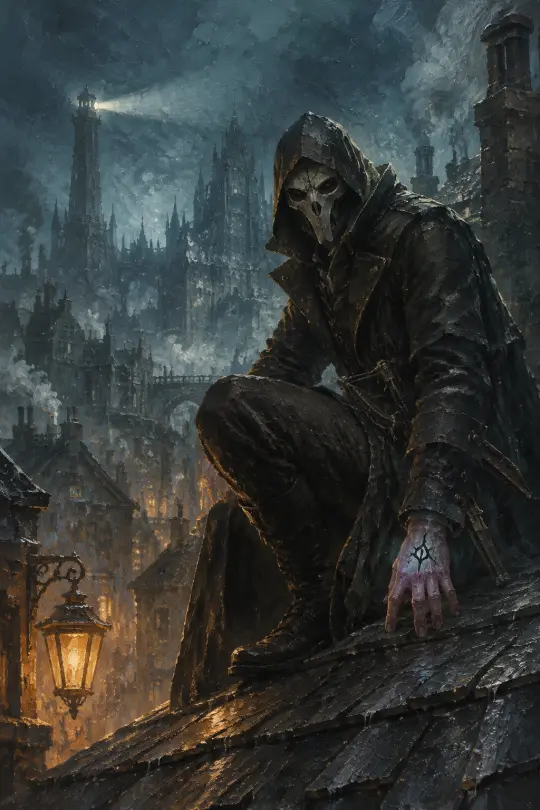
The target look is impasto oil painting: broad opaque strokes, broken palette-knife edges, warm-cool value planes and detail only where it identifies the subject. That style is not decoration. It is a constraint that keeps a soot-and-teal palette from collapsing into mud.
Why GPT Image 2 for This World
GPT Image 2 is strongest where this world is hardest: material truth. Wet slate, brass fittings, bone carving, wool coats and plague fog all need to read as different substances in the same frame. The model's detail bias is an asset here, and its known weakness — fine texture creeping into non-photoreal styles — is neutralised by asking for visible impasto.
It also accepts reference images. For a world with a fixed cast, that means you can feed back an approved frame and keep a face, a coat or a mask consistent across a set. Krea 2 is text-only, so it cannot do that; it is the ideation and poster model, not the continuity model.
The Six-Clause Brief
Every successful frame in this world used the same six clauses. The order matters: the model weights early tokens more heavily, and the costume must arrive before the light.
- Subject and role. “Corvo Attano, Royal Protector of Dunwall” — a name and a job, not a mood.
- Costume and props. High-collared coat, deep hood, carved bone-white mask with dark eye slits, folding crossbow, mark on the left hand.
- Place. A rain-slick slate rooftop high above the city, wet chimneys and crooked spires behind.
- Light. Cold teal backlight, warm amber whale-oil lamp below, volumetric mist.
- Style engine. Thick impasto oil painting, broad brushstrokes, palette-knife broken edges, layered opaque masses, warm-cool planes.
- Negative clause. No text, no letters, no signage, no watermark, no logo, no UI, no HUD.
A Worked Example: Corvo on the Rooftop
The character brief produced a frame in which the mask reads as carved bone rather than plastic, the lantern has soot on the glass, and the mark on the hand is legible without being a glowing logo. Those are all consequences of clause two and clause four, not of a lucky seed.
Note what the brief does not contain: no plot, no mention of the Empress, no instruction to look sad. The emotion is carried by the pose, the hood and the single warm lamp below him. If you write the feeling, the model draws a feeling; if you write the scene, the model draws a scene that produces the feeling.
Settings That Worked
Model
gpt-image-2. The 2.5 variants are faster or higher-fidelity, but this run used the documented base model so the comparison stays honest.
Size
1024×1536 for the character poster, 1536×1024 for the location. Vertical for people, horizontal for architecture.
Quality
high. The difference is in edges and small props, which is exactly what this style needs.
Prompt length
around 150 words. Long enough for six clauses, short enough that the negative clause is still in context.
Repetitions
one per model per brief. No seed hunting; the comparison is between models, not between lucky draws.
The Comparison Frame
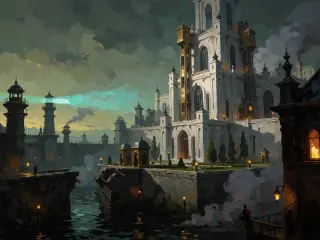
The second image on this page is Krea 2 on the identical sentence. It is faster, cheaper and better at silhouette, and it will not hold a costume detail to save its life. Use it to find the shape, then use GPT Image 2 to build the object.
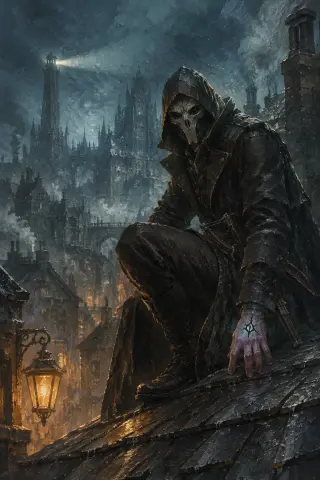
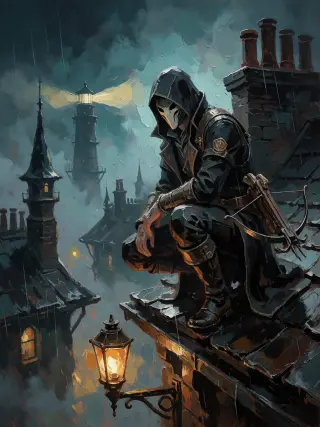
Read them side by side and the division of labour is obvious. GPT Image 2 gives you a reference sheet. Krea 2 gives you a poster. A world needs both, and the same brief produces both for about a cent and a half.
A Worked Example: Dunwall Tower
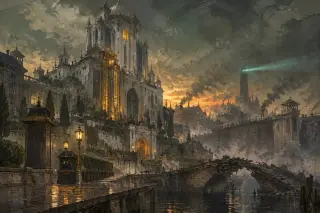
The location brief uses the same six clauses with the subject swapped for architecture. It adds one clause that matters: a scale object. Tiny lanterns along the quay and a human-sized figure on the bridge are what tell the viewer the tower is enormous.
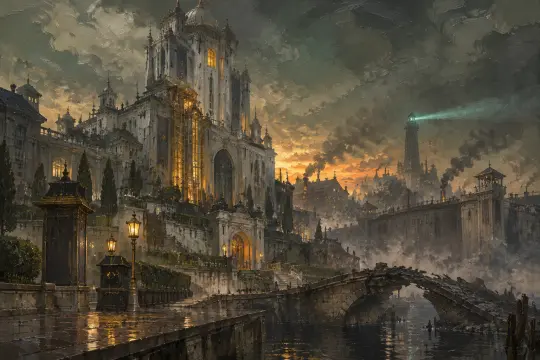
The result is a place that can hold an argument. There is a door someone could be thrown out of, a wall someone could be sealed behind, and a lit window that means someone is still pretending the empire works.
Documented Settings and Cost
| Run | Model | Size | Billed |
|---|---|---|---|
| Corvo, rooftop | GPT Image 2 | 1024×1536 | $0.034 |
| Dunwall Tower | GPT Image 2 | 1536×1024 | $0.034 |
| Corvo, rooftop | Krea 2 | 768×1024 → 1536×2048 | $0.010 |
| Dunwall Tower | Krea 2 | 1024×768 → 2048×1536 | $0.010 |
Failure Modes and Fixes
- Muddy darks. A photoreal render turns soot and teal into one brown mass. Fix: name impasto, broken local colour and visible strokes, and reduce the palette to five values.
- Plastic mask. “Mask” alone gets you a smooth prop. Fix: “carved bone-white mask with dark eye slits and visible grain”.
- Logo-like rune. The Outsider mark becomes a glowing brand. Fix: “faintly glowing, embedded in the skin, no design language”.
- Accidental signage. Street scenes invite invented shop signs. Fix: keep the negative clause last and explicit, every time.
- Flat poster. Detail bias can crowd the frame. Fix: one warm object, one cold key, generous negative space on one third.
Prompting the Cast, Not Just the Hero
The same six clauses work for every character in the world. Swap costume, props and place, keep the light and style clauses identical, and the eight characters will look like they were painted by the same hand on the same day.
Where It Still Fails
Hands remain the weak point, especially a hand that has to hold a crossbow and show a mark at the same time. Complex mask-plus-hood silhouettes can merge into a blob at small sizes. Architecture with many repeated windows can develop a wallpaper rhythm. The honest summary: GPT Image 2 is a superb materials engine and a mediocre art director — give it a described scene and it will execute, give it a mood and it will decorate.
Reusable Patterns
Costume before light
Name what the character wears and carries before you describe the lamp. The model weights early tokens and will spend them on the coat.
One warm object
A lamp, a window or a lantern. A single amber note in a teal frame is the whole Dishonored palette in one rule.
Negative clause last
The final sentence of every brief is the same. It is the cheapest quality control in the workflow.
Questions About the Tool
Do I need a reference image? +
No. Both frames here were text-only. Add a reference when you need continuity across a set — a face, a coat, a mask.
Why not use gpt-image-2.5? +
Use it if you want speed or higher resolution. This page documents gpt-image-2 because that is the model that produced the published works, and the comparison had to be honest.
Can I sell what I generate? +
Check your plan and the model terms. This page documents the workflow, not a licence. For fan work, keep it clearly non-commercial and non-official.
Render Your Own Dishonored Character
Take the six clauses, change two nouns and render a frame that belongs in the same set. Then send the same sentence to a second model and see what it is for.