
GPT Image 2 Snake Game Key Visual Generator — Pixel-Art Arcade Posters
GPT Image 2 is the detail-first model for arcade key visuals: scale rows, chrome, fruit, crowds and architecture that survive a crop. This page documents its real settings and the exact prompts behind four published works from The Serpent Circuit.
Generate a Snake-Game Key Visual with GPT Image 2
One sentence, six clauses, one frame. Start from the GPT Image 2 snake game key visual generator and build a poster that survives the crop.
What This Tool Page Covers
This is a working page for GPT Image 2 as a snake-game key visual generator. It covers the model's real settings, the six-clause prompt recipe, two worked examples from a published world, the places where the model breaks, and an honest comparison against Krea 2 on identical briefs. Every image on this page is a published work from The Serpent Circuit world, not a demo render.
- Model: GPT Image 2, text-to-image with optional reference images.
- Best at: pixel-scale detail, costume and ornament continuity, readable props, long spatial briefs.
- Weak at: extreme minimalism, fast iteration, any frame that needs a single graphic silhouette.
- Use it when: the frame will be inspected, cropped or printed at full bleed.
Why GPT Image 2 for Snake-Game Key Visuals
GPT Image 2 is not the fastest image model and it is not the cheapest. It is, however, unusually good at following a long spatial brief. That is the core skill of a snake-game key visual: placing a serpent, a lattice, a railing, a monolith and three pieces of fruit in one frame at the correct relative scale, with the light coming from the right place. The model treats the prompt like a layout instruction, not a vibe.
The trade-off is speed. A high-quality render takes time, and the model can over-texture a pixel-art surface if the medium clause is vague. The fix is not a shorter prompt. It is a more specific first clause — "1990s arcade fighting-game sprite illustration" — and a stricter negative clause: no text, no lettering, no watermark, no UI.
The Model at a Glance
These are the settings that matter for poster work. Everything else is secondary. The goal is not to use every parameter; it is to remove the variables that cause a frame to fail after you have already paid for it.
| Model | gpt-image-2 |
| Input | Text, plus optional reference images |
| Best aspect | 16:9 for location frames, 4:5 or 2:3 for character posters |
| Working styles | 1990s arcade sprite, pixel-art key visual, semi-realistic painterly |
| Strength | Long spatial briefs with many named objects |
| Weakness | Lettering on signage; over-texture when the medium clause is soft |
| Cost | Metered per generation; a high-quality poster is a few cents |
Size, Quality and Format Settings That Matter
Snake-game key visuals are wide by default, but the published crop is rarely the rendered crop. Render wider than you need, then crop to the platforms you actually use. The working set for this world: 16:9 for the hero, 4:5 for social, 1:1 for thumbnails. A character poster can start at 2:3 so the tail has room to curl.
| 1536×864 | 16:9 hero, high quality — used for the Coil Well location frame |
| 1024×1536 | 2:3 character poster — used for the Vess champion frame |
| 1024×1024 | 1:1 thumbnail and social crop |
| Quality | High for anything that will be inspected; medium only for thumbnails |
| Format | PNG for the master, WebP for the published card |
The Prompt Recipe: Six Clauses
The recipe is the same one used to produce both published GPT Image 2 frames in this world. It is intentionally boring. Boring prompts are repeatable, and repeatable prompts are the only way to compare models fairly.
Medium and genre
1990s arcade fighting-game sprite illustration, character or location key visual. Lock the rendering system first.
Scale object
One enormous thing: a forty-by-forty lattice, a spiral pit, four white walls. Not a lattice, a pit and a city.
Subject
One serpent, named by role, costume and posture — champion, heretic, herald — not by emotion.
Physics and ornament
Scale rows, a knotted tail, a chipped crown-plate, three fruit. Specific props keep the frame honest.
Light and palette
Name the hour and the two light sources: cold lattice glow, white wall rim, warm amber key.
Negative clause
No text, no lettering, no watermark, no logo, no UI. Repeat it every time; models forget.
Worked Example 1 — Vess of the Long Line
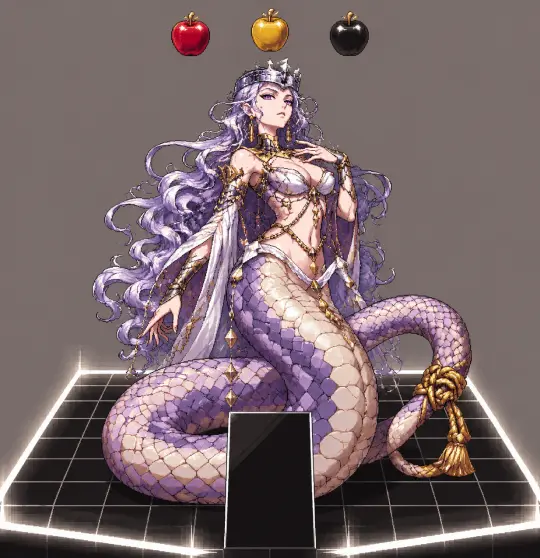
The first brief is the emotional centre of the world: the reigning champion, forty-seven segments long, coiled in a slow deliberate diagonal on the Grid while three trophy fruits hang above her. The prompt names the crown, the knotted tail, the colours of the fruit and the blank monolith, then closes with the negative clause. GPT Image 2 renders the jewellery and scale rows as readable detail rather than noise, which is the thing that makes the frame feel like a character poster and not a screenshot.
Prompt. 1990s arcade fighting-game sprite illustration, character key visual, vertical composition: Vess of the Long Line, reigning champion of the Serpent Circuit, a forty-seven-segment serpent of pale violet and bone-white scales coiled in a slow deliberate diagonal across a black forty-by-forty lattice arena; her tail knotted at the tip with a braided gold cord; a chipped chrome crown-plate above her brow; three glowing fruit — one crimson, one gold, one black — hovering in a neat row behind her like trophies; a blank monolith of black glass rises at the south end, its face dark and completely unlettered; four walls of white light at the arena’s edge; crisp colored pixel clusters, three-tone scale shading, selective dark outlines, tall readable silhouette, plain warm gray background band, no smooth painting, no text, no lettering, no watermark.
Worked Example 2 — The Coil Well
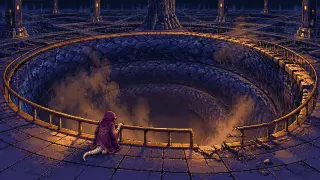
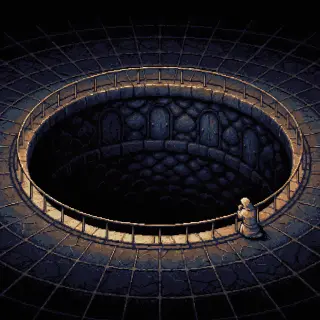
The second brief moves the camera out to the world's darkest room and changes the job: instead of a character, the frame has to carry an entire sacred site. The prompt stacks the pit in readable layers — black throat, banded walls, brass railing, lattice floor — and lets one small hooded pilgrim establish the scale. GPT Image 2 keeps the layers distinct, which is why the frame still works when it is cropped to a vertical.
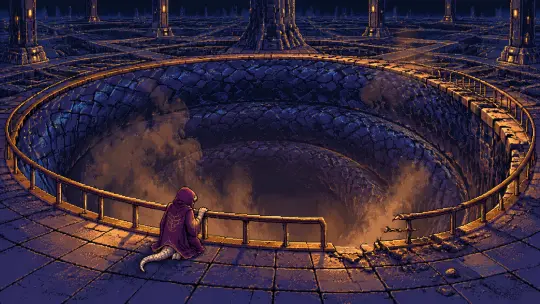
Prompt. 1990s arcade fighting-game sprite illustration, location key visual, wide horizontal composition: The Coil Well at the center of the Serpent Circuit, a spiral pit descending further than the cabinet should allow, its inner walls built from the enormous banded body of Coil-Mother Sable — dark indigo scales the size of doors, faintly rippling; a thin brass railing circles the rim, bent where the Uncoiled sawed through it; warm air and pale dust rise from the black throat of the well, smelling of rain and old electricity; the faint lattice of the Grid stretches away on all sides; a small serpent pilgrim in a hooded robe kneels at the railing, tiny against the pit; crisp colored pixel clusters, three-tone shading, selective dark outlines, moody arcade palette of deep blue-black with warm amber rim light, no smooth painting, no text, no watermark.
GPT Image 2 vs Krea 2 on the Same Brief
The comparison is only useful if the brief is identical. Both models received the same text, no references, the same world atoms. GPT Image 2 produced the detail-first frames; Krea 2 produced the atmosphere-first frames. The difference is not quality. It is where each model spends its attention.
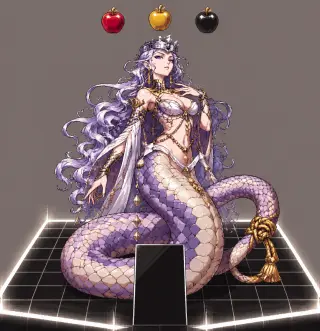
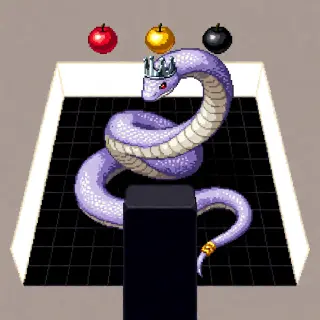
At thumbnail size, Krea 2 often wins: one shape, one board, three dots of colour. At full bleed, GPT Image 2 wins: the frame rewards inspection, and the story is in the small props. If you need one asset for both, render GPT Image 2 for the hero and Krea 2 for the social card.
Where GPT Image 2 Breaks
The failures are predictable, which is good news. GPT Image 2 over-renders painterly texture when the medium clause is vague; it adds pseudo-text when a frame contains signage; and it can produce a tail that looks like a decorative ribbon if the physics clause does not establish weight and contact. All three are fixable in the prompt.
- Over-texture: add "crisp colored pixel clusters, three-tone shading, no smooth painting".
- Pseudo-text: add "no text, no signage, no watermark, no logo" and avoid shop fronts and scoreboards with lettering.
- Ribbon tail: specify "thick segmented body, visible weight, contact shadow on the lattice".
- Melting ornaments: name garments and materials, not just colours — chrome, brass, braided cord.
- Flat foreground: demand "wet stone reflection, dust in the light, a hard rim on the railing".
A Repeatable Production Loop
Treat the model as one step in a loop, not a slot machine. The loop below is what produced the four published works in this world, and it is short enough to run without a project manager.
Pick four atoms
One character, one location, one event, one rule. That is enough for a key visual.
Write the six clauses
Keep the order. Change one clause at a time when iterating.
Render wide
16:9 at 1536×864 or larger, high quality. Do not render the final crop.
Compare models
Run the same text through Krea 2. Keep both; publish the one that survives your real crop.
Publish with provenance
Attach the prompt, the model and the world. A captioned work is reusable; an orphan image is not.
Publishing and Reuse
A published work is more than a file. It carries the world it came from, the atoms it used, the prompt that produced it and the model that rendered it. That is what makes it useful to other people: they can fork the world, change one atom, and generate a related frame without starting from zero. The four works on this page are published exactly that way, and every image URL is a real asset from this world.
Build Your Own Snake-Game Poster
Take the six-clause recipe, point it at a world with real atoms, and publish the frame that survives the crop.
GPT Image 2 settings, prompt recipe and four real published works from this world.