
GPT Image 2 Subnautica Key Visual Generator — Underwater Sci-Fi Frames From a Prompt
A working generator for Subnautica-style underwater key visuals: planet-scale establishing shots, leviathan encounters, biome frames and event art, with the prompt structure and a Krea 2 comparison built in.
GPT Image 2 Subnautica Key Visual Generator
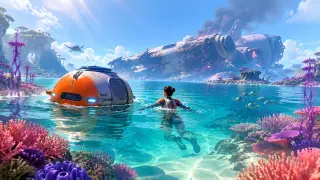
This is a generator page for a specific job: making Subnautica-style underwater science-fiction key visuals that read as places rather than wallpaper. It covers the establishing shot, the leviathan encounter, the biome frame and the event art, using four published frames from the Subnautica: 4546B world as the reference set.
The style target is stylized semi-real 3D game art: clear CG volume, non-photographic materials, vibrant teal and cyan water, volumetric god rays, bioluminescent bloom, coral pinks against deep ocean blue, cinematic haze and caustics. GPT Image 2 is unusually good at the physical logic of that look — surface light, material weight, scale — which is why it is the finishing model in this workflow.
Underwater images fail in a specific way: they are beautiful everywhere and specific nowhere. This generator exists to force specificity — a layer, a body, a fact, a scale.
What This Generator Makes
Four output types cover almost every key visual an ocean world needs. Each has its own composition logic, and mixing them up is the most common reason a set feels incoherent.
World key visual
One frame that states the whole premise: the habitat, the wreck, the horizon and the survivor at the correct scale. Shoot at the surface layer so the audience understands what is at stake.
Event key visual
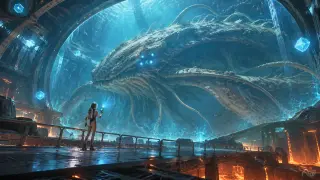
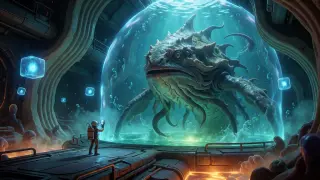
The story's turning point: a creature, a machine, a rescue, a betrayal. One witness, one light source, one fact. This is where GPT Image 2's depth rendering earns its cost.
Biome establishing shot
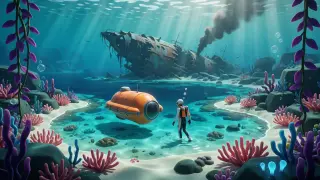
The map in miniature: a place with a route and a reason to hesitate. No protagonist required; the environment is the character.
Creature encounter
Scale and threat in the same frame. The creature should leave the frame; the witness should be small, low and lit.
Why GPT Image 2 for Underwater Science Fiction
Water is a material problem before it is a mood problem. It has to refract, absorb, scatter and carry particles at different densities, and it has to do all of that while remaining readable. GPT Image 2 handles the physics well: caustics land on surfaces with the right softness, distant objects lose contrast at a believable rate, and metal reads as metal even when it is wet.
It is also good at the thing underwater art usually gets wrong: air. The pocket of atmosphere inside a lifepod, the dry vault at the bottom of a lava sea, the inside of a helmet — these are the details that make an ocean feel lethal rather than decorative. When the model renders a dry room inside the water, the whole world gains a logic.
The Prompt Formula
The formula is six clauses. It is deliberately boring: each clause removes a decision the model would otherwise make for you, and none of them describe a feeling.
Lock the medium
Stylized semi-real 3D game key visual, 16:9, clean geometry, semi-realistic material detail, non-photographic surfaces.
Name the layer
At the surface, just below it, on a shelf edge, inside a vault. The layer fixes the light, the palette and the visibility.
Build the column
Surface swell, god rays, caustics, particle density, the color of the water at three distances.
Place one body
A lone diver in a white-and-orange wetsuit, or a tiny figure at a rail with a scanner raised. One body is a scale; five bodies are a crowd.
State one fact
The ship is still burning. The shield is still holding. The eggs are hatching. A fact is stageable; an adjective is not.
Exclude the interface
No text, no logos, no HUD, no depth readouts, no watermark. This clause saves more images than any other.
Reading the Two Model Answers
The published pair makes the difference legible. GPT Image 2 keeps the horizon, gives the lifepod real displacement in the water and lets the Aurora dominate the background without flattening the foreground. Krea 2 moves the camera underwater, swaps the lifepod for a rounded submersible, stands the diver on sand and turns the wreck into a silhouette behind a curtain of sunbeams.
Neither is wrong. One is a film still, the other is a poster. The practical lesson is to use Krea 2 to find the composition and GPT Image 2 to finish it, with the prompt held constant so the comparison means something.
Six Things That Break Underwater Frames
These are the failure modes we see most often when generating ocean key visuals. Each one has a prompt-level fix.
The blue fog
The model fills depth with haze until nothing is readable. Fix: name the color of the water at three distances and ask for a defined visibility limit.
The fish confetti
Empty water gets populated with identical fish. Fix: specify “one school in the middle distance” and “no other fish.”
The floating diver
A body with no contact shadow, no bubble trail and no correct scale. Fix: state the depth, the pose and what the diver is touching.
The fake HUD
Depth readouts, warning labels and lens marks appear uninvited. Fix: the exclusion clause, every time, without exception.
The bathtub wreck
A ship that reads as a toy because the water is too clear and the scale reference is missing. Fix: add a witness and a foreground object.
The glow everything
Bioluminescence applied to every surface. Fix: name exactly what glows — coral, ion cubes, eyes — and say everything else is matte.
Aspect Ratios and Where the Images Go
Generate the ratio you will publish. A 16:9 frame cropped to 3:4 loses its edges, and underwater compositions put their scale cues at the edges. The world key visual lives at 16:9; a vertical cut needs its own generation, not a crop.
16:9 — 2048 × 1152
World and event key visuals. The horizon, the wreck and the witness all fit, and the image survives a wide hero crop.
3:2 — 1536 × 1024
Editorial and gallery cards. Slightly tighter on the vertical, still comfortable for a creature and a diver.
1:1 or 4:5
Social and thumbnail use. Re-prompt with the subject centred and the environment simplified; do not crop the 16:9 original.
From Frame to World
A key visual is not the world. It is the proof that the world has a look. The next step is to write the atoms the frame implies: the place, the person, the event, the rule that made the event possible. On 4546B the cover implies a lagoon, a survivor, a wreck and a quarantine; each becomes an editable atom in the setting.
That is the advantage of generating inside a world rather than in a blank prompt box. The frame and the canon grow together, and the second image inherits the first one's decisions instead of starting over.
Prompt Library: Three Openers
Three copy-paste openers that reliably produce different parts of an ocean world. Add the exclusion clause to all of them.
The first morning
Stylized semi-real 3D game key visual, 16:9. Dawn in a shallow turquoise lagoon; an orange lifepod half-flooded beside a lone diver in a white-and-orange wetsuit; pink coral and purple creepvine; a vast wreck burning on the reef behind; volumetric god rays, caustics on white sand. No text, no HUD.
The deep vault
Stylized semi-real 3D game key visual, 16:9. A dry alien vault of dark metal and pale ribbed arches under a lava sea; floating blue ion cubes; a colossal barnacled leviathan behind a shimmering shield; a tiny diver on a walkway with a scanner raised; teal haze and amber floor seams.
The drowned corridor
Stylized semi-real 3D game key visual, 16:9. Inside a flooded habitat corridor, one emergency light still working, a cracked visor floating past, a sealed hatch at the far end, cold blue water and a single warm pool of light.
Cost, Speed and Iteration
GPT Image 2 is the slower, more expensive half of this workflow, and it is worth it for final frames. The efficient pattern is to spend the cheap model's budget on composition and the expensive model's budget on finish: ten Krea 2 sketches, one or two GPT Image 2 finals per visual.
Keep the prompt text identical across the pair. The moment you rewrite the brief for the second model, you are comparing prompts rather than models, and the result stops being useful as a reference.
Limits and Honest Failure Modes
GPT Image 2 will not reliably render legible signage, and it will occasionally invent a creature anatomy that does not hold up under inspection. Underwater scenes also tempt it toward over-rendered particles. None of these are fatal; all of them are cheaper to fix in the prompt than in post.
Treat the output as a key visual, not a simulation. The job is to make the world legible and desirable enough that someone wants to step into it, fork it and write the next frame.
Generate Underwater Key Visuals
Four published frames, one prompt structure, two models. Run the brief yourself inside 4546B.