
GPT Image 2 Tidegate Key Visual Generator — Drowned Doorway Key Art
GPT Image 2 is the detail-first model for Tidegate key visuals: wet basalt that reads as weight, stone lintels with the sea still on them, salt on oilskin, and a doorway you can believe opens somewhere. This page documents its real settings and the exact prompts behind four published works.
Generate a Tidegate Key Visual with GPT Image 2
One sentence, six clauses, one frame. Start from the GPT Image 2 Tidegate key visual generator and build a threshold that survives the crop.
What This Tool Page Covers
This is a working page for GPT Image 2 as a Tidegate key visual generator. It covers the settings that matter, the six-clause prompt recipe used to produce the four published works on this page, two worked examples with the full prompt text, and an honest account of where the model fails. The same briefs were run unchanged through Krea 2, so the comparison is fair.
- The real parameters — size, quality, format — and when each one changes the result
- The six-clause recipe and why the order matters
- Two worked examples from Tidegate, with the full prompt
- A side-by-side with Krea 2 on the same brief
- The failure modes you can plan around
Why GPT Image 2 for Tidegate Key Visuals
GPT Image 2 is not the fastest image model and it is not the cheapest. It is, however, unusually good at holding a physical argument together: wet stone that has weight, a doorway that sits on the same ground plane as the figure, a lantern whose light falls off correctly across a cave wall.
Tidegate needs exactly that. The subject is architecture plus water plus a price. If the lintel floats, the threshold stops reading. If the sea light is flat, the door is a rectangle. If the keeper has no posture, the toll is invisible. GPT Image 2 spends its budget on those three things, which is why it is the detail-first choice for this world.
The Model at a Glance
These are the settings that matter for poster work. The goal is a frame that reads at card size and still rewards a full-size look, so favour resolution and quality over speed, and render wide enough to crop.
| Setting | For Tidegate | Why |
|---|---|---|
| size | 1536×1024 world · 1024×1536 character | Room for the cave and the causeway, or the lantern and the pendant |
| quality | high | Wet stone and salt need the detail headroom |
| output_format | png | No compression artefacts in film grain |
| background | opaque | The cave is the background; transparency adds nothing |
The Six-Clause Prompt Recipe
The recipe is six clauses in a fixed order, because each one constrains the next. Put the rendering system first so the model stops reaching for illustration, then the composition, then the subject, then the wrong-physics detail, then the light, then the negative clause.
Rendering system
35mm film still, photoreal, visible film grain, warm low lamp light, desaturated bone-white and warm grey, deep soft shadows.
Composition
Wide establishing shot, low camera, quiet observational framing — or a vertical environmental portrait for a keeper.
Place and threshold
The Saltglass Caves, black basalt, a drowned stone doorway with a cut-stone lintel and seawater sheeting down it.
Subject and faction
A Tidewarden in grey oilskin, seen from behind, lantern in one hand and a brass tally-key in the other.
Wrong-physics detail
Through the doorway, a pale sunlit coast under a low sun instead of rock.
Negative clause
No readable text, no watermark, no logo, no illustration, no painterly style, no anime.
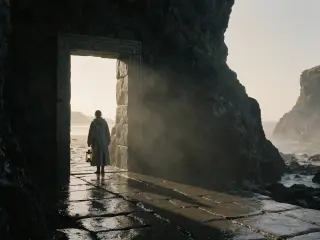
Worked Example 1 — The Saltglass Caves
This is the exact brief behind the world key visual on this page. It is long by design: the cave, the door, the keeper and the coast each get their own clause so the model cannot satisfy one by sacrificing another.
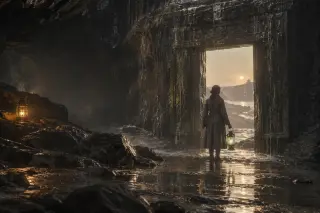
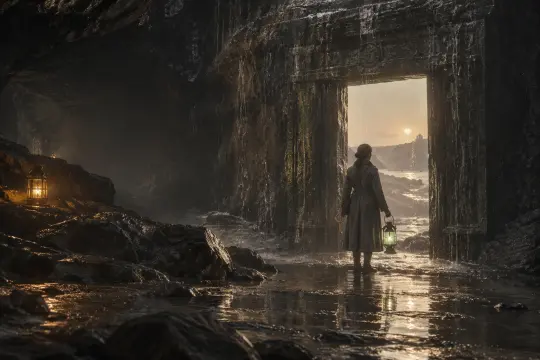
35mm film still, photoreal, visible film grain. Warm low lamp light, desaturated bone-white and warm grey, deep soft shadows. A wide establishing shot inside the Saltglass Caves beneath Tidegate harbor at the ninth hour of the ebb: black basalt walls slick with seawater, a drowned stone doorway standing upright in the rock with the sea sheeting down its carved lintel and pooling around its threshold. Through the doorway, instead of a wall, a different shore is faintly visible — a pale sunlit coast under a low sun, small and wrong beyond the frame. A Tidewarden in a grey oilskin coat stands at the threshold holding a brass tally-key and a lantern, seen from behind at a careful distance, her shadow long on wet stone. Wet stone reflections, salt crust, oxidized brass, green-glass lantern glow, mist in the air, quiet observational framing, low camera, no people facing camera. Natural melancholy, restrained documentary realism, cinematic depth of field. No readable text, no watermark, no logo, no illustration, no painterly style, no anime.
What the Render Gets Right
- Weight — the lintel sits in the rock instead of on top of it. The cave has depth behind the figure.
- Water — the sheet on the lintel and the pool at the threshold read as the same tide.
- Two lights — the lantern in hand and the second lantern on the rocks, which turns a portrait into a scene.
- A coast with weather — the shore through the door has a horizon, a haze and a lighthouse, not a flat gradient.
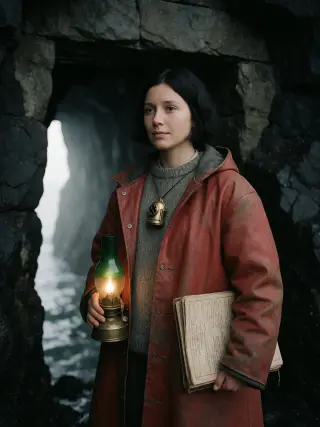
Worked Example 2 — Iselde Crane
The character brief keeps the same opening clauses and then changes the composition from wide to vertical. The door stays in frame, because the door is what makes the portrait belong to Tidegate rather than to any cold coastal story.
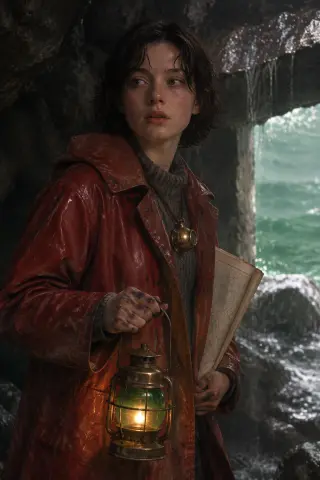
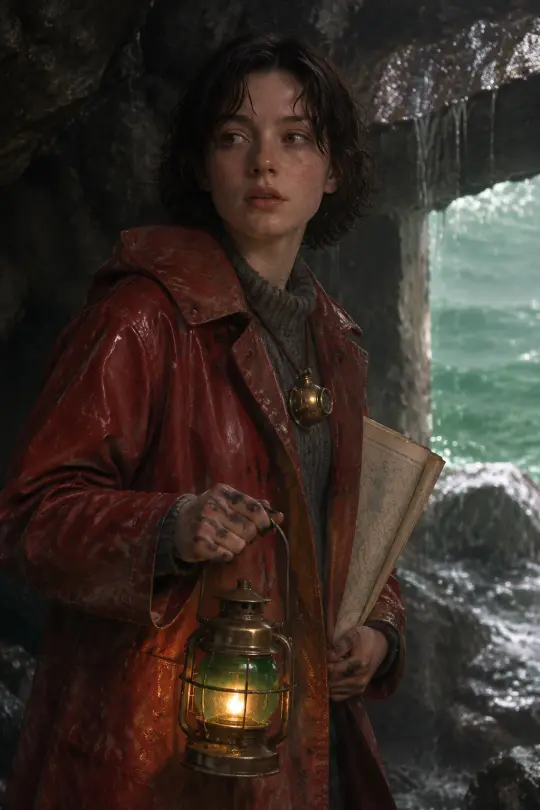
35mm film still, photoreal, visible film grain. Warm low lamp light, desaturated bone-white and warm grey, deep soft shadows. Environmental character portrait, vertical hero composition: Iselde Crane, the lighthouse keeper’s daughter, standing at the mouth of a sea cave with a doorway of green seawater opening behind her. Cropped black hair, ink-stained fingers, a worn red oilskin coat over a grey wool sweater, a brass diving-bell pendant at her throat, a tide-almanac tucked under one arm, a small green-glass lamp in her hand. She is in three-quarter view, not smiling, listening for a note only she can hear, gaze slightly off-camera. Behind her the cave wall is black basalt, the stone lintel of the door beaded with salt, seawater sliding down in a thin sheet, faint mist. Tangible textures: wet oilskin, rusted brass, damp wool, salt on skin. Natural skin texture, no idealized beauty, grounded in physical reality. Quiet observational framing, shallow but honest depth of field, low warm practical light from the lamp against cold cave shadow. No readable text, no watermark, no logo, no illustration, no painterly style, no anime.
What the Render Gets Right at Portrait Scale
- Material truth — the oilskin is wet, the wool is damp, the brass is oxidized, and each has a different highlight.
- Hands — ink-stained fingers on the lantern handle, which is the detail that makes her a keeper rather than a model.
- The door behind — green seawater and a stone lintel, enough to place her without stealing the portrait.
- A face with a job — she is listening, not posing. The expression is the character.
GPT Image 2 vs Krea 2 on the Same Brief
The comparison is unusually clean because the only variable is the model. Both prompts are identical; only the size parameter changed to fit each model’s supported range. GPT Image 2 gives you a place; Krea 2 gives you a diagram of the same decision.
Lighting and Palette for Tidegate
Tidegate lighting is economic, not decorative. Every light source should imply who is paying for the space. A green-glass lantern means a warden is counting the hour. A green visor means the Exchange is collecting. A cold cave shadow means the tide has not turned. A warm coast beyond the door means someone is being sold passage.
- Lantern amber — the default working light. Warm, low, practical, always in someone’s hand.
- Green glass — the Tidewarden signature. Use it as a small accent, never the whole frame.
- Bone grey and wet black — the cave. Let the basalt stay almost colourless so the door can be the brightest thing.
- Sea light — pale, slightly overexposed, always on the far side of the threshold.
Common Failure Modes and Fixes
- A doorway with no destination. Add the coast clause. Without it the model paints a dark rectangle and stops.
- Tourist posture. Say “seen from behind” or “listening, not posing.” A character facing camera turns the scene into a portrait.
- Clean dry stone. Water is the world’s clock. Keep “seawater sheeting down the lintel” in every prompt.
- Too many keys. One brass tally-key reads; a belt of forty reads as costume jewellery.
- Illustration drift. If the frame goes painterly, move the 35mm film clause to the front and repeat the negative clause.
Most weak Tidegate generations are not model failures. They are brief failures: a missing coast, a pose that hides the toll, or a door that was never given a destination. Fix the brief before you re-roll the model.
Publishing the Result with Its World
A finished frame is only half the work. Publishing the work attaches it to Tidegate, keeps the prompt and atoms alongside it, and lets another creator fork the world instead of guessing at it. The four works on this page are published this way, which is why the comparison is repeatable rather than anecdotal.
Start Creating
Six clauses, two models, four published works — now render the threshold only you would choose.