Jeopardy Maker — Free Online Jeopardy Game Maker & Generator
Make your own jeopardy maker
Use our free Jeopardy maker to build a custom board, generate questions with AI, and play it online. No download, no signup — start a game in seconds.
A Jeopardy maker lets you type a topic and get a playable board — six categories, five values per category, twenty-five clue/response pairs — plus the controls to run it live. Neta Studio's Jeopardy maker runs entirely in the browser on Three.js, so the same board you generate can be styled, played, and embedded without a download or an account. The generator produces a board in a few seconds; the first click after a topic is the only thing you wait on.
This page covers the live tool, the AI clue generator, the single-clue card path, board theming, how free tiers compare, and why a 100-to-500 value ladder outperforms a flat question list for recall. If you want the broader game builder instead of a quiz-only surface, use the 3D game builder; this page stays on the Jeopardy maker.
Free Jeopardy Game Maker (Live Tool)
The live tool is above the fold. You type a topic and a title, press Generate, and the board renders in the same viewport — no tab switch, no redirect, no modal. Generation calls the model, returns six categories with five clue/response pairs each, and writes them into the board state. Typical wall time from click to visible board is a few seconds on a stable connection; the board render itself is under 200 ms once the payload arrives.
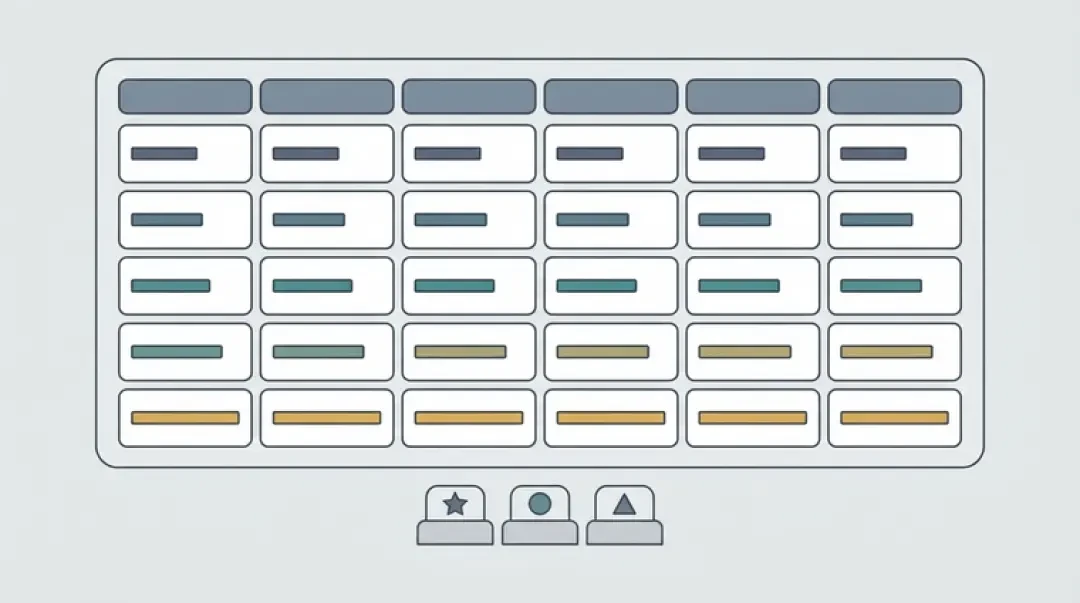
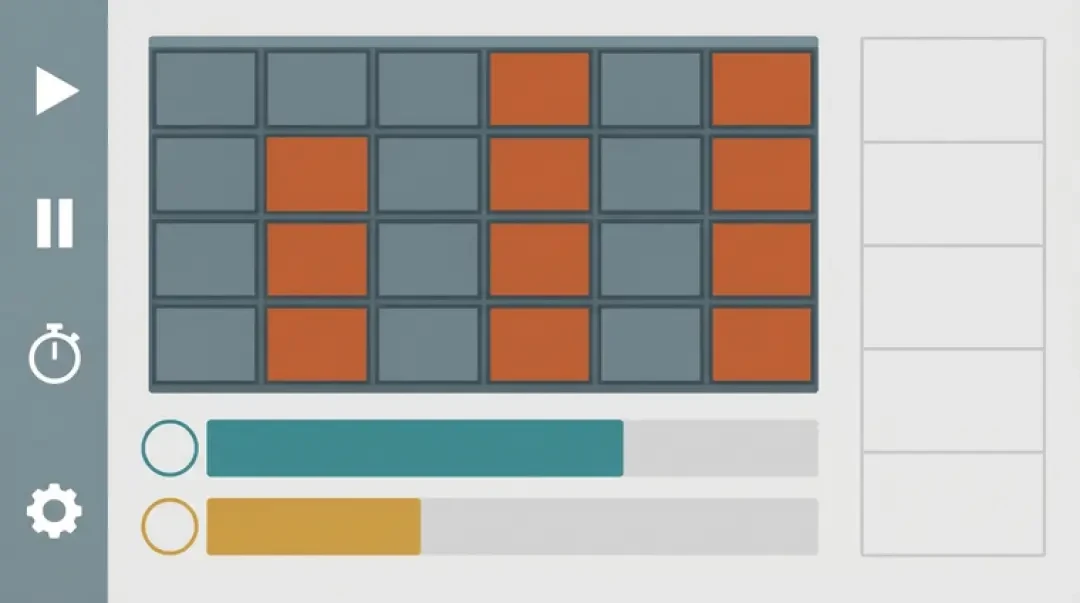
The board is a Six-by-Five grid: six category cells along the top row, five value cells per column at 100, 200, 300, 400, 500. Clicking a value cell flips it to the clue, then to the response, then marks it used. The state is local to the page until you export or open a live session. There is no signup wall between you and the first game.
Keep the promise narrow: the tool generates a board and runs it in the browser. It does not schedule teams, does not store per-player history, and does not guarantee every generated fact is current. Treat the first generated board as a draft you edit.
- No signupThe generator and the board editor run without an account. Accounts only matter if you want saved boards across sessions or a hosted live session.
- In-browser renderingThe board is a Three.js scene. It renders at device pixel ratio capped at 2, which keeps the grid sharp on high-DPI laptops without oversampling.
- Inline editingAny clue or response is editable in place. The generator is a starting point, not a locked output.
- Live scoring scaffoldValue cells carry their numeric weight into the scoring panel. Teams subtract or add against the cell value, not against a manual number.
01
Enter a topic and a board title in the two fields at the top of the tool.
02
Press Generate. Wait for the board to paint — a few seconds; the grid fills column by column.
03
Click any value cell to reveal the clue. Click again to reveal the response.
04
Edit any cell inline: click the text, type, press Enter. The value and category stay anchored.
05
Use Mark Used on each cell as you play, or let the click sequence handle it.
06
Export the board or open a live session when the questions read cleanly.
AI Jeopardy Question / Answer Generator
The generator takes a topic string and returns six category names and twenty-five clue/response pairs. The model is prompted to write clues in the Jeopardy convention: the clue is a statement, the response is phrased as a question. It also gets the value ladder as context, so 100-level clues stay general and 500-level clues get specific.
The model is reliably bad at four things. It writes double answers — a clue with two defensible responses, which forces a judgment call mid-game. It dates facts. It writes clues that give away the response by repeating a distinctive word from the answer. And it drifts category: column four starts on-topic and column five is a different subject. All four are fixable by editing, but you have to read the board before you play it.
The fix is a read-through pass. Scan all twenty-five clues once, mark the three or four that are ambiguous, and rewrite those cells. That pass takes a few minutes and is the difference between a board that plays cleanly and one that produces an argument on the 400.
How a topic becomes six categories and twenty-five pairs
The topic string goes into a single generation call with the grid shape as a constraint. The model returns structured output: six category objects, each with five clue/response pairs and an assigned value. Categories are meant to be distinct sub-topics, not six paraphrases of the input.
If a topic is narrow — a single episode, a single statute — the model will pad categories with adjacent topics. That padding is usually fine for a warm-up and usually wrong for a graded review. Widen the topic string instead of accepting the padding.
What the generator gets wrong, and what to do about it
Dated facts are the most common failure. A clue about a current officeholder or a recent release ages badly. For corporate or classroom boards, either add a date constraint to the topic or replace dated cells with mechanism-level clues.
Double answers are the second. If two responses both fit, the response field should name the more specific one and the clue should carry an extra constraint. Rewrite the clue rather than the response.
Jeopardy Clue Card Generator
The clue card path is for one clue, not a board. You enter a prompt, the generator returns a single clue card with the response folded underneath. The card is the unit of reuse: drop it into an existing board, a warm-up slide, or a tie-breaker.
The prompt's phrasing sets the clue's register. A bare noun gives you a definitional clue. A comparison gives you a contrast clue. A number gives you a quantitative clue. If you want a specific difficulty, say the difficulty in the prompt — the model has no other signal.
| Prompt | Clue style | Where to use it |
|---|---|---|
| A single noun, e.g. 'photosynthesis' | Definitional, one fact | Warm-up, 100-level cell |
| A comparison, e.g. 'mitosis versus meiosis' | Contrast, one distinguishing detail | Category filler, 300-level cell |
| A number, e.g. 'the year 1789' | Quantitative, date or magnitude | Tie-breaker |
| An everyday object | Inference, describe the function | 100-level cell |
| A named mechanism | Sequence, what happens first | 400 or 500-level cell |
Custom Jeopardy Board (Themes & Categories)
Theming without a designer comes down to three inputs: a colour per round, a board title, and the category row. Set the round colour first — a single accent applied to the value cells — then set the title in the board header. Categories come from the generator or from your own list of six strings.
One layout rule matters more than the rest: the clue text has to be readable at the distance people are sitting. Board text scales with viewport width, but the value cells and the clue text have independent minimum sizes. Set the clue text to at least 28 px at 1080p and let it scale up from there. On a projector, sit in the back row and read the longest clue out loud; if you hesitate, raise the size.
Avoid three things. Avoid a background image behind the clue text — it eats contrast and the text stops being legible at distance. Avoid more than two accent colours per round; each extra colour competes with the value cells. Avoid category names longer than roughly eighteen characters; the column header wraps and the top row grows, which pushes the value cells out of the viewport.
- Colour per roundOne accent colour applied to the value cells. Single-Round and Double-Round boards can use different accents, which signals the round change without a separate screen.
- Board titleSets in the header. Keep it short; a long title wraps and pushes the grid down.
- Category rowSix strings. Eighteen characters or fewer each keeps the header on one line at 1080p.
- Clue text sizeMinimum 28 px at 1080p. This is the setting that most boards get wrong.
Free vs Paid Jeopardy Makers Compared
Most makers differ on five axes: free-tier limits, whether signup is required, whether AI question generation is included, whether you can export the board, and whether live multi-team scoring is available. The table below is a comparison of categories, not of named products — check the specific tool before paying.
Two notes. Signup walls often appear at the export step rather than at generation, so a tool can feel free for the whole build and charge at the door. And live scoring is the feature most likely to be gated, because it needs a server. Tier boundaries change; verify before you commit a budget.
| Category | What to check |
|---|---|
| Free tier limits | Number of boards, cells per board, and whether generated boards expire. |
| Signup requirement | Whether an account is needed to generate, to export, or only to host live. |
| AI question generation | Whether generation is included or a separate credit, and whether editing is allowed. |
| Export | Formats offered — image, PDF, or a data file you can re-import. |
| Live multi-team scoring | Whether teams are on separate devices, and whether scores sync in real time. |
Review Games: Why the Ladder Beats the List
A flat question list treats every question as equal. A 100-to-500 ladder encodes difficulty and stakes in the same number, and that does two things a list cannot. It forces you to distribute questions across difficulty bands, and it gives players a reason to attempt the hard ones. The recall effect comes from retrieval under slightly elevated stakes, not from the board styling.
Weighting the ladder matters when categories differ in difficulty. If one column is objectively harder — a column on a niche statute next to columns on general history — do not put the hardest question in that column at 500 and the hardest question in the easy columns at 500. Move the niche column's easy question to 100 and its hardest to 400, and use the 500 cells for the categories players are most likely to clear. The ladder is a difficulty scale, not a fixed slot per category.
A practical distribution: two easy clues per category, two mid, one hard. That gives ten easy, ten mid, and five hard across the board, which is close to the ratio most review sessions can finish in a sitting.
Weighting the ladder across uneven categories
Write each clue's intended difficulty first, then assign the value. If you assign values first, you will find yourself writing clues to fit slots, which produces a board that reads as filler.
If a category is so hard that its 100-level clue is still a coin flip, cut the category. A board with five strong columns plays better than six with one dead column.
Walk into the world it belongs to
A sprite is a character with nowhere to stand. The last step is the one nobody else offers: take the sheet you just built and put it in a world someone can walk around in — a small island, a planet, a rainy street corner. Every world on this site was made from one written description and published as a page you can play.
FAQ
How is this different from the game maker page? +
The game maker page covers the full 3D game builder — worlds, characters, and gameplay. This page is the quiz surface only: a Six-by-Five board, clue/response pairs, and live scoring. Same engine, narrower tool.
Is the generator free? +
Generation and editing run without an account. Hosted live sessions and saved boards across sessions are the parts that require a session, and tier limits change — check the current limits before you rely on a specific allowance.
How many games can I make? +
A board is six categories by five values, so twenty-five clues per board. Nothing in the generator stops you from making another board after you finish one; the limit you hit first is usually your own read-through time, not a board count.
Can I edit generated questions? +
Yes. Any cell is editable in place — click the text, type, press Enter. The read-through pass is the step that turns a generated draft into a board that plays without arguments.
Do I need an account? +
No, not to generate or to edit. An account matters only for saved boards across sessions and for hosted live scoring.
Can I host it live? +
The board runs in the browser and a live session can be opened from it. Teams are on their own devices and scores sync against each cell's value. If you are on a shared network, test the session before the room fills.
Is it suitable for corporate training? +
It works for recall-style review, and the ladder helps with retention. The failure mode is dated facts: if the topic touches current policy, add a date constraint or replace dated cells with mechanism-level clues before you run the session.
What happens to my board afterwards? +
The board state is local to the page until you export it or open a live session. Export if you want to re-import or keep it across sessions; otherwise a refresh clears the board.
Back to the 3D Game Builder
All 31 finished 3D worlds, games and scenes live on one page — every one of them playable.