Text to 3D Model Free — Generate a 3D Model From a Sentence
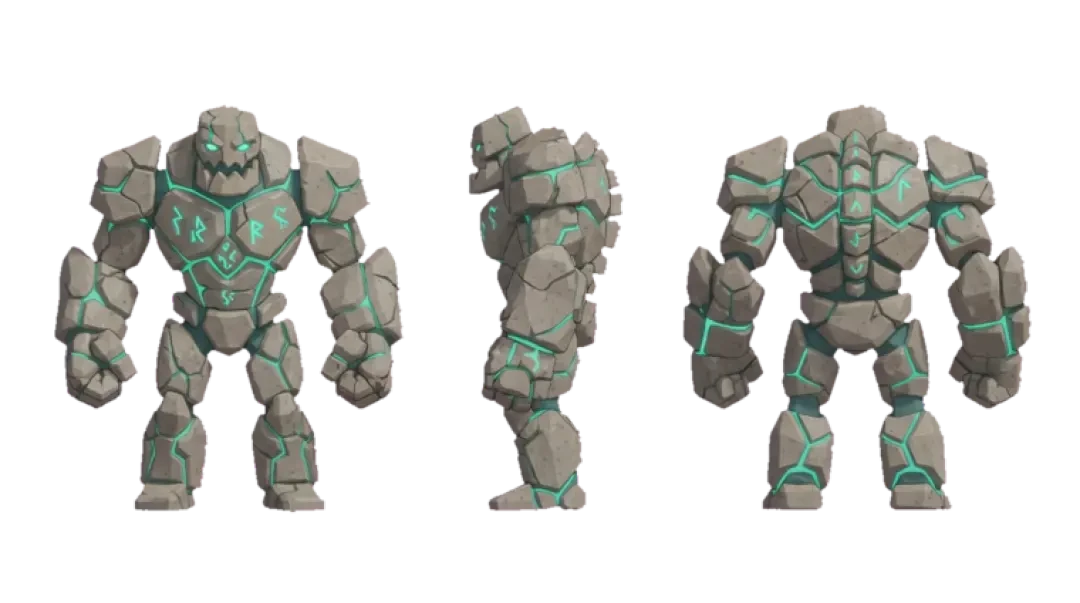
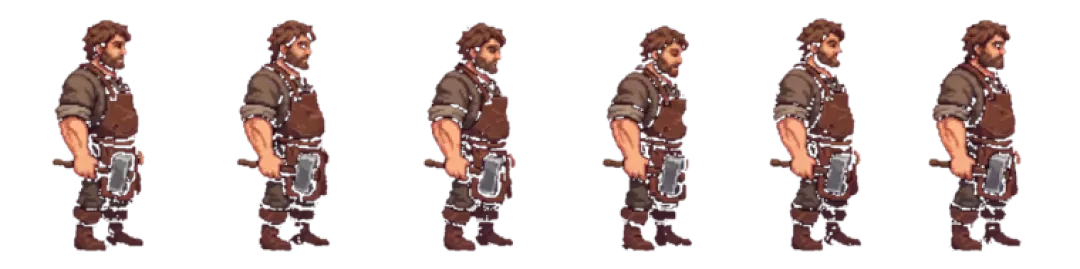
Make your own text to 3d model
Turn a sentence into a 3D model free — no signup, no software. Type what you want, watch it appear, spin it in your browser, then download the .glb or load it into a walkable 3D scene.
A text to 3D model pass takes one sentence and returns geometry you can orbit in the browser. You type 'cast-iron park bench, slatted seat, curled armrests, matte black paint', press generate, and a few tens of seconds later a mesh arrives in the viewport. No installer, no account wall in front of the first result.
Two outputs come out of the same sentence. The first is a file: a .glb you can open in any glTF viewer, drop into Blender, or ship in a game engine. The second is a place: the same props placed on a ground plane inside a walkable scene you can move through with WASD and mouse look, with collision so you do not fall through the floor.
Text to 3D in Three Steps
The pipeline has three stages and one of them is the slow one. Describe the object, wait for the server-side pass, then send the result somewhere — a file you download, or a scene you walk into. Everything else on this page is detail about those three stages.
The wait is the part people underestimate. Generation is not a browser-side effect and it is not instant. It is a server request measured in tens of seconds, plus whatever queue sits in front of it. Budget a minute for the first pass of a session, less for each pass after that, and keep the tab open while it runs.
What the Text to 3D Model Step Actually Runs
You do not need the internals to use the feature, but they explain the shape of the output. Your sentence is encoded into a conditioning signal, a form is resolved from that signal, and the form is converted into triangle geometry — then reduced to a mid-poly budget and given a baked base-colour texture so it arrives looking like an object rather than a grey clay lump.
That chain is not deterministic the way a CAD kernel is. Two runs from the same sentence produce siblings, not copies. Treat the output as a strong first draft of a shape, and treat the sentence as the control surface you actually edit.
01
Describe the object in one sentence. Noun first, then material, then finish or scale: 'weathered copper diving helmet, riveted seams, matte patina, waist-high display scale'. Leave out camera words, lighting words and mood words — they do not survive into geometry.
02
Press generate. The request goes to a server-side generator; nothing heavy runs on your laptop or phone, and your device GPU is not the limiting factor. Expect tens of seconds, not a single frame.
03
Inspect from four sides before you accept it. Orbit, zoom, check the profile, the base, and whether the parts you named are still separate. If the silhouette is wrong, rewrite the sentence and run again. A second pass costs tens of seconds; fixing a bad mesh by hand costs an afternoon.
04
Export or embed. Download the .glb for Blender, Unity, Unreal or a glTF viewer, or load it straight into the 3D game builder as a placed prop inside a scene you can walk through.
12 Prompts That Produce Good Models
Twelve prompts that come back usable. Each one names a concrete noun, states a material or finish, and states a size or a use. Copy them as written, then swap one word at a time — that is how you find out which word the generator was actually listening to.
The pattern underneath all twelve is four slots: noun, material, size or use, one structural detail. Prompts that fill all four come back coherent. Prompts that fill one or two come back generic, and generic is the failure mode that wastes the most time.
- Street furniture'cast-iron park bench, slatted seat, curled armrests, matte black paint, outdoor furniture scale.' Material is named and the use sets scale, which stops the bench from arriving at sculpture size.
- Modular cube'wooden shipping crate, 60 cm cube, plank sides, iron corner brackets, stencilled label on one face.' A stated size on a box shape is the easiest geometry to get right; the brackets add detail that survives being read from across a scene.
- Symmetric ornament'granite Japanese stone lantern, six-sided roof, mossy base, waist-high garden scale.' Naming the material and the height keeps the roof from melting into the post, which is what happens when symmetry is left implicit.
- Held prop'compact sci-fi pistol, matte grey polymer body, brushed steel barrel, visible grip panel, held in one hand.' 'Held in one hand' sets scale from a body part; two named materials keep the frame from fusing to the slide.
- Architecture'two-storey timber watchtower, open railing, ladder on one side, weathered planks, 7 metres tall.' Buildings come back as one solid object, not a floorplan, so name the parts that have to be visible — railing, ladder, storeys.
- Hero prop, capped detail'weathered copper diving helmet, riveted seams, front porthole, matte patina.' Pick two details, not ten. A crowded prompt pushes detail into a smear that reads worse up close than a clean surface with two crisp features.
- Style and scale together'low-poly pine tree, faceted trunk, three tiers of angular branches, dark green, 4 metres tall.' 'Low-poly' sets a style target and the height sets a scale target; tree prompts with neither come back at arbitrary size and density.
- Thin and mirrored'ornate brass key, long shaft, bow with a circular hole, three teeth, flat plane of symmetry.' Thin mirrored objects need the symmetry stated outright, or the teeth come back at three different lengths — the most common failure in this category.
- Appendages'glazed ceramic teapot, rounded body, curved spout, C-shaped handle, cream glaze with a thin blue band.' Name each appendage separately. Unnamed handles and spouts tend to get absorbed into the body.
- Orientation and ground'ruined sandstone arch, broken top course, rubble at the base, 4 metres tall, standing on flat ground.' 'Standing on flat ground' tells the generator which way is up and where the origin belongs, so the prop drops onto terrain without sinking.
- Vehicle'six-wheeled exploration rover, boxy chassis, exposed suspension arms, dusty orange paint, 3 metres long.' A length plus a wheel count fixes scale and structure at once; wheels are something the generator handles well when the count is stated.
- Character scale'friendly low-poly frog character, rounded body, wide feet, two large eyes, standing upright, 1 metre tall.' Characters need a height and a stance. Without them you get a creature floating at an arbitrary size in a pose nobody asked for.
What Makes a Prompt Generate a Good Mesh
A generator can attach geometry to words it can place: wheel, hinge, spout, bracket, blade, ladder, rail. It has nothing to attach to 'futuristic', 'beautiful', 'detailed' or 'high quality'. Those tokens compete with the noun for the same attention and push the result toward an average of everything the model has seen. Cut them and the noun gets sharper.
One sentence is enough. Longer prompts do not add detail; they dilute the noun that matters and the later clauses get quietly dropped. If you need two objects, run two passes and place them yourself — that is what the world tier is for.
Name the material and the finish
Material words change the surface, not just the colour: matte, brushed steel, glazed ceramic, weathered copper, dusty orange paint, cast iron. 'Shiny' is weaker than 'polished chrome'. 'Old' is weaker than 'rust-streaked'.
A second named material is also how you keep parts separate. 'Brass fittings on a walnut box' produces two surfaces with a visible boundary. 'A box' produces one surface and no boundary.
Name the scale and the axis of symmetry
State size in units a person can picture: 60 cm cube, waist high, 3 metres wide, held in one hand. The generator will pick a size on its own if you do not, and you will not like the pick.
For mirrored objects, write 'flat plane of symmetry'. For wheels, bowls and lanterns, write 'radially symmetric'. For an object meant to be stood on terrain, write 'standing on flat ground' — that fixes the up-axis and puts the origin at the base.
Three Failure Modes of a Text to 3D Model Prompt
Contradiction. 'Clean rusted chrome sphere' averages into a muddy blob, because the prompt asks for two surfaces that cannot coexist. Pick the surface you actually want.
Scene prompts. 'A forest at sunset with a cabin' returns one object, usually the cabin, occasionally a tree fused to a roof. Scene-level description belongs in the world tier, not the model tier.
Text and thin open surfaces. 'A sign reading OPEN' is close to worst case — lettering comes back as a smear and single-sided planes come back either torn or unintentionally solid. Chains, cloth and bare wire have the same problem: the generator wants volume, and a surface with no thickness gives it nothing to work with.
Text to 3D Model Free — What You Get and What You Don’t
Free means you can test the whole loop before committing anything: describe, wait, orbit the result, download the .glb. What you are really testing is whether a generated mesh fits your pipeline at all. For props, blockouts and scene filler it usually does. For measured parts and hero assets it usually does not.
The honest split is between shape and specification. A text to 3D model pass is strong at the first and deliberately indifferent to the second. It gives you a silhouette and a surface. It does not give you a dimension you would trust to a millimetre, a UV layout you would ship, or a skeleton.
| What the pass gives you | What it does not give you |
|---|---|
| A silhouette that reads correctly from four sides | Exact dimensions to a drawing or a spec sheet |
| One mid-poly mesh, dense enough to look solid at normal viewing distance | Tuned topology with animation-friendly edge flow |
| A baked base-colour texture covering the whole object | Clean UV islands, or separate metalness and roughness maps |
| A consistent origin and a predictable up-axis | A collision mesh or a level-of-detail chain |
| A .glb that opens in any glTF viewer with no conversion step | Named parts or a separated node hierarchy |
| A starting shape you are allowed to cut up and retexture | A finished asset that ships unedited |
| Repeatable results from the same prompt family | The identical mesh twice — re-runs give siblings, not copies |
From a Sentence to a Walkable World
The same sentence that produced a bench can produce a place to stand next to the bench. The world tier takes a scene description, lays a ground surface, resolves each recognised noun into a placed prop, adds collision, and drops a spawn point. You move with WASD and mouse look, in the tab, with nothing to download.
What changes is the unit of generation. Model tier is one object, one origin, one material set. World tier is many objects sharing a scale in metres, plus a camera that has to be able to walk between them without clipping through a wall. Describe the scene the way you would brief a level designer — 'a walled courtyard, three market stalls along the north wall, a stone well in the middle, dusk lighting' — and the builder resolves the nouns into placed props.
Worlds embed as playable blocks on a page. The scene loads in the same tab and starts at the spawn point; no plugin and no build step. Mini World and The Cyclops' Island are both built this way — small worlds that load as a page component rather than as a downloadable executable. Agent Sprite Forge covers the agent side when a world needs moving characters rather than static props.
01
Describe the place, not the object: what bounds it, what is inside it, and what time of day it is.
02
Generate. Named objects become placed props and a ground surface is laid under them at a shared scale.
03
Walk it. Collision keeps you on the ground and out of the walls; the spawn point is where the description implies you start.
04
Fix one thing at a time. Regenerate a single prop and it drops back into the same slot instead of rebuilding the scene.
Text to 3D vs Image to 3D
Image to 3D is the right input when the object already exists and its shape is the point. Photos carry real proportions, real wear and real asymmetry, so the job becomes reconstruction rather than invention. If you need that specific chair, no sentence will get you that chair.
Text to 3D is the right input when nothing exists yet, when you need a set of objects that share one material language, or when the object is scenery nobody will inspect closely. It is also cheaper to iterate: rewrite one clause, wait tens of seconds, look again. No reshoot, no relighting, no reshooting the back of the object you forgot.
| Question | Image to 3D | Text to 3D |
|---|---|---|
| Does the object exist? | Yes — you have it in front of you | No — you are describing something new |
| What you actually get | Its real proportions and surface detail | A plausible shape in the material you named |
| Input cost | Several angles, even light, a clean background | One sentence |
| Strong at | Matching a specific real object | Filling a scene, building a set, prototyping |
| Weak at | Occlusion, glare, thin parts, anything you did not photograph | Fine detail, lettering, exact dimensions |
| Iteration speed | Reshoot and reprocess | Rewrite one clause and re-run |
| Best first choice when | You need this object, not an object | You need something that reads correctly and does not exist yet |
Where the Mesh Goes Next
The generator hands back a binary glTF file: geometry plus a baked base-colour texture in one container. That is the most portable default available — it opens in Blender, in game engines and in a browser tab without a conversion step.
Where the mesh goes next depends on whether it is finished or a starting point. As a starting point it goes straight into the 3D game builder as a placed prop inside a scene. As a finished asset it needs compression and probably a topology pass. Both routes are ordinary work and neither needs a bespoke tool. This page is one step in a sequence, not a dead end; the workflow pages that follow cover import settings, compression targets and scene assembly.
- Download the .glbDrag it into any glTF viewer, Blender, Unity, Unreal or a three.js app. Geometry arrives with its own material and texture already packed.
- Compress before you shipDraco or meshopt for geometry, textures down to 1024 or 512 for props. A crate or a lantern rarely needs more, and load time in a browser tab is the thing players actually notice.
- Place it in the world builderImport as a prop, set scale and rotation, and it inherits collision from the scene. This is the shortest path from a sentence to something you can walk around.
- Retopologise if it is going on cameraGenerated meshes are not quad-flow and will not deform cleanly. For a hero asset, rebuild the topology by hand and keep the generated shape as your reference.
- Use it as a blockoutGrey-box a level with ten generated props at the right scale, then replace them one at a time as real art arrives. Layout problems show up at this stage, not after texturing.
- Batch a matched setHold the sentence structure and swap the noun — chair, bench, stool — to get a set that shares one material language without three separate art passes.
Walk into the world it belongs to
A sprite is a character with nowhere to stand. The last step is the one nobody else offers: take the sheet you just built and put it in a world someone can walk around in — a small island, a planet, a rainy street corner. Every world on this site was made from one written description and published as a page you can play.
FAQ
Is text to 3D model free, and do I need to sign up? +
You can generate and download a .glb without creating an account. There is no software to install and no paywall in front of the first result — generation runs on our side and the file comes back to your browser.
What formats do I get? +
.glb, binary glTF, with the mesh and a baked base-colour texture inside a single file. That opens in Blender, Unity, Unreal and any three.js or glTF viewer. If you need .obj or .fbx, convert from the .glb in Blender — it is a two-click export.
How long does one generation take? +
Tens of seconds per object. The work runs server-side, so your device is not the limit; queue depth is. A walkable world built from several described objects takes longer, because each prop is generated and then placed on the ground surface.
How good is the output? +
Good enough to read as the object from every side, at mid-poly density, with a baked base colour. Not good enough for exact dimensions, clean UV islands, lettering or hero close-ups. Plan on one fix pass in Blender for anything that ends up on camera.
Can I generate a whole scene instead of a single model? +
Yes. The same description can resolve into a walkable scene with a ground surface, placed props, collision and a spawn point rather than a file. Model tier gives you an asset; world tier gives you a place.
Can I edit the mesh afterwards? +
Yes. The .glb imports as ordinary mesh data — vertices, faces, one texture — so you can cut, merge, retexture or retopologise it in any DCC tool. It arrives unrigged, so add bones yourself if the asset needs to move.
Back to the 3D Game Builder
All 31 finished 3D worlds, games and scenes live on one page — every one of them playable.