
Attack on Titan Family Tree — Yeager, Ackerman, Reiss and Fritz Networks

The Attack on Titan family tree as four interactive networks: 24 characters, 8 locations, 4 events and 3 factions, with every parent, spouse, sibling, adoption, mentor and loyalty edge held as explicit data.
The Attack on Titan family tree, without the guesswork
Attack on Titan is usually drawn as one trunk with Eren Yeager at the top and everyone else arranged beneath him. That drawing is useful for a first look and wrong for almost every question worth asking. It cannot show why the Ackermans cannot be controlled by the Founding Titan. It cannot show why Zeke's royal blood matters to a plan he shares with Eren. It cannot show that Historia Reiss is the legitimate heir of the same Fritz line that built the walls, or that Frieda Reiss was the Founding Titan before Grisha took the power from her.
This archive draws the same world as four separate relationship networks: the Yeagers, the Ackermans, the Reisses and the Fritzes. Every parent, spouse, sibling, adoption, mentor and loyalty connection is a named source-target pair in a data file. The interactive networks draw those pairs; an image model is never asked to invent a line. The result is a family tree you can check, filter and argue with, which is the only kind of Attack on Titan family tree that survives contact with the final chapters.
The families
The story is not one family. It is four bloodlines that keep colliding across the walls and the sea. The Yeagers carry two Titans and a father who crossed from Liberio to Paradis. The Ackermans carry a bloodline that the Founding Titan cannot rewrite and a set of soldiers both sides need. The Reisses hold the Founding Titan in a chapel and the throne behind the throne. The Fritzes are the royal line that started the Titan cycle, built the walls and imposed the vow of renunciation.
Each network has its own cast, its own centre and its own way of failing. The Yeager network is about inheritance and two sons on opposite sides. The Ackerman network is about blood that cannot be commanded. The Reiss network is about legitimacy and the child who was hidden. The Fritz network is about the origin of the power and the king who chose to stop using it. Together they cover 24 characters, 8 locations, 4 events and 3 factions.
The Yeager family
Grisha Yeager is the hinge. He married Dina Fritz in Liberio, had Zeke, lost Dina to Marley's Titan programme, crossed the sea, married Carla, and raised Eren in Shiganshina. He carried the Attack Titan with him and gave it to Eren by letting his son eat him. His little sister Fay is the reason he joined the Eldian Restorationists in the first place; her death at the hands of Marleyan officers is the first lesson in what the internment zone really is.
This network has nine characters and fourteen explicit edges. The gold parent lines run from Grisha and Carla to Eren, and from Grisha and Dina to Zeke. The rose spouse lines connect Grisha to Carla and to Dina. The sage sibling line connects Eren and Zeke as half-brothers, and the line from Grisha to Fay marks the sister he could not save. Teal adoption lines bring Mikasa into the Yeager house through both Grisha and Carla. Tom Xaver appears as Zeke's mentor, and Levi as Eren's captain. The network is the best place to start because every other network is a consequence of this one.

Yeager network
Read every parent, spouse, sibling, adoption, mentor and loyalty edge in the interactive Yeager network.
The Ackerman family
The Ackermans are the family the Founding Titan cannot edit. Their bloodline resists the coordinate's memory control, which is why the Reiss kings persecuted them and why Kenny Ackerman is both a weapon and a warning. Kuchel died in the Underground and left her son Levi to be raised by her brother Kenny. Mikasa's father was an Ackerman who hid his family in the hills; her mother was a survivor of an Asian clan. Both were killed by traffickers, and Grisha brought Mikasa into the Yeager house afterward.
This network has ten characters and fourteen explicit edges. The parent lines from Kuchel to Levi and from Mikasa's unnamed mother and father to Mikasa are the blood spine. The sibling line between Kenny and Kuchel explains why Levi and Kenny are family even though they meet as enemies. The mentor lines from Kenny to Levi and from Levi to Eren and Mikasa show how the Ackerman style of survival is passed down. The loyalty lines to Historia and Uri Reiss show that the family's loyalty is always personal, never institutional.

Ackerman network
Read every parent, spouse, sibling, adoption, mentor and loyalty edge in the interactive Ackerman network.
The Reiss family
Rod Reiss is the patriarch who kept the Founding Titan in his family and kept his illegitimate daughter in a farmhouse. His brother Uri held the power before him; his daughter Frieda held it after Uri; his legitimate sons Dirk, Urklyn and Florian died with Frieda when Grisha came to the chapel. Historia, his daughter by Alma, was raised as Krista Lenz and told that her mother was dead. When Rod finally needed an heir, he had already spent the ones he recognised.
This network has eleven characters and twenty explicit edges. The sibling line between Rod and Uri opens the story of the throne. The parent lines from Rod to Frieda, Historia, Dirk, Urklyn and Florian mark the legitimate and the hidden branches. Alma's parent line to Historia is the one Rod tried to erase. Frieda's sibling lines to the other Reiss children make the chapel massacre a family event rather than a political one. Kenny's loyalty to Uri and Rod, and Levi's loyalty to Historia, are the two ends of the Reiss security arrangement.

Reiss network
Read every parent, spouse, sibling, adoption, mentor and loyalty edge in the interactive Reiss network.
The Fritz family
The Fritz line is the origin and the problem. Ymir Fritz gained the power of the Titans, was enslaved by the first Fritz king, and built the Paths from the sand for two thousand years. Her daughters carried the power into the royal line. Karl Fritz, the 145th king, moved the Eldian capital to Paradis, built the three walls and imposed the vow that stopped every successor from using the Founding Titan to fight. Dina Fritz, a royal descendant, married Grisha and became the mother of Zeke; her blood is why Zeke can use the coordinate at all.
This network has ten characters and thirteen explicit edges. The parent line from Ymir to Maria is the beginning of the royal bloodline, and Maria is marked as manga-only because the anime does not name all three daughters on screen. The spouse line between Dina and Grisha and the parent line from Dina to Zeke carry the royal blood into the Yeager story. The mentor lines from Karl Fritz to Uri and Frieda show how the vow is inherited as an idea, not only as a power. The loyalty line from Historia to Zeke is the last attempt to use the royal blood for something other than Eren's plan.

Fritz network
Read every parent, spouse, sibling, adoption, mentor and loyalty edge in the interactive Fritz network.
Seven profile cards
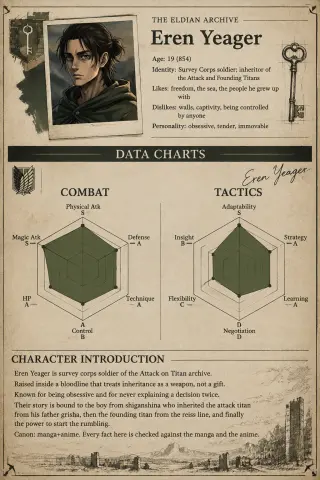
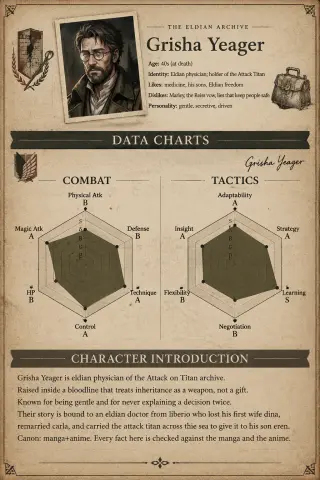
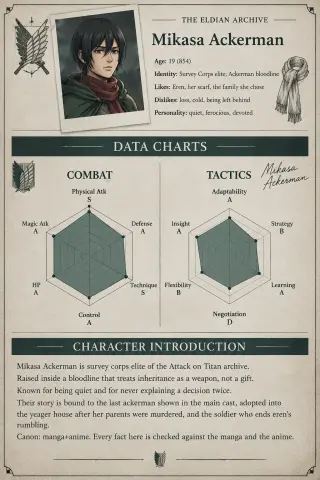
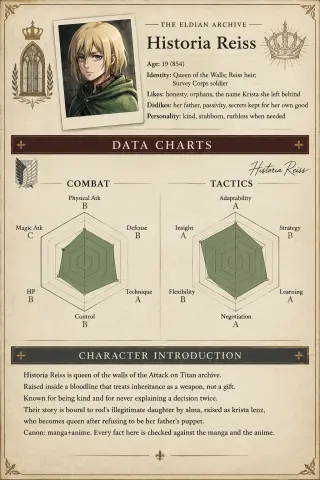
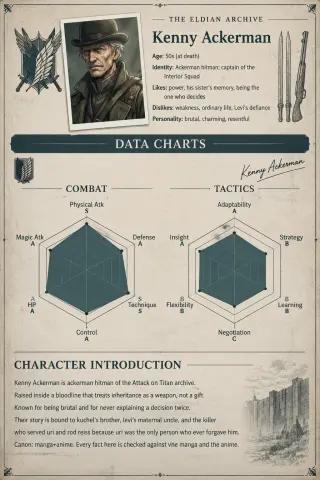
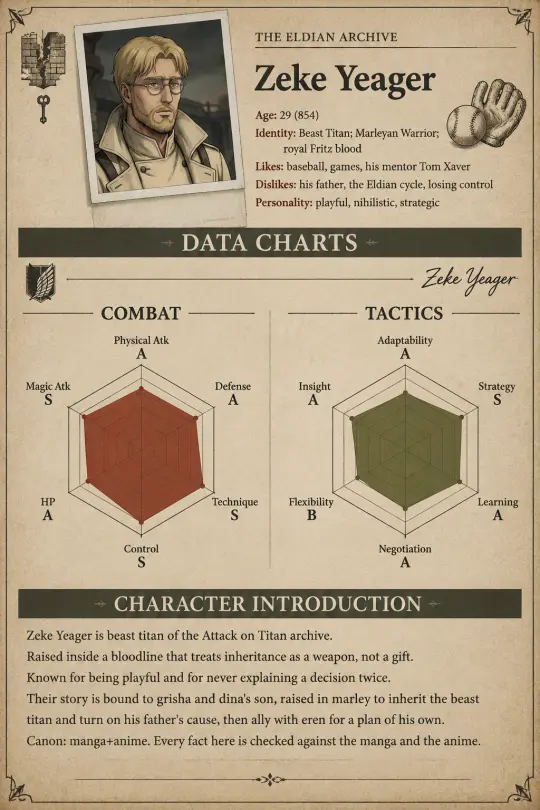
The archive includes seven archival profile cards, each made with the character-profile-card skill: Eren Yeager, Grisha Yeager, Mikasa Ackerman, Levi Ackerman, Historia Reiss, Kenny Ackerman and Zeke Yeager. Each card is a full dossier, not a portrait. It carries age, identity, likes, dislikes, personality, a COMBAT radar chart, a TACTICS radar chart and a five-line character introduction. The cards sit inside their family sections on the hub, so you meet Eren and Grisha with the Yeagers, Mikasa and Levi with the Ackermans, Historia and Kenny with the Reisses, and Zeke with the Fritzes.
The radar charts are deliberately comparable. A reader can see that Eren and Levi are both high on physical attack and control, but that Eren's weakness is negotiation and Levi's is flexibility. Zeke's card is the only one with a royal-blood identity line, and Historia's is the only one that names a crown. The cards are visual summaries of the data, not replacements for the networks.
Five design sheets
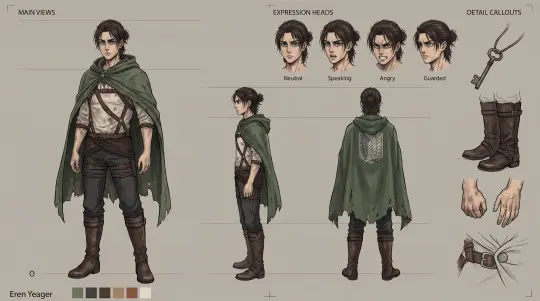
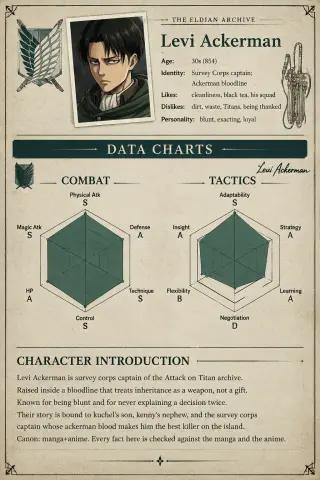
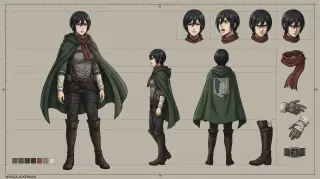
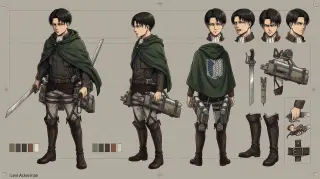
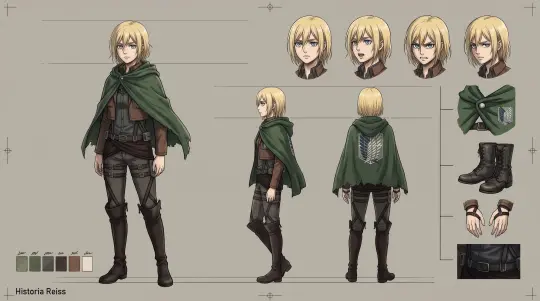
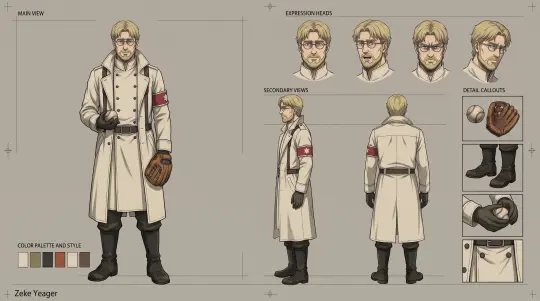
Five characters also have full design sheets made with the character-design-sheet skill: Eren, Mikasa, Levi, Historia and Zeke. Each sheet shows a front, side and back view at the same scale, four expression heads, detail callouts for the signature item, boots, hands and one costume fastener, and a small colour palette. The sheets are visual references, not posters: they exist so the same face and costume can be reused across the networks and the poster.
The point of the sheets is continuity. Eren's sheet keeps the green Survey Corps cloak, the harness and the basement key. Mikasa's keeps the red scarf and the same cloak. Levi's keeps the white cravat and the dual blade rig. Historia's keeps the crown and the white dress. Zeke's keeps the cream Marleyan uniform, the glasses and the baseball. When the same character appears in a network preview, a card and a sheet, the face and the costume should not change.
One family poster
The family poster is made with the character-relationship-poster skill. It shows seven named people exactly once: Grisha Yeager, Carla Yeager, Eren Yeager, Zeke Yeager, Dina Fritz, Mikasa Ackerman and Levi Ackerman. It draws exactly nine edges: Grisha and Carla as spouses; Grisha to Eren, Carla to Eren, Grisha to Zeke and Dina to Zeke as parent lines; Eren and Zeke as half-brothers; Carla to Mikasa and Eren to Mikasa as adoption lines; and Levi to Mikasa as a mentorship line.
The poster is a summary, not the source of truth. Its nine pairs are also in the network data files, and the legend separates bloodline, marriage, adoption and mentorship. The poster exists for the one-glance question: who is standing next to whom, and what does that line mean. The networks exist for the next question: why, and what happens when the line is broken.

Why a network instead of a poster
A poster is a picture of a family tree. A network is the family tree itself. In the four interactive networks, every edge is a source-target pair with a relation type, so a line cannot drift to the wrong person. You can switch views: the whole family, the blood and marriage line, the two sons, the chapel, the royal blood or the vow. You can click a face and read the relations around it. You can use it on a phone. None of that is possible when an image model is asked to draw a family tree from prose.
The poster still matters, but it has a different job. It is the one-glance summary: seven faces, nine correct edges, a legend that separates bloodline, marriage, adoption and mentorship. It is generated from the same cast and the same pairs, so it cannot contradict the networks. That division of labour is the whole point: the networks hold the argument, the poster holds the image.
Frequently asked questions
**Is this canon?** The family relations follow Hajime Isayama's manga and the anime adaptation. Every atom is marked manga+anime, manga-only or anime-only. Where the versions diverge — the final chapters, the extra pages and the fate of several characters — the note says which version is being used. We do not import facts from fan wikis without checking them against the primary text.
**Why are there four networks?** A single graph with 24 characters and dozens of edges becomes unreadable. Four networks keep each argument legible and let you start from the question you actually have: inheritance, blood that cannot be controlled, legitimacy, or the origin of the royal power.
**Is Mikasa really an Ackerman?** Yes. Her father was an Ackerman and her mother was a survivor of an Asian clan. She is adopted into the Yeager house after traffickers kill her parents. The archive marks both the Ackerman blood line and the adoption line, because they answer different questions.
**Is Historia a Fritz or a Reiss?** Both. The Reiss family are descendants of Karl Fritz and therefore part of the Fritz royal line. Historia is Rod Reiss's illegitimate daughter by Alma. She is the legitimate heir to the Reiss title and, through that line, to the Fritz blood that the Founding Titan requires.
**Why does the poster show only seven people?** Because a poster with 24 faces stops being readable. The poster is the summary: seven named people, nine correct edges. The four networks carry the full archive, including the characters the poster leaves out.
Open the archive
Start with the hub, then open the Yeager network and click a face. If you want the blood that cannot be controlled, open the Ackermans. If you want the chapel and the hidden heir, open the Reisses. If you want the king, the founder and the vow, open the Fritzes. The poster is there when you need the whole argument in one glance.
Every layer of this archive was built with four named skills: relationship-network for the four interactive graphs, character-relationship-poster for the family poster, character-profile-card for the seven dossiers, and character-design-sheet for the five turnaround sheets. The data, the drawings and the pages are separate on purpose, so each one can be checked against the others.
The family hub
Open the hub for the four networks, the poster, the seven profile cards and the five design sheets.