
Aurora — A Gothic Conservatory Otome Roleplay (3 AM Slow Burn)
Final Product: Aurora
Aurora is a playable gothic conservatory otome roleplay — a 3 AM slow burn about music, grief and the man on the other side of the door, directed live by AI and running in your browser with nothing to install.
For a week you have left your half-written nocturnes on the practice-room piano, and every night someone has finished them. The completions arrive at three in the morning through the mail slot — the ink still warm, the phrasing yours, the ending not. The only person with a key to the room is Ayn, the prodigy who walked off a stage mid-concerto three years ago and has not performed since.
What follows is not a confession scene. It is an investigation into three silences: why Ayn stopped playing, who has been completing your music, and why Maestro Varga has spent a year putting you in Ayn's path. A notebook of motifs you hummed in hallways. A concerto annotated in a dead brother's hand. A spring gala that requires a duet. Every thread you pull changes what the music can become — and whether Ayn returns to the stage on his own terms or not at all. Play Aurora →
Game Features
- Live LLM Narrative Direction — nothing here is a fixed script. A deepseek-v4-flash agent reads the action you type, keeps Ayn in the register of a man who speaks fluently only at the keyboard, and writes the next beat, the subtext and the pause after it as you play. The same agent planned the premise, the opening at 3 AM, three investigable threads and four locations from a single world prompt.
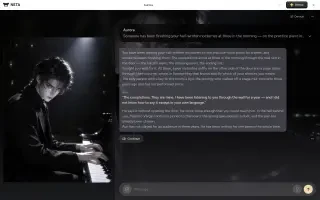
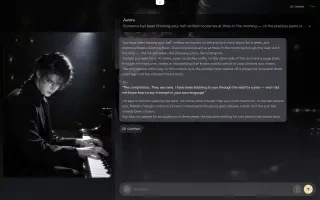
- A Pianist Who Speaks Only at the Keyboard — Ayn does not explain himself in paragraphs. He says one true sentence through a closed door, then goes quiet: "The completions. They are mine. I have been listening to you through the wall for a year — and I did not know how to say it except in your own language." Varga is too kind to be harmless. The narration never tells you what you feel.
- Answer In Your Own Words — the free-text action box is the whole interface. Wait past 3 AM to catch him. Compare the handwriting to his old scores. Ask Varga what the "duet" file means. Say nothing and let the next nocturne answer for you. Every typed beat lands differently, and the story remembers which silences you chose to break.
- Three Investigable Threads — Why did Ayn stop performing? (the main thread: a concerto abandoned mid-performance, Varga's notes describing a man who "heard something the audience could not", a score covered in annotations), Who is finishing your nocturnes? (conservatory practice-wing paper, a year of 3 AM bookings, a notebook of motifs catalogued with dates), and What does Maestro Varga want from you? (an anonymous scholarship with a familiar letterhead, practice slots scheduled directly after Ayn's, a file marked "duet"). Each carries clues, actions, discoveries, a reveal and consequences that change the ending.
- A Story About Grief, Not Stage Fright — Ayn's silence is not fear. The concerto he walked away from was his dead brother's last unfinished work, and finishing it felt like letting him go. Confront him and the year of anonymous music becomes a real conversation; help him face the archive and he may compose his own music again; play Varga's gala and he returns to the stage — on his terms or the director's; protect his grief and the music stays private. Refusal, confession and forgiveness are written as real outcomes, not failure states.
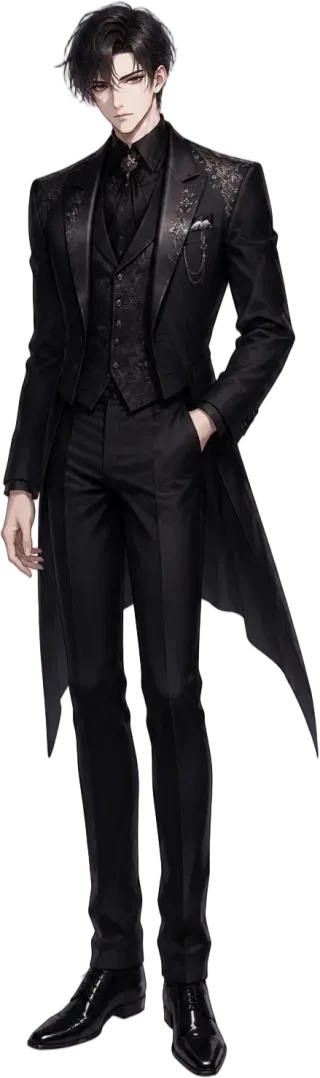
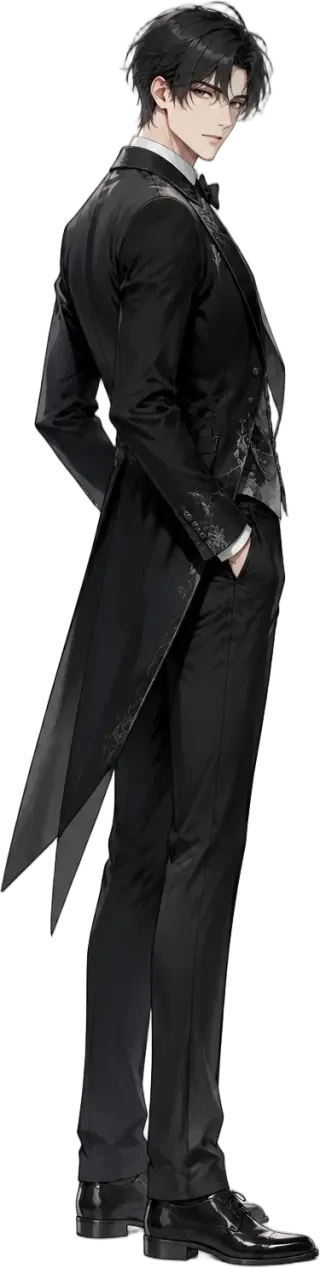
- Two Cut-Out Sprites, Four Painted Scenes, Zero Install — Ayn's concert-black standees were cut out with birefnet-general into true transparent PNGs, so he stands cleanly over four painted settings — the 3 AM practice room, the stairwell landing, the rooftop over the city and his own flat. The whole story is a mobile-first page: free to start, nothing to download.
Character Sprites
Production Process Breakdown
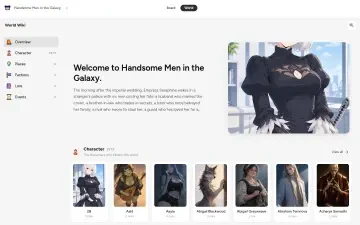
The world "Handsome Men in the Galaxy" set the house art direction — refined semi-realistic painterly, value-defined contours, organized shadow planes, warm translucent midtones, small controlled speculars, idol semi-3D painterly. For this route the AI narrowed it into a conservatory register: blue-hour indigo, warm lamplight amber, rain-glass grey and cream, with the hush of a building after midnight.
From the one-line premise — someone keeps finishing your half-written nocturnes at 3 AM, and the only key holder is the prodigy who stopped performing — the agent wrote the playable spine: a four-link relationship graph, three investigable threads with clues and consequences, four locations, four story directions and the default opening on the night you wait for the ghost.
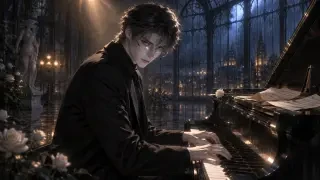
The 16:9 key art was painted with GPT Image 2 as a single staged scene — Ayn at the grand piano, the spotlight, the rain-streaked conservatory glass and the nocturne pages on the lid — so the cover is literally the opening image. The cast portraits were painted in the world's own studio to the same palette, keeping Ayn's concert black and the amber/indigo contrast consistent.
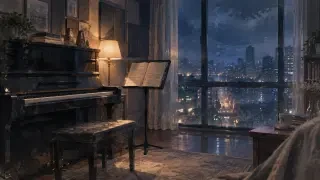
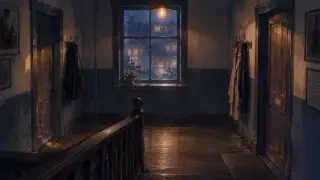
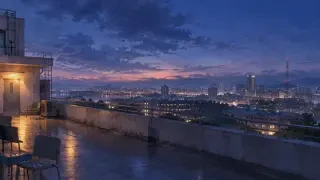
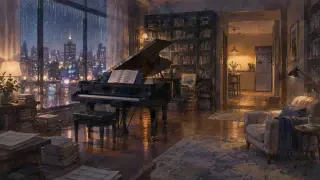
Four 16:9 backgrounds were painted at 2048×1152 to stage the investigation: the practice room at one in the morning, the stairwell landing where two doors face each other, the rooftop over the sleeping city, and the pianist's flat with its grand piano and rain-blurred window. Each keeps the lower third calm and uncluttered so dialogue and sprites can sit over it without fighting the art.
Both Ayn standees were background-removed with BiRefNet into true transparent PNGs, so he composites cleanly over any painted scene — no grey box, no matte edge — and can be swapped mid-scene without re-lighting the background.
The build was checked in-browser at 1280×800 — scene framing, sprite scale, text contrast in dark and light, the Save / Load / Restart menu and the free-text turn flow — then published in one click to a shareable play link, with the world's sprites, scenes and prompts left reusable by any fork.
Scene Backgrounds
Asset Prompts
"Cinematic 16:9 RPG game cover key art for 'Aurora', a gothic conservatory romance. A handsome young prodigy pianist with elegant dark hair, intense quiet eyes and a black concert suit sits at a grand piano in a vast empty conservatory at 3 AM, one warm spotlight, rain streaked tall windows, city lights beyond, scattered handwritten nocturne scores on the lid. Refined semi-realistic painterly style, value-defined contours, organized shadow planes, warm translucent midtones, small controlled speculars, idol semi-3D painterly, deep blue-hour indigo with amber lamplight. Dramatic composition with negative space, no text, no watermark, no logo."
"Ayn, a prodigy pianist with elegant dark hair and intense quiet eyes, wearing a fine black suit, seated at a grand piano in a dim empty concert hall with a single spotlight, portrait. No text, no labels, no letters, no signage anywhere."
"A small music-practice room at one in the morning — an upright piano, a music stand with hand-written sheets, a single warm lamp, a tall window over a sleeping city with scattered lights, acoustic panels, a cup of tea gone cold, intimate and quiet. Cheliz-style otome digital painting, watercolor-ink softness, painterly loose edges, soft cinematic lighting, subtle grain, muted modern palette of deep blue-hour indigo, warm lamplight amber, rain-glass grey and cream. 16:9 widescreen background illustration for a visual novel, no text, no watermark, no people, no UI, lower third calm and uncluttered."
"The rooftop of a music school over the city at night — low parapet, a few chairs, a city of lights stretching to the horizon, blue hour, a faint radio mast blinking, cold air, the city breathing below. Cheliz-style otome digital painting, watercolor-ink softness, painterly loose edges, soft cinematic lighting, subtle grain, muted modern palette of deep blue-hour indigo, warm lamplight amber, rain-glass grey and cream. 16:9 widescreen background illustration for a visual novel, no text, no watermark, no people, no UI, lower third calm and uncluttered."
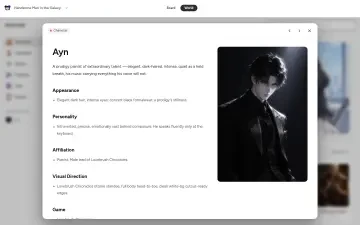
"Lovebrush Chronicles otome standee, full body head-to-toe, clean white-bg cutout-ready edges." — the world atom's visual direction for Ayn, used for both standees before BiRefNet removed the white ground and produced the transparent sprites above.
Why Choose Neta Studio
Professional — a cloud harness runs the whole production from world building to story direction to publishing, with no local setup. Stable access to the latest models: GPT Image 2 · BiRefNet · deepseek-v4-flash.
One-click generation — officially tuned skills drive every step: world building, roleplay drafting, key art and scene painting, transparent cut-outs, in-browser visual QA and one-click publishing, with world fork and resource sharing built in — so every sprite, scene and prompt in this route is reusable in your own world.
Community-first — users build unlimited worlds, and every public world can be forked, remixed and reimagined. Start from this conservatory at 3 AM, or begin fresh from any idea — a one-line prompt is enough.
Studio Interior
Start Creating
Aurora was generated by Neta Studio AI from a single world prompt — the world took minutes, the route and the artwork took minutes. You can do it too — adapt this world or start fresh from any idea. No coding required, free to start.