
Investigator Jiao-07 · Portrait — AI Archive Film from Neta Studio

Final Video: Investigator Jiao-07 · Portrait


Investigator Jiao-07 · Portrait is a five-second archive film from Bureau Nine Archives, the institution that documents events which are real yet cannot be fully explained. It is not a character trailer; it is evidence. A field investigator, case number K-07, recorded at 06:23:41 on 18 November 1996 above the North Suburb construction site — lantern still burning at his feet, film camera still in his hand.
The film is one continuous slow push-in with no cut: a wide shot from behind, a turn to profile against the dawn, then a close-up that holds eye contact a beat too long. Burned into the frame are the marks of a working archive — 档案编号 K-07 · 1996-11-18 · 06:23:41 · CLASSIFIED — with 监测地点:北郊城建工地 and 记录人:凌川 along the bottom edge. No explanation. No conclusion.
Watch the film: Investigator Jiao-07 · Portrait — 5 seconds, MP4 →
The Video
5 seconds · 960 × 960 · 24 fps — generated with Seedance 2.0 Fast from this world's own character sheet and location keyframes. The square frame is deliberate: a rounded black border and soft, grainy edges make it read like a recovered film scan rather than a social clip.
The burnt-in HUD — 档案编号 K-07, 1996-11-18, 06:23:41, CLASSIFIED, 监测地点:北郊城建工地, 记录人:凌川 — is the same archival grammar used across the Bureau's case films. It is not decoration; it is what turns a shot into a file.
How It Was Made
Production Process Breakdown
Bureau Nine Archives is built on a single rule: seventy percent verifiable fact, thirty percent classified framing, and no conclusions. The world's visual doctrine is Tarkovsky-inspired documentary realism — 1990s film stock, almost monochrome mossy green and damp brown, one warm practical light in the dark, dust in the air, static observational framing. Every generated frame has to feel like evidence from a case file, not a poster. That rule is what makes a five-second portrait read as an artefact instead of a character reveal.
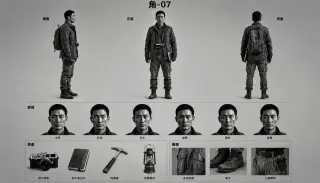
Before any motion, Jiao-07 was locked on paper: a complete reference sheet with front, profile and back views, six expression heads — neutral, suspicious, focused, frowning, alert, tired — four equipment callouts (Leica-style film camera, waterproof notebook, geologist hammer, portable lantern) and three costume details. Northern Chinese features, high cheekbones, square jaw, monolid, short black hair, worn grey field jacket, no insignia. The sheet is labelled in Chinese (侧面 / 正面 / 背面 / 表情 / 装备 / 服装) so the identity survives every later render.
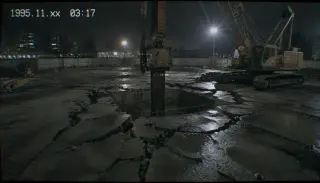
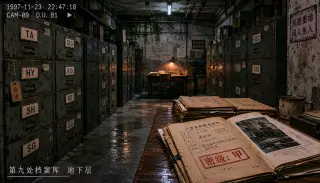
Two environments were keyed to the same palette: the underground archive vault — metal filing cabinets in rows, clearance markings, a single desk lamp — and the North Suburb construction site, already stamped 1995.11.xx 03:17 in a prototype keyframe. That timestamp is the origin of the film's HUD. The site's cracked concrete, crane silhouettes and wet reflections gave the portrait its cold grey background and its one warm point of light.
The first motion test was a four-second wide shot inside the archive vault: the investigator reduced to a silhouette in a distant doorway of light, shelves swallowing the frame. It was atmospheric and completely wrong for a portrait — the face never arrived. The pass was kept as a location plate and rejected as the final film.
A second test cut four investigators into one second each — Jiao-07 on site, Dou-03 over the evidence bags, Kang-09 with a geological compass, Liu-02 in the folklore stacks — to check whether the whole cast could share one film grammar. The cuts held, but the sequence belonged to a different file. It became the Bureau's rapid-montage case film; this portrait stayed a solo shot.
The final render is five seconds, square, with no cut: behind, profile, close-up. Seedance 2.0 Fast held the reference sheet's face, jacket, camera and lantern across the turn, and the archive HUD was burned in so the clip arrives already filed. It plays directly from the world's media library — no download required, just the record.
Generation Prompt
Recorded video prompt — spacing restored for readability, wording unchanged:
“Investigator Jiao-07 portrait shot. Character consistency maintained: Northern Chinese features, high cheekbones, square jaw, single eyelids, steady gaze. Camera movement: slow push-in, from chest portrait to facial close-up. Expression change: stern and solemn, slowly turning head, looking at shot, eye contact. Atmosphere: archive room, dim tone background, single warm profile lighting, film texture, documentary style. Avoid distortion, limb error, body drift.”
The renderer resolved the prompt against the archive's own reference sheet, so the face, the worn grey field jacket, the film camera and the lantern all stay on-model. The final frame also carries its own file header — 档案编号 K-07 / 1996-11-18 / 06:23:41 / CLASSIFIED / 监测地点:北郊城建工地 / 记录人:凌川 — burned in so the portrait arrives as a catalogued record rather than a clip.
Asset Prompts
“@Investigator Jiao-07, Complete character reference sheet for AI video generation. Single comprehensive image. CANVAS LAYOUT (neutral grey background, professional design sheet): TOP SECTION: Character name: Jiao-07 (large, top center); full body front view (center, largest, 40% of canvas); full body side view (left, smaller); full body back view (right, smaller). MIDDLE SECTION: 6 expression heads in a row: neutral, suspicious, focused, frowning, alert, tired — each face clearly visible, same person identity maintained. BOTTOM SECTION: 4 equipment items with labels: film camera, waterproof notebook, geologist hammer, portable lantern; 3 costume details: jacket texture, boots, belt with tools. CHARACTER: North Chinese Asian male, 35-40, high cheekbones, square jaw, monolid, high nose, darker skin, short black hair, steady eyes. Worn grey jacket, dark trousers, boots. No insignia. STYLE: 1990s documentary film, Kodak Tri-X 400 black-and-white grain, Tarkovsky aesthetic. Clean reference sheet layout, clear silhouettes, consistent character across all views. TEXT: Chinese only: Jiao-07 / front / profile / back / expression / equipment / costume. Minimal labels. CONSTRAINTS: One single image. Same person across all views. No poster, no trading card, no watermarks, no extra characters. Professional production reference sheet.”
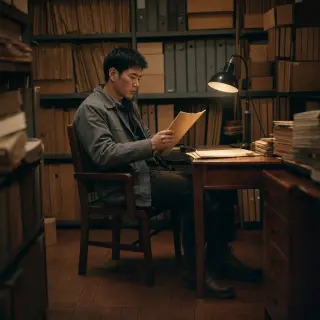
“@Investigator Jiao-07 Medium shot scene. archive room, warm desk lamp light, figure occupies one-third of frame. Northern Chinese male, age 35-40, high cheekbones, square jaw, single eyelids, short hair. grey jacket, dark trousers, boots. Kodak Portra 400 color film. single subject, text-free.”
“1995 Shanghai Dragon Pillar anomaly: piles that refused to drive down, strange cracks appearing on the ground.” The resulting keyframe carries its own 1995.11.xx 03:17 timestamp — the visual grammar the final film inherits.
Reference Frames


Why Choose Neta Studio
Professional — Neta Studio's cloud harness carries the whole chain from world building to a finished film: character bibles, location keyframes, motion tests and final renders, all in the browser with no local setup. Stable access to frontier models including Claude Opus 5, GPT Image 2 and Seedance 2.0 Fast.
One-click generation — Officially tuned skills drive each step. A single sentence produces a world; a reference sheet and a location plate produce a shot; a render publishes to a playable link. The prompts, frames and sprites stay yours to remix.
Archive-grade consistency — The same character sheet, palette and HUD grammar carry across every clip in a world, so a five-second portrait and a full case film look like they came out of the same filing cabinet. No coding required, free to start.
Studio Interior


Start Creating
One portrait, five seconds, and a world that already knows how to file it. Bureau Nine Archives was built in Neta Studio from a single premise; this film was generated from its own character sheet. Start from this world or bring your own — no coding required, free to start.