
Naruto Family Tree — Uzumaki, Uchiha, Hyuga and Senju Networks
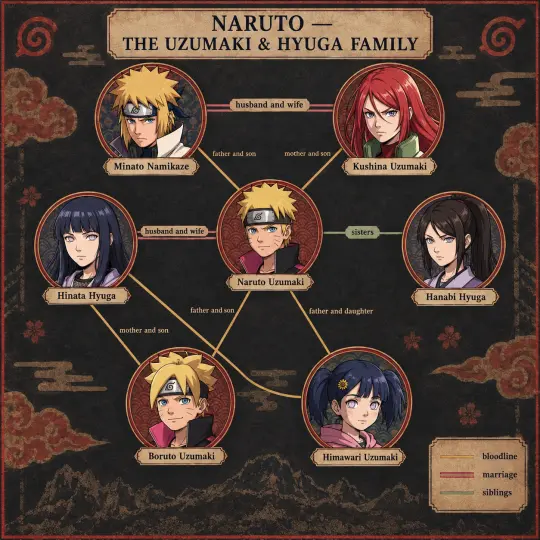
The Naruto family tree as four interactive networks: 24 characters, 8 locations, 4 events, 3 factions, with every parent, spouse, sibling, mentor and loyalty edge held as explicit data.
Naruto Family Tree — Four Bloodlines, One Village
The Naruto family tree is not one pedigree. It is four bloodlines that keep colliding inside the Hidden Leaf: the Uzumaki, who carry a jinchuriki burden across a destroyed homeland; the Uchiha, whose grief becomes a coup and then a massacre; the Hyuga, whose main and branch houses turn a family into a caste system; and the Senju, whose idea of the village is inherited by a granddaughter who never wanted the chair.
This archive treats every relationship as data, not decoration. Parent, spouse, sibling, adopted, mentor and loyalty edges are named pairs in a file; the four interactive networks draw those pairs, and an image model is never asked to invent a line. The result is a tree you can check, zoom and argue with.
The families
The story is not one tree but four arguments that share a village. The Uzumaki ask what a family owes a village that used its children as weapons. The Uchiha ask whether a founding clan can survive being treated as a suspect. The Hyuga ask whether a bloodline can reform itself without destroying its own house. The Senju ask whether a dream of peace can be inherited without becoming a bureaucracy. Each network has its own cast, centre and failure mode.
The Uzumaki network
Eight characters and twelve explicit edges. Minato and Kushina die sealing the Nine-Tails into Naruto; Naruto marries Hinata and builds the household that produces Boruto and Himawari. Mito Uzumaki, the first jinchuriki, and Nagato, the Uzumaki orphan who becomes Pain, sit at the network's two ends: the same clan, two completely different answers to power.

The Uzumaki network
Start with the hub, then follow the fault line into any of the four networks.
The Uchiha network
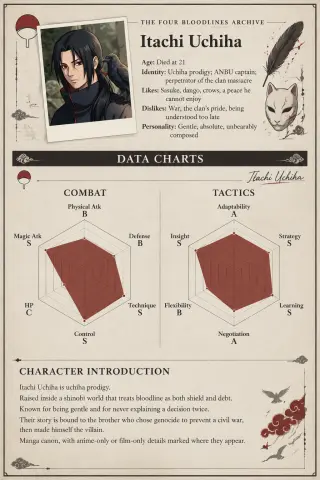
Nine characters and twelve edges. Fugaku and Mikoto raise Itachi and Sasuke inside a clan the village has fenced off. Itachi kills them on Konoha's order and leaves Sasuke alive; Sasuke marries Sakura and has Sarada; Madara and Obito pull the whole family toward the Eye of the Moon Plan. The Uchiha network is a genealogy of grief and the Sharingan that records it.

The Uchiha network
Start with the hub, then follow the fault line into any of the four networks.
The Hyuga network
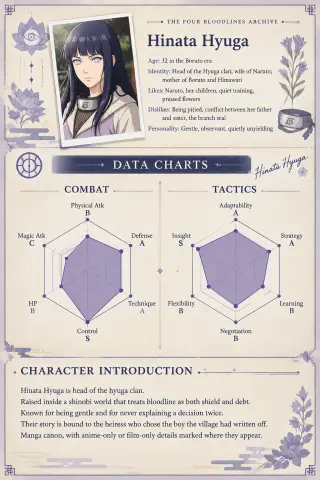
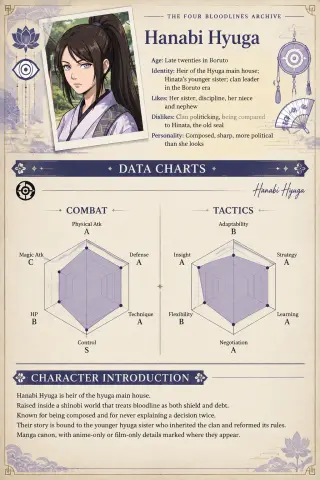
Eight characters and sixteen edges. Hiashi runs the main house; his twin Hizashi dies in his place; Neji grows up in the branch house believing fate is fixed. Hinata marries Naruto and brings the Hyuga argument into the Hokage's home, while Hanabi inherits the clan and begins to dismantle the worst of the old rules.

The Hyuga network
Start with the hub, then follow the fault line into any of the four networks.
The Senju network
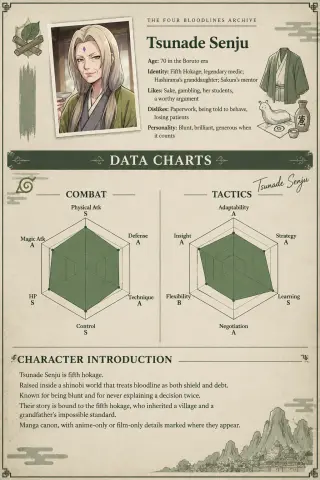
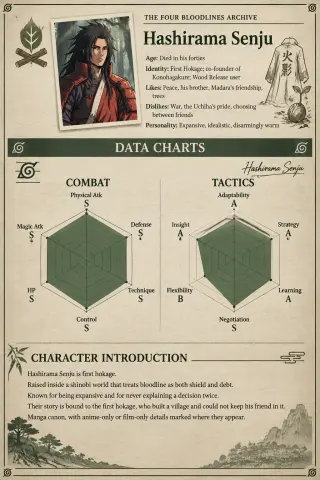
Nine characters and twelve edges. Hashirama and Tobirama build the village; Hashirama marries Mito Uzumaki; Tsunade inherits the name, the gambling debts and the Hokage's chair. Jiraiya teaches Minato, Nagato and Naruto, and Sakura inherits Tsunade's medical practice. The Senju network is about inheritance as obligation, not blood right.

The Senju network
Start with the hub, then follow the fault line into any of the four networks.
Seven profile cards
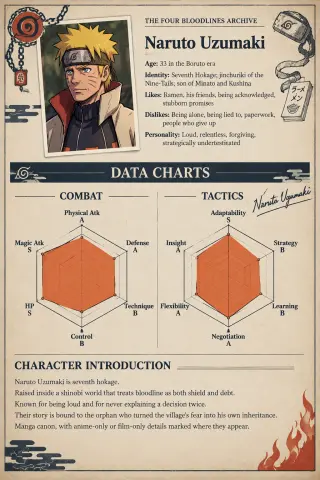
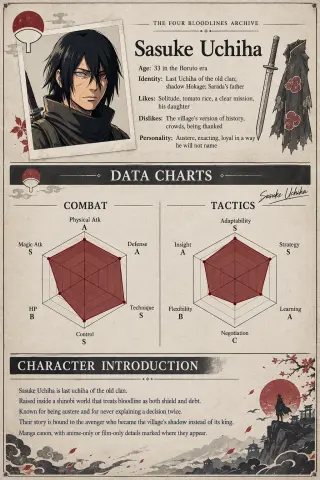
Seven archival profile cards, made with the character-profile-card skill: Naruto, Hinata, Sasuke, Itachi, Hanabi, Tsunade and Hashirama. Each is a full dossier, not a portrait: age, identity, likes, dislikes, personality, COMBAT and TACTICS radar charts, and a five-line introduction. The cards sit inside their family sections on the hub.
Five design sheets
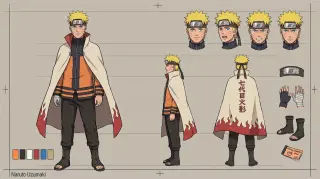
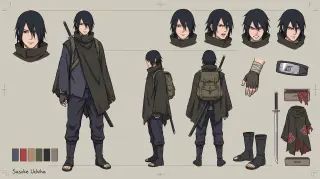
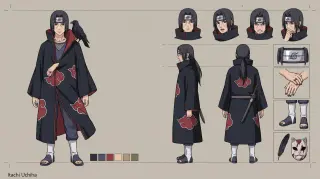
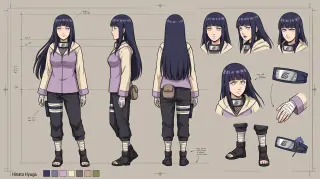
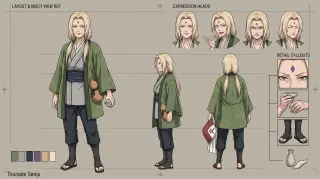
Five design sheets, made with the character-design-sheet skill: Naruto, Sasuke, Itachi, Hinata and Tsunade. Each shows front, side and back views at the same scale, four expression heads, detail callouts and a colour palette, so the same face and costume can be reused across the networks and the poster.
The family poster — seven people, nine edges
One family poster, made with the character-relationship-poster skill. It shows seven named people exactly once — Minato, Kushina, Naruto, Hinata, Boruto, Himawari and Hanabi — and draws exactly nine edges: the Minato-Kushina marriage, both parents to Naruto, the Naruto-Hinata marriage, both parents to Boruto and Himawari, and the Hinata-Hanabi sister line. The poster is a summary, not the source of truth.
Why a network instead of a poster
A poster is a picture of a family tree. A network is the family tree itself. In the four interactive networks every edge is a source-target pair with a relation type, so a line cannot drift to the wrong person. You can switch views, click a face and read the relations around it, and use it on a phone. None of that is possible when an image model is asked to draw a family tree from prose.
The poster still matters, but it has a different job: one glance, seven faces, nine correct edges, and a legend that separates bloodline, marriage and siblings. It is generated from the same cast and the same pairs, so it cannot contradict the networks.
Frequently asked questions
Is this canon? Yes: the relations follow the Naruto and Boruto manga, and anime-only or film-only details are marked at the atom where they appear.
Why four networks? A single graph with every character becomes unreadable, so each network keeps one argument legible and lets you start from the question you actually have.
Is Boruto included? Yes: Boruto, Sarada and Himawari are part of the next generation, and their parentage is drawn explicitly.
Is the poster enough? No: the poster is a summary, while the networks are the checkable source.
Every layer of this archive was built with four named skills: relationship-network for the four interactive graphs, character-relationship-poster for the family poster, character-profile-card for the seven dossiers, and character-design-sheet for the five turnaround sheets.
Open the full archive
Start with the hub, then follow the fault line into any of the four networks.