Steins;Gate — World Line AVG: The First D-Mail

Play Steins;Gate — World Line AVG: The First D-Mail, a browser interactive visual novel where you are Rintaro Okabe of the Future Gadget Lab. Send D-Mails into the past, watch the Divergence Meter climb, and fight across Alpha and Beta world lines to reach Steins Gate. Every choice is written live by an LLM as you play.
Final Product: World Line AVG — The First D-Mail


Steins;Gate — World Line AVG: The First D-Mail is a playable interactive visual novel set in Akihabara, summer 2010. You are Rintaro Okabe, self-proclaimed mad scientist and leader of the Future Gadget Lab — the day his microwave accident becomes the first time machine in history.
Every D-Mail you send rewrites reality. The Divergence Meter climbs with every timeline you break, SERN closes in, and on the Alpha world line Mayuri dies no matter what you do. Somewhere beyond Alpha and Beta lies the one corridor where both Mayuri and Kurisu survive — Steins Gate.
Play it now: Steins;Gate — World Line AVG: The First D-Mail →
Game Features
- Live LLM Narrative — Every scene, every reply, and every character — Okabe, Kurisu, Mayuri, and Daru — is written in real time by an LLM as you play. No two trips through the world lines unfold the same (deepseek-chat real-time narrative).
- D-Mail Choice System — Type a message, aim it at the past, and watch reality rewrite itself. Approve a D-Mail or cancel it — every text you send bends the world line around you.
- Divergence Meter — The nixie-tube meter ticks upward with every timeline you break. Cross 1.000000 and you have left the world you knew — and the story follows you.
- Live Lab Cast — Okabe, Kurisu, Mayuri, Daru and the rest of the Future Gadget Lab react to your choices in character, improvising dialogue as the plot spirals across attractor fields.
- Multiple Endings Across World Lines — From Mayuri's fixed death on Alpha to the war-torn Beta line, the ending is built from every choice — unless you can deceive fate itself and reach Steins Gate.
- Browser Playable — Runs directly in your browser, no download needed. Live LLM dialogue on every page turn.
Character Sprites


Production Process Breakdown
AI receives the prompt "Create a Steins;Gate world with time travel, the Future Gadget Lab, world-line divergence, and Okabe Rintaro's desperate fight against fate" and generates the Steins;Gate world — 29 atom cards: characters (8), locations (6), events (6), lore (4), tech (5). Each card contains original descriptions, cover art, and interconnections.
AI designs the game from atom cards: writes story rules, designs scene flow, generates all art assets (title background + scene backgrounds) and the character sprites. Each sprite was generated with a full-body sprite prompt, then background-removed to transparent PNG via BiRefNet.
Game built and published with one click, instantly shareable online. A live LLM (deepseek-chat) improvises dialogue in each character's voice — Okabe, Kurisu, Mayuri, and Daru — as you play.
Scene Backgrounds

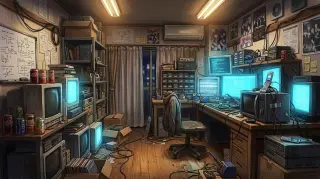
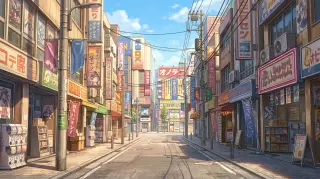
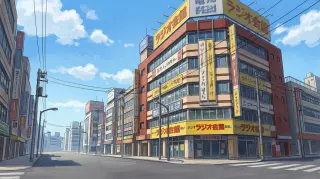
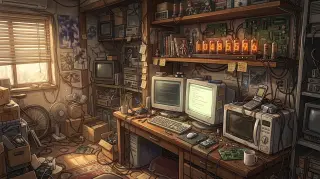
Asset Prompts
"Semi-realistic painterly anime visual novel title background, 16:9, Akihabara Electric Town at night, neon signs, CRT glow reflections on wet pavement, distant Radio Kaikan silhouette, warm street lights, cool blue night sky, empty street no people, no text, no logo, no watermark, no UI, cinematic game splash art, quiet dark lower third for title overlay"
"Semi-realistic painterly anime visual novel background, 16:9, interior of Future Gadget Lab Akihabara 2010, cramped second-floor apartment above Braun Tube Workshop, cluttered with CRT monitors, soda cans, unfinished gadgets, a microwave with a phone taped to it on a workbench, warm fluorescent mixed with CRT blue glow, empty room no people, no text, no watermark, clean center space for character sprite, game splash art style"
"Full-body visual novel character sprite source image for AVG runtime. One young Japanese man Rintaro Okabe standing upright in a natural neutral pose, entire body visible from head to shoes, centered with generous margin around hair, hands, clothing, and feet. Tall university student, wild messy black hair, intense eyes, white lab coat over black shirt, dark pants, phone in hand. Neutral calm expression. Plain pure white matte background (#ffffff) for clean cutout; no scenery, no interior, no exterior, no decorative backdrop, no gradient, no shadowy environment, no checkerboard transparency pattern, no pixel grid, no fake transparent background. Semi-realistic painterly anime style. No text, logo, watermark, frame, card border, or UI."
"Full-body visual novel character sprite source image for AVG runtime. One character standing upright in a natural neutral pose, entire body visible from head to shoes, centered with generous margin. Plain pure white matte background (#ffffff). Semi-realistic painterly anime. Kurisu Makise, young woman genius neuroscientist, long reddish-brown hair with side ponytail, white lab coat over red necktie and black top, short skirt and tights, thoughtful serious expression, full body shoes visible. No text logo watermark."
Why Choose Neta Studio
Professional — Cloud harness system supports the full workflow from world building to game publishing, all running in the cloud with no local setup. Stable access to the latest models: Claude Opus 5 GPT Image 2 DeepSeek V3
One-click generation — Officially tuned skills drive every step: world building, character design, art generation, game packaging. World fork resource sharing.
Community-first — Users build unlimited worlds, all public worlds can be forked, remixed, reimagined.
Studio Interior


Start Creating
This game was generated by Neta Studio AI from a single sentence. The world took minutes. The game took minutes. You can do it too — adapt this world or start fresh from any IP. No coding required, free to start.