The Inner Current — 15-Second Vertical Inner-Body AI Video — Neta Studio
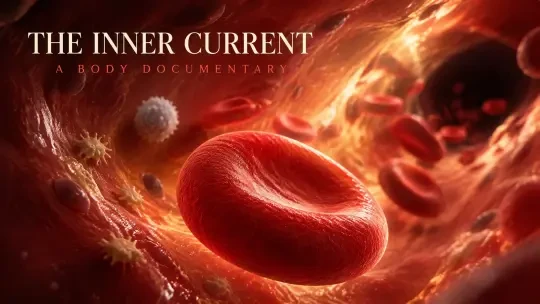
Final Video: The Inner Current — A 15-Second Vertical Inner-Body Short
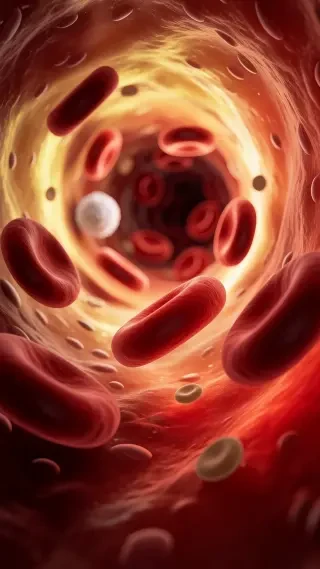
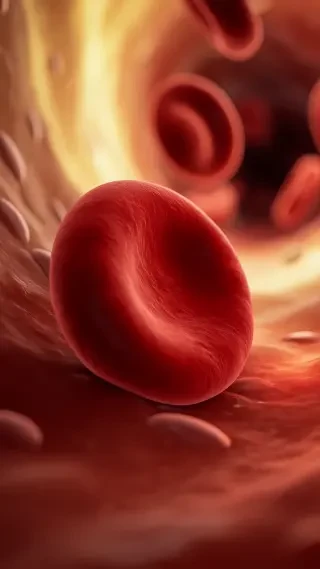
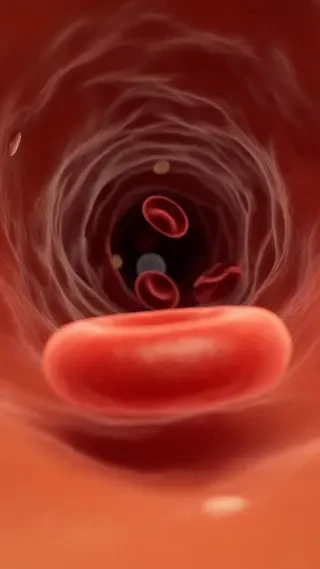
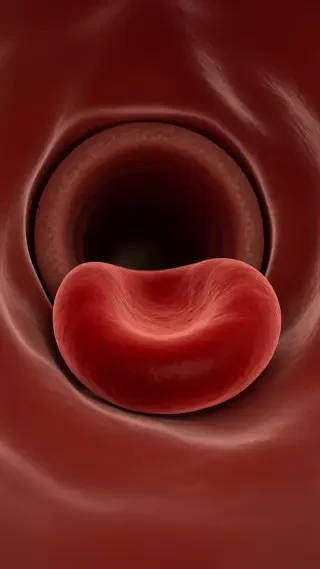
The Inner Current is a 15-second, 9:16 vertical inner-body short shot entirely inside a living human arteriole — the kind of camera you would normally only get with an endoscope, a scanning electron microscope and a very large visual-effects budget. Here it comes from one sentence: “video of a human cell floating along in the blood.” Warm golden-red plasma scatters light through the lumen, the endothelial wall pulses, platelets hug the lining, and one mature red blood cell — anucleate, biconcave, glossy scarlet — is shoved down the vessel by the heartbeat until its rim reaches the pinch of a capillary.
No narrator, no music, no microscope hardware, no exterior anatomy: just fifteen seconds inside the blood, riding the current with a single cell. The heartbeat is the clock, the plasma whoosh is the score, and the last thing you see is a membrane beginning to fold into a channel narrower than itself.
▶ Watch The Inner Current in full — 15 seconds, vertical, sound on.
The Video
15 seconds · 9:16 vertical (1080 × 1920) · photoreal medical CGI · no dialogue, no music — rendered with Seedance 2.0 in image-to-video mode from the world’s own reference frames, in a single continuous pass with four hard-cut beats authored directly in the prompt. Sound is effect-only: a muffled deep heartbeat, a wet plasma whoosh, a soft membrane flex on the pulse and a rubbery creak at the pinch.
How It Was Made
Production Process Breakdown
The world starts from a single line — “video of a human cell floating along in the blood.” Neta Studio’s one-line creation mode expands that sentence into a complete inner-body documentary world: a camera living inside a human arteriole, warm golden-red volumetric light through translucent plasma, a faintly pulsing endothelial wall, beige platelets hugging the lining, and a single scarlet red blood cell chosen as the protagonist of the whole piece.
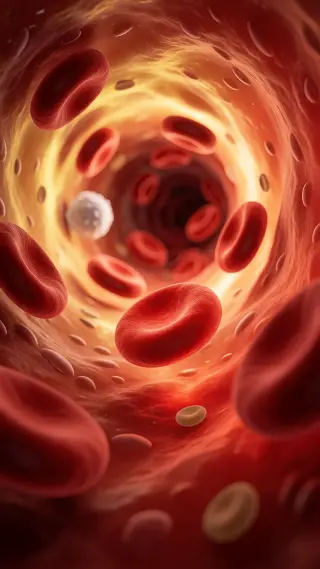
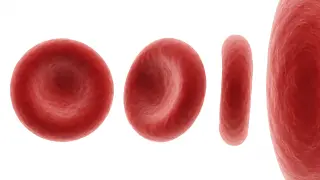
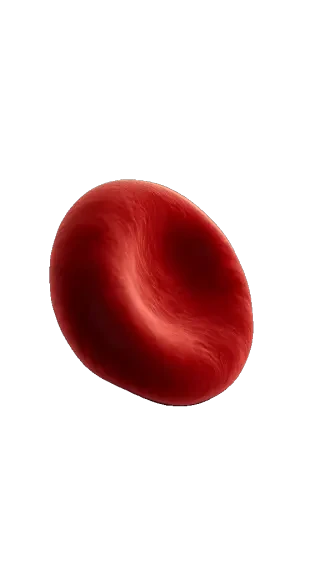
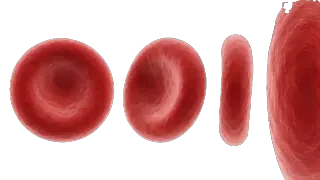
Two reference images lock the look before any motion exists. The scene reference fixes the world — the arteriole lumen, the plasma colour, the lighting, our cell in the near-centre of the current, other cells receding down the vessel and the capillary mouth a dark pinch in the distance. The character reference is a four-view studio sheet of the exact same erythrocyte — face-on, three-quarter, edge-on profile and an extreme membrane close-up — so the cell can never be re-invented mid-shot.
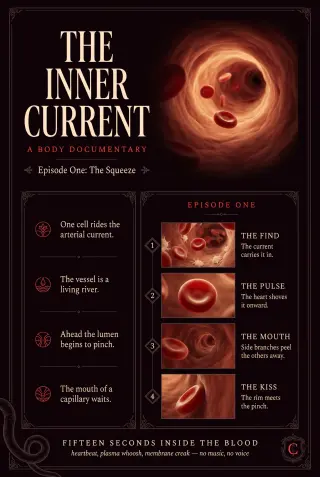
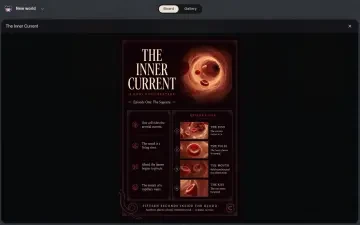
The two references are then composed into a single vertical episode board, “The Inner Current — Episode One: The Squeeze.” It works as the film’s key art and as its story map at once: the title block, one large atmospheric frame of the arteriole, a four-entry sidebar of one-line beats, and an episode panel whose four numbered photographs — The Find, The Pulse, The Mouth, The Kiss — match the four beats of the finished video exactly.
There were no failed takes and no re-rolls on this one: the final render is the first render. Both reference frames are passed in as reference_image inputs and the motion is controlled entirely at the prompt level — one protagonist cell and never a duplicate, a hard rule against microscope hardware, diagrams, HUD or exterior anatomy, a four-beat timeline (0-3s find, 3-7s pulse, 7-12s mouth, 12-15s kiss) with hard cuts between beats, and an explicit instruction that the squeeze must begin but never complete. Seedance 2.0 renders all fifteen seconds in one continuous image-to-video pass.
The prompt also carries the sound design, so the clip arrives finished: no music, no voiceover, no narration — only a muffled deep heartbeat as the world’s clock, a wet plasma whoosh, a soft flex of membrane on each pulse, and a rubbery creak with a plasma hiss at the pinch. The look is kept deliberately un-glossy: slightly missed focus, mild motion blur, natural compression, no HDR.
Generation Prompt
The full prompt behind the final 15-second render. Both reference frames are passed in as "reference_image" inputs; everything else — blocking, camera, beats, sound and the hard negative constraints — is authored here.
15 seconds. Photoreal medical inner-body documentary, National Geographic / Inner Space CGI, vertical 9:16. Interior of a living human arteriole. Continuous present, wet organic lighting: warm golden-red volumetric light scattering through translucent plasma. No music, no voiceover, no dialogue, no narration.
Reference image 1 (reference_image): three-view of our single mature human red blood cell. This is the only cell we follow. Match that exact scarlet biconcave disc, glossy membrane, deep central dimple, no nucleus. Do not re-invent its shape or color.
Reference image 2 (reference_image): the arteriole interior. This is the vessel, the endothelial wall, the plasma color, and the lighting. Keep that world.
Event goal: one red blood cell rides the arterial current until its leading rim kisses a capillary mouth and begins to fold. The squeeze is not completed.
Spatial blocking before anything moves: camera is inside the lumen looking down the vessel. Our cell occupies the near-center, slightly lower-middle in the current. Other red cells recede into the distance. Small beige platelets hug the endothelial lining. One larger pale white blood cell sits far left in the background. Ahead, the lumen begins to narrow toward a darker capillary mouth.
Camera: close third-person, always with our cell, never a microscope eyepiece, never an exterior body, never a diagram.
Beat timeline:
0-3s: Camera finds our cell among the others in the arteriole. Platelets tumble along the lining. The white cell drifts far left. Slow push toward our disc. Hard cut.
3-7s: Close third follows as our cell rotates once in the current. A pressure pulse from the heart flexes the disc; it recovers and is shoved onward. Hard cut.
7-12s: Camera looks past our cell. The capillary opening grows in frame. Side-branch cells peel away. Ours stays on the center line, approaching. Hard cut.
12-15s: The leading rim of our cell contacts the capillary mouth and begins to fold inward. Camera eases in. Hold as the fold starts — do not complete the squeeze.
Sound: sound effects only, no background music, no spoken words, no dialogue, no narration. Muffled deep heartbeat as the world's clock. Wet plasma whoosh. On the pulse, a soft flex of membrane. At the pinch, a rubbery creak and a plasma hiss.
Hard constraints: one protagonist cell, no duplicate of our cell, no extra lobes or torn membrane, no text, no labels, no HUD, no diagrams, no people, no exterior anatomy, no microscope hardware, no cartoon look, no beauty filter. Photoreal wet organic CGI. Slightly missed focus, mild motion blur, natural compression, no HDR.
Asset Prompts
<p>Photoreal medical CGI, Inner Space and National Geographic inner-body documentary look. Vertical 9:16 frame. Camera is inside a living human arteriole lumen.</p><p>Warm golden-red volumetric light scattering through translucent plasma. Curved endothelial wall with faint elongated nuclei, the wall slightly pulsing. A single mature biconcave red blood cell in the near-center of the current, scarlet, glossy, tumbling slowly, occupying the lower-middle of the frame. Other red cells recede into the distance along the vessel. A few small beige platelets hug the wall. One larger pale white blood cell far in the background left. Ahead in the distance the lumen begins to narrow toward a darker capillary mouth.</p><p>Wet, viscous, organic, no text, no labels, no HUD, no diagrams, no people, no exterior anatomy, no microscope hardware.</p>
<p>Photoreal scientific visualization, medical CGI quality matching a National Geographic inner-body documentary. Four views of the SAME single mature human erythrocyte (red blood cell) arranged left to right on a seamless pure white studio background, even soft studio lighting, no text, no labels, no borders, no watermarks, no scale bars, no diagrams.</p><p>Left to right on one row:<br />1) face-on front view of the cell showing the classic biconcave disc with a deep central dimple, smooth glossy scarlet-crimson plasma membrane, slightly translucent gelatinous interior, no nucleus<br />2) three-quarter view of the same cell, dimple still visible, rim catching a specular highlight<br />3) edge-on profile of the same cell, thin dumbbell doughnut cross-section, both dimples visible as concavities<br />4) extreme close-up of the membrane surface of the same cell, lipid-bilayer sheen with faint protein texture, still photoreal</p><p>Consistent scarlet-red color, wet organic membrane, one cell only, no other cells, no blood plasma, no vessel wall.</p>
<p>A vertical series pitch page for a screen story, laid out as one dark ornate printed page. The whole page is near-black deep wine black, edged with a thin double rule and small ornamental flourishes at each corner. Body text is warm cream; headings and ornaments are warm arterial red.</p><p>The three photographic images on this page are photoreal live-action film stills in full colour — real skin texture, real fabric, film grain, true photographic depth of field. No illustration, no painting, no drawn or cartoon look inside them. The page furniture — rules, ornaments, panels, type — is flat print laid over the dark ground.</p><p>The world in every image is the same: Interior of a living human arteriole, warm golden-red plasma light scattering through the lumen, endothelial walls faintly pulsing. The same single mature human red blood cell in every image: anucleate biconcave disc, glossy scarlet-crimson membrane, deep central dimple, no nucleus, wet organic sheen. It is the same cell in every photograph.</p><p>Upper left, the title is set very large across three stacked lines in an elegant high-contrast display serif with tall capitals, reading "THE" then "INNER" then "CURRENT". Directly beneath it a small widely letterspaced line in warm arterial red reads "A BODY DOCUMENTARY". Beneath that, flanked by two tiny ornamental fleurons, a line reads "Episode One: The Squeeze".</p><p>Upper right, one large atmospheric photograph of the arteriole seen wide from inside the plasma, endothelial walls curving away, other red cells receding, our cell small in the current, the capillary mouth only a distant dark pinch. It is big: it fills the whole upper right of the page, stands as tall as the entire title block beside it, and takes up nearly half the width of the page. It has no frame and no border at all: its edges darken and dissolve softly into the black page so there is no visible boundary.</p><p>The lower half of the page holds two bordered panels side by side, each edged with a thin rule and small corner ornaments.</p><p>The left panel is a vertical list of four very short entries. Each entry has a small warm arterial red line-art emblem at its left and one short line of small cream text beside it, never more than about eight words, and each entry is separated from the next by a thin horizontal rule with a tiny diamond at its centre. The four entries read, in order: "One cell rides the arterial current." / "The vessel is a living river." / "Ahead the lumen begins to pinch." / "The mouth of a capillary waits."</p><p>The right panel is headed by a small widely letterspaced line in warm arterial red reading "EPISODE ONE", with a small ornament beneath it. Under that heading are four stacked entries. Each entry has, at its left, a small diamond-shaped badge holding a numeral, then a large rectangular photograph that takes up about half the width of the panel and is clearly the biggest thing in its row, and to the right of those a heading in small serif capitals with one very short line of small cream text beneath it. The four entries are: badge one, a photograph of camera finding our scarlet disc among other cells with platelets on the wall, heading "THE FIND", text "The current carries it in."; badge two, a photograph of close on the cell rotating, dimple catching light as a pulse flexes it, heading "THE PULSE", text "The heart shoves it onward."; badge three, a photograph of looking past the cell toward the narrowing capillary mouth growing in frame, heading "THE MOUTH", text "Side branches peel the others away."; badge four, a photograph of the cell's leading rim just touching the capillary entrance, fold only beginning, heading "THE KISS", text "The rim meets the pinch.". Each heading and each photograph belong to the same entry and match each other exactly.</p><p>Along the bottom, centred, one widely letterspaced line reads "FIFTEEN SECONDS INSIDE THE BLOOD", and beneath it one short line of small italic cream text reads "heartbeat, plasma whoosh, membrane creak — no music, no voice". In the bottom left corner a large dark coiled capillary illustration curls into the margin, and in the bottom right corner an ornate monogram cartouche holds the single letter "C".</p><p>Every piece of text listed above is spelled exactly as given and written once only. There is no other text anywhere on the page — no page numbers, no captions beyond those given, no signature, no watermark, no gibberish lettering, and no invented words.</p>
Reference Frames
Why Choose Neta Studio
Professional — the full workflow runs in the cloud with no local setup: world building, key art, character sheets, episode boards, image-to-video and instant publishing to a shareable link. Stable access to the latest models: GPT Image 2 Seedance 2.0 Seedance 2.5 Kling Image-to-Video MiniMax H3.
Cinematic control without a studio — reference frames, character sheets and prompt-authored beat timelines give you documentary-grade consistency: one protagonist, one world, one locked look, across every shot. Physics-heavy subjects like fluids, membranes and soft tissue stay wet, organic and photoreal.
One sentence in, a finished short out — start from any idea, adapt an existing world, or remix a public one. Vertical 9:16, sound design included, published to a link you can share immediately. No coding required, free to start.
Studio Interior
Start Creating
This video was generated by Neta Studio AI from a single sentence about a cell in the blood. The world took minutes. The video took minutes. You can do it too — adapt this world or start fresh from any idea. No coding required, free to start.