The Long Watch — Neta Studio AI Video
Final Video: The Long Watch

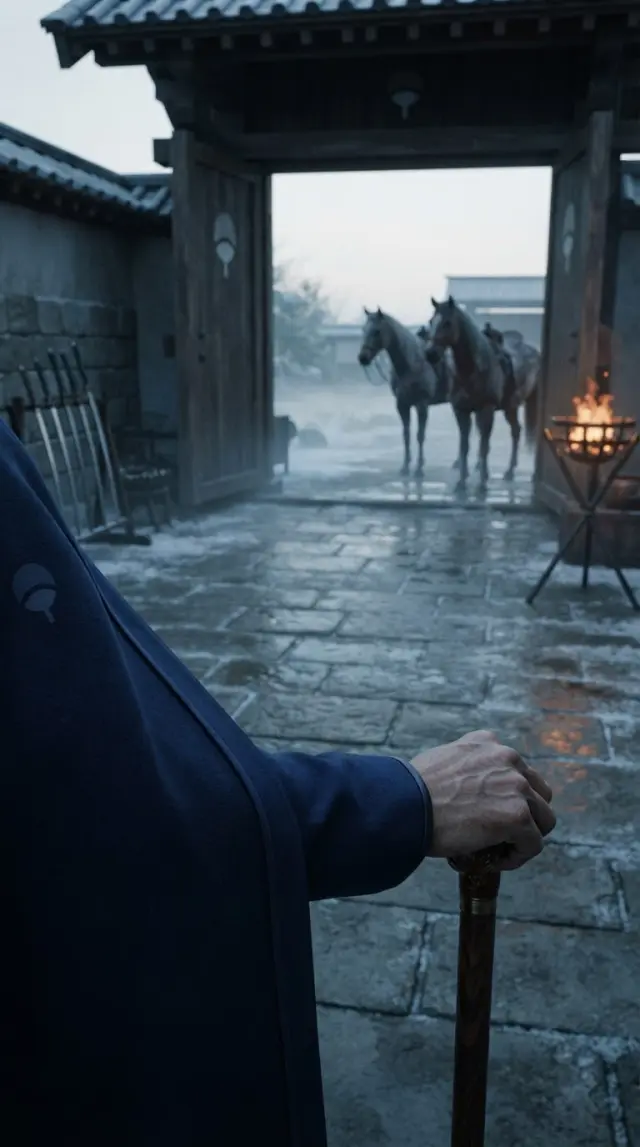
Ten seconds. One unbroken take. A maimed Uchiha lord grips his cane at the gate of his own compound and watches both of his surviving sons ride out to a war he can never ride to again.
The Long Watch is a 10-second first-person POV historical short generated by AI in Neta Studio. The camera sits in the viewer’s own eye line — Tajima Uchiha, the maimed patriarch of the Uchiha clan — and never leaves the gate: a frosted flagstone courtyard at cold grey dawn, two saddled horses waiting at the open timber gate, a blacksmith’s brazier still burning orange. His heir Madara swings up in scarred crimson lamellar, grave and silent; his younger son Izuna mounts last, grinning, and calls back over his shoulder — “We’ll be home before you’ve finished scowling, Father.” Then the hoofbeats fade, the courtyard is empty, and the only thing left to watch is the hand whitening on the cane.
The clip is semi-realistic and painterly — deep indigo, iron grey and ember orange, real fabric and film grain — and it plays the whole beat as a single fixed take at the viewer’s chest height with only a slight handheld drift. Sound is effects only: hooves on wet stone, armour plates, a distant smith’s hammer, wind through the gate.
Watch it now: The Long Watch →
The Video
9:16 vertical · 716×1284 · 24 fps · 10 seconds · image-to-video — rendered with Kling Image-to-Video (kling-image-to-video) from the vertical POV scene plate.
How It Was Made
Production Process Breakdown
The world is Sengoku Shinobi: Blood of the New Moon — an alternate Sengoku Jidai where the shinobi clans are not hidden villages but sovereign nations drawn across the real geography of East Asia. Along the Tone River the Senju hold the forested north bank and the Uchiha the fertile south, and every truce between them runs through clan war. The film picks one quiet morning on the Uchiha side and turns it into a character piece: Tajima Uchiha, the patriarch maimed in the Hagoromo betrayal — a lost leg, a spine that never stops aching, a grudge he lays at the Senju’s feet — can only watch as his remaining sons ride to the river war he can no longer fight.
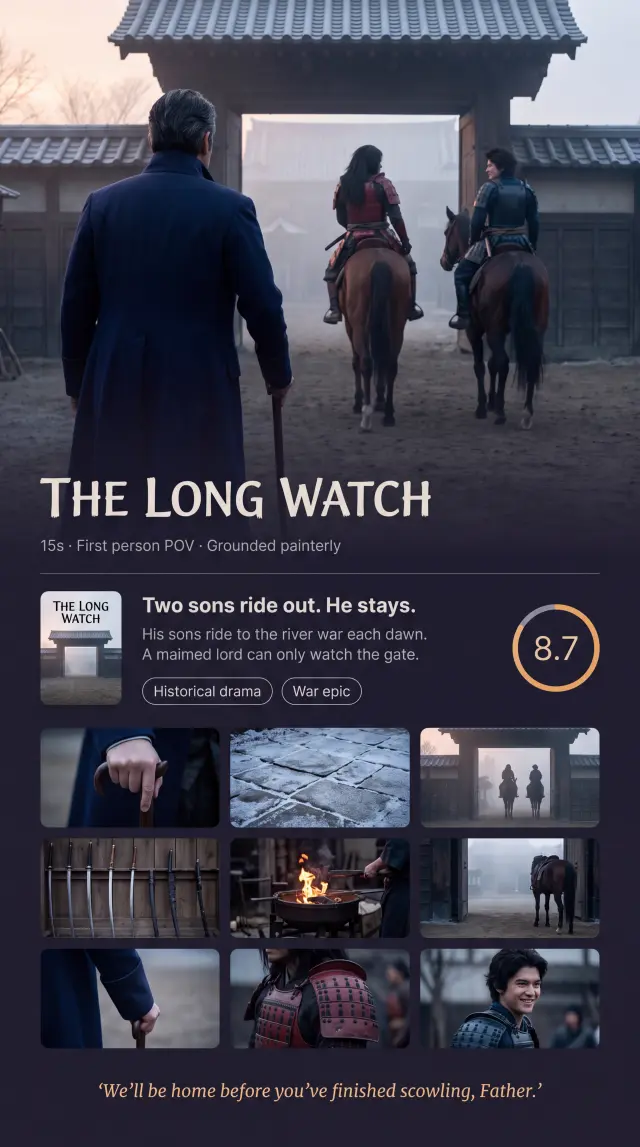
Two locked sources define the film. First, a vertical first-person POV scene plate fixes the exact opening composition and the viewer’s point of view: an older Uchiha lord’s gnarled hand closed around a dark polished cane, the cuff and hem of a deep indigo high-collared battle coat at the lower right of frame, a wet frosted courtyard, two saddled horses, a burning brazier and a rack of long swords. Second, a vertical title-page board locks the cast, palette and lighting — the same lord, and the two sons in crimson and dark-blue lamellar. Because both boards share one indigo-iron-ember palette and one cold dawn, the finished take holds together as a single, believable place.
The first two attempts to film the sequence were 15-second passes on <strong>Seedance 2.0 Fast</strong>, both rejected mid-render by the provider’s output policy (“OutputVideoSensitiveContentDetected.PolicyViolation” — flagged as possibly tied to copyright restrictions). Neither pass ever produced an MP4. The prompts were tightened afterwards, the two named sons were reduced to roles (“the elder son”, “the younger son”), and the target length was cut from 15 seconds to a single 10-second beat.
The finished film was rendered in one image-to-video pass with <strong>Kling Image-to-Video</strong> from the vertical POV scene plate. The motion prompt keeps the camera fixed at the viewer’s chest height with only a slight handheld drift, and scripts the beat second by second: the sons mount and ride out through 0:06, the elder’s eyes lift to the gate for a single silent beat, and the final two seconds hold on the empty courtyard while the cane-hand whitens on the grip. Hard constraints in the same prompt keep the film first-person throughout — the viewer’s face never appears — and forbid on-screen text, signage, modern objects and duplicated limbs. The recorded pass completed ready at 716×1284.
The finished film publishes instantly to a shareable link that plays in any browser — no download needed — and lives in the same world as its source plates, ready to remix into a longer cut or the next dawn at the gate.
Generation Prompt
10 seconds. Semi-realistic painterly historical war film, a warlord clan's castle compound courtyard and heavy timber gate in Sengoku-era Japan, grey pre-dawn, cold mist, ember braziers, one continuous take. Image 1 is the opening frame: a first-person view from the viewer's own eye line at the gate — the viewer's cane-hand and the cuff of a deep indigo coat at the lower right of frame, a wet flagstone courtyard, two saddled horses waiting at the open timber gate, thin mist beyond. Two young horsemen: the elder son, about twenty-four, waist-length untamable black hair, scarred crimson lamellar armour, grave; the younger son, eighteen, a wild shorter black shock of hair, dark blue lamellar armour, grinning. Event goal: a maimed clan lord watches his two sons mount and ride out to war, unable to follow; by the end the courtyard is empty and his grip on the cane has tightened. Blocking: the viewer stands still at the gate, a dark wooden cane under one hand; the two sons are to the left and centre of the courtyard before the open gate, the elder already mounted and turned outward, the younger mounting last and nearest the viewer; behind them a rack of long swords and a burning brazier. Camera: fixed at the viewer's chest height for the whole take, with a slight handheld drift. 0:00–0:03: the cane-hand and indigo cuff rest low in the lower right of frame; ahead, the two sons swing up onto the saddled horses at the open gate. Hooves scrape wet stone, armour plates click, a blacksmith's hammer rings far off, wind. 0:03–0:06: the younger son hauls his horse half-round toward the gate, grinning, and calls back over his shoulder — he says, 'We'll be home before you've finished scowling, Father.' His horse snorts and stamps. 0:06–0:08: the elder son's eyes lift to the gate for a single beat, grave, and he says nothing; he turns his horse and rides out into the mist, both riders carrying out through the gate and out of frame. Hooves quicken, wind rises. 0:08–0:10: the courtyard is empty and still; the viewer's cane-hand fills the lower right of frame, knuckles whitening on the grip. Hooves fade, the hammer rings far off, wind. Sound: sound effects only, no background music. Hooves on wet stone, armour plates, a distant smith's hammer, wind through the gate. Hard constraints: first person — the viewer's face never appears, only the cane-hand, the indigo sleeve and what the viewer sees; no on-screen text, no signage, no banners.
Asset Prompts
Vertical first-person POV scene plate for a historical war film. The viewer is an older Uchiha lord standing at the timber gate of an Uchiha compound courtyard at cold grey dawn. In the lower right of frame: the viewer's own hand — an older man's, knuckles gnarled — closed around the head of a dark polished wooden cane, and the cuff and hem of a deep indigo, high-collared Uchiha battle coat; keep the exact indigo colour and cut of the coat shown in the attached reference image. Ahead: a wet stone courtyard, thin frost on the flagstones, two saddled horses waiting by the open gate, a blacksmith's brazier still burning orange, a rack of long swords along the wall, low mist outside the gate. Palette of deep indigo, iron grey and ember orange. Semi-realistic painterly wartime historical look, film grain, soft dawn contrast, cinematic depth of field. No text, no lettering, no watermark.
A tall vertical key art page for an upcoming series, laid out like a premium streaming service's title page — restrained, cinematic, mostly image. The page ground is a deep desaturated indigo. All interface furniture — type, thin dividers, pill outlines, the score ring — is flat, crisp and minimal, laid over the photography. Every photograph on this page is a photoreal live-action film still in full colour — real skin texture, real fabric, film grain, true photographic depth of field. No illustration, no painting, no drawn or cartoon look inside any photograph. The world in every still is the same: the Uchiha compound in Sengoku Japan, cold grey dawn, ember light, thin mist. The same maimed Uchiha patriarch appears throughout — a man in his late forties with grey-streaked black hair, a deep indigo high-collared battle coat and a dark wooden cane, his left leg gone below the knee; when his two sons appear they are the same in every image, the elder about twenty-four with waist-length untamable black hair and scarred red armour, the younger eighteen with a wild shorter black shock of hair and dark blue armour. The hero still begins at the very top edge of the page and fills the top three fifths of it: one large full-bleed photograph of a lone figure in a deep indigo coat seen from behind at a compound gate, a dark cane under one hand, watching two mounted horsemen ride off through the gate into cold dawn mist as the courtyard empties behind them, given plenty of room to breathe, its lower edge fading smoothly into the page ground. There is no bar, no band, no strip and no block of flat colour above the photograph or across the top of the page — the photograph itself reaches the top edge and the very first thing at the top of the page is the image. Above the title, the hero photograph runs uninterrupted all the way to the top edge of the page: that entire upper area is bare photograph with nothing whatsoever laid over it. The title is the very first element on the page. Laid over the lower left of the hero, the title reads "THE LONG WATCH" in a weathered high-contrast serif with slightly irregular, brush-like terminals. It is completely flat — no bevel, no three-dimensional extrusion, no metallic sheen, no chrome, no drop shadow and no glow. Directly beneath the title, one small thin line of metadata reads "15s · First person POV · Grounded painterly". Below the hero, a thin full-width divider. Under it, on the left, a small upright poster thumbnail card with rounded corners showing a small upright poster of the empty compound gate in cold mist. To the right of that thumbnail: one short bold headline reading "Two sons ride out. He stays.", and beneath it two short lines of small grey body text reading "His sons ride to the river war each dawn. A maimed lord can only watch the gate." Beneath that sit two rounded outline pill buttons side by side, the first reading "Historical drama" and the second reading "War epic". At the right end of that same row, a small refined circular score ring: a single thin even stroke with rounded ends, sweeping about three quarters of the way round in warm amber. The remaining quarter of the circle is completed by a pale frosted arc of the same thickness that is clearly lighter than the page behind it, as though it were milky glass over the ground. It is never darker than the page. The number "8.7" is set large and light in the centre of the ring. There is no word or label of any kind beneath or beside the ring. Below that row, with no section label and no heading of any kind, a tidy grid of nine small stills, three across and three down, narrow even gutters, slightly rounded corners. The nine are different moments from the same world and are deliberately not in story order: a hand whitening on a dark cane grip; frost on courtyard flagstones; two riders shrinking into gate mist; a rack of Uchiha-forged swords along a plank wall; a blacksmith's brazier still burning orange; the bare saddle-less spot by the gate where a third horse is not; the indigo cuff of a coat at the edge of frame; the scarred red shoulder-plate of the elder rider; the younger rider's grin caught mid-turn. Beneath the grid, centred in generous empty space, one line of quoted dialogue reads "We'll be home before you've finished scowling, Father.", set in a plain warm serif italic. The page ends there — there is no bar, no panel, no strip and no block of any kind below that line, only clean empty page ground. Every piece of text listed above is spelled exactly as given and written once only. There is no other text anywhere on the page — no section labels, no cast list, no credits, no additional captions, no ratings from any real review company, no other brand names, no page numbers, no signature, no watermark, no gibberish lettering and no invented words.
Reference Frames
Why Choose Neta Studio
Professional — The full pipeline from world building to cinematic video runs in the cloud, with no local setup. Direct access to current-generation models, including Kling Image-to-Video, Seedance 2.0 Fast and GPT Image 2.
One-click generation — Tuned skills drive every step: world building, reference art, image-to-video, and instant publishing to a shareable link. When one model is blocked, the workflow can reroute to another and finish the shot.
Community & IP-first — Adapt any world or start fresh from a single sentence. Keep your frames, prompts and references — remix them into new clips anytime. No coding required.
Studio Interior


Watch & Explore
This 10-second first-person short was generated by Neta Studio AI from a vertical POV scene plate and one motion prompt. The world took minutes. The film took minutes. You can do it too — explore this world’s studio or start fresh from any idea. No coding required, free to start.