Still Rolling — The Full Tape — AI Found-Footage Horror Short
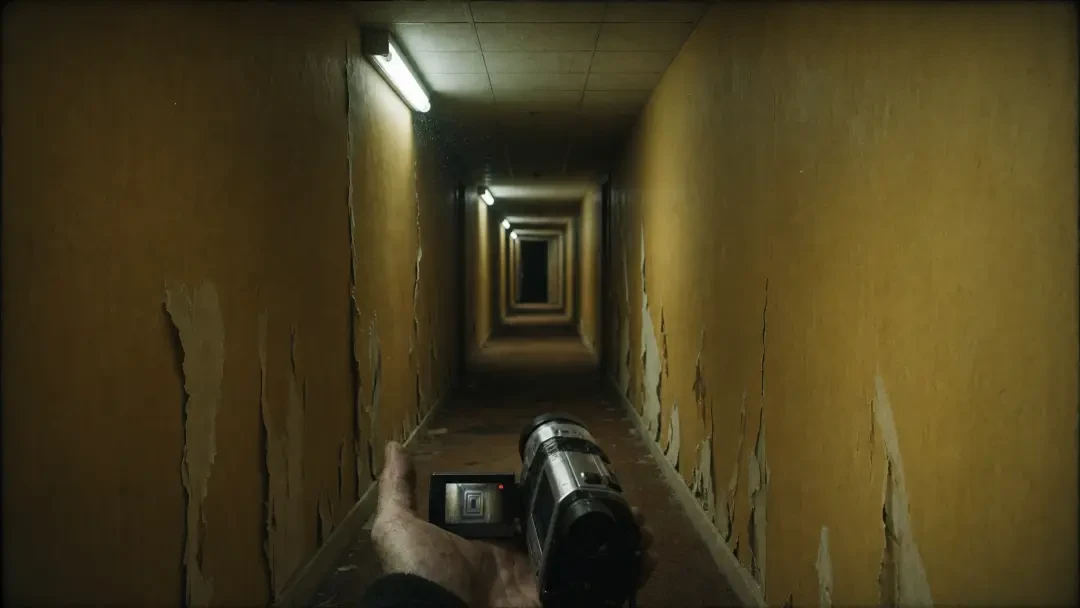
Watch Still Rolling — The Full Tape — a 37-second vertical 9:16 AI found-footage horror short from Neta Studio: a first-person walk down an endless mustard-yellow office corridor with a taped silver DV camcorder, rendered with Seedance 2.0 and cut from three separate takes into one continuous tape.
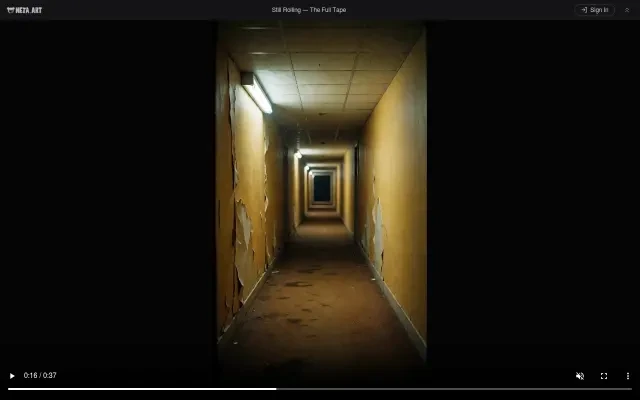
Final Video: Still Rolling — The Full Tape
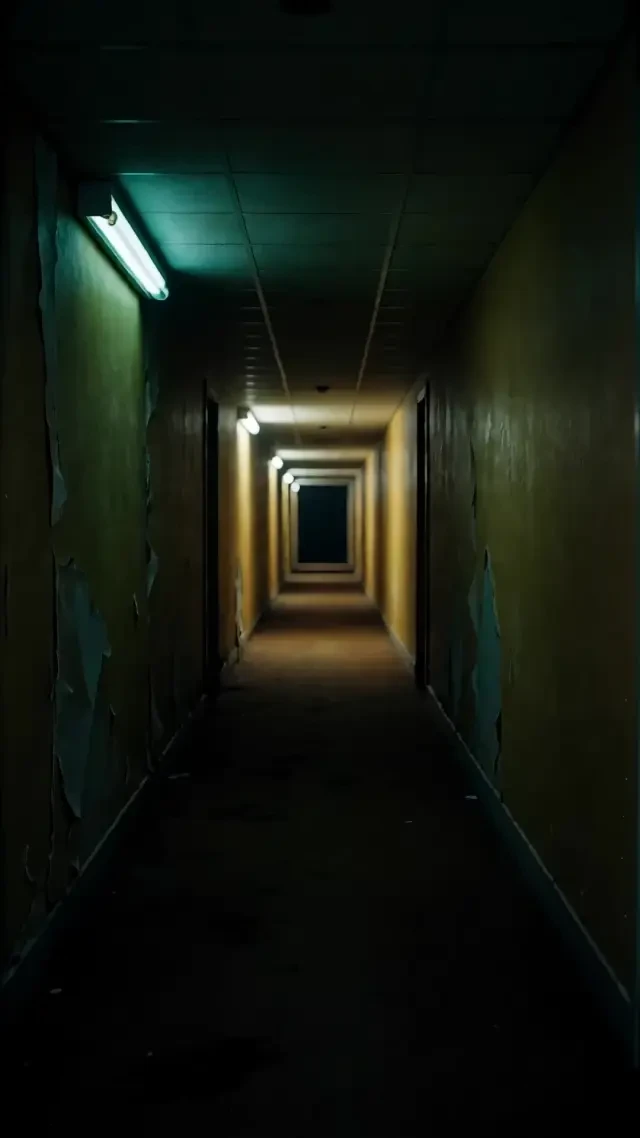
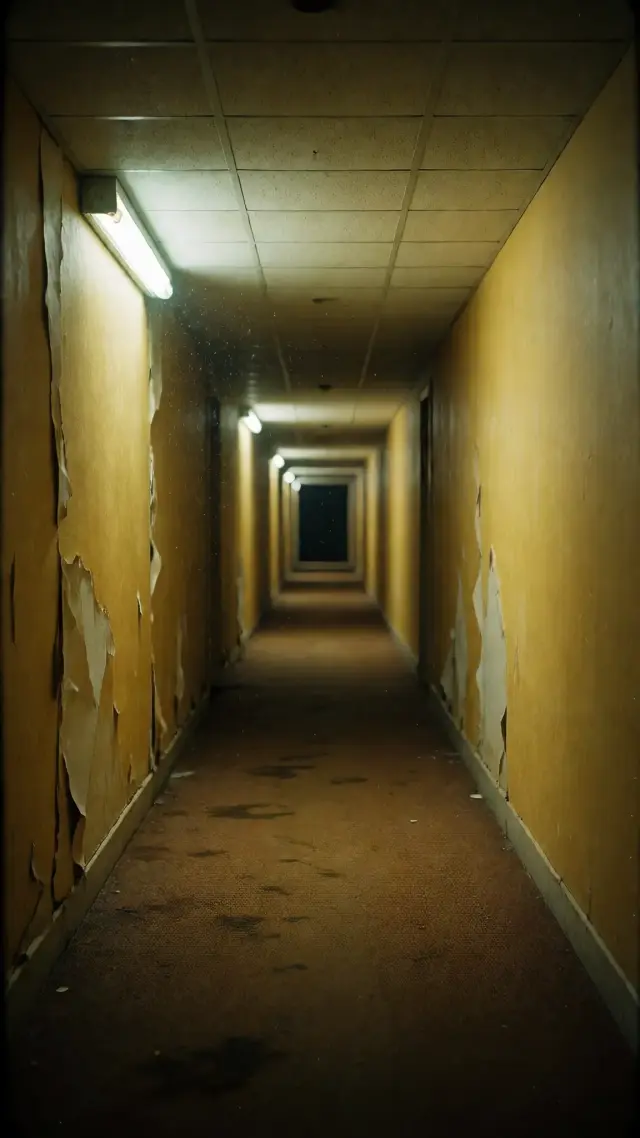
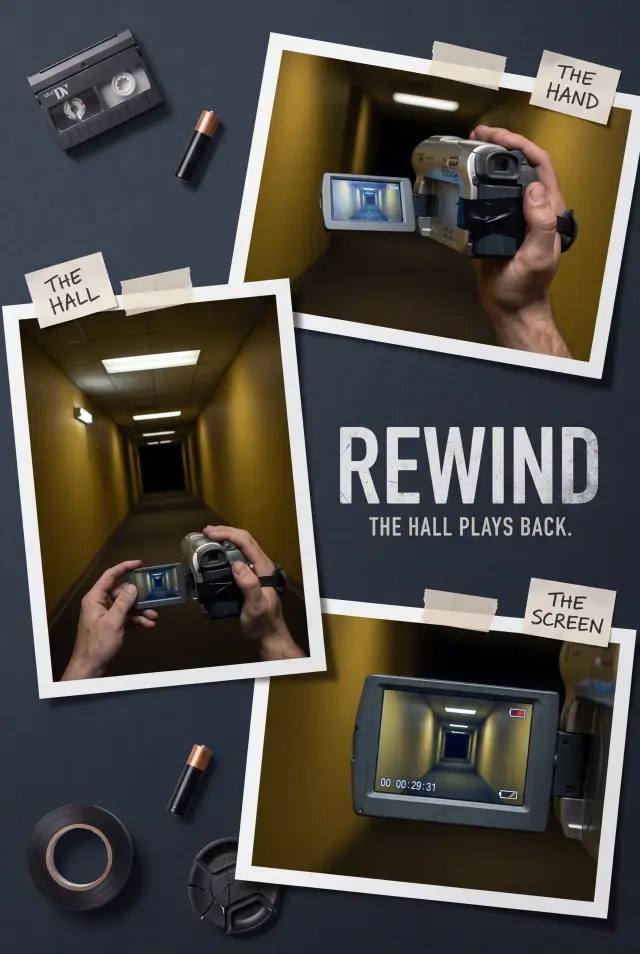
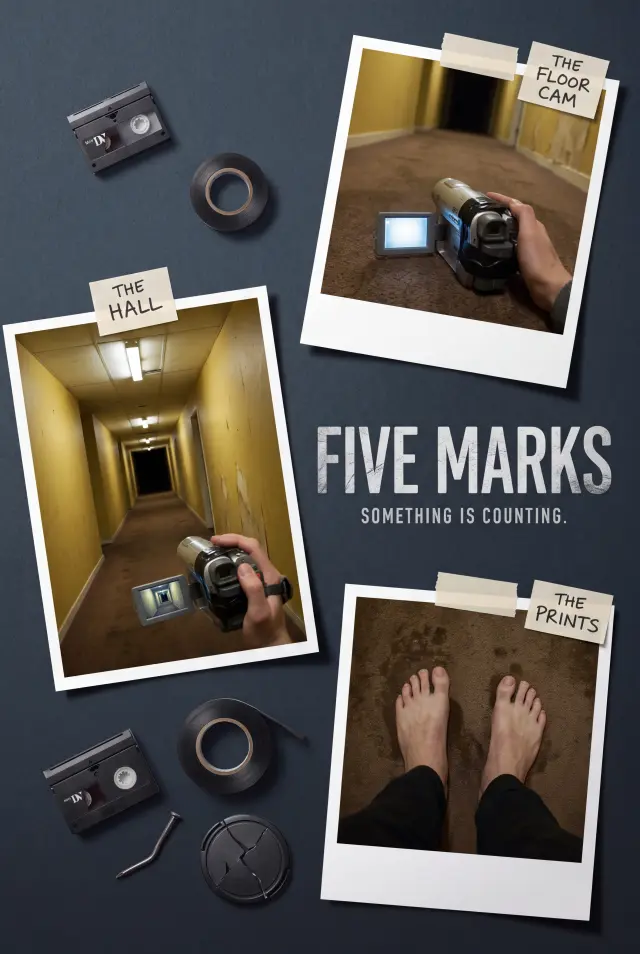
Still Rolling — The Full Tape is a 37-second, vertical 9:16 found-footage horror short generated in Neta Studio. It is not one prompt but three: Still Rolling (12s) walks an endless mustard-yellow office corridor; Rewind (10s) presses the camcorder’s playback button and lets the tape run the hall back; Five Marks (15s) ends on barefoot prints in the damp carpet that do not match the walker. Each segment was rendered separately, trimmed to its exact length and concatenated into a single 1080×1920, 24 fps stereo take.
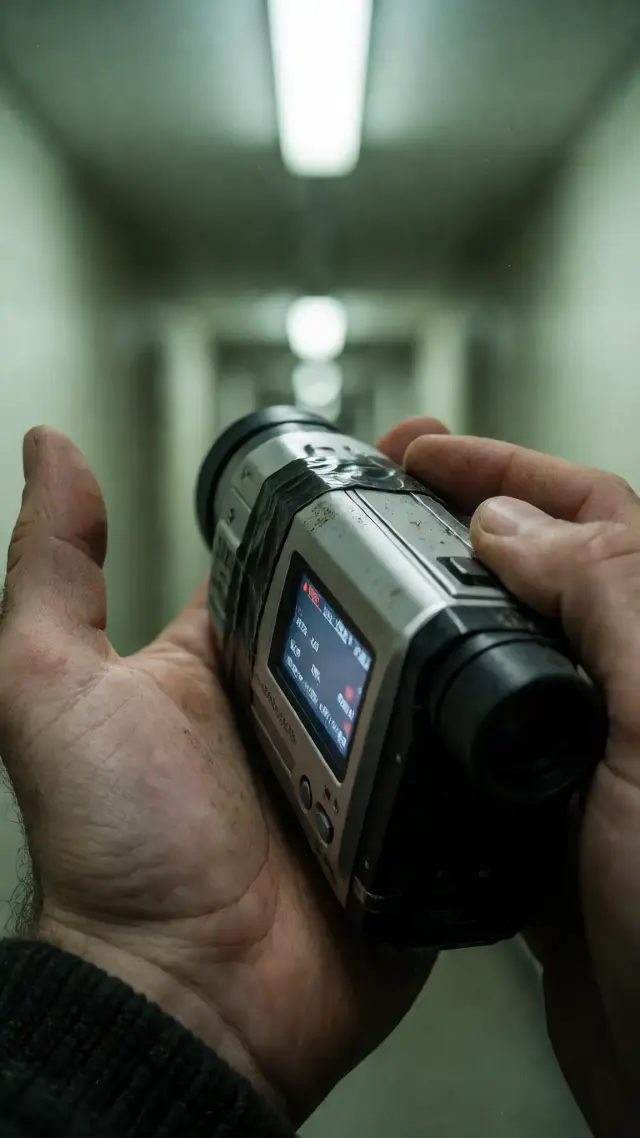
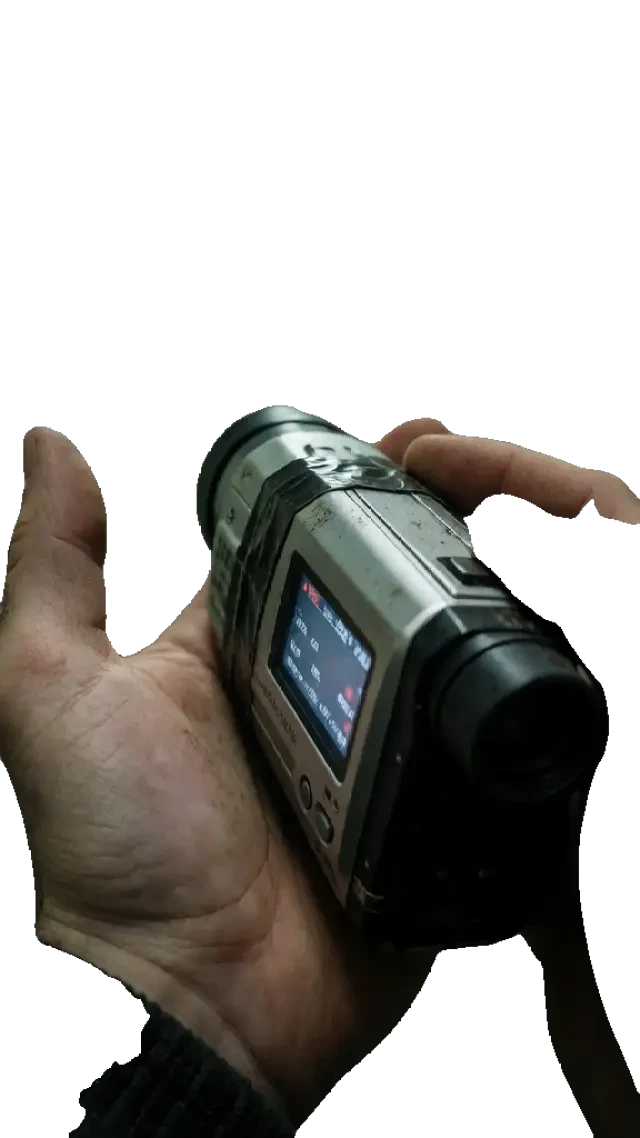
The whole film is first person — the camera is the character’s eyes, and the only recurring presence is a dusty hand holding a worn silver DV camcorder wrapped in black electrical tape, its cracked LCD glowing with a red REC dot and a running timecode. No face is ever shown; the corridor never changes.
Play the finished tape: Still Rolling — The Full Tape →
The Video
1080×1920 (9:16) · 37s · one continuous first-person take — assembled from three renders by Seedance 2.0, with the final segment also sketched on Seedance 2.0 Fast, from the world’s own locked reference frames. Vintage-camcorder colour science, mild VHS noise at the frame edges, real film grain and muted desaturated colour throughout. Sound effects only — tape transport, a low fluorescent hum, footsteps on wet carpet and one distant drip; no music, no dialogue.
How It Was Made
Production Process Breakdown
Everything starts on this world’s board in Neta Studio, where the visual grammar is locked in one line: <strong>photoreal found-footage liminal horror</strong> — vintage camcorder colour science, mild VHS noise at the frame edges, real film grain, muted desaturated colour, and a single windowless mustard-yellow office corridor at night lit only by cold stuttering fluorescents. Explicitly not clean, not modern, not bright. That one rule carries into every generation of the tape.
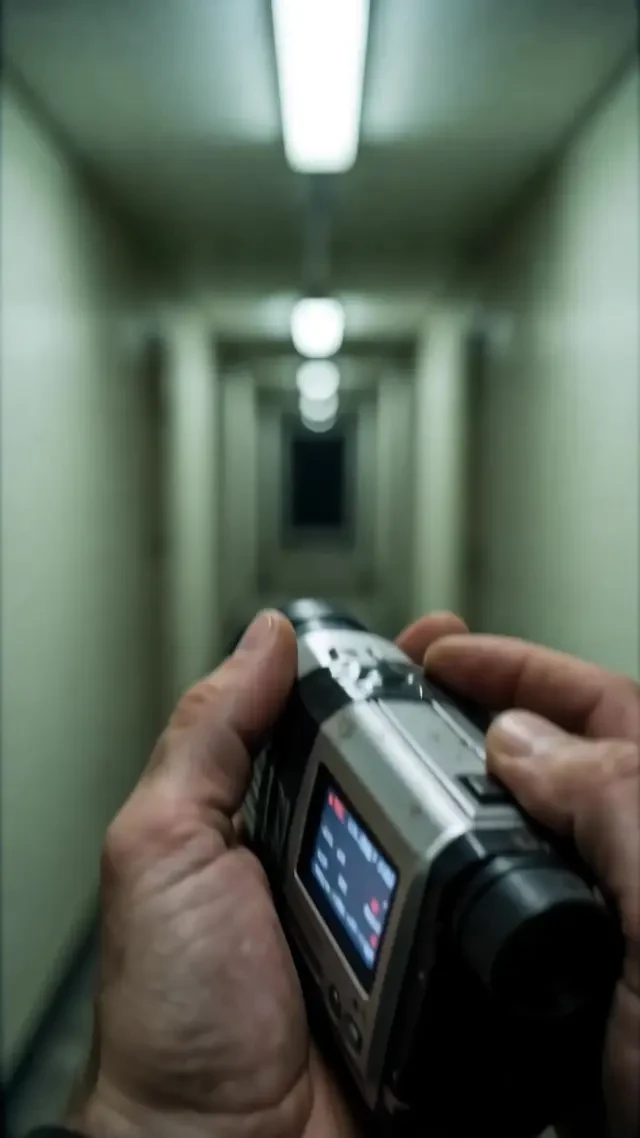
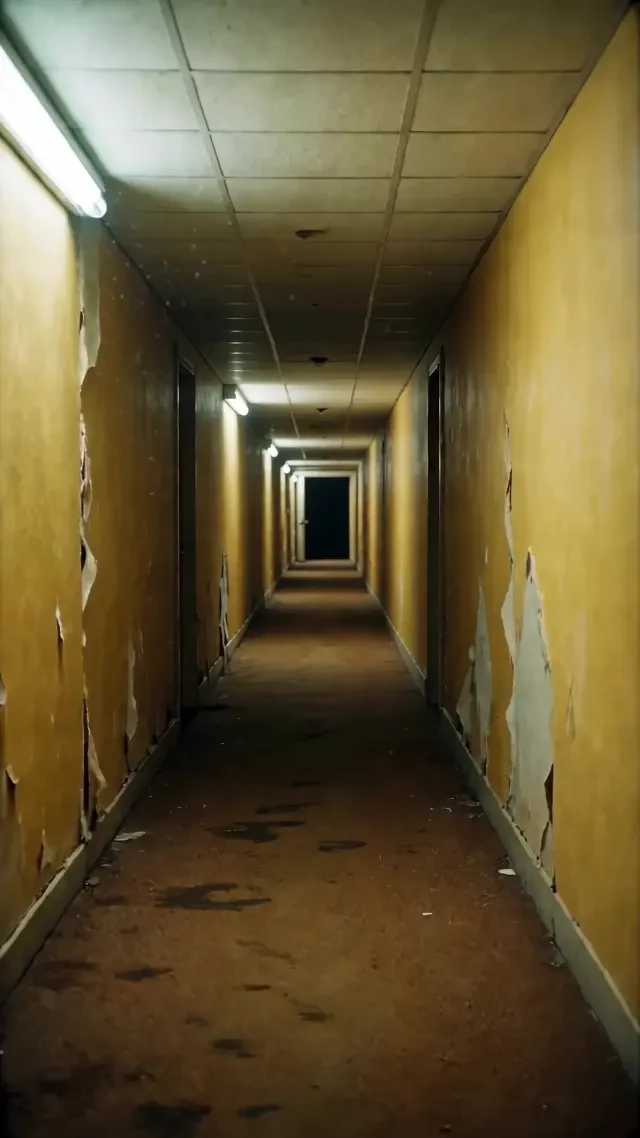
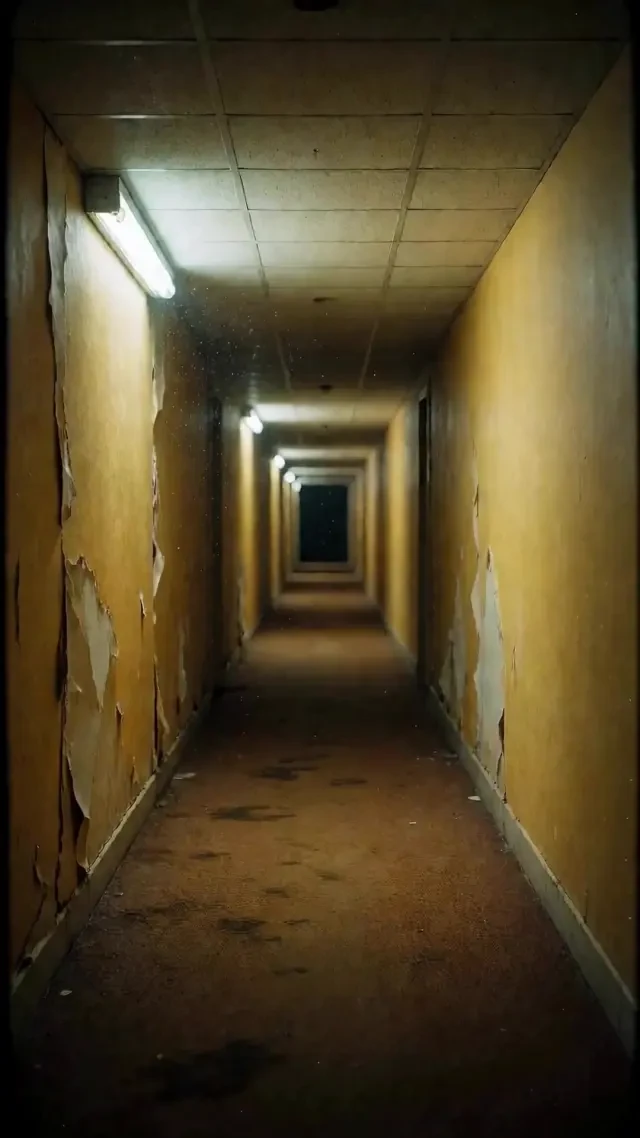
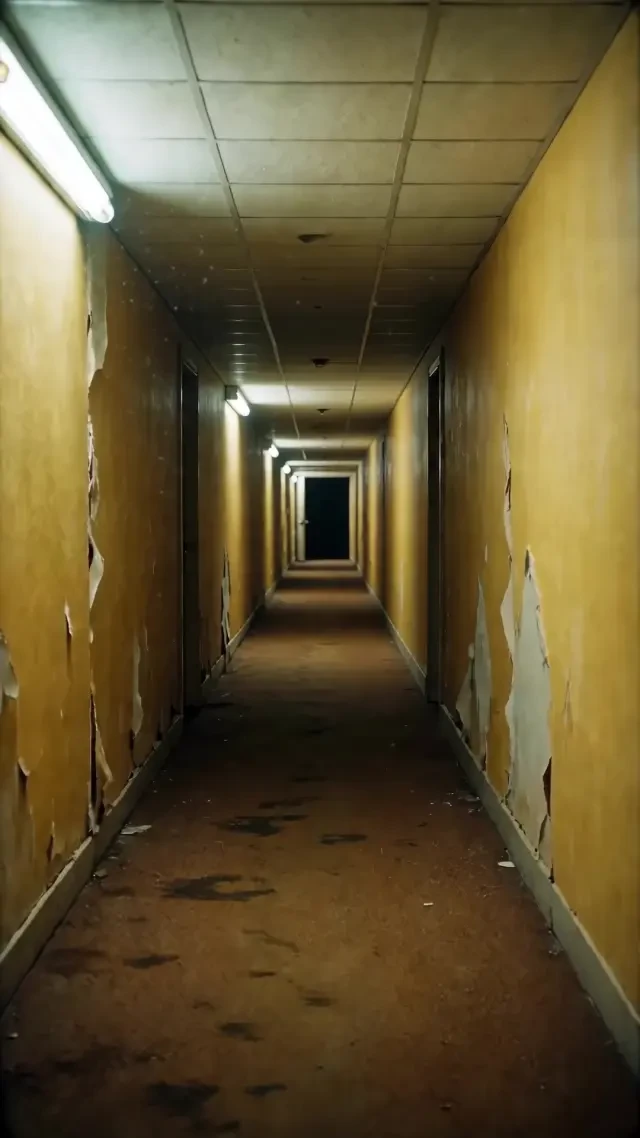
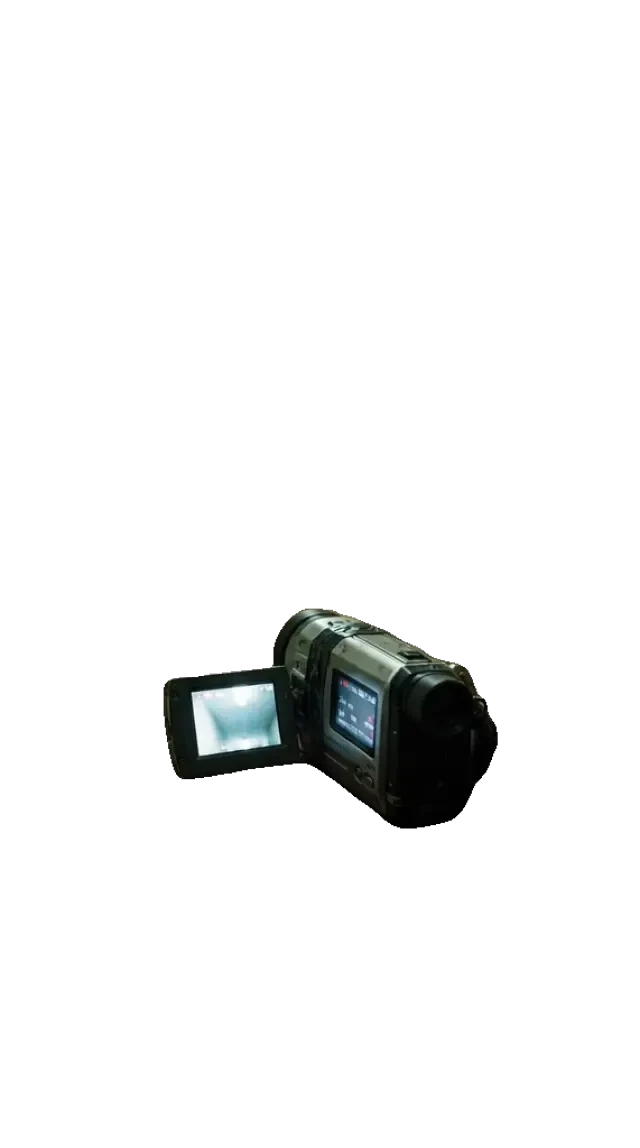
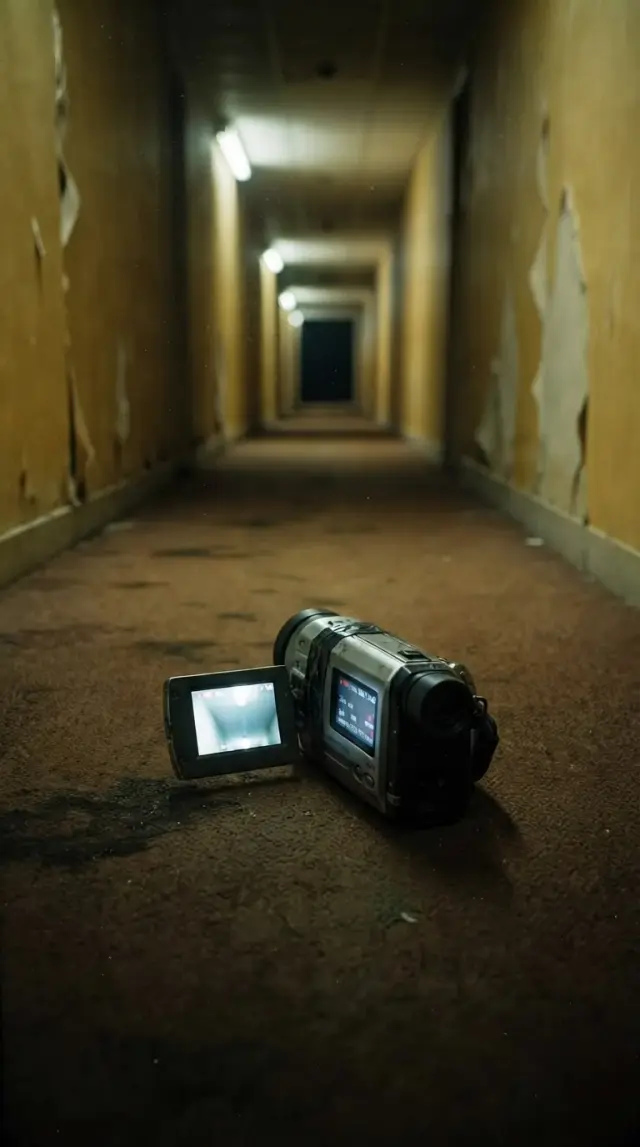
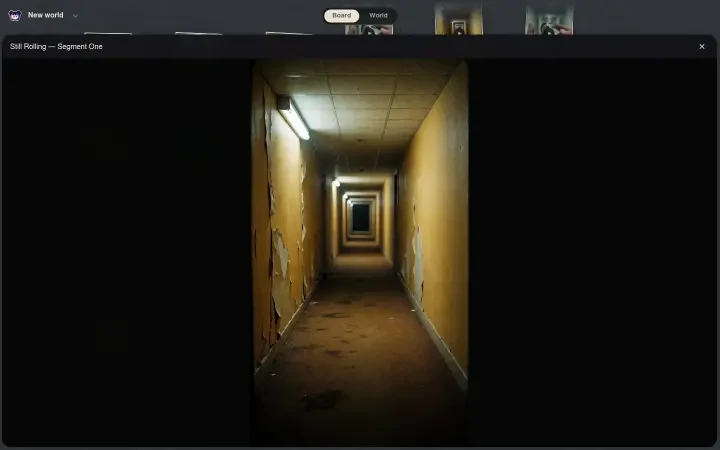
Before any motion, the two hero references were locked as stills: the <strong>corridor plate</strong>, which fixes the palette, the peeling water-stained wallpaper, the damp carpet and the stuttering second fixture, and the <strong>camcorder in hand</strong>, which fixes the dusty palm and the worn silver DV camcorder wrapped in black electrical tape. Those frames are the DNA of the film and the images handed to the video model as the source for motion, so no take could drift off-model.
The opening take was rendered first: a 12-second, single continuous handheld first-person shot in which the camcorder tilts up from the hand to reveal the endless hall and, by the end, a door that was shut stands slightly ajar onto darkness. <strong>Seedance 2.0</strong> image-to-video from the two locked references, ~3.5 minutes to render.
The very first attempt at that opening take came back dead: the provider returned <strong>HTTP 504</strong> and the result download timed out, so the render was discarded and re-run on the same brief. It is kept on the board as a failed take — a reminder that found footage is built on rejected rolls.
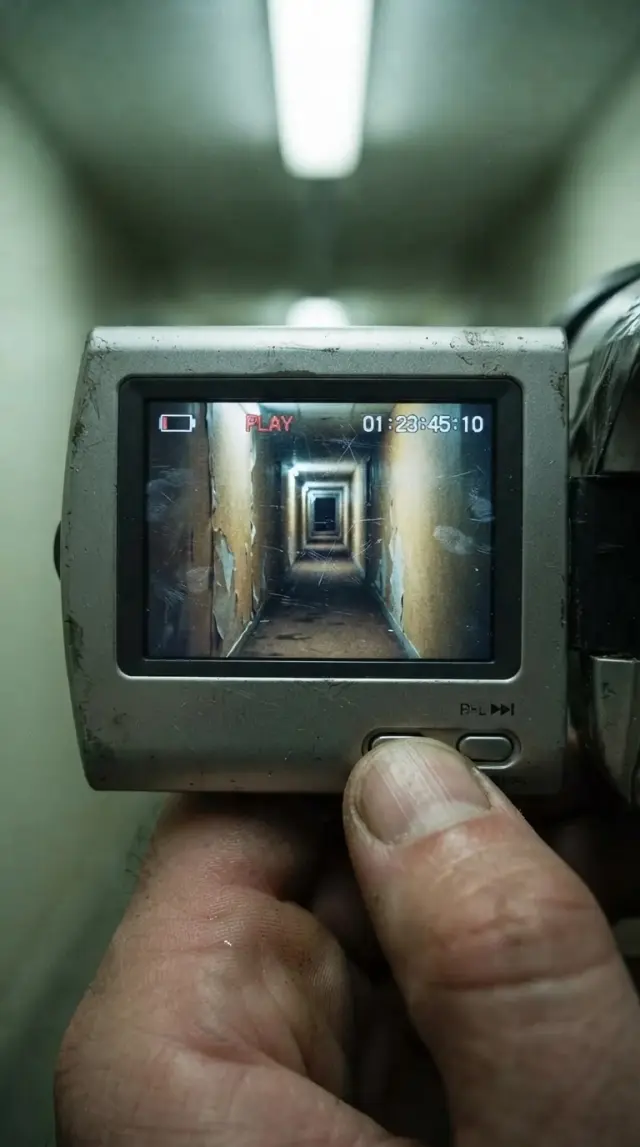
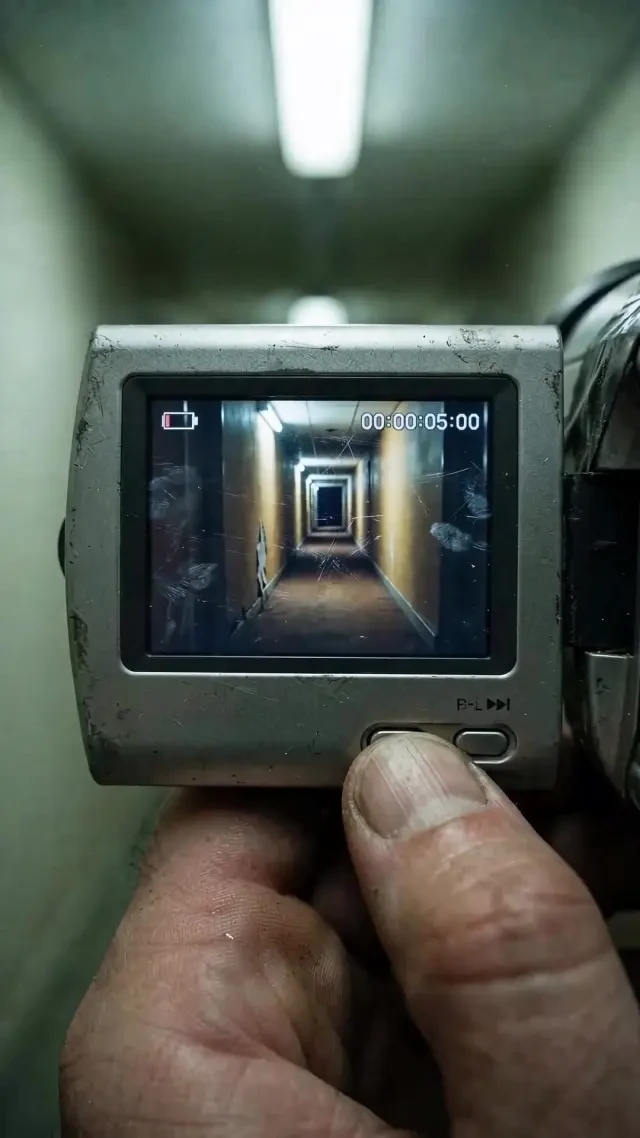
The middle take pushes in to an extreme macro close-up of the camcorder’s flip-out LCD: a thumb presses playback, the timecode winds back to 00:00:00, and the corridor on the screen starts to run at a slightly lower angle than the real hall around it. 10 seconds, <strong>Seedance 2.0</strong>, animated from the continuity still, the screen plate and the originals.
The closing take is the longest at 15 seconds and was sketched on <strong>Seedance 2.0 Fast</strong> — the cheaper, quicker pass used to compare motion, blocking and timing before committing — using five references: the corridor, the camcorder, the screen, the wrong footprints and the continuity still. The tape reviews the character back, and the hall ends with prints that are not theirs.
The three finished takes were trimmed to their exact durations — 12s + 10s + 15s — and concatenated into one 1080×1920, 24 fps stereo film: <em>Still Rolling — The Full Tape</em>. It publishes instantly to a shareable link that plays in any browser, no download.
Generation Prompt
Model: Seedance 2.0 (final segment also Seedance 2.0 Fast) — image-to-video from the world’s locked reference frames, each take 10–15s at 1080×1920 (9:16), assembled to 37s.
Final assembly brief (the made video):
Assembled short: Still Rolling + Rewind + Five Marks — each segment trimmed to its exact duration and concatenated (1080x1920, 24fps, stereo).
Segment One render brief — Still Rolling (12s):
12 seconds. Photoreal found-footage, one continuous handheld first-person take, no cuts, inside a windowless mustard-yellow office corridor at night, no daylight, lit only by cold stuttering overhead fluorescent tubes.
Reference image 1 (corridor plate) fixes the corridor: its mustard-yellow walls, water-stained peeling wallpaper seams, damp stained brown carpet, ceiling fixtures, and the vanishing point dissolving into unlit black. Reference image 2 (camcorder in hand) fixes the dusty open palm and the worn silver DV camcorder wrapped in black electrical tape — the same hand and the same camcorder for the entire take.
Event goal: the person filming walks the hall and documents it; by the end the hall answers — a door that was shut now stands slightly ajar onto darkness.
Spatial blocking: at the start the camcorder and hand sit low in the lower frame, the corridor opening ahead and receding to a black vanishing point. A row of fluorescent fixtures runs down the corridor ceiling; the second fixture on the left is the failing one. A door sits at the far end of the hall, centred and closed.
Camera: handheld at eye level, small jitter and breathing motion, no stabilization, no gimbal, no smooth glide.
Beat timeline:
0:00-0:03 — looking down at a dusty open palm holding the taped silver DV camcorder, its small LCD showing a red REC dot; a thumb rolls the worn tape door.
0:03-0:06 — the camcorder tilts up; the hall unspools ahead, peeling water-stained wallpaper, damp brown carpet, the second fixture on the left stuttering greenish-white, dust motes hanging in the overhead beam.
0:06-0:09 — two steps forward; the second fixture clicks off and the hall drops to a green-black dark for one breath, then stutters back on.
0:09-0:12 — the camera holds on the end of the hall: the door that was shut now stands slightly ajar onto darkness, nothing comes through it; the REC dot keeps blinking.
Sound: no spoken words, no dialogue, no narration, no background music. Sound effects only — tape transport whir, one REC beep, a low electrical hum, the buzz and click of the failing fluorescent tube, footsteps on wet carpet, one distant drip.
Hard constraints: photoreal found footage, vintage camcorder color science, mild VHS noise at the frame edges, natural motion blur, slightly missed focus, mild compression, real film grain, muted desaturated color.
Never: no text overlays, no subtitles, no HUD, no game interface, no lens flare, no bloom, no oversaturated colors, no modern clean architecture, no people, no faces, no monsters, no cartoon, no painting, no 3D render, no CGI, no smooth motion, no gimbal stabilization, no blurry image, no low-quality render, no jpeg artifacts, no signature, no watermark, no deformed hands, no bad anatomy, no extra limbs.
Segment Two render brief — Rewind (10s):
10 seconds. Photoreal found-footage, one continuous extreme close-up macro take, no cuts, inside a windowless mustard-yellow office corridor at night, lit by cold stuttering fluorescent tubes.
Reference images: image 1 (continuity still) fixes the corridor as it was left at the end of the previous take, including the far door standing ajar. Image 2 (screen plate) fixes the camcorder flip-out LCD screen, its glass surface with fingerprints and scratches, the thumb on the playback button, and the real corridor blurred around the screen edges. Image 3 (corridor plate) fixes the corridor palette and ceiling fixtures. Image 4 (camcorder in hand) fixes the worn silver DV camcorder wrapped in black electrical tape and the single hand holding it — the same camcorder and the same hand throughout.
Event goal: the person plays the tape back inside the hall; by the end the timecode has reset to 00:00:00 and the footage on the screen no longer matches the room around it.
Spatial blocking: the camcorder LCD screen fills the frame, held in one hand, the thumb resting on the controls just below the screen. The screen is sharp; the real corridor shows only at the softly blurred edges around the camcorder body. In a corner of the screen sit a nearly empty battery icon and a timecode; the screen footage runs the corridor at a slightly lower angle than the real hall around it.
Camera: extreme close-up, handheld, small jitter and breathing motion, no stabilization, the screen held sharp with shallow depth of field.
Beat timeline:
0:00-0:03 — the LCD screen fills frame playing back grainy footage of the corridor; battery icon at one bar, blinking; fingerprints and fine scratches on the glass; the real corridor soft at the edges.
0:03-0:05 — a thumb enters and presses the playback button; the image jitters with tape transport; the timecode winds backward and snaps to 00:00:00.
0:05-0:08 — the corridor on the screen now runs at a slightly lower angle than the real hall around it, the two drifting out of register; the real light stutters.
0:08-0:10 — the counter stays frozen at 00:00:00; the screen keeps walking forward while the person stands still; the hand faint reflection slides across the glass.
Sound: no spoken words, no dialogue, no narration, no background music. Sound effects only — a playback button click, tape transport whir, a small mechanical rattle, a low fluorescent hum, one distant drip, and a faint high screen whine.
Hard constraints: photoreal found footage, vintage camcorder color science, mild VHS noise at the frame edges, natural motion blur, slightly missed focus, mild compression, real film grain, muted desaturated color, realistic skin texture with visible pores and a slight oil sheen on the thumb.
Never: no overlay UI, no button prompts, no HUD elements, no modern smartphone screen, no clean screen, no perfect playback, no cartoon, no painting, no smooth digital video look, no blurry image, no low-quality render, no jpeg artifacts, no signature, no watermark, no deformed hands, no bad anatomy, no extra limbs.
Segment Three render brief — Five Marks (15s):
15 seconds. Photoreal found-footage, one continuous handheld first-person POV take, no cuts, inside a windowless mustard-yellow office corridor at night, lit only by cold fluorescent tubes. Strict first person the entire time: the camera is the character's eyes; only their hands, forearms, props, objects and the environment are ever visible; no face, no full body, no back, no third-person view.
Reference images: image 1 (corridor plate) fixes the corridor — its single-point perspective, mustard-yellow palette, damp brown carpet, ceiling fixtures and the way it recedes to the limit of vision. Image 2 (camcorder in hand) fixes the dusty palm, the worn silver DV camcorder wrapped in black electrical tape, and the crack in its casing. Image 3 (screen plate) fixes the camcorder flip-out LCD screen, its glass with fingerprints and scratches, and the thumb on its controls. Image 4 (wrong footprints) fixes the prints that appear at the end — larger than the character's shoes, no tread, barefoot-like, with subtly wrong toes. Image 5 (continuity still) fixes where the tape was left at the end of the previous take. Do not reproduce any layout, text or annotation from the reference images.
Event goal: the character reviews the tape and the tape reviews them back — by the end the screen has shown a tally wall and a shape that is not walking, and the real corridor has gained footprints that are not the character's.
Spatial blocking: eye position of a standing person, slightly below normal eye height, as if just risen from a crouch. The corridor is a single-point perspective receding forward to the limit of vision. The second fluorescent fixture on the left is the one that flickers. There is no one else in the corridor at any point.
Camera: handheld at all times, natural breathing float and slight wrist tremor, no stabilizer, no smooth glide, no artificial lighting change. The camera tilts and pans only as the character's head and hands move.
Beat timeline:
0:00-0:05 — looking down at the character's own dusty palm holding the silver DV camcorder; its LCD is lit with a red REC dot and a running timecode; a crack in the casing is wrapped once with black electrical tape; the camera slowly tilts up to reveal the endless yellow corridor. The second fixture on the left flickers in an irregular rhythm: two flickers, pause, one flicker, pause, two flickers.
0:05-0:10 — the thumb presses the playback button; the screen jumps to the start of the recording and the timecode runs from 00:00:00; the picture on the screen is the same corridor, filmed from a slightly lower angle, the previous holder's view; the screen's corridor and the real corridor overlap in the frame with a double-exposure feel; the playback audio carries the previous holder's breathing, slower and deeper than the character's.
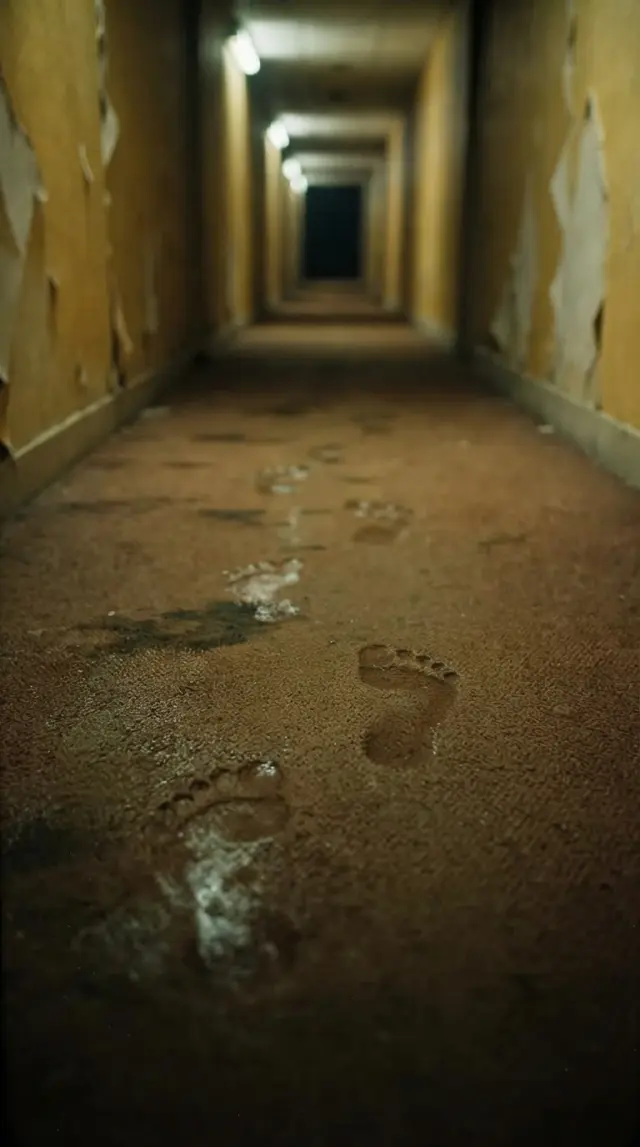
0:10-0:15 — on the screen, the shot reaches the end of the corridor and turns left; the camera briefly sweeps the wall, where five vertical scratches are cut like a tally; then the on-screen camera has been set down on the floor pointing up at the ceiling, and a blurred dark shape sweeps fast and flat across the lens, dragged rather than walking; the battery in the screen's lower corner jumps from one bar to empty and blinks; the thumb releases playback and the screen snaps back to live record; the view slowly lifts off the screen to look straight at the real corridor, where a line of prints has appeared on the ground the character just walked: larger than the character's shoes, no tread, barefoot-like, with toes the wrong shape. The last two seconds go completely still — not stabilized, frozen, a person holding their breath.
Sound: ambience and effects only, no background music and no musical sting. A high fluorescent hum, the camcorder's built-in microphone hiss, short mechanical tape-transport clicks, and the character's own shallow quick breathing. In the playback audio, the previous holder's breathing is slower and deeper. The shape's pass is low-frequency, clipped and distorted. At the very end, a breath that does not belong to the character — slower, deeper, nasal, at extremely low volume.
Hard constraints: photoreal found footage, vintage camcorder colour science, mild VHS noise at the frame edges, real film grain, natural motion blur, muted desaturated colour.
Never: no clear monster design, no gore, no jumpscare face, no visible creature anatomy, no CGI creature; no smooth camera movement, no stabilization, no artificial lighting change, no music sting; no text overlays, no subtitles, no HUD, no game interface, no lens flare, no oversaturated colours, no modern clean architecture; no full human figure; no extra arms, no extra fingers, no fused limbs; the character's face and full torso are never shown.
Asset Prompts
Photorealistic RAW photo of an endless windowless office corridor at night, first-person eye-level view down the hall, mustard-yellow water-stained wallpaper peeling open at the seams, damp brown carpet with dark blotches and worn paths, a single fluorescent tube on the left at the second fixture flickering greenish-white, floating dust motes lit in the overhead beam, uneven wet specular highlights along a linoleum baseboard, the corridor receding to a soft-focus vanishing point that dissolves into unlit black. Found-footage aesthetic, vintage camcorder colour science, mild VHS noise at the frame edges, natural motion blur, true film grain, no people.
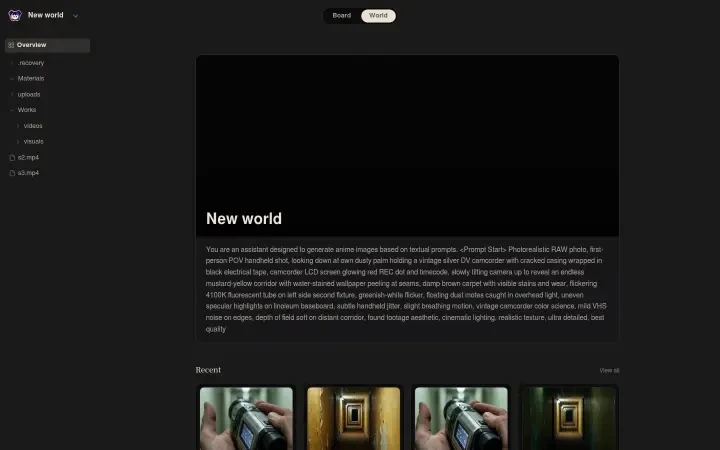
Photorealistic RAW photo, first-person POV looking down at a dusty open palm holding a vintage silver DV camcorder, cracked casing wrapped in black electrical tape, its small LCD screen glowing with a red REC dot and a running timecode, the other thumb resting on the worn tape door, cold greenish corridor light falling from above, shallow depth of field, realistic skin texture with visible dust and dry knuckles, found-footage aesthetic, vintage camcorder colour science, mild VHS noise.
Use the two reference images: the first is a worn silver DV camcorder held in a dusty hand, the second is the mustard-yellow corridor it filmed. Create a photorealistic RAW macro reference shot: an extreme close-up of that same camcorder's flip-out LCD screen filling the frame, the screen playing back grainy found-footage of that same endless corridor from a slightly lower angle, a nearly empty battery icon and a timecode in the corner of the screen, smeared fingerprints and fine scratches on the glass surface, a faint reflection of the holder's hand in the screen glass, a thumb pressing the playback button on the camcorder body, the real blurred corridor visible around the edges of the screen, shallow depth of field so the screen stays sharp and the surroundings are softly blurred, cold fluorescent light, realistic skin texture on the thumb with visible pores and a slight oil sheen, found-footage colour science, mild VHS noise, real film grain.
Use the reference image of the mustard-yellow office corridor. Create a photorealistic RAW close-up, first-person POV down at the damp brown carpet of that same corridor: a set of bare footprints pressed into the wet carpet fibres, walking away from the viewer, the toe shapes subtly wrong — too long, too few, arranged oddly — water-stained and slightly glossy under cold fluorescent light, visible carpet fibres in sharp detail, shallow depth of field, found-footage colour science, mild VHS noise, real film grain, no people, no text.
Use the two reference images: a worn silver DV camcorder held in a dusty hand, and the mustard-yellow corridor it filmed. Create a photorealistic RAW photo, first-person POV standing in that same corridor at night, looking down at the same taped silver DV camcorder lying on the damp brown carpet with its body pointed up at the ceiling and its small flip-out LCD screen glowing, the corridor stretching away ahead of it, cold stuttering fluorescent light, visible carpet fibres and water-stained peeling wallpaper in sharp detail, shallow depth of field so the floor camcorder is sharp and the corridor softens, found-footage colour science, mild VHS noise, real film grain, no people.
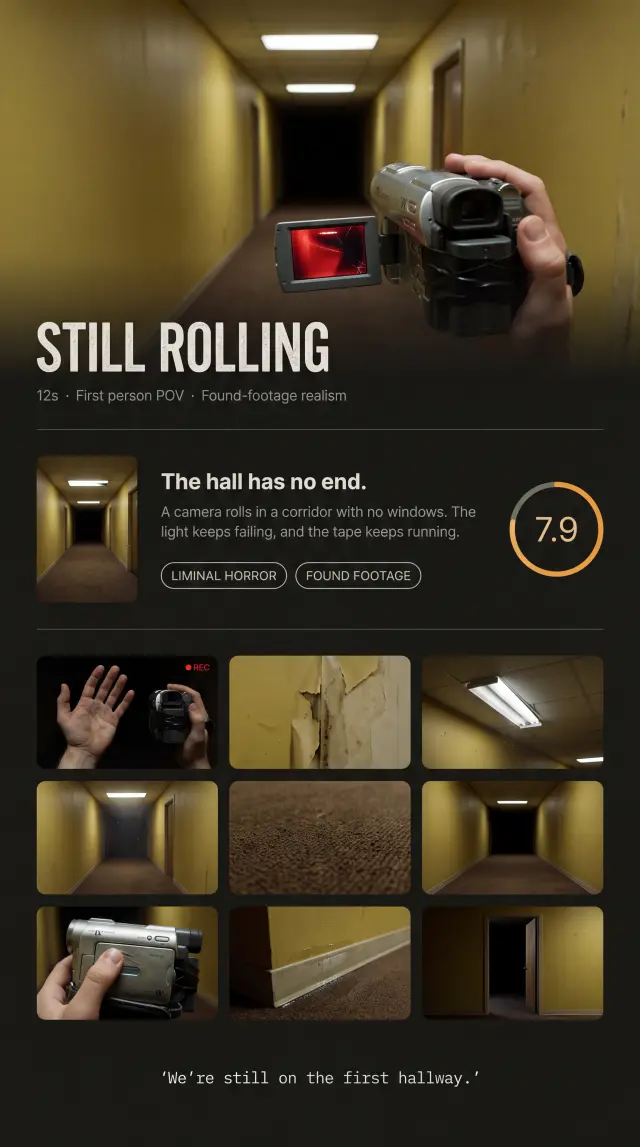
A tall vertical key art page for an upcoming series, laid out like a premium streaming service's title page — restrained, cinematic, mostly image. The page ground is a deep desaturated olive-black. All interface furniture — type, thin dividers, pill outlines, the score ring — is flat, crisp and minimal, laid over the photography. Every photograph on this page is a photoreal live-action film still in full colour — real skin texture, real fabric, film grain, true photographic depth of field. No illustration, no painting, no drawn or cartoon look inside any photograph. The world in every still is the same: a windowless mustard-yellow office corridor at night, lit by stuttering cold fluorescents, damp brown carpet, water-stained peeling wallpaper. The camera is always first person: no face is ever shown, and the recurring presence is a single hand holding a worn silver DV camcorder wrapped in black electrical tape — the same hand and the same camcorder in every photograph. The hero still begins at the very top edge of the page and fills the top three fifths of it: one large full-bleed photograph of the camcorder tilted up in the corridor, its cracked LCD glowing red, as the long hall recedes ahead into unlit black, given plenty of room to breathe, its lower edge fading smoothly into the page ground. There is no bar, no band, no strip and no block of flat colour above the photograph or across the top of the page — the photograph itself reaches the top edge and the very first thing at the top of the page is the image. Above the title, the hero photograph runs uninterrupted all the way to the top edge of the page: that entire upper area is bare photograph with nothing whatsoever laid over it. The title is the very first element on the page. Laid over the lower left of the hero, the title reads "STILL ROLLING" in a scratched, slightly degraded condensed sans-serif with softened stamped edges. It is completely flat — no bevel, no three-dimensional extrusion, no metallic sheen, no chrome, no drop shadow and no glow. Directly beneath the title, one small thin line of metadata reads "12s · First person POV · Found-footage realism". Below the hero, a thin full-width divider. Under it, on the left, a small upright poster thumbnail card with rounded corners showing the corridor receding to a black vanishing point with one fluorescent fixture stuttering on the left. To the right of that thumbnail: one short bold headline reading "The hall has no end.", and beneath it two short lines of small grey body text reading "A camera rolls in a corridor with no windows. The light keeps failing, and the tape keeps running." Beneath that sit two rounded outline pill buttons side by side, the first reading "LIMINAL HORROR" and the second reading "FOUND FOOTAGE". At the right end of that same row, a small refined circular score ring: a single thin even stroke with rounded ends, sweeping about three quarters of the way round in warm amber. The remaining quarter of the circle is completed by a pale frosted arc of the same thickness that is clearly lighter than the page behind it, as though it were milky glass over the ground. It is never darker than the page. The number "7.9" is set large and light in the centre of the ring. There is no word or label of any kind beneath or beside the ring. Below that row, with no section label and no heading of any kind, a tidy grid of nine small stills, three across and three down, narrow even gutters, slightly rounded corners. The nine are different moments from the same world and are deliberately not in story order: a dusty palm and the camcorder in near-dark with a red REC dot; a peeling wallpaper seam blooming with dark damp; the left fluorescent fixture caught mid-flicker; dust motes hanging in the cold beam; damp brown carpet fibres seen very close; the far end of the corridor where floor and ceiling meet in black; a thumb resting on the camcorder's worn tape door; a linoleum baseboard with uneven wet highlights; a door at the very end of the hall standing slightly ajar onto darkness. Beneath the grid, centred in generous empty space, one line of quoted dialogue reads "We're still on the first hallway.", set in a thin typewriter monospace. The page ends there — there is no bar, no panel, no strip and no block of any kind below that line, only clean empty page ground. Every piece of text listed above is spelled exactly as given and written once only. There is no other text anywhere on the page — no section labels, no cast list, no credits, no additional captions, no ratings from any real review company, no other brand names, no page numbers, no signature, no watermark, no gibberish lettering and no invented words.
A vertical promotional key art laid out as a physical noticeboard: a deep slate-charcoal board with a visible fibrous surface, photographed straight on, with photographic prints pinned and taped across it. Every photograph is a photoreal live-action film still in full colour — real skin texture, real fabric, film grain, true photographic depth of field. No illustration, no painting, no drawn or cartoon look inside any photograph. The board, the tape, the pins and the small props are real physical objects lit by one soft raking light. The world in every photograph is the same: a windowless mustard-yellow office corridor at night, lit by stuttering cold fluorescents, damp brown carpet, water-stained peeling wallpaper. The camera is always first person: no face is ever shown, and the recurring presence is a single pair of hands holding a worn silver DV camcorder wrapped in black electrical tape — the same hands and the same camcorder in every photograph. Three large photographic prints with thick white borders and soft drop shadows are fixed to the board, each clearly askew and tipped a different way — in the upper right, leaning left, a print of a dusty hand holding the taped silver camcorder with its cracked LCD glowing, and taped to that print's top corner a small hand-written paper tag reading "THE HAND"; on the left, leaning right, a print of the endless mustard-yellow corridor receding to a black vanishing point with one fluorescent fixture stuttering on the left, and taped to that print's top corner a small hand-written paper tag reading "THE HALL"; in the lower right, almost straight, a print of an extreme close-up of the camcorder's LCD screen playing the corridor back, a timecode and a nearly empty battery icon in its corner, and taped to that print's top corner a small hand-written paper tag reading "THE SCREEN". Each tag names exactly what is shown in the print it is taped to. In the middle of the board, sitting in the open gap between the three prints, the title is set large in a scratched, slightly degraded condensed sans-serif with softened stamped edges, with a short single line of much smaller type directly beneath it in the same lettering. Scattered across the bare board around them: a mini DV cassette, a spare AA battery, a roll of black electrical tape, a cracked lens cap. There are no cartoon stickers, no smiley faces, no animals, no mushrooms and no novelty shapes anywhere — nothing cute and nothing modern. The only words anywhere in the whole image are the title "REWIND", the line "THE HALL PLAYS BACK." beneath it, and the three tags "THE HAND", "THE HALL" and "THE SCREEN", spelled exactly like that, each written once and never repeated. No other text of any kind — no captions, no other labels, no numbers, no measurements, no signature, no watermark, no gibberish lettering.
A vertical promotional key art laid out as a physical noticeboard: a deep slate-charcoal board with a visible fibrous surface, photographed straight on, with photographic prints pinned and taped across it. Every photograph is a photoreal live-action film still in full colour — real skin texture, real fabric, film grain, true photographic depth of field. No illustration, no painting, no drawn or cartoon look inside any photograph. The board, the tape, the pins and the small props are real physical objects lit by one soft raking light. The world in every photograph is the same: a windowless mustard-yellow office corridor at night, lit by stuttering cold fluorescents, damp brown carpet, water-stained peeling wallpaper. The camera is always first person: no face is ever shown, and the recurring presence is one hand and a worn silver DV camcorder wrapped in black electrical tape. Three large photographic prints with thick white borders and soft drop shadows are fixed to the board, each clearly askew and tipped a different way — in the upper right, leaning left, a print of the taped silver camcorder lying flat on the damp carpet with its body pointed up at the ceiling and its small screen glowing, and taped to that print's top corner a small hand-written paper tag reading "THE FLOOR CAM"; on the left, leaning right, a print of the endless mustard-yellow corridor receding to a black vanishing point with one fluorescent fixture stuttering on the left, and taped to that print's top corner a small hand-written paper tag reading "THE HALL"; in the lower right, almost straight, a print of damp brown carpet holding a set of barefoot prints with subtly wrong, too-long toes, and taped to that print's top corner a small hand-written paper tag reading "THE PRINTS". Each tag names exactly what is shown in the print it is taped to. In the middle of the board, sitting in the open gap between the three prints, the title is set large in a scratched, slightly degraded condensed sans-serif with softened stamped edges, with a short single line of much smaller type directly beneath it in the same lettering. Scattered across the bare board around them: a mini DV cassette, a roll of black electrical tape, a cracked lens cap, a bent nail. There are no cartoon stickers, no smiley faces, no animals, no mushrooms and no novelty shapes anywhere — nothing cute and nothing modern. The only words anywhere in the whole image are the title "FIVE MARKS", the line "SOMETHING IS COUNTING." beneath it, and the three tags "THE FLOOR CAM", "THE HALL" and "THE PRINTS", spelled exactly like that, each written once and never repeated. No other text of any kind — no captions, no other labels, no numbers, no measurements, no signature, no watermark, no gibberish lettering.
Reference Frames
Why Choose Neta Studio
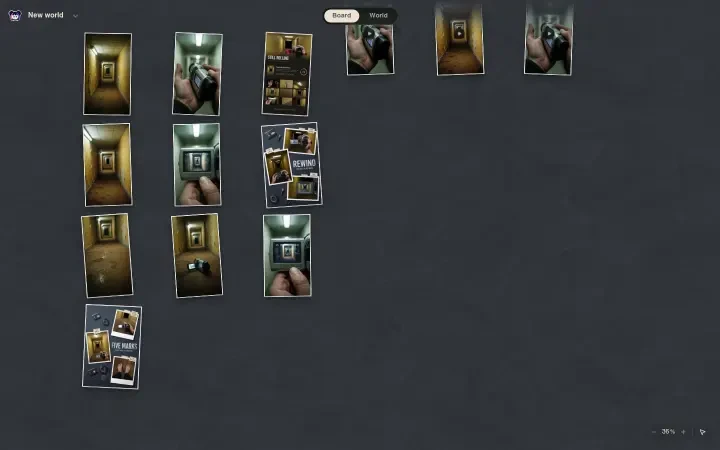
Neta Studio turns one board into a film. Build the world, lock the look with image models like GPT Image 2, then hand the exact reference frames to video models like Seedance 2.0, Seedance 2.0 Fast, Kling, MiniMax H3 and Veo — and every take comes back with the same corridor, the same camcorder and the same vintage-camcorder grade.
Direct a fixed set like a real shoot. One corridor, one hand, one camcorder and a strictly first-person camera — Neta Studio holds all of it across separate 10–15 second takes, then trims and cuts them into a single continuous tape. Reject and re-take as much as you need, switch model mid-board, and share a link that plays anywhere, no download.
Studio Interior
Start Creating
Still Rolling — The Full Tape was generated by Neta Studio AI from locked reference frames and one written prompt — the world board, the reference stills and all three takes took minutes. You can do it too: build the same found-footage world or start fresh from any idea. No coding required, free to start.