
S1-07 · Site Panorama — AI Archive Film from Neta Studio
Final Video: S1-07 · Site Panorama
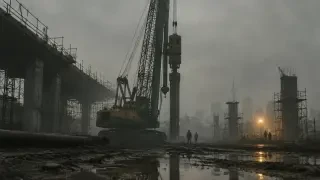
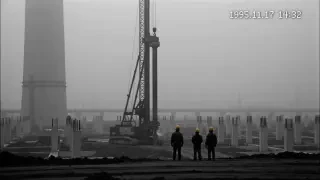
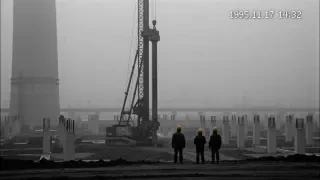
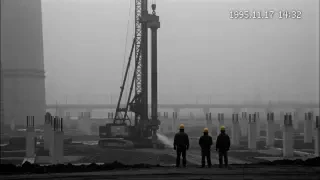
S1-07 · Site Panorama is the wide establishing shot of the Bureau Nine Archives file TA-0019 · Shenzi Junction — the 1995 Shanghai pile-driving anomaly at the Yan'an Road interchange. It is the shot that shows how ordinary the site looked. No dragons, no crowds, no explanation: just a field of concrete pile caps, a crane at rest, and three men standing in the mud where thirty-six steel pipes refused to reach depth.
The camera holds still at standing eye level. The pile driver rises out of the centre of the frame; the first elevated deck crosses the background in a thin grey band; Shanghai's towers dissolve into haze behind it. In the top-right corner a documentary timestamp reads 1995.11.17 14:32. That is the whole argument of the film — a date, a place, and nothing that can be disproven.
Play the film: S1-07 · Site Panorama — 5 seconds, MP4 →
The Video
Seedance 2.0 Fast · 5.08 seconds · 1280 × 720 · 16:9. A slow observational push creeps toward the workers while the pile driver stays fixed. The hammer hangs above the pipe, the crane's lattice boom holds its angle, and a thin plume of steam drifts at ground level. Nothing dramatic happens. That is the point: the archive records the pause before the next attempt, not the attempt itself.
The timestamp is the only piece of authored type in the frame — 1995.11.17 14:32 — set in the same thin white documentary face used across the file. The three workers wear the only colour in the shot, yellow helmets against a nearly monochromatic field of mossy green, cold grey and damp brown. No music, no narration, no camera flourish.
By 14:32 on 17 November the site had already failed more than once. The film does not show the failure; it shows the ordinary afternoon in which the failure had become procedure. The pile driver is at rest because the crew is waiting — for a decision, for a new hammer, for something the record never names.
How It Was Made
Production Process Breakdown
Bureau Nine Archives works from a fixed doctrine: seventy percent verifiable fact, thirty percent classified framing, and no conclusions. TA-0019 supplied the facts — 1995, the Yan'an Road and North-South Elevated Road interchange, thirty-six steel pipe piles that stopped short of design depth, two contradictory reports, a monk who died nine days before the road opened, and the only decorated pillar among thousands in Shanghai. S1-07 was assigned the plainest job in the file: show the site as it looked, before any of that became a story.
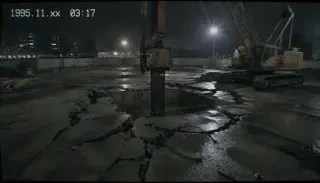
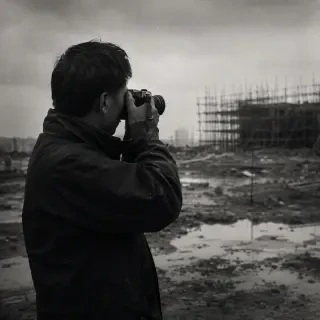
Two stills were made before any motion. The first was the 03:17 evidence plate — cracked slab, one pipe standing out of the hole, an idle rig under sodium light — which fixed the wet ground and the night palette. The second was Investigator Jiao-07 in profile, camera to his eye, shooting the site in Ilford HP5 Plus 400 grain. Between them they established the film's two registers: what the Bureau photographs, and who photographs it.
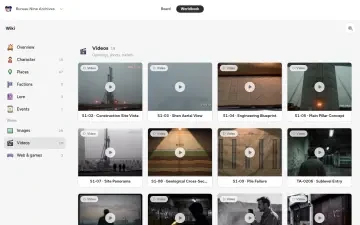
The first attempt, <strong>S1-02 · Construction Site Vista</strong>, pushed the lens low and close to a single rig, so the frame read as a portrait of a machine. The version that worked pulled back to standing eye level and let the field of pile caps run to the horizon. The crane moved left of centre, the three workers entered at the lower right, and the city appeared only as a suggestion in the haze. At that distance the site stops being a subject and becomes evidence.
Three more plates tested how literal the case could get. <strong>S1-04 · Engineering Blueprint</strong> laid the pile grid over a technical drawing; <strong>S1-05 · Main Pillar Concept</strong> looked straight up the finished column; <strong>S1-08 · Geological Cross-Section</strong> cut the ground open to the sixty-two-metre design depth. Each was accurate and each was too explanatory. They stayed in the file as inserts, while S1-07 kept the wide, unannotated view.
<strong>S1-09 · Pile Failure</strong> was animated first — a diagram of the pipe stopping short, the hammer rebounding, the ground refusing. It communicated the anomaly in three seconds, but it told the viewer what to think. S1-07 was built as its opposite: a shot in which the failure is invisible, and the only evidence is that the machine is not working.
The final render is a five-second image-to-video pass from the panorama plate. Seedance 2.0 Fast held the lattice boom, the pile caps, the three helmeted figures and the timestamp while the camera crept forward. The only movement is the push, a faint drift of steam at the base of the pipe, and the workers' slight shift of weight. BiRefNet General produced the transparent cutouts of Jiao-07 and the Dragon Pillar used in the case-file layout around the film.
Generation Prompt
Recorded shot brief — the full prompt stored with S1-07, wording unchanged:
“Panoramic construction site, pile driver at rest, worker silhouettes, black-and-white film grain.”
The harness resolved that line against the world's own visual doctrine. The construction-site anchor supplied the materials: steel scaffolding, exposed concrete, post-rain muddy ground, overcast diffuse light, rust, cement dust, Kodak Portra 400 cool-toned. The documentary-camera anchor supplied the restraint: static long takes, calm observational distance, no dramatic push-pull-zoom, no wide-angle distortion. The film-stock anchor supplied the grain: Ilford HP5 Plus 400 B&W silver grain, detail retained in the highlights, shadows allowed to crush.
What is authored on top is only the evidence layer: the timestamp 1995.11.17 14:32 in thin white type, and the decision to keep the workers small. No dragons, no red lanterns, no rain. The brief asks for a panorama, and the film returns a site survey — patient, flat, and unwilling to explain itself.
Asset Prompts
“1995 Shanghai Dragon Pillar anomaly: piles that refused to drive down, strange cracks appearing on the ground.” Rendered as a night evidence plate: a cracked concrete slab radiating from the pipe, one steel pile standing proud of the hole, a second rig parked under sodium light, the city reduced to a smear of windows. The 03:17 timestamp and the wet sheen on the slab are what the final panorama inherits.
“Documentary style, 1990s B&W film texture. Northern Chinese male investigator, age 35–40, high cheekbones, square jaw, single eyelids, darker complexion. Profile or from behind, in a dimly lit construction site at work, holding a vintage film camera (Leica M6 style) shooting evidence. Rain-wet muddy construction site, scaffolding in the distance, overcast diffuse light, grey dust in the air. Dark windproof jacket, focused on composing the shot, no front face. Ilford HP5 Plus 400 B&W film texture, deep shadows, calm and restrained archive-evidence style.” The plate keeps Jiao anonymous — a silhouette doing the Bureau's looking.
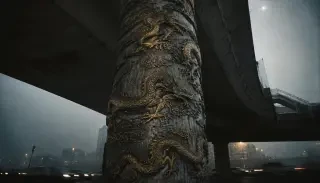
“The central pillar at the intersection of the Yan'an Road and North-South Elevated Roads in Shanghai — the only support column in the entire city adorned with nine bronze dragons.” Five metres in diameter, thirty-two metres tall, carrying four road layers, its piles specified to sixty-two metres. The plate is the case's closing image: the decoration that should not exist on an engineering column, photographed from below in the last grey light.
“Steel scaffolding, exposed concrete, post-rain muddy ground; overcast diffuse light or dawn/dusk low-angle light; rust, cement dust, tool scratches, safety net grid; Kodak Portra 400 cool-toned.” Applied to every site frame in the world. It is why S1-02, S1-05, S1-07 and S1-09 read as four exposures from the same afternoon rather than four unrelated generations.
Two transparent PNGs were cut with BiRefNet General from the portrait and location plates. Jiao-07's cutout sits in the case-file margin as the investigator of record; the Dragon Pillar cutout is used as the closing exhibit. Both keep their film grain and edge softness — the cutouts are evidence, not stickers.
Reference Frames
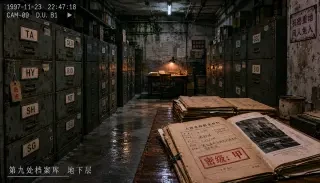
Why Choose Neta Studio
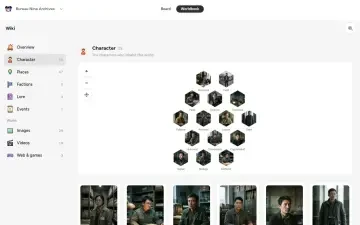
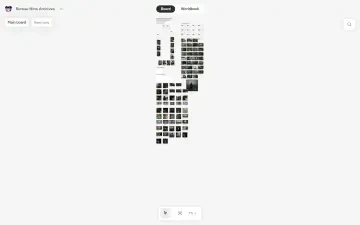
Professional — Neta Studio carries the whole chain from world doctrine to a finished shot: worldbook, location plates, character bibles, seed keyframes, motion tests and final renders, all in the browser. Frontier models including GPT Image 2.5 Sunburst, Seedance 2.0 Fast and BiRefNet General are available without local setup.
One-click generation — A one-line shot brief is enough. The harness resolves it against the world's palette, camera language and material anchors, so “panoramic construction site, pile driver at rest, worker silhouettes, black-and-white film grain” comes back as a graded, timestamped archive frame rather than a generic stock clip.
Archive-grade consistency — The same site, palette, timestamp face and camera distance carry across every shot in the file. S1-02's close vista, S1-04's blueprint, S1-05's column, S1-07's panorama and S1-09's pile failure look like five pieces of evidence from one investigation, not five unrelated generations. No coding required, free to start.
Studio Interior
Watch the Archive
The piles stopped short, the timestamp held, and the site stayed open. Bureau Nine Archives was built in Neta Studio from a single premise; this panorama was generated from the world's own evidence plates. Watch the shot, then walk the rest of the file — or start a world of your own.