Yellowstone Family Tree — The Dutton, Beth & Rip, Kayce and Jamie Networks
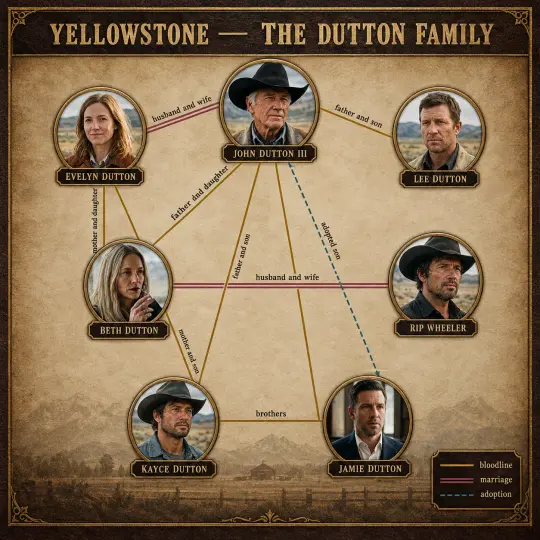
The Yellowstone Dutton family tree as four interactive networks: 24 characters, 8 locations, 4 events and 3 factions, with every parent, spouse, sibling, adoption, mentor and loyalty edge held as explicit data.
The Dutton family tree, without the guesswork
Yellowstone is a show about land, but its family tree is where the land argument becomes personal. John Dutton wants the ranch kept whole. Beth wants it defended with the family's own money. Kayce wants it kept away from his wife and son. Jamie wants to be recognised as the heir he was raised to be. Four people, one inheritance, and a set of relationships that change meaning every season.
This archive treats the Dutton family tree as data, not decoration. Every parent, spouse, sibling, adoption, mentor and loyalty connection is a named pair in a file. The interactive networks draw those pairs; an image model is never asked to invent a line. The result is a family tree you can check, filter and argue with — which is the only kind of Dutton family tree that makes sense.
The families
The Yellowstone story is not one tree. It is four separate arguments that share a ranch. The Dutton core asks who inherits. Beth and Rip ask what loyalty costs and whether love can survive the family code. Kayce asks whether a man can belong to the ranch and the reservation at the same time. Jamie asks what adoption means when blood comes back with a claim. Each network has its own cast, its own centre and its own way of failing.
The Dutton core
John Dutton III and Evelyn Dutton raised four children on a ranch that was already a legal and moral argument. Lee, the eldest, is killed in the opening episode. Jamie is adopted and told he is blood. Beth turns the family's accounts into a shield. Kayce marries Monica Long and lives between the ranch and Broken Rock. This network has twelve characters and twenty-nine explicit edges, including the adoption that Jamie only learns about as an adult.
The core network is the place to start because every other network depends on it. The gold parent lines run from John and Evelyn to Lee, Beth, Kayce and Jamie. The teal adoption lines mark the difference between being raised and being born. The rose marriage lines connect John to Evelyn and Beth to Rip. The sibling lines carry the show's longest grudge: Beth and Jamie, raised as brother and sister, ending as enemies.
Beth and Rip
Beth Dutton is the daughter who came back to fight. Rip Wheeler is the orphan John took in after the boy killed his abusive father. Their marriage is the one relationship in the show that is not a negotiation. Around them sit Carter, the teenager they take in; Lloyd and Walker, whose bunkhouse feud is a small war about status; and Colby and Teeter, the hands who make the bunkhouse feel like a home.
This network has eleven characters and nineteen explicit edges. The rose spouse line between Beth and Rip is the centre. The loyalty lines to John, Carter and the bunkhouse show how the couple becomes a family inside a family. The sibling and fault lines to Jamie and Kayce show what the marriage is protecting itself from.
Kayce, Monica and Tate
Kayce Dutton is the son who left, came home and discovered that he belonged to two jurisdictions. Monica Long teaches on the reservation and refuses to be treated as a bridge between the Dutton ranch and Broken Rock. Their son Tate is the grandson who inherits both claims. Thomas Rainwater, the chairman of Broken Rock, and Mo Brings Plenty, his right hand, sit on the other side of the fence line with the strongest historical claim to the valley.
This network has ten characters and twenty-five explicit edges. The parent lines from Kayce and Monica to Tate are the emotional centre. The loyalty lines to Thomas and Mo are political, not sentimental. The sibling lines to Jamie and Lee keep the family argument inside the same generation, even when the characters are standing on opposite sides of a border.
Jamie and the Randall secret
Jamie Dutton was raised as the second son, educated as a lawyer and promoted as the family's political face. Then he learned he was adopted, and that his biological father was Garrett Randall, a convicted killer with a claim of his own. Garrett does not ask for forgiveness. He offers Jamie a story in which the Duttons are the criminals. That story nearly destroys the family.
This network has ten characters and twenty-two explicit edges. The teal adoption lines from John and Evelyn are the ones Jamie cannot stop reading. The parent line from Garrett is the one that gives him a weapon. Christina, his partner and campaign manager, and Lynelle Perry, the governor, represent the two futures he keeps choosing between. The sibling line to Beth is the shortest fuse in the archive.
Seven profile cards
The archive includes seven archival profile cards, each made with the character-profile-card skill: John Dutton III, Beth Dutton, Rip Wheeler, Kayce Dutton, Jamie Dutton, Monica Long Dutton and Thomas Rainwater. Each card is a full dossier, not a portrait: age, identity, likes, dislikes, personality, a COMBAT radar chart, a TACTICS radar chart and a five-line character introduction. The cards sit inside their family sections on the hub, so you meet John with the Dutton core, Beth and Rip with their marriage, Kayce with Monica and Thomas, and Jamie with the Randall secret.
Five design sheets
Five characters also have full design sheets made with the character-design-sheet skill: John, Beth, Rip, Kayce and Jamie. Each sheet shows a front, side and back view at the same scale, four expression heads, detail callouts for hat, boots, hands and signature item, and a small colour palette. The sheets are visual references, not posters: they exist so the same face and costume can be reused across the networks and the poster.
One family poster
The family poster is made with the character-relationship-poster skill. It shows seven named people exactly once: John, Evelyn, Lee, Jamie, Beth, Kayce and Rip. It draws exactly nine edges: John and Evelyn as spouses; John to Lee, Beth and Kayce as parent; Evelyn to Beth and Kayce as parent; John to Jamie as adoptive parent; Beth and Rip as spouses; and Kayce and Jamie as siblings. The poster is a summary, not the source of truth. The source of truth is the data file behind the networks.
Why a network instead of a poster
A poster is a picture of a family tree. A network is the family tree itself. In the four interactive networks, every edge is a source-target pair with a relation type, so a line cannot drift to the wrong person. You can switch views: the whole family, the blood and adoption line, the marriages and in-laws, or the Randall secret. You can click a face and read the relations around it. You can use it on a phone. None of that is possible when an image model is asked to draw a family tree from prose.
The poster still matters, but it has a different job. It is the one-glance summary: seven faces, nine correct edges, a legend that separates bloodline, marriage and adoption. It is generated from the same cast and the same pairs, so it cannot contradict the networks. That division of labour is the whole point: the networks hold the argument, the poster holds the image.
Frequently asked questions
Is this canon? The family relations follow the television series Yellowstone, plus the prequels 1883 and 1923 where they establish the Dutton claim. Every narrative note is marked show-only because the Dutton story has no novel canon. We do not import book facts that do not exist.
Why are there four networks? A single graph with every character becomes unreadable. Four networks keep each argument legible and let you start from the question you actually have: inheritance, marriage, two families, or adoption.
Is Jamie really adopted? Yes. Yellowstone reveals that Jamie was adopted by John and Evelyn and that his biological father is Garrett Randall. The archive marks the adoption with a distinct teal line rather than folding it into the bloodline.
Are Beth and Rip married? Yes. Their marriage is one of the few stable relationships in the show, and it is drawn as a rose spouse line in the Beth and Rip network and on the poster.
Why show-only? Because Yellowstone, 1883 and 1923 are television drama, not adaptations of novels. The archive says so on every atom instead of pretending to a book canon that does not exist.
Can I read it on a phone? Yes. The networks are built to be dragged, zoomed and tapped. The hub and the archive page reflow to a single column, and the images are served as compressed WebP files.
Open the archive
Start with the hub, then open the Dutton network and click a face. If you want the marriage argument, open Beth and Rip. If you want the reservation argument, open Kayce. If you want the adoption argument, open Jamie. The poster is there when you need the whole family in one glance.
Every layer of this archive was built with four named skills: relationship-network for the four interactive graphs, character-relationship-poster for the family poster, character-profile-card for the seven dossiers, and character-design-sheet for the five turnaround sheets. The data, the drawings and the pages are separate on purpose, so each one can be checked against the others.
Open the Yellowstone family-tree hub: https://neta.art/app/yellowstone-family-tree
Dutton — Open · Beth & Rip — Open · Kayce — Open · Jamie — Open
Built with relationship-network, character-relationship-poster, character-profile-card and character-design-sheet.
Start Creating
Enter one sentence, AI generates a complete world and playable game. No coding required, free to start.