
Dishonored — The Empire of the Isles, Rebuilt as a Playable AI World
A gaslit empire on the edge of collapse, rebuilt as an explorable AI world: eight characters, six locations, six events and four factions — plus four published key visuals from a GPT Image 2 vs Krea 2 comparison on identical briefs. Every power that could save Dunwall wants a piece of Corvo first.
Dishonored: An Empire Measured in Whale Oil
Dunwall, 1837. The Empire of the Isles runs on whale oil, brass and fear. Whole districts have been sealed behind quarantine walls, the poor die of a plague that turns the sick into weeping husks, and the Empress has been murdered in her own tower. This is not a kingdom in decline — it is a machine that has already decided who it can afford to lose.
Into that city comes Corvo Attano, Royal Protector, branded the assassin he did not commit, tortured for six months in Coldridge Prison and then handed a gift by a god with black eyes. The Outsider marks his hand. From that moment Corvo can blink across rooftops, see through walls and call a swarm of rats — and every power arrives with a moral invoice attached.
A dying empire demands a savior, but every power that could save Dunwall — the Outsider's magic, the Abbey's purges, the Loyalists' coup — demands a piece of Corvo's soul in return.
This page is the entrance to that world as a playable AI setting: twenty-four atoms, four published key visuals rendered from two different image models, and the exact briefs and settings used to make them. It is built to be read, forked and rendered again — not just admired.
The Same Brief, Two Painters
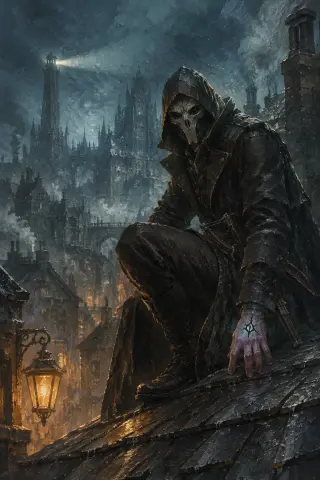
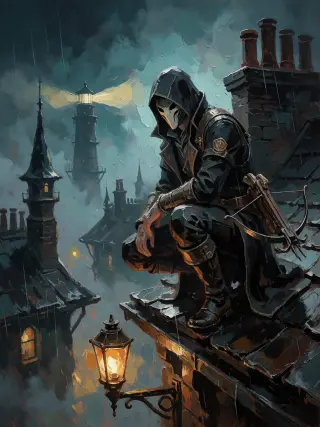
Both character images on this page come from one sentence, sent unchanged to GPT Image 2 and to Krea 2. No re-prompting, no cherry-picked variants, no second pass. The point is not to declare a winner but to show what each model is actually good at before you spend a render budget on a world.
GPT Image 2 resolves the world as materials: the wetness of the slate, the soot on the chimneys, the venting brass of the lantern, the distinct grain of the bone mask. Krea 2 resolves it as a poster: the hood, the mask and the crossbow become one shape, and the rain becomes a texture laid over the sky rather than a physical event.
What the comparison teaches
The City Is the Antagonist
Dunwall is not a backdrop with streets on it. It is a vertical argument about who deserves to breathe. The wealthy live above the waterline in marble and brass; the poor live below it, in flooded tenements where the rats have learned to use the doors. Every location in this world is a rung on that ladder, and every mission is about climbing it or falling off it.
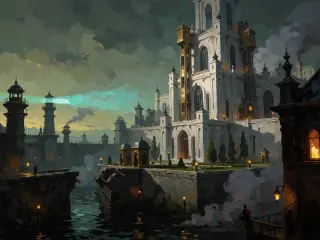
Dunwall Tower: The Room That Rules
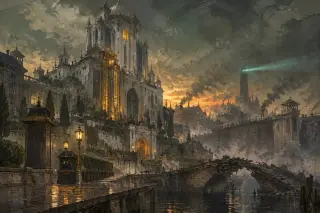
The tower is the clearest single image of the world's thesis. It is beautiful, it is empty, and it is built on a river of black water that is carrying the plague past its gardens. Every window is lit because the Empire still wants to look inhabited.
The Four Powers of the Isles
Nobody in this world is clean, and no faction is simply evil. Each one offers a version of order, and each version costs somebody their life. That is the engine that makes the setting playable: the player is never choosing between good and evil, only between different people's accounting.
The Outsider's Bargain
Magic in Dishonored is not a power fantasy; it is a contract with no readable terms. The Outsider appears in shrines, in dreams and in the corner of a cell, offers a gift, and then watches what the gift does to you. Runes and bone charms are scattered through the city like unmarked bills.
Six Events, One Clock
The world ships with six events that function as a timeline and a pressure system. They already happened; the player arrives in the gap between the last one and the next. That is enough structure for a campaign and little enough to leave room for invention.
The clock starts with the assassination and the framing, moves through six months of Coldridge, turns on the Golden Cat rescue and the Loyalist betrayal, and ends at the lighthouse with Emily's fate and the city's. You can run it in order, or start anywhere and let the consequences find you.
“The Abbey burns the street to save the soul. The Watch seals the street to save the treasury. The Loyalists free the street to inherit it. Corvo walks the street and decides which of them was lying.”
Eight People Who Each Want Something
The cast is small on purpose. Eight characters is enough for a conspiracy and few enough that every one can hold a secret. Each has a want, a method and a line they will not cross until they do.
- Impasto, not polish. Visible brushstrokes, palette-knife edges and layered opaque paint. If a surface looks airbrushed, it is wrong.
- Two keys only. Cold teal distance and one warm amber source. Everything else is a value between them.
- Wet stone, not chrome. Reflections come from rain and river water, never from polished sci-fi panels.
- One warm object per frame. A lamp, a window, a lantern. The warm note is the human note.
- Fixed negative clause. No text, no letters, no signage, no watermark, no UI.
Painting Dunwall in Impasto
This world carries a deliberate visual style: impasto oil painting. Broad opaque strokes, broken local colour and warm-cool value planes, with crisp detail retained only where it identifies the subject. It is the opposite of the usual game-key-art default, and that is why it works.
Impasto suits gaslight because both are about accumulated layers. A gaslit room is not evenly lit; it is a stack of warm pools and cold gaps. A palette knife leaves the same kind of evidence. The style makes the city feel painted by someone who was there, which is exactly the tone the world needs.
The style also protects the image from its own subject matter. Dishonored's palette — soot, teal, brass, bone — becomes muddy fast in a photoreal render. Broken pigment and visible strokes keep the darks readable and the warm accents honest.
Two Briefs That Built This World
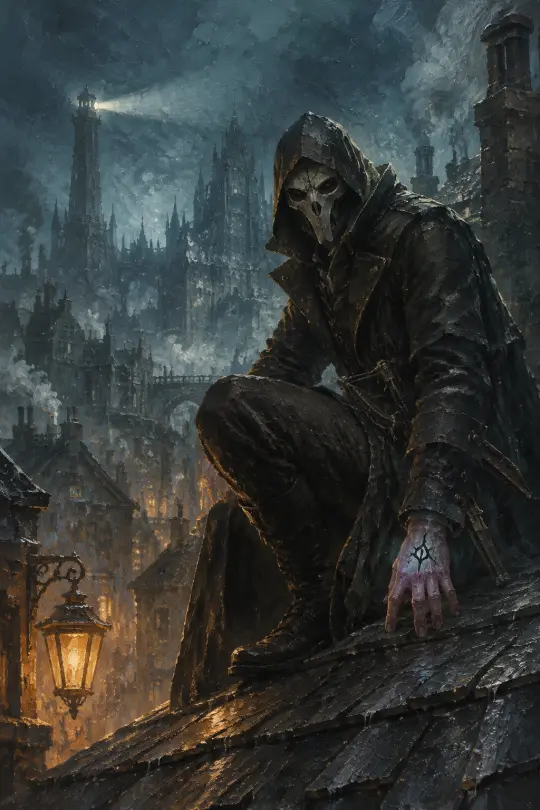
Character brief. Character key visual for a gaslit steampunk fantasy world. Corvo Attano, Royal Protector of Dunwall: a quiet, scarred man in a dark high-collared coat with a deep hood, a carved bone-white mask with dark eye slits over his face, a folding crossbow at his belt, and the black mark of the Outsider glowing faintly on his exposed left hand. He crouches on a rain-slick slate rooftop high above plague-ridden Dunwall at night, wet chimneys, crooked spires and a distant lighthouse beam cutting cold blue fog behind him, one warm amber whale-oil lamp burning below. Style: thick impasto oil painting, visible broad brushstrokes, palette-knife broken edges, layered opaque paint masses, warm-cool value planes, restrained ridge texture, painterly handmade illustration. Composition: vertical cinematic character poster, figure on the right third, cold teal backlight against warm amber rim, volumetric mist. No text, no letters, no signage, no watermark, no logo, no UI, no HUD.
Location brief. Environment key visual for a gaslit steampunk fantasy world. Dunwall Tower above the Wrenhaven at dusk: a colossal white-marble imperial keep with brass lifts, whale-oil lamps and high arched windows, clipped gardens and empty guard posts, plague smoke drifting over black canal water, a broken stone bridge and quarantine walls with watchtowers in the distance, a sickly green-grey sky pierced by one cold teal lighthouse beam and a single warm amber window. Style: thick impasto oil painting, visible broad brushstrokes, palette-knife broken edges, layered opaque paint masses, warm-cool value planes, restrained ridge texture, painterly handmade illustration. Composition: cinematic wide establishing shot, architecture dominating the frame, tiny human-scale lanterns for scale, wet reflective stone. No text, no letters, no signage, no watermark, no logo, no UI, no HUD.
Both briefs are deliberately over-specified. The model is not asked to be creative about the world; it is asked to execute a described place. The creativity lives in the atoms, the briefs are contracts.
In practice the two-frame set cost less than a takeaway meal and took minutes rather than days. The expensive part of a world is deciding what it is about; the rendering is now the cheap part.
From Brief to Playable World
The loop is simple and repeatable: read the atoms, choose a consequence, render two models on one brief, publish both, compare, then fork or re-prompt. Nothing in this world was hand-painted and nothing was hand-waved — every image on this page is a published work of the world, reachable from its own share page.
Because the works are attached to the world rather than to a chat, they compound. A new character brief can join the same set, and the next person to fork the world inherits both the atoms and the visual argument they were built around.
The vertical city
Altitude is politics. Put the palace at the top, the plague at the bottom and a bridge between them; the map now argues without dialogue.
One warm lamp
A single amber source in a teal room reads as hope, trespass or a trap depending only on who is standing next to it.
The mask that is also a skull
A face-shaped object with no eyes is the world's whole moral position: a protector who looks like the thing he protects you from.
Design Motifs You Can Steal
These are the reusable parts — not the intellectual property, the grammar. Take them into an original world and they still hold.
The city as a ladder
Stack four districts by height and income. Give each one its own light source and its own way of disposing of bodies.
The gift with a price
Any supernatural ability should make one thing easier and one thing worse. Blink saves time and makes you careless about who saw you leave.
The conspiracy that is right about the problem
The Loyalists genuinely want to fix Dunwall. They are also planning a coup. Both facts must be true at once.
The child as the real objective
A throne is an abstraction; a ten-year-old with a wooden boat is not. Put the political stakes inside a person the player can carry.
Four Ways to Play This World
Who This World Is For
It is for writers who want a conspiracy they can walk through, game masters who need a city with a clock in it, art directors who need a visual rule set that survives twenty images, and anyone testing image models on material that punishes decoration.
Read the atoms → choose a consequence → render two models on one brief → publish both works → compare → fork or re-prompt
That loop is the product. The four images are evidence that it runs.
Questions From the Workbench
Is this an official Dishonored product? +
No. This is a fan-built world assembled from publicly known Dishonored canon and rendered with AI models. It is not affiliated with or endorsed by Arkane Studios or Bethesda.
What is actually in the world? +
Twenty-four atoms: eight characters, six locations, six events and four factions, plus four narrative sections and four published key visuals generated inside the world with GPT Image 2 and Krea 2.
Can I fork it and change the story? +
Yes. Fork the world, keep the atoms you need, and replace the rest. The visual style and the negative clause are the parts worth keeping intact.
Why publish both models instead of the best one? +
Because the comparison is the useful artifact. One image tells you what a model can do; two images on one brief tell you what it is for.
Enter the World
Inherit a mask, a mark and a city that has already decided who it can afford to lose — then tell your own story inside the plague walls.