
Princess Mononoke AI World — Gods, Iron Towns, and the Girl Raised by Wolves
A forest that is also a god, a town that is also a furnace, and a curse that will not let either side look away.
Princess Mononoke: An AI World Where the Forest Is a God and the Town Is a Furnace
A prince rides west with a curse burning in his right arm. A girl raised by wolves stands on a cedar root with a spear and no interest in being rescued. Below them a forge town cuts the forest into iron, and above them the forest answers with teeth. That is the whole argument, and it does not resolve.
This world rebuilds that argument as a working, editable setting: 26 materials, 8 characters, 5 locations, 5 turning points, 4 factions and 4 rules, plus four published key visuals made from the same two prompts with GPT Image 2 and Krea 2. Every card opens. Every description can be rewritten. Every image can be regenerated from the world it belongs to.
The forest does not need saving. It needs to be left enough room to live.
The Premise, Without the Spoilers
It starts with a wound that should not exist. A boar god named Nago is driven mad by pain, attacks the Emishi village, and is killed by Ashitaka, the last prince of a people already fading. The killing does not end the god. It transfers the hatred: a black, worm-like curse climbs Ashitaka's arm, gives him monstrous strength, and will eventually kill him. He is told to ride west and see with eyes unclouded what is happening there. He goes because staying means dying without understanding why.
The west is a collision. Iron Town is a walled furnace run by Lady Eboshi, who buys her workers out of brothels, shelters a leper colony, and arms a militia of women — and who is cutting the forest down to keep all of them alive. The forest is defended by Moro, a three-hundred-year-old white wolf goddess, her two-tailed pack, the blind boar god Okkoto, and San, the human daughter Moro raised. Neither side is lying about what it needs. That is the design of the world.
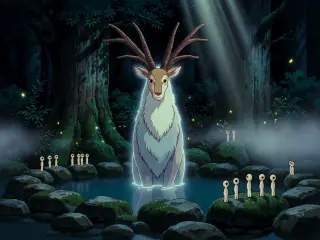
Above both sides sits the Great Forest Spirit: a deer with a human face by day, a vast night-walker by night, the thing that gives and takes life. The Emperor wants its head because he believes it grants immortality. When the head is taken, the forest dies in hours. When it is returned, the green comes back — but not the same green, and not the same world.
Every faction in this world is defending something real: work, food, grief, territory, a daughter, a species. Nothing here can be solved by picking a side.
What Is Actually in This World
The world is not a summary with pictures attached. It is a set of linked cards: 8 characters, 5 locations, 5 events, 4 factions and 4 rules, each with a description written to be used. A location card tells you what the light does and what the place costs. A rule card tells you what cannot happen, which is usually more useful than what can. The four key visuals were produced inside the world so that the visual language on this page and the written language in the cards are the same language.
The Eight People Who Hold the Argument
Each character exists to make one position unavoidable. Open any card and you get a body, a motive, and a contradiction you can put into a scene.
Five Places That Decide How a Scene Feels
The locations are not backdrops. Each one has a different relationship between people and scale, and that relationship is what you are actually prompting.
Five Turning Points You Can Build a Scene Around
The events are written as beats, not as plot summary: each one has a place, a physical action, and a consequence that changes what the next scene can be.
Four Institutions, Four Loyalties
Factions are how the world distributes blame and affection. Each one has a legitimate claim, which is what makes a scene between any two of them interesting.
The Four Rules That Make the World Behave
Rules are the most useful cards for generation, because they tell you what a correct image cannot show. A world with rules produces scenes; a world without them produces wallpaper.
What the World Is Really About
The engine is not a fight between good and evil. It is a fight between two kinds of survival that have been made incompatible by technology and need. Iron Town is not evil; it is a lifeboat with a saw. The forest is not gentle; it is a system that will kill you for stepping wrong. Ashitaka's curse is the physical form of the problem: pain that enters one body and makes it dangerous to everyone around it.
This is why the world is good raw material for images. It gives you built-in tension in every frame: a human scale against a god scale, a warm interior against a cold forest, a tool against a body. You do not have to invent a mood. You have to choose which contradiction to photograph.
Two Models, One Brief: GPT Image 2 vs Krea 2
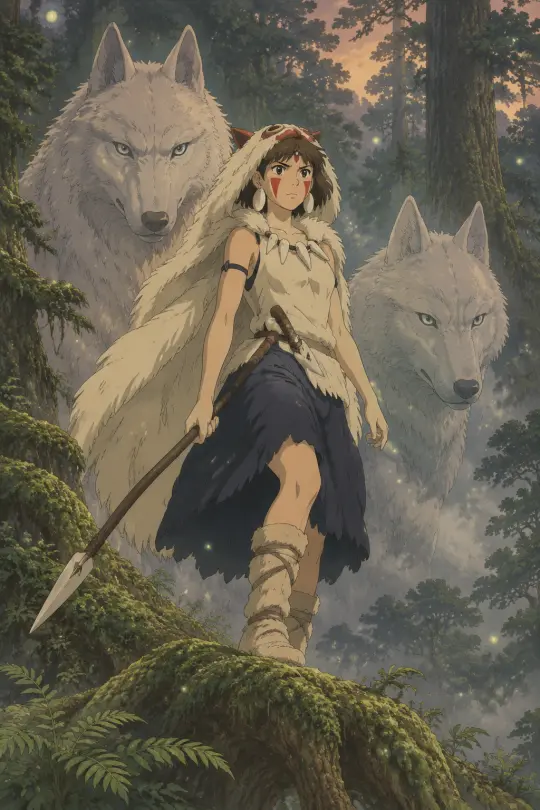
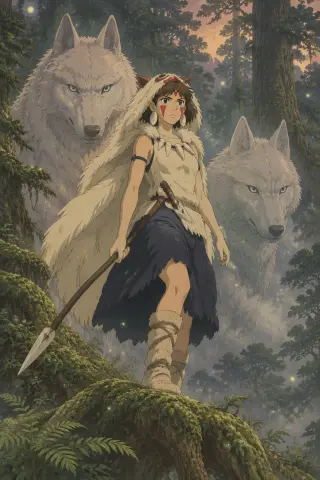
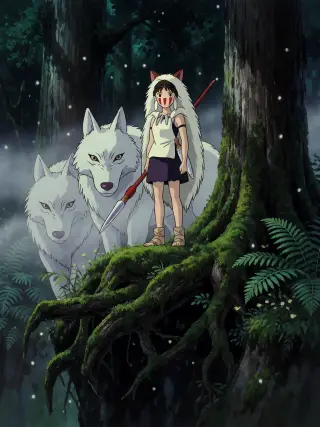
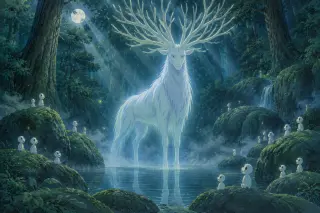
Both pairs on this page used identical prompts. Nothing was reworded between models, and nothing was retouched afterwards. The San prompt asked for a wolf-raised girl on a moss-covered cedar root at dusk, white pelt, red war paint, bone dagger, spear, two wolves in the mist, muted earth greens and painterly light. The Sacred Pool prompt asked for the deer-like god standing knee-deep in still water, kodama on the rocks, moonlight through cedar, silver-blue godlight, a cinematic wide frame.
- CompositionGPT Image 2 builds a stage with foreground root, middle figure and background ravine. Krea 2 composes a poster: figures centred, background flattened into bands. For a character sheet, Krea 2 is faster to read. For a scene, GPT Image 2 gives you somewhere for the eye to walk.
- Detail and propsGPT Image 2 renders the bone dagger, the lashing on the spear, the fur break at San's shoulder. Krea 2 simplifies props into graphic shapes — a red spear shaft instead of a wrapped grip. Neither is wrong; decide whether the prop needs to be usable or readable.
- LightGPT Image 2 gives dusk a temperature gradient, warm at the horizon and cold under the canopy. Krea 2 gives night a single clean key light and a flat luminous outline around the god. If the brief depends on time of day, GPT Image 2 is more literal.
- ScaleThe Sacred Pool is a scale test. GPT Image 2 makes the god fill the canopy and still fit in the water; Krea 2 brings the camera closer, which makes the god feel like a creature rather than a landscape. Choose the crop before you choose the model.
How the San Key Visual Was Built
The prompt did not start from "Princess Mononoke". It started from the card. The card gives the pelt, the paint, the dagger and the wolves; the prompt only decides where the camera stands.
Read the character card first
San is not a girl in a costume. She is a person who lives outside, fights with a spear, and has wolves larger than she is. That hierarchy — wolves first, girl second — is the composition.
Choose one beat, not a montage
The chosen beat is the edge of the forest at dusk, before a raid. It explains the pelt, the paint and the spear without a single caption.
Write the prompt in layers
Style, subject, costume, props, companions, environment, light, palette, composition, exclusions. Ten short clauses beat one long sentence.
Set size before generating
A character poster wants a vertical frame. GPT Image 2 was set to 1024×1536 at high quality; Krea 2 to 768×1024, its maximum portrait size.
Compare the same brief
Run the identical prompt on both models before you edit anything. Differences you see at this stage are model character, not prompt error.
Edit the card, not just the image
If the image reveals something true about San — the way she stands, the height of the root — write it back into the card so the next scene inherits it.
How the Sacred Pool Key Visual Was Built
The Sacred Pool is the harder of the two prompts because it contains a contradiction: a god that is both an animal and a landscape. The prompt has to hold both without turning into a nature photo.
Start from the rule
The Law of the Forest Spirit says the god gives and takes life, is a deer by day and a walker by night, and keeps its power in its head. The image therefore needs a head you can imagine being cut off.
Fix the time of day
Night is the version with the walker and the godlight. Dusk is the version with the deer and the human face. This image chose night and kept the human face, which is the unsettling combination.
Place the camera at water level
A low camera makes the pool a mirror and the god a reflection as much as a body. It also lets the kodama sit at eye level with the viewer.
Name the light source
Moonlight through cedar, plus the god's own pale blue emission. Two sources, one cold, one colder. Without naming them, the model invents a generic blue fog.
Seed the frame with small lives
Kodama on the rocks give scale and an audience. They also make the god look attended rather than alone.
Choose the crop by model
GPT Image 2 was given 1536×1024 for the wide canopy; Krea 2 was given 1024×768 and answered with a closer, frontal frame. The crop changed the meaning, not just the aspect.
Where the Two Models Actually Disagree
On San, GPT Image 2 produced a warm dusk with a visible horizon and three distinct planes; Krea 2 produced a night forest with a bright flat background and a much stronger graphic silhouette. On the pool, GPT Image 2 scattered kodama across the whole frame and gave the god a forest of antlers; Krea 2 lined the kodama up like a chorus and simplified the antlers into a crown. GPT Image 2 is the better illustrator of a described place. Krea 2 is the better poster designer of an idea.
The practical consequence: use GPT Image 2 when the image has to explain a space, a costume or a prop. Use Krea 2 when the image has to land at thumbnail size, carry a title, or hold a graphic shape. Then use the world's cards to keep both versions recognisably in the same story.
Five Story Seeds You Can Play Tonight
These are not scenes from the film. They are scenes the world's rules produce when you push two cards together.
How to Start From This World
Open the studio
Every card is readable and editable: characters, locations, events, factions, rules. Start with the rule that interests you, not with the character you like.
Pick one card and one beat
A card describes a person or place; a beat decides what is happening right now. One of each is enough for an image.
Generate, compare, keep the better crop
Run the prompt on both models if the scene matters. Keep the version that serves the beat, not the version that looks most expensive.
Write the result back
Add the detail you learned to the card. The world gets more specific every time you use it, which is the opposite of how a prompt library behaves.
Questions People Ask Before Starting
Do I need to know the film? No. The world is written to be entered cold: the cards explain the curse, the town, the forest and the god without assuming you have seen anything.
Is this a replica of the film?
No. It is a fan-built setting with its own editable materials. The characters and places are recognisable, but the cards are written to be rewritten, and the images on this page were generated from those cards rather than copied from stills.
Which model should I use first?
GPT Image 2 if you need a place, a costume or a prop explained. Krea 2 if you need a strong poster image quickly and cheaply. The four key visuals here are the comparison, so you can decide from the evidence rather than from a spec sheet.
Can I use the images commercially?
The images are generated assets published inside this world. Treat them as fan work: check the platform terms and keep the independent, non-affiliated disclaimer with any reuse. Do not present them as official stills.
Start From the World as It Stands
You do not have to rebuild the forest to stand in it. The world is open: 26 materials with descriptions, four published key visuals, and a studio where every card can be opened and changed. Take the premise, keep the rules, and put a different person at the edge of the trees. The forest will still be a god, and the town will still need iron.
Enter the forest, then change it
The world is built. The pool is still. Start from San's root — or fork the setting and give the story a different ending.
Every image on this page was generated inside this world. Princess Mononoke is an independent, fan-built world in Neta Studio and is not affiliated with Studio Ghibli. The key visuals on this page were generated inside this world; every character, place and event is an editable material rather than canonical text. Open the studio to read every card.