
Xenoblade Chronicles — Two Titans, One Playable AI World
A mythic JRPG world balanced on the bodies of two gods, rebuilt as an explorable AI setting: eight characters, six locations, six events and four factions — plus four published key visuals from a GPT Image 2 vs Krea 2 comparison on identical briefs. A sword that shows the future is really a question about what you will do next.
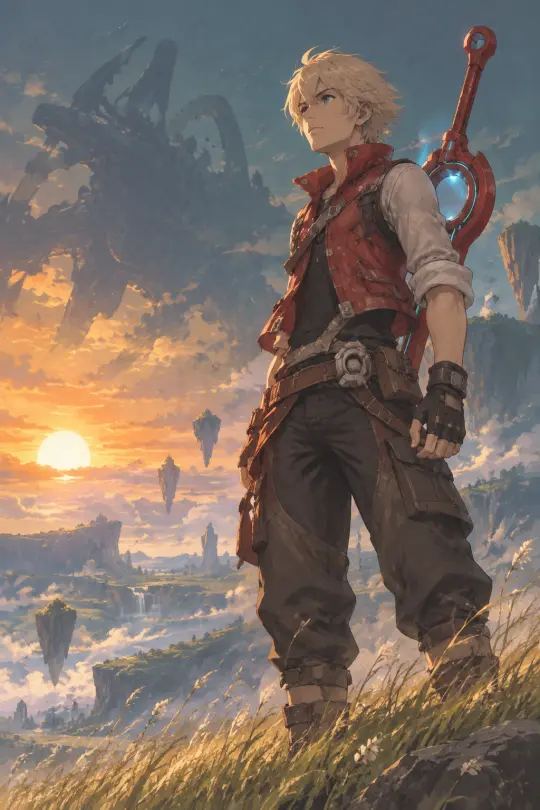
Xenoblade Chronicles: A World Held Up by Two Titans
Two giants stand in a deadlocked ocean. Bionis carries life on its back — grasslands, forests, colonies, a whole civilisation that has learned to farm the body of a god. Mechonis carries machines, and the machines have spent a thousand years deciding that the only way to save the universe is to end the life on the other titan first. Between their crossed swords lies a frozen pass full of wreckage, and in the middle of the argument stands an eighteen-year-old engineer with a red blade that shows him the future.
This is Xenoblade Chronicles rebuilt as an explorable AI world: eight characters, six locations, six events and four factions, with four published key visuals rendered from two different image models on identical briefs. It is designed to be read, forked and replayed — not just admired.
A god's corpse is a country. A sword is a weapon and a prophecy. And the boy who can see the future has to learn that seeing it and choosing it are different acts.
Everything below is playable material: the factions that make the politics move, the timeline that supplies the clock, the locations that can hold an argument, and the exact briefs used to render the two titan-scale key visuals on this page.
The Same Brief, Two Painters
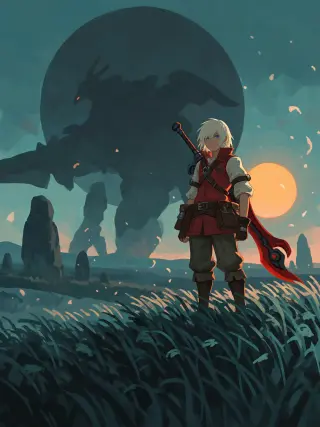
Both character images on this page come from one sentence, sent unchanged to GPT Image 2 and to Krea 2. No re-prompting, no alternate seeds, no second pass. The point is not to crown a winner but to show what each model is actually for before you spend a render budget on a world.
GPT Image 2 resolves the world as materials and distance: the nap of the grass, the matte grain of the red vest, the leather straps, the mechanical hilt of the Monado, and a Mechonis that genuinely recedes into haze. Krea 2 resolves it as a poster: Shulk becomes a red-and-cream shape, the sword becomes a single stroke, and the titan becomes a graphic shadow against a pale disc of sky.
What the comparison teaches
Two Titans, One Sea of Grass
The world's geography is a body. Bionis is the god of life; Mechonis is the god of machines; their swords are still crossed where the blow never landed. Every location in the setting is a rung on that body, from the foot at Colony 9 to the shoulder at Alcamoth, and every journey is a climb up a corpse that is not entirely dead.
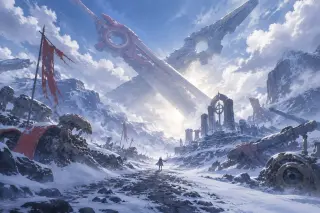
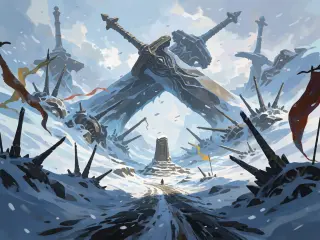
Sword Valley: The Room That Remembers
The valley is the clearest single image of the world's thesis. Two weapons too large to be understood are locked in a shape that has not changed in a thousand years, and underneath them people have built roads, shrines and graves. The war is over and the memorial is still being added to.
Four Powers of the World
Nobody in this setting is simply evil. Each faction offers a version of order, and each version costs somebody their life. That is the engine that makes the world playable: the party is never choosing between good and evil, only between different people's accounting.
The Monado's Bargain
The Monado is not a sword that makes you strong. It is a sword that makes you responsible. It cuts Mechon armour, it shows glimpses of the future, and every vision arrives with the same question attached: now that you have seen it, what will you do?
Six Events, One Clock
The world ships with six events that function as a timeline and a pressure system. They already happened; the player arrives in the gap between the last one and the next. That is enough structure for a campaign and little enough to leave room for invention.
The clock starts with the Battle of Sword Valley and the arm Dunban paid for it, moves through the fall of Colony 6 and the raid on Colony 9, turns on Melia's trial and the truth at Prison Island, and ends with the fall of Alcamoth and a capital that becomes monsters in a single night. You can run it in order, or start anywhere and let the consequences find you.
“The High Entia built their capital above the sea so they would never have to look at the ground. The Mechon came up through the water anyway. Every empire in this world is a height that mistake has been waiting at.”
Eight People Who Each Want Something
The cast is small on purpose. Eight characters is enough for a conspiracy and few enough that every one can hold a secret. Each has a want, a method and a line they will not cross until they do.
- Painted planes, not polish. Forms are built from broad visible brush-shaped planes with hard structural edges. If a surface looks airbrushed, it is wrong.
- Two keys only. Cold teal distance and one warm amber source. Everything else is a value between them.
- Landscape as body. Every location is part of a titan: bone, grass, metal, snow or sea. Never generic fantasy terrain.
- One human for scale. A figure or a lantern in the frame tells the viewer how enormous the world is.
- Fixed negative clause. No text, no letters, no signage, no watermark, no UI.
Painting Bionis in Planes
This world carries a deliberate visual style: commercial game painterly. Broad visible painted planes, solid brush-shaped hard edges at structural turns and focal points, large connected local colour and value groups, deep-colour shadows and a few saturated accents. Detail is concentrated on identity, hands and signature props; large surfaces stay quiet and connected.
That style suits a world made of a god's body. A titan is too large to render as texture, so it has to be rendered as planes: a green plane of grass, a blue plane of sky, a black plane of machine. The eye assembles the scale from the value structure, not from micro-detail.
It also protects the palette. Xenoblade's colours — grass green, ether blue, Monado red, Mechon iron — turn into mud in a photoreal render. Broken pigment and visible strokes keep the darks readable and the accents honest.
Two Briefs That Built This World
Character brief. Character key visual for a mythic fantasy JRPG world. Shulk, an eighteen-year-old Colony 9 engineer and the bearer of the Monado: white-blond hair falling over blue eyes, a red sleeveless vest over rolled shirtsleeves, leather work straps and a tool belt, the red blade of the Monado strapped across his back, its mechanical hilt glowing faintly with ether light. He stands on a wind-bent grass ridge on the Gaur Plain at dusk, the colossal black silhouette of Mechonis on the horizon like a second, hostile moon, floating rock spires and drifting pollen in the air, one warm amber sun low behind him against a cold teal distance. Style: commercial game painterly, high-finish game art, forms built from broad visible painted planes, solid brush-shaped hard edges at structural turns and focal points, large connected local colour and value groups, deep-colour shadows, a few saturated accent colours, detail concentrated on identity, hands and signature props, large surfaces quiet and connected. Composition: vertical cinematic character poster, figure on the right third, generous negative space, dramatic rim light. No text, no letters, no signage, no watermark, no logo, no UI, no HUD.
Location brief. Environment key visual for a mythic fantasy JRPG world. Sword Valley, the frozen pass where the colossal swords of Bionis and Mechonis cross: two blades taller than clouds filling the sky, snow and wind-bent metal, a graveyard of broken Mechon and shattered Homs artillery half-buried in the drifts, rusted banners snapping in the wind, a stone memorial at the pass, a narrow road of packed snow and dark rock leading toward the pale light between the blades. Style: commercial game painterly, high-finish game art, forms built from broad visible painted planes, solid brush-shaped hard edges at structural turns and focal points, space built from large value groups and selective edges, restrained warm accents against a cold blue-white palette, detail concentrated on the memorial and the wreckage. Composition: cinematic wide establishing shot, the crossed blades dominating the frame, a tiny human-scaled figure on the road for scale, volumetric snow. No text, no letters, no signage, no watermark, no logo, no UI, no HUD.
Both briefs are deliberately over-specified. The model is not asked to be creative about the world; it is asked to execute a described place. The creativity lives in the atoms, the briefs are contracts.
In practice the four-frame set cost less than a sandwich and took minutes rather than days. The expensive part of a world is deciding what it is about; the rendering is now the cheap part.
From Brief to Playable World
The loop is simple and repeatable: read the atoms, choose a consequence, render two models on one brief, publish both, compare, then fork or re-prompt. Nothing in this world was hand-painted and nothing was hand-waved — every image on this page is a published work of the world, reachable from its own share page.
Because the works are attached to the world rather than to a chat, they compound. A new character brief can join the same set, and the next person to fork the world inherits both the atoms and the visual argument they were built around.
The vertical world
Altitude is theology. Put the capital on the shoulder, the colony at the foot and the sword in the sky; the map now argues without dialogue.
One warm sun
A single amber source in a teal landscape reads as hope, trespass or a trap depending only on who is standing in front of it.
The sword that is also a person
The Monado is a weapon, a prophecy and a burden. Give an object three jobs and it stops being a prop and becomes a character.
Design Motifs You Can Steal
These are the reusable parts — not the intellectual property, the grammar. Take them into an original world and they still hold.
The world as a body
Build your map on a living thing. Give every region an anatomical name, a resource and a disease. Travel becomes a kind of diagnosis.
The weapon with a point of view
Any legendary object should want something. A sword that shows the future is really a sword that asks what you are going to do about it.
The enemy with a correct diagnosis
Egil is right that the titan's life is consuming the universe. He is wrong about the treatment. That gap is where the story lives.
The empire above the sea
Put one faction physically higher than everyone else and give them beautiful manners. The fall is now built into the architecture.
Four Ways to Play This World
Who This World Is For
It is for writers who want a mythic scale they can walk through, game masters who need a map with a body in it, art directors who need a visual rule set that survives twenty images, and anyone testing image models on material that punishes decoration.
Read the atoms → choose a consequence → render two models on one brief → publish both works → compare → fork or re-prompt
That loop is the product. The four images are evidence that it runs.
Questions From the Workbench
Is this an official Xenoblade product? +
No. This is a fan-built world assembled from publicly known Xenoblade Chronicles canon and rendered with AI models. It is not affiliated with or endorsed by Monolith Soft or Nintendo.
What is actually in the world? +
Twenty-four atoms: eight characters, six locations, six events and four factions, plus four narrative sections and four published key visuals generated inside the world with GPT Image 2 and Krea 2.
Can I fork it and change the story? +
Yes. Fork the world, keep the atoms you need, and replace the rest. The visual style and the negative clause are the parts worth keeping intact.
Why publish both models instead of the best one? +
Because the comparison is the useful artifact. One image tells you what a model can do; two images on one brief tell you what it is for.
How large is the world, really? +
Small enough to hold in your head: twenty-four atoms and six events. Large enough for a full campaign, because every atom is built to create scenes rather than lore.
Enter the World
Stand on a god's shin with a sword that shows you what happens next — then decide whether to obey it.