
A Silent Voice AI World — The Apology That Arrives Five Years Late
A contemporary Japanese town, one deaf girl, one former bully, and eight classmates who all remember a different version of the same year.
A Silent Voice AI World — The Apology That Arrives Five Years Late
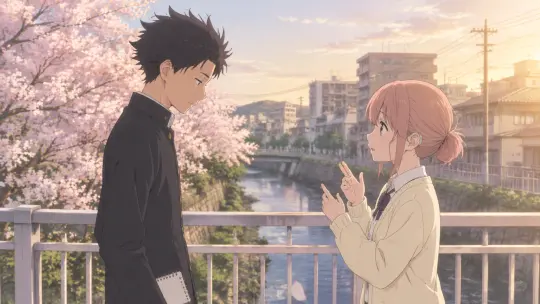
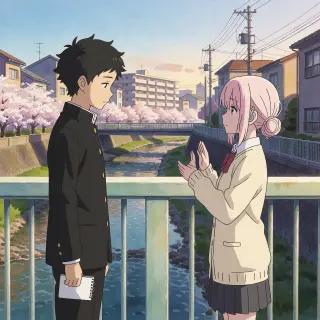
A boy stands on a narrow pedestrian bridge with a spiral notebook in his hand. A girl a few steps away raises her hands to sign something she has rehearsed and cannot say out loud. The river keeps moving underneath them. Neither of them is a hero yet. That is the whole promise of this world: nobody arrives fixed, and nobody is let off the hook by a single beautiful scene.
This is an editable AI world built from the bones of A Silent Voice — a contemporary Japanese town, a sixth-grade classroom that did something unforgivable, and the years afterwards in which everyone grows up carrying a different version of the same story. It contains 27 materials you can open and rewrite: 8 characters, 5 locations, 6 events, 4 factions and 3 rules. Four published key visuals test those materials with two prompts, each run unchanged on GPT Image 2 and Krea 2.
A silent voice is not a silent story
The title is a misdirection. Shōko Nishimiya is deaf, but she is not the quiet one — she is frequently the most direct person in the room, and the one who keeps trying. The silence belongs to the hearing characters: the classmates who watched, the teachers who looked away, the boy who learned to sign five years too late. This world is designed around that inversion. Sound, or the lack of it, is a point of view rather than a decoration.
The story is not about a boy saving a deaf girl. It is about a boy discovering that the person he hurt has her own plan for her life — and that his apology is not the centre of it.
It begins with a transfer, not a confession
The Transfer is the first event in the timeline because everything else is a consequence of it. A new girl walks into a sixth-grade classroom with a notebook and a smile, and the class has to decide what to do with her. They decide badly. The notebook, the hearing aids, the laughter and the teacher’s silence are all ordinary objects and ordinary failures, which is exactly why the world is playable rather than operatic.
From there the timeline runs forward and backward at once. You can play the classroom in the years when the cruelty was still a game, or the high-school years when everyone has learned to describe that cruelty as “complicated.” The world does not force chronology. It asks which version of the past a character is willing to admit in the present.
Eight people, and none of them are only one thing
The cast is the world’s real engine. Every character has both bullied and been bullied, or watched and been spared, or apologised and expected to be thanked for it. Open any card and you get a position, not a personality type: what this person wants, what they refuse to see, and what they would have to lose to become kind.
Five places that hold the whole story
The locations are chosen for what they make people unable to say. A bridge is a place of crossing where nobody can sit down. A classroom is a room built for being watched. A riverbank at a fireworks festival is beautiful in a way that makes despair feel obscene. The Nishimiya apartment is organised around protecting one daughter. The sign-language circle is the only room in the world where listening is a skill you can practise in public.
Six beats you can play in any order
The events are not a plot outline to be followed; they are pressure points. Drop a scene on any of them and the world knows what is at stake. The Transfer establishes the wound. The Notebook in the River makes it irreversible. The Scapegoat redistributes the blame without distributing the guilt. The Bridge Meeting is the first attempt at repair. The Fireworks Fall is the cost of that attempt. The Final Walk is not a cure — it is the first morning someone wants to stay alive.
Four groups, no villains
The factions are the social machinery. The Sixth-Grade Class is a closed world where kindness is a performance and one child is chosen to carry everyone’s cruelty. The Film Crew is the same group five years later, held together by guilt and half-spoken affection. The Nishimiya Family is love organised as defence. The Sign Language Circle is the alternative: a group that has agreed to be bad at something together until they get better.
Three rules that make the world behave
The rules are the difference between a themed chatbot and a world. Faces Crossed Out turns Shōya’s perception into a visible progress bar: every face he passes wears an X until he lets someone back in. No One Is Only a Bully forbids the easy villain. Sign Is a Language makes every gesture carry grammar, timing and tone — misreading a hand can wound as deeply as a shouted word.
Why the bridge is the whole world
Every story about repair needs a place where the two people cannot leave. The bridge does that without trapping them in a room. It is public enough that they have to behave, narrow enough that they cannot avoid each other, and moving enough that the river keeps reminding them time is passing. The pale railing catches the light and turns the whole scene into a line: two figures on one side of it, the town on the other.
What the two models saw differently
The same paragraph of prompt went to both models. GPT Image 2 treated the scene as a photograph of a place: it built the bridge deck, the river, the far bank, the apartment blocks and the cherry tree in separate planes, then placed the figures inside that space. Krea 2 treated it as a poster: it flattened the town into coloured blocks, squared the composition and pushed the two silhouettes forward. Neither is wrong. They answer different questions.
- GPT Image 2 — depth and detailSeparates foreground, subject and background into readable planes. The railing, the notebook, the hearing aid and the river all hold their place. Best when the image has to explain a place, or when a small prop carries the story.
- Krea 2 — shape and speedCompresses the same scene into graphic bands with cleaner silhouettes and a paler, flatter palette. Roughly a quarter of the cost per image and much faster. Best when the image has to read at thumbnail size or carry a title.
- Where they agreeBoth models understood the emotional beat without being told: two people standing too far apart, a town going on behind them, and light that is beautiful and slightly unbearable. That agreement is the real proof the prompt works.
The classroom with nobody in it
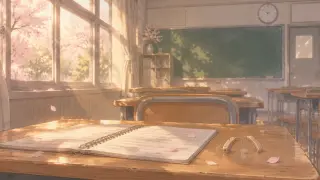
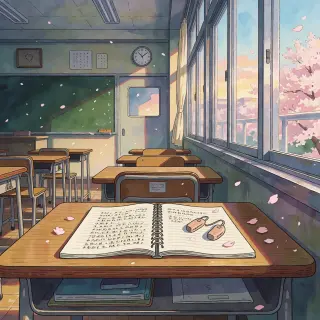
The second prompt removes the characters entirely. An open spiral notebook and a pair of hearing aids sit on a desk by the window; cherry petals have blown across the paper; the clock and the blackboard are still keeping time. It is a harder test than the bridge, because there is no face to carry the feeling. The image has to make an absence feel like a person.
GPT Image 2 renders the room as a still life: the notebook’s ruled pages, the curve of the hearing aids, the dust in the low sun and the receding rows of empty desks. Krea 2 renders it as a colour event: the sunset window becomes a flat poster shape, the desks become bands, and the notebook and hearing aids become two bold objects on a warm plane. One is a memory; the other is a cover.
Sign is a language, not a gesture
Most fiction about deafness films the hands as mime. This world treats signing as speech: it has grammar, regional variation, timing, emphasis and jokes that do not survive translation. A character can interrupt, lie, flirt or refuse in sign. A hearing character can think they are being kind while signing something condescending. The rule exists to stop the story from using deafness as a mood.
Decide who is fluent
Establish what each character can actually say with their hands. Shōya is a late learner and should make grammatical mistakes. Shōko is fluent and should be allowed to be impatient with his mistakes.
Give the hands a job
Signing while holding a notebook, a bag or a camera changes what is possible. Physical obstruction is drama: someone has to put something down to say the important thing.
Write the misread
A sign is misread, or read correctly and ignored. The scene should turn on that gap, not on a spoken line that clarifies everything afterwards.
Let silence answer
End on the absence of a reply. A character waiting for an answer they will not get is more powerful than a speech.
Playing Shōya without excusing him
The temptation is to make him a sad boy who deserves comfort. The world resists that. His guilt is not proof of growth; it is often proof that he is still thinking about himself. The playable question is not “will he be forgiven?” but “can he do one useful thing without being watched doing it?” A good Shōya scene ends with him less interesting than the person he is trying to help.
Playing Shōko without making her a lesson
Shōko is not a symbol of forgiveness and she is not a reward for his growth. She has her own anger, her own plans, her own reasons for smiling that have nothing to do with him. The strongest scenes give her the option to leave, and then let her choose something the player did not expect. If every branch ends with her teaching him something, the world has failed her.
What the classmates are for
Naoka, Miki, Miyoko, Satoshi and Tomohiro are not side quests. They are the social field in which the apology has to happen. Naoka refuses to admit her part; Miki remembers herself as kind; Miyoko did the right thing once and paid for it; Satoshi names the problem; Tomohiro simply treats Shōya as a friend. Put any two of them in a room and the scene writes itself, because each one has a different reason to protect the story they tell about the sixth grade.
The apology problem
An apology is not a transaction. It cannot be traded for absolution, and the person receiving it is not obliged to perform gratitude. The world’s core conflict is precisely this: Shōya wants to apologise and disappear; Shōko has already decided the world would be lighter without her. Forgiveness has to be built by the two people least equipped to give it, and it does not arrive on schedule.
How to start, in four moves
Open the world
Start from the world card and read the three rules first. They are the constraints that make every later choice mean something.
Pick a pressure point
Choose one event — the Transfer, the Notebook, the Scapegoat, the Bridge, the Fireworks or the Final Walk — and decide which character is telling the truth about it today.
Set the scene in one sentence
Write what is happening in the next ten minutes, not the next ten years. “Shōya waits on the bridge with a notebook he does not open” is enough.
Play the silence
Let the first reply be signed, missed or withheld. The scene will tell you what it is about faster than an outline will.
What you can make from this world
The world is a material library, not a single story. The same 27 cards can become a playable visual novel about the bridge reunion, a set of character posters for the Film Crew, a short animated scene of the notebook falling, or a quiet still-life series about rooms after everyone has left. Every card can be rewritten; every image can be regenerated; every share link opens the exact asset it came from.
- Play it as a visual novelBranch the bridge conversation, the classroom confrontation or the festival night. The rules keep the branches honest: no easy villain, no miracle cure, no reward for apologising.
- Generate key visualsUse the two published prompts as a starting point, then re-run them for your own scene. Compare GPT Image 2’s spatial detail with Krea 2’s graphic compression before you commit to a look.
- Build a character studyTake one card — Naoka, Miki, Yuzuru — and play a single afternoon from their point of view. The world is small enough that a side character can carry a whole episode.
Questions people ask before entering
- Do I need to know the film or manga? No. The world introduces the town, the classroom and the cast from scratch. Knowing the original adds recognition, not access.
- Is this a retelling or a new story? It is a playable world built from the same materials. You can replay canonical beats or write a scene that never happened, as long as you respect the three rules.
- Can I change the characters? Yes. Every card is editable. You can age them up, move the story to another town, or write a version in which the apology is refused.
- What are the four published works? Two prompts — the bridge meeting and the empty classroom — each rendered by GPT Image 2 and Krea 2. Every image on this page is one of those four real outputs.
- Where do I start? Open the world studio, read the rules, then choose the Bridge Meeting and write one sentence about what Shōya is afraid will happen.
Enter the world
The bridge is built, the classroom is empty, and the apology is still unsaid. Start a scene in A Silent Voice — or open the studio and read the cards first.