
Neo-Tokyo 2019 — An Akira World Built with AI
A complete Akira-inspired Neo-Tokyo canon rebuilt as an AI world: eight characters, six locations, five events and four factions, plus four published key visuals from a GPT Image 2 vs Krea 2 comparison. A city raised on a crater, a boy carrying a stolen future, and a red bike that keeps riding toward the light.
Neo-Tokyo 2019 — Worldview
Thirty-one years after a psychic detonation erased the old capital, Neo-Tokyo stands on the crater as if the ground were ordinary. Elevated highways cut between neon canyons. Military checkpoints sit at the on-ramps like toll booths for a war nobody has declared. In the lower wards, motorcycle gangs own the night; under a public hospital, a sealed research floor owns the future.
A city built on a crater. A boy kept asleep beneath a stadium. A red motorcycle moving fast enough to believe the past cannot catch up. This is a world where the future is not invented — it is remembered, contained and occasionally detonated.
The World in One Frame
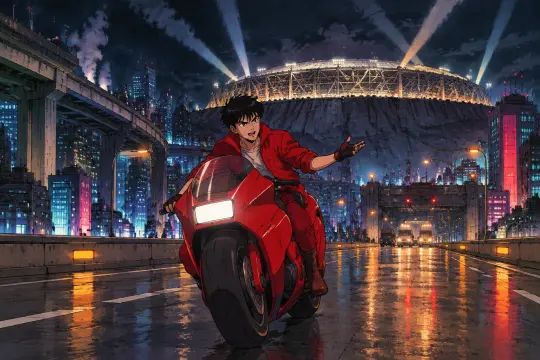
The cover is not a montage. It is a single road at night, and everything the world needs is arranged along it: a rider who believes speed is a form of freedom, a stadium that was built to prove history was over, and a crater the city has paved around but never filled. The road points forward. The stadium points backward. The rider is caught between them.
That is the tone of this Neo-Tokyo. It is loud, wet and electric, but underneath the neon is a municipal confidence trick: the reconstruction is a founding myth, the calm is a suppressant, and the kids at the bottom of the city are the only ones who can see the seams.
What Neo-Tokyo Actually Runs On
The city runs on three currencies: electricity, access and silence. Electricity keeps the neon and the trains moving. Access decides which wards get a checkpoint and which get a clinic. Silence is the most valuable of the three, because the Akira Project has spent thirty years buying it in increments — a sealed floor here, a missing file there, a witness who suddenly remembers nothing.
The pills are the visible edge of that bargain. Latent espers take them to stay stable; awakened espers take them so the army can keep them useful. Either way the dependency is the point: a population that needs the state to think clearly is a population that can be governed by pharmacy.
“The city was not rebuilt to forget the crater. It was rebuilt to make the crater rentable.” — a line from the world’s prologue
Cast: Eight People Inside One Catastrophe
Every character in this world is defined by what they do with power they did not ask for. One rides it, one is consumed by it, one sleeps through it, one studies it, one worships it, one guards it, one loves the person it is destroying, and one simply wants the whole hierarchy to fall down.
Six Places That Should Not Exist
Each location answers a different production question: where the city performs its official story, where the crater refuses the story, where the gang drinks, where the discarded children are kept, where the survivors pray, and where the boy under the stadium sleeps. The sets are all pressure vessels.
The Timeline: Five Events, Three Decades
The chronology is deliberately simple because every event is also a prompt seed: one sentence that already contains a place, a cost and a person who has to decide whether to keep going. The order matters. The catastrophe is not the beginning of the story; it is the inheritance.
The Powers Behind the City
Four organisations hold the map together. One is a state research apparatus, one is a motorcycle gang, one is a rival gang and one is a temple full of survivors. None of them is primarily interested in the city; they are interested in continuity, territory, revenge and witness. That is what makes the politics feel like a family argument conducted with military hardware.
The Rules of the World
Two rules do most of the world-building, and both are medical before they are mystical. Psychic power is not a gift from nowhere; it is a latent capacity that can be forced awake. And the state’s response to that capacity is not extermination but management, delivered in pill form.
The Core Conflict
Kaneda can outrun any vehicle in Neo-Tokyo and cannot outrun the fact that his best friend is becoming something the city will have to kill. Tetsuo can move matter with his mind and cannot move a single person’s opinion of him. Shikishima can contain a catastrophe and cannot admit that containment is what created it. Akira can end the world and has never been allowed to choose a single thing.
The question is not whether Tetsuo can be stopped. It is whether anyone can stop treating a sixteen-year-old as a weapons program with a face long enough to find out what he actually wants.
The Look: 1980s Theatrical Anime, Painted Straight
The visual target is not modern glossy anime and not a retro filter. It is 1980s theatrical animation: hand-painted backgrounds, cel characters with hard specular highlights, dense mechanical detail, and colour that is saturated but never digital. The city should look expensive to draw. The light should look painted onto the frame.
Restraint is the style lock. Neo-Tokyo is loud, but the materials are ordinary: wet asphalt, painted steel, fluorescent tubes, cotton hospital curtains, worn vinyl booths. When a psychic event happens, the room does not turn into a light show. It turns into a room where the furniture has stopped agreeing with gravity.
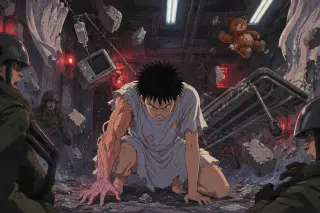
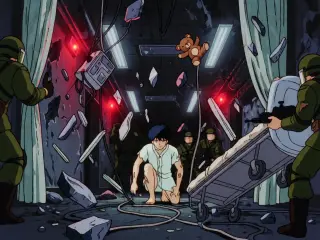
Model Comparison: Detail Against Atmosphere
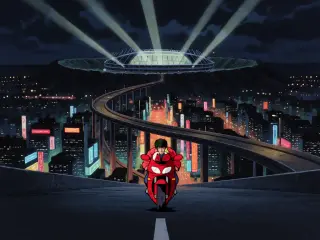
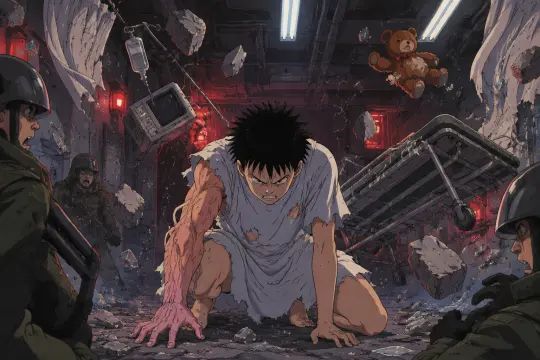
Both models were briefed from the same world atoms and the same two scene briefs, at the same moment in the story. GPT Image 2 resolves the world as a document: lane markings, guardrail bolts, the stadium truss, the veins in Tetsuo’s arm, the exact way a hospital curtain hangs when the air pressure changes. Krea 2 resolves the world as a poster: a red rider at the bottom of a dark ribbon, a ring of light on a hill, a corridor reduced to a symmetrical stage.
Neither is the correct answer. The useful question is what the frame has to survive. If it will be cropped into a store card or examined as a reference sheet, choose the document. If it has to stop a scroll and explain the premise in half a second, choose the poster. The four works below let you inspect both readings side by side.
The Prompts Behind These Frames
Neo-Tokyo brief. 1980s theatrical anime key visual, hand-painted cel animation with hard specular highlights and dense hand-painted backgrounds, cinematic wide shot: Neo-Tokyo at night in 2019, a rebuilt megacity of elevated concrete highways and neon canyon streets standing on the crater of the old capital; a nineteen-year-old gang leader in a bright red jacket rides a red sport motorcycle down the elevated highway toward camera, lean and cocky, one hand off the bars; behind him the floodlit Neo-Tokyo Olympic Stadium rises over the crater rim, searchlights sweeping the clouds; steam from vents, wet asphalt reflecting sodium orange and cyan neon, distant military checkpoint lights, a vast dark sky; 1980s anime film cel, visible paint texture, strong rim light, high contrast, dramatic perspective, epic scale, no text, no watermark, no logos.
Awakening brief. 1980s theatrical anime key visual, hand-painted cel animation with hard specular highlights, cinematic interior: Tetsuo Shima, a pale sixteen-year-old in a torn white hospital gown, crouched in the center of a wrecked military laboratory corridor beneath the hospital; his right arm is swollen with veined psychic energy, a halo of broken concrete, glass and medical equipment floating around him, wires and torn curtains lifted by pressure; red emergency lights and cold fluorescent tubes, soldiers in riot gear frozen at the edges of the frame, one gurney overturned, a shredded teddy bear drifting; 1980s anime film cel, visible paint texture, deep shadows, strong rim light, claustrophobic composition, no text, no watermark, no logos.
Both prompts follow the same six-clause order: medium and genre, place, subject, evidence of physics, light and palette, and a negative clause that removes text and logos. That order is what makes the outputs comparable. If one prompt were written for GPT Image 2 and another for Krea 2, the comparison would only prove that the prompts were different.
What You Can Build From These Atoms
A world is a kit, not a bible. The same twenty-three atoms support a visual novel about a courier who keeps choosing the wrong side, a racing game about outrunning a checkpoint, a short film about a bartender closing up while the city burns, or a management sim about running a temple that takes in children the state has finished with.
Visual novel
Play Kei in the week before the stadium reopens: every courier run you accept makes the resistance stronger and the Nursery harder to expose.
Racing game
Outrun the checkpoints across six wards with a psychic pressure meter instead of a damage bar. The faster you go, the more the city bends.
Short film
A bartender at Harukiya serves the last round while the Capsules argue about whether to go after Tetsuo. Nobody says the thing they mean.
Campaign setting
Run a temple of discarded espers in a city that has stopped counting them. Every child you shelter is a favour the state will eventually call in.
Why This World Is Built for AI
This setting is unusually well suited to a world-grounded generation pipeline because its visual logic is a set of concrete operations: a road lifts, a stadium glows, a corridor loses gravity, a boy’s arm changes shape. There is no dragon to invent and no alien grammar to explain. The model can be held to the physics of a place.
It also has a built-in comparison axis. The same brief can be rendered as infrastructure or as poster; as a document of a city or as a memory of one. That is exactly the difference between the two models used here, which makes the world a useful benchmark rather than a mood board.
Operations as prompts
Lift, flood, glow, suspend, detonate. Five verbs cover most of the world, and each one produces a readable image without a character name.
Materials as style lock
Wet asphalt, painted steel, fluorescent tubes and worn vinyl give the model something to hold onto. Neon is an accent, not a substance.
Scale as story
A rider is small against a stadium. A boy is small against a corridor. The same composition rule explains both the city and the catastrophe.
Comparison as content
Run one brief through two models and publish both. The difference is not a flaw; it is the editorial argument the page is making.
From World Seed to Published Work
The pipeline is deliberately short: a world is a set of atoms, a work is a prompt pointed at those atoms, and a published work is a permanent share link attached to the world. That means lore and marketing are the same asset. The key visual is not decoration for the world page; it is an argument that the world can be seen.
Fork the world → edit character, location and event cards → generate key visuals → publish as works → others fork your version
For this world, that loop produced four published frames in two passes. The first pass established the city at street level: a highway, a stadium, a rider. The second established the awakening at body level: a corridor, a boy, a room that has stopped holding still. Both passes used the same six-clause brief, which is why the two models can be compared without an argument about prompt quality.
Choose the seed
Fork this world, or write a one-sentence brief about a city that was rebuilt on top of the thing that destroyed it.
Pick the operation
A highway lift, a stadium glow, a corridor under pressure, a crater that refuses to be paved. One impossible gesture per frame.
Cast the witness
Name the rider, the soldier, the courier or the child — and the object they are holding that proves which world they are standing in.
Render both models
Run the same brief through GPT Image 2 and Krea 2 and publish both as works of this world so they can be inspected side by side.
Iterate in public
Compare, re-prompt or fork the world and start again — every published frame is a fork point for the next person.
Studio Workflow
The world lives in Neta Studio, where atoms are editable cards and works are published artefacts. You can fork the world, rewrite a character, add a location, generate a new frame and publish it without leaving the studio. The four works on this page are the proof: every image is a live asset attached to this world, not a screenshot in a folder.
Open the world
Start from the Neo-Tokyo 2019 studio and read the atoms before you write a prompt.
Change one thing
Move the stadium, age a character, rewrite the pills or add a ward. The world is a draft, not a licence.
Generate a frame
Use the six-clause brief and keep the materials ordinary. The city is already strange enough.
Publish the work
Attach the prompt and model, publish it to the world, and let the next person fork from your frame.
Explore the World
The world, its twenty-three atoms and its four published key visuals live on Neta Studio. Fork it, rewrite a character, add a location, or generate the next frame. If you only want to look, start with the highway at night and then open the corridor under the hospital — the two frames together explain the whole bargain of Neo-Tokyo: a city that looks forward while standing on the hole that made it.
Create from This World
Inherit a red jacket, a stolen future and a city built on a crater — then tell your own story inside Neo-Tokyo.