
Alan Wake: Bright Falls — A Town, A Lake, and a Story That Writes Back
A complete psychological-horror world generated by AI: 24 atoms — 8 characters, 6 locations, 6 events, 4 factions — plus four published key visuals from a GPT Image 2 vs Krea 2 comparison. Bright Falls runs on logging, diner coffee, and a polite agreement not to discuss Cauldron Lake. By night the fog comes down off Elderwood, and the Taken walk out of it carrying axes and the faces of people you knew.
Worldview
Bright Falls is a Pacific Northwest town on the lip of something that should not exist. Nine hundred people, a diner, a church, a hydroelectric plant, and a volcanic lake that is older than the forest around it. By day it is deer festivals and polite conversation; by night the fog comes down off Elderwood and the town keeps its porch lights on for reasons nobody will explain to a stranger. The world's truth is simple and terrible: creative work made near Cauldron Lake becomes real, and the dark thing at the bottom of the lake edits it. Writers, poets, photographers and musicians are therefore both the only people who can fight it and the only people who can feed it. Alan Wake is the current author. He is not the first, and the story he is writing is not going well.
A loop of writing, haunting, and revision: every draft opens a door for the author and closes one on someone else. The town is the witness, the lake is the publisher, and the Dark Place is the desk where the work never quite finishes. Nothing in Bright Falls is abandoned. It is all still doing what it was doing when the lights went out.
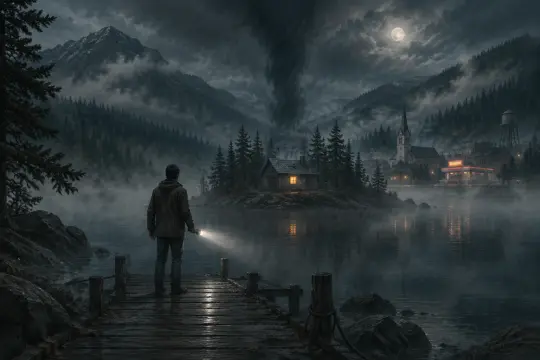
Visual style: overcast psychological film-still realism — desaturated teal and charcoal, wet asphalt, practical lamps and flashlight beams, one warm window or neon sign against a wall of darkness — rendered with GPT Image 2 and Krea 2.
Characters (8)
Locations (6)
Events (6)
Factions (4)
The Rules of This World
Bright Falls: The Town That Agrees Not to Notice
The town is the world’s front door and its whole emotional argument. Bright Falls is kind and it is closed. People here know the rules — stay inside after dark, keep a light on, do not follow a voice you recognise into the trees — and they will not explain them to a stranger, because explaining is how the story gets written down. The Oh Deer Diner stays lit past closing. The church windows glow. The sawmill runs one shift. The normality is not ignorance; it is maintenance.
Cauldron Lake: A Doorway with a Bottom
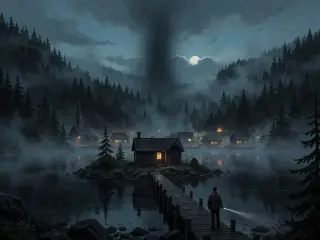
The lake is the most important character in the world and it never says a line. It is black in daylight, gives back no reflection at night, and sits inside a caldera that the town has never explained. Diver’s Isle holds the cabin; the dam holds the water down; nothing holds down what is in it. Sound carries strangely — a shout from the far shore arrives too late, and sometimes answers. Every image of Bright Falls is really an image of the lake deciding what the town is allowed to be.
Bird Leg Cabin: One Room, One Lamp, One Typewriter
The cabin is where the world becomes a story and the story becomes a trap. It has been burned, rebuilt, flooded and rewritten more times than the county records admit. Whatever state it is in when you arrive, the wood stove is warm, there is a typewriter on the table, and the pages beside it are always three days ahead. It is a honeymoon rental, a crime scene, and a writer’s desk at the same time — which is exactly the joke the lake is playing.
The Taken: A Villain Made of Neighbours
The Taken are the horror’s most human element and its cruellest idea. A logger with an axe, a deputy with a shotgun, a hiker with a lantern that burns dark — each one still moving with a purpose that is not theirs, speaking in fragments of an old life. Sarah Breaker knows most of their names. That is what makes the action mean something: every muzzle flash is also a small act of recognition, and every flare is a promise that the town has not given up on its own.
The Dark Place: A City Written Wrong
The Dark Place is not a void; it is New York with the logic removed. Streets loop back to the same corner. A late-night talk show will not end. The Oceanview Motel gives you the door you want and charges you the memory of opening it. Time does not pass so much as get rewritten: you can walk for a year and arrive at the same Tuesday. It is the most original room in the world because it is a writer’s mind rendered as architecture — and it explains why Alan keeps writing even when writing is the trap.
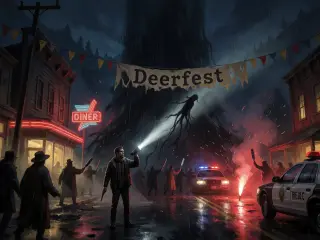
Deerfest: The Night the Story Came Due
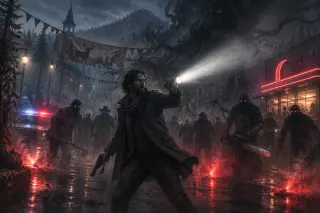
Deerfest is the world’s turning point and the best single scene to put on a poster. The parade, the bunting, the whole town gathered and lit — Alan’s manuscript asked for a battlefield and the lake gave him one made of the thing he was trying to save. Sheriff Breaker’s people held the streets with flares. Barry drove a car through a wall of shadow. Rose kept the diner lit. Alan reached the cabin, used the clicker, and wrote the ending that returned Alice and took him. By morning the bunting was still up and nobody could say who had hung it.
Events That Shape the Map
The six events are not lore decoration; each one changes what the world can do. Barbara Jagger’s drowning establishes the bargain. The week at the cabin establishes the cost. Deerfest establishes the scale. Scratch’s night establishes that the dark presence can learn. Seven years of drafts establish the attrition. The Bureau establishes that the outside world has noticed. Read in order, they are a tragedy with one slot left for a different ending.
Factions and Their Agendas
Four powers share the dark. The Sheriff’s Department wants a town that gets to be boring, and knows exactly what that costs. The Keepers of the Light believe light is a boundary, a promise and a weapon, and tend it one bulb at a time. The Dark Presence wants publication — a finished story that lets it out permanently. The Taken want nothing at all; they are occupied, not allied. Every alliance in Bright Falls is a choice about which of the four you would rather survive.
Works from This World
Four key visuals have been generated from this world and published as shareable works — a two-subject, two-model comparison made on Neta Studio. The same two briefs were run through GPT Image 2 and Krea 2: a world key visual of Cauldron Lake at dusk, from the pier and the flashlight to the lit cabin, the town steeple and the column of darkness in the sky; and an event key visual of Deerfest night, with Alan in the rain, the Taken closing in, red flares on the wet street and the diner neon burning behind. Every render stays attached to the world it came from, ready to fork, remix, and build on.
Model Comparison: GPT Image 2 vs Krea 2
The same prompt, two very different posters. GPT Image 2 leans detail-first: it builds depth with hundreds of small decisions — a reflection on wet planks, a lit window across the water, a figure’s breath in the cold — and the result reads like a film still shot on location. Krea 2 leans atmosphere-first: it simplifies the value structure, keeps the silhouette clean, and produces a cover that is legible at thumbnail size. Neither is better; they answer different questions. Use GPT Image 2 when the image has to reward a long look, Krea 2 when it has to read in one second.
The Deerfest Pair, Examined
The event pair is the harder brief and the better test, because it has to hold a crowd, a hero, a light source and an idea at once. GPT Image 2 stages it as a scene: Alan mid-stride with the flashlight up and the revolver down, the Taken emerging from the rain in layers, the cruiser’s light bar smeared across the asphalt, the diner glowing. Krea 2 turns it into a graphic poster: the festival banner overhead, a single towering shadow figure at the end of the beam, the crowd reduced to silhouettes and torches, the street lit in red. The first is a moment; the second is a memory of the moment.
The World Key Visual, Examined
The world key visual has one job: sell a whole setting in a single frame. GPT Image 2 answers with a location shoot — the pier in the foreground, the cabin on its island, the town on the far shore, the moon and the impossible funnel in the sky, all under one cold light. Krea 2 answers with a storybook plate: fewer landmarks, stronger shapes, a clear path for the eye from the winding pier to the warm window. Put side by side, they show the two ways a world can be introduced: as an inventory, or as an invitation.
Fork This World
This world is public. You can fork it — inherit all 24 atoms, every character secret, every location, and the published key visuals — then rewrite what you want. Save Alice before the second night. Let Sarah Breaker hold the bridge. Give Barry the ending he deserves. Or let Mr. Scratch finish the draft and see what the town looks like when the story is finally published. Bright Falls is built to be rewritten: the lake does not care which ending you choose.
Choose a path and see where it takes you. Keep the diner lit, walk into Elderwood with a flare, or sit down at the typewriter and write the page that gets everyone home — the lake keeps the consequences either way.
Fork world → Edit atom cards → Generate new key visuals/games/videos → Publish → Others can Fork your version
From Seed to Key Visual
Choose the seed
Fork Alan Wake: Bright Falls or write a one-sentence psychological-horror brief about a town on a lake that makes stories real.
Pick the scene
Cauldron Lake at dusk, the diner after closing, the fog road into Elderwood, the cabin on Diver’s Isle, or Deerfest under the bunting.
Cast the subject
Name the character and the beat — Alan on the pier, Sarah with a flare, Rose in the diner doorway, the Taken stepping out of the trees.
Render both models
Run the same prompt through GPT Image 2 and Krea 2; the studio publishes both as works of the world.
Iterate
Compare, re-prompt, or fork the world and start again — every poster is a fork point.
World, Not Work
In Neta Studio, a world is the beginning of everything. A world contains the characters, locations, events, and rules; a work is one expression of them. That is why the key visuals on this page share a cast, a palette, and a set of places: they are not four unrelated images, they are four views of the same town on the same bad night.
A world is not a single image. A world is the source of every image: the same wet main street can become a game cover, a location card, a video thumbnail, or a scene background, because the atoms behind it do not change. Fork the world once and you inherit the whole visual vocabulary.
World → Game
Select a storyline from world cards; AI auto-writes game logic, generates art, and builds a playable experience from the same atoms.
World → Video
Generate dynamic videos from world characters and scenes — fog over Cauldron Lake, a walk through Elderwood, Deerfest going dark.
World → Assets
Each character generates a cover, each location generates a background. The world itself is an asset library.
Who This World Is For
Psychological-horror players who want a world with a clock on it. Game masters who need a town that is already keeping a secret before the players arrive. Writers who like their horror literary, damp, and lit by one diner sign. Artists who want a canon-consistent palette to generate covers and backgrounds from. And anyone who has ever driven into a small mountain town at dusk and felt the road get longer behind them.
Frequently Asked Questions
- Is this the official Alan Wake? No — it is an AI-generated, fan-style world inspired by Alan Wake’s Bright Falls and Cauldron Lake premise, rebuilt as an original Neta Studio world with its own atoms, palette, and story beats.
- What can I do with it? Fork it, edit its atoms, generate key visuals, build a playable scenario, or use it as a setting for your own table.
- Which models made the art? GPT Image 2 and Krea 2, from the same two prompts, published as four works of this world.
- Do I need to know the games? No. The world carries its own rules: art made near the lake becomes real, light strips the Taken, and every draft has a price.
- Can I remix the works? Yes — public works of a public world are forkable and remixable on Neta Studio.
Start Creating
Fork Alan Wake: Bright Falls or start from your own one-sentence psychological-horror brief. The world ships with its 24 atoms, its overcast film-still palette, and four published key visuals — your next cover, game, or descent is one prompt away.
Create from This World
Inherit 24 atoms, rewrite what you want, tell your own story in a town where the lake is always listening and the diner is still lit.