
Ashen Vigil — A Dark Fantasy World Where the Last Fire Burns Names
A complete dark fantasy world rebuilt as an AI world: 21 atoms — 7 characters, 5 locations, 5 events and 4 factions — plus four published key visuals from a GPT Image 2 vs Krea 2 comparison, and an interactive studio. Give the flame your name and the dark holds one more winter.
Worldview
Ashen Vigil is a dark fantasy realm of ash-fall and dying light. One flame survives at the centre of the world — the Vigil Flame — and it will only burn what a person is: their true name, freely given. Around that bargain a church grew that harvests names as tithe, an order of deaf bellringers who count the fire's remaining years, and a drowned choir that sings for the flame to go out. Between them walk the Oathworn: the dead who cannot rest until an oath is kept, rising again each time they fall, forgetting one more piece of themselves with every return.
The premise is a horror story told as an economy. Warmth has a price, the price is identity, and the institution that sets the price calls the transaction a sacrament. Nobody in Ashen Vigil is fighting a monster; they are arguing over an invoice.
The Bargain at the Centre
Every story in this world is a variation on one sentence: the fire takes a name and the dark steps back one winter. A mother gives her name so her daughter survives the cold, and the daughter grows up unable to remember who raised her. A knight swears an oath and cannot die until it is kept, but each resurrection costs him the memory of why he swore it. The Church keeps a ledger of every name burned; the Bellwardens keep a rope of knots for every year the flame has left; the Drowned Choir keeps a hymn for every name they intend to take back.
That is the whole engine. A world built on a single, legible exchange can generate an inexhaustible supply of scenes, because any character can be placed on either side of the ledger at any moment. It is also why the setting survives translation into images: every prompt has a subject, a price and a light source.
The Unwritten Laws
Characters (7)
Locations (5)
Events (5)
Factions (4)
Works from This World
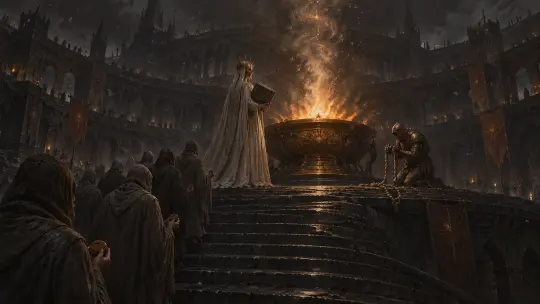
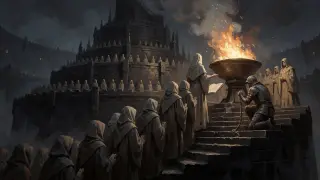
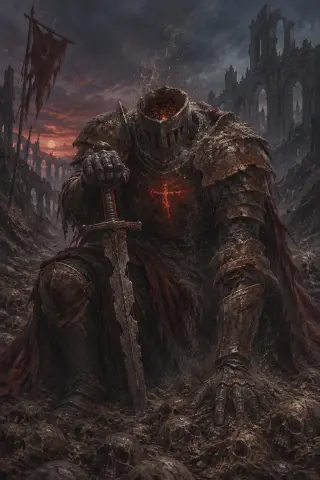
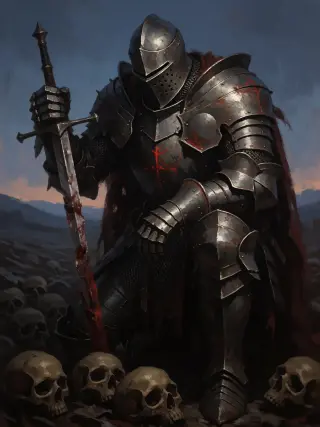
Four works have been published from this world — two briefs, each rendered by two models. The first is the world key visual: the tithe at the Cinder Citadel. The second is a character frame: Greaves, the Ashless, kneeling on the Ossuary Road. Neither model received a reference image; both received the same prompt, so the difference you see is the model's reading of the brief, not the brief itself.
Model Comparison: GPT Image 2 vs Krea 2
GPT Image 2 renders an interior with a history: the brazier has weight, the pilgrims have shoulders, and the flame throws just enough bounce light to describe the black basalt on all four sides of the Citadel. Krea 2 renders the same scene as a poster: fewer tonal steps, cleaner silhouettes, the ceremony compressed into a stack of tiers and a single warm shape. Neither is wrong. One is built to be inspected; the other is built to be seen at thumbnail size.
The Vigil Flame — GPT Image 2 vs Krea 2
Run your eye along the stair in both frames. In the GPT Image 2 version the steps are wet, uneven and crowded; each pilgrim is a separate silhouette with a different posture, and the priestess is placed slightly left of centre so the flame has room to climb. In the Krea 2 version the stair is a graphic band, the crowd is a single mass of hoods, and the priestess reads from an open book that GPT Image 2 kept closed. The brief asked for a sealed ledger; only one model kept it sealed.
Greaves, the Ashless — GPT Image 2 vs Krea 2
The character brief splits the models even more cleanly. GPT Image 2 treats "made of packed ash" as a material problem and solves it: ash pours from the gorget, drifts above the helm, and dusts the skulls at his knees. Krea 2 treats it as a costume problem and gives you a knight with a red cross on his breastplate — a better poster, a worse answer to the sentence. If the frame is going on a store page, either will do. If it is going to be inspected, only one of them read the brief.
What the Comparison Proves
Run the same sentence twice and you learn more about a model than any benchmark. GPT Image 2 follows clauses literally and pays for it in speed. Krea 2 follows the mood and pays for it in specifics. For a world like this one, where the horror is administrative — a ledger, a rope of knots, a sealed book — the literal model wins, because the props are the argument.
- GPT Image 2 — best for the frame that carries evidence: ledgers, knots, brands, ash as a material.
- Krea 2 — best for the frame that carries mood: a poster, a thumbnail, a key art block with clean dark shapes.
- Both — respond to a prompt that names one light source and one price. The brief does more work than the model.
From Seed to Key Visual
Read the ledger
Open the world and read the atom cards before you write anything. The Cinder Citadel card tells you what is inside the fire; the Greaves card tells you what is missing from his head.
Choose the transaction
Every frame in Ashen Vigil should show somebody paying. A name on a stair, an oath in a chest, a hymn under water. Pick one and make it visible.
Name the light
One source, no fill. The flame, a dusk, a single lantern at the Ash Market. If you ask for two light sources the setting stops being tenebrist and starts being generic dark fantasy.
Render both models
Run the identical prompt through GPT Image 2 and Krea 2 and publish both as works with their own share pages.
Keep the frame that survives the crop
A dark fantasy key visual has to work at 1200 pixels wide and at 300. Keep the one with a readable silhouette, then re-prompt the next scene from the same atoms.
World, Not Work
In Neta Studio a world is the beginning of everything. A world contains characters, locations, events and factions as editable atoms, and every image is generated from those atoms rather than from a blank prompt box. That is why Ashen Vigil can produce a consistent poster of a priestess and a consistent poster of a knight without a reference image: both are drawn from the same written world.
A world is not a single image. A world is the source of every image: the location list becomes a background library, the character list becomes a cast sheet, the event list becomes a shot list. Fork the world and you inherit all twenty-one atoms, then rewrite the one you want to argue with.
World → Key Visual
Pick a transaction from the timeline and stage it with the cast and the location cards. The studio keeps the palette and the light logic consistent.
World → Sequence
Turn the tithe into a run of frames: the queue, the ledger, the fire, the forgetting. Same atoms, four posters, one story.
World → Asset Library
Each character yields a portrait, each location a plate. The world becomes a reusable art department you can hand to a team.
Why This World Matters
Dark fantasy is usually built out of architecture and weather. Ashen Vigil is built out of bookkeeping, and that is what makes it useful: a ledger can be photographed, a debt can be staged, a name can be crossed out on screen. The setting gives a writer or a designer a visible object for every abstract fear.
- A single exchange — a name for a winter — that any reader understands in one sentence.
- Four factions that each answer the same question differently, so every scene has a built-in argument.
- Five locations that function as lighting setups: fire, lantern, fog, water, dusk.
- A visual style — tenebrist painterly — that survives both a detailed render and a flat poster.
Reading the Ash: Motifs
Ash is the world's clock. It falls in the Citadel, drifts off Greaves's shoulders, and paves the road to the fire. When you prompt a frame, decide what the ash is doing: falling, settling, or rising. Falling means the world is still running. Settling means something has just ended. Rising means an oath has been broken and the dead are rebuilding.
The second motif is rope. The Bellwardens count years in knots; the Oathworn are bound by a brand; the Choir sings a hymn with no end. A rope in frame is never decoration — it is a measurement, and the audience reads it as one even if nobody explains it.
Fork This World
This world is public. You can fork it, inherit all twenty-one atoms — every character, location, event and faction — then rewrite the ledger, move the fire, or write a fifth faction that wants to pay the debt differently. The four published key visuals are attached to the world, so a fork keeps the visual proof and gains a new argument.
Collaborative workflow
Start Creating
Create from This World
Inherit twenty-one atoms, choose which debt comes due, and light the frame with one fire.
Every image on this page is a published work from this world, not a demo render: four frames, two briefs, two models, the same written world underneath. The studio link opens the living world where the atoms can still be edited.