Bendy and the Ink Machine — A Cartoon Studio That Learned to Pour Its Drawings Out
A complete cartoon-horror world generated by AI: 20 atoms — 7 characters, 5 locations, 5 events, 4 factions — plus four published key visuals from a GPT Image 2 vs Krea 2 comparison. The lobby is still advertising cartoons nobody has made in sixty years, the corridors are ankle-deep in ink, and the machine in the basement has never been switched off — go down, and decide who gets to leave.
Worldview
Joey Drew Studios was built on a simple bargain: draw something beloved, sell it cheap, keep the doors open. Its star was Bendy, a grinning little devil in a bow tie, and for a while the studio could do no wrong. But founder Joey Drew wanted more than drawings. He wanted the cartoons to walk, to breathe, to come out of the page, and he built a machine in the basement to do it. Now the studio is a flooded maze of drafting tables, recording booths and ink, and everyone who ever worked here is still on the payroll. Henry Stein, the animator who walked out in 1946, has been invited back by a letter he cannot explain. The halls remember him. So does the ink.
A loop of arrival, descent and redrawing: every floor of the building is a decade of the studio’s history, and every room is still rehearsing the job it was built for. The lobby still advertises cartoons nobody has made in sixty years; the drafting floor still has cels pinned to the boards; the basement still has pressure in the pipes. Nothing in Joey Drew Studios is abandoned. It is all still working, and that is the problem.
Visual style: 1930s rubber-hose cartoon illustration — round heads, pie-cut eyes, crescent mouths, noodle limbs, white gloves, bold fluid black outlines — pushed into slow-dawning dread. Black, bone cream and muted brick red, with one sickly ink-green light. Rendered with GPT Image 2 and Krea 2 from the same two prompts.
Characters (7)
Locations (5)
Events (5)
Factions (4)
The Rules of the Ink
The Lobby: A Front Door That Remembers
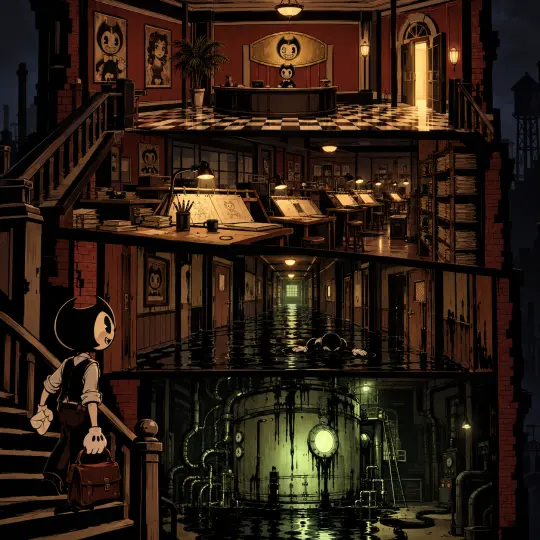
The lobby is the only room in the building that still looks like a business. A black-and-cream checkerboard floor runs to a curved reception desk; framed Bendy and Alice posters hang two deep on the walls; a palm stands in a pot that nobody has watered since the war. The great double door stands open with warm light coming through it, and that light is the cruellest thing in the world, because it suggests leaving. Henry walks in through that door with a letter in his hand and a satchel on his shoulder, and the building closes behind him without a sound. Every key visual in this world starts here, because the lobby is where the bargain was signed.
The Animation Department: Where the Drawings Were Made
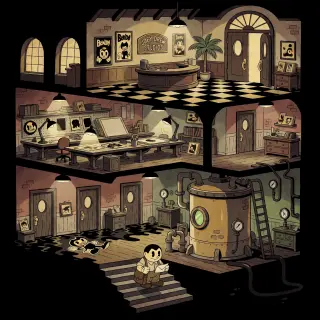
One floor down the studio stops being a lobby and becomes a workshop: long drafting tables in rows, peg bars, stacked cels, gooseneck lamps lit one at a time, a pencil cup, a coffee ring that never dried. This is the room that made Bendy, and it is the room the machine copied first. In the GPT Image 2 cutaway the department reads as a real production floor — you can count the desks and see which lamps are on. In the Krea 2 cutaway it collapses into a single long table with a pegboard behind it, which is the more honest summary: an office is only ever a few objects pretending to be a system.
The Flooded Halls: The Plumbing Is the Plot
Below the working floors the building gives up on architecture. Ink stands ankle-deep in the corridors and reflects every ceiling light twice; doors are waterlogged and swollen shut; a Bendy cutout floats face-down in the shallows with its grin against the floor. The Flooded Halls are where the Searchers walk and where the Butcher Gang has built its shantytown out of office furniture. Nothing here is a puzzle for its own sake — the water line is a clock. It marks how much of the studio has already been converted, and how much is left.
The Ink Machine Room: A Threshold With a Pressure Gauge
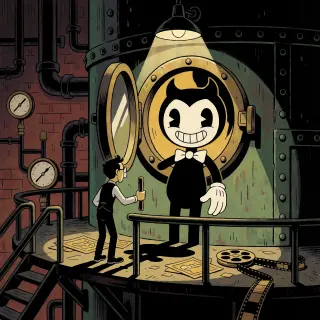
The basement is a cathedral built by a man who only ever budgeted for cartoons. A riveted iron tank the size of a rail car sits in the middle of the floor, banded and bolted, with a single round porthole, hand valves, pressure gauges and pipes climbing every wall. Ink runs down the shell and pools on the boards. It is not a metaphor and it is not a reactor: it is a door with plumbing, and every person who has ever crossed it has been copied. That is why the room has two settings in this world’s art — the machine asleep and dripping, and the machine open.
Bendy: A Star Who Was Never Given a Choice
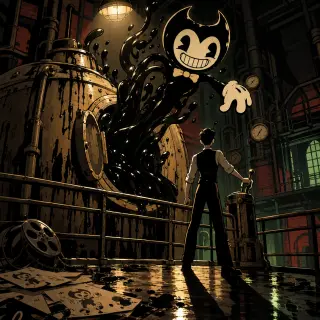
Bendy is the most likeable thing in the building and the most dangerous, and the two facts are the same fact. He was drawn to be loved, then poured into a body so he could be loved in person, and nobody ever asked him what he wanted after that. In the event art he comes out of the porthole smiling, bow tie straight, one glove already solid — the smile is the horror, because it is the same smile from the 1929 poster two floors above. He does not need to be evil. He needs an audience that cannot leave.
The Cycle: Why the Story Loops
The Cycle is the rule that makes this world a setting rather than a haunted house. When the story reaches its end, the studio resets: rooms return to their first frame, characters forget, and the ink starts over with a full tank. It means death is not a stake here — memory is. A character who remembers across a reset is the only kind of rebel the building has. It also means every session in this world can begin at the lobby door without contradicting the last one.
Events That Shape the Building
The five events are not lore decoration; each one changes what the building can do. A Devil Is Drawn creates the star and the debt. The Machine Is Switched On creates the door. The Long Walkout removes the only people who could have stopped it. The Studio Closes turns a company into a loop. The Letter Arrives reopens the loop with a new visitor, which is where play begins. If you fork this world, those five beats are your timeline — rewrite any one of them and the rest of the building changes shape around it.
Factions and Their Agendas
Four powers share the halls, and none of them wants the same thing. Joey Drew Studios wants the picture finished. The Butcher Gang wants territory and a grudge settled. The Lost Ones want their names back. The Searchers want company, and they take it by the ankle. Bendy sits outside all four: he is the product, the god and the landlord at once, and the only faction that does not need to negotiate because he is the reason there is anything to negotiate over.
Works from This World
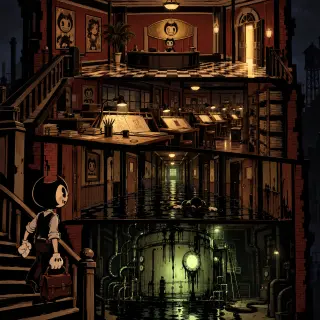
Four key visuals were generated from this world and published as shareable works — two briefs, two models, one prompt each. The first pair opens the building up as a cutaway; the second pair stages the moment the machine is switched on. Every image on this page is one of those four works, published from this world and remixable.
Model Comparison: GPT Image 2 vs Krea 2
The same prompt, two very different posters. GPT Image 2 leans detail-first: it builds a floor plan you can walk, keeps lamps, gauges, cables and cels separate, and lights each level of the cutaway like a film set with its own key light. Krea 2 leans atmosphere-first: it flattens the building into a warm storybook diagram, drops the extra floors and extra props, and makes every shape readable at thumbnail size. Neither is the correct answer. GPT Image 2 sells a place; Krea 2 sells a mood, and it does it at a tenth of the cost.
The Machine Is Switched On, Examined
The event pair is the harder brief, because it has to hold a machine, a monstrous silhouette and a human being in one frame and keep all three legible. GPT Image 2 solves it with weight: the tank is heavy, the ink has real volume and specular highlights, and Bendy’s head is enormous and unfinished at the same time. Krea 2 solves it with staging: the open hatch becomes a proscenium arch, the light becomes a spotlight cone, and Bendy stands in it fully formed like a vaudeville entrance. One is a still from a horror film; the other is the poster on the wall outside the theatre.
Fork This World
This world is public. You can fork it — inherit all 20 atoms, every character secret, every flooded corridor, and the four published key visuals — then rewrite what you want. Save Henry before the door closes, give Sammy a congregation that listens, let Alice finish one of her repairs properly, or switch the machine on again and see who comes out this time. The Cycle will reset the building either way. What survives a reset is whatever you decided to remember.
Choose a path and see where it takes you. Walk into the lobby with the letter, follow the ink down to the basement, or take the lever from Joey’s hand — the studio keeps the consequences either way.
Fork world → Edit atom cards → Generate new key visuals/games/videos → Publish → Others can Fork your version
From Seed to Key Visual
Choose the seed
Fork Bendy and the Ink Machine, or write a one-sentence brief about a cartoon studio that built a machine to make its drawings real.
Pick the scene
The checkerboard lobby, the drafting floor at night, the flooded corridor, or the basement tank with its porthole open.
Cast the subject
Name the character and the beat — Henry on the stairs with the letter, Joey at the lever, Bendy half-poured out of the ink.
Render both models
Run the same prompt through GPT Image 2 and Krea 2; the studio publishes both as works of the world.
Iterate
Compare at full size and at thumbnail size, then re-prompt one variable — never the scene, the subject and the light at once.
World, Not Work
In Neta Studio a world is the beginning of everything. A world contains the characters, locations, events, factions and rules; a work is one frame pulled out of it. This page is a world page, which means the four images below are not the product — they are evidence that the setting holds up when you point a camera at it.
A world is not a single image. A world is the source of every image: the same lobby can be a 1929 poster, a 1963 ruin, a game level, a five-second loop of ink climbing a wall, or a character cover for Henry. Because the atoms are fixed, all of those stay recognisably the same building. That is the difference between generating pictures and building a setting.
World → Game
Select a storyline from world cards; AI auto-writes game logic, generates art, and builds a playable experience from the same atoms.
World → Video
Generate dynamic video from world characters and scenes — ink rising in the tank, a corridor filling, Bendy crossing a doorway.
World → Assets
Each character generates a cover, each location generates a background. The world itself is an asset library.
Who This World Is For
Horror players who want a cartoon they remember from childhood turned inside out. Game masters who need a building with a clock on it and a cast that is already lying to each other. Artists who want to work in rubber-hose linework without drawing every cel themselves. Writers who like rules more than jump scares. And anyone who has ever looked at an old studio logo and felt, for no reason they could name, that the mascot was watching them back.
Frequently Asked Questions
- Is this the official Bendy and the Ink Machine? No — it is an AI-generated, fan-style world inspired by the 1930s-cartoon horror premise, rebuilt as an original Neta Studio world with its own atoms, palette and story beats. It is not affiliated with or endorsed by the rights holders.
- What can I do with it? Fork it, edit its atoms, generate key visuals, build a playable scenario, or use it as a setting for your own table. Every work published from it is remixable.
- Which models made the art? GPT Image 2 and Krea 2, from the same two prompts, published as four works of this world.
- Do I need to know the game? No. The world carries its own rules: ink remembers, the machine copies, the cycle resets, and a body costs somebody else something.
- Why does the art look like a 1930s cartoon? Because the world’s visual style is 1930s rubber-hose animation — pie-cut eyes, noodle limbs, white gloves, flat black-and-cream fills — held even when the subject is horrific. The contrast is the point.
Start Creating
Fork Bendy and the Ink Machine or start from your own one-sentence cartoon-horror brief. The world ships with its 20 atoms, its rubber-hose palette and four published key visuals — your next cover, game or descent is one prompt away.
Create from This World
Inherit 20 atoms, rewrite what you want, tell your own story in a studio where the lights are still on and the ink is still moving.