
Better Call Saul — An Albuquerque Legal-Crime World Built with AI
A complete Better Call Saul-inspired legal-crime canon rebuilt as an AI world: eight characters, six locations, six events and four factions, plus four published key visuals from a GPT Image 2 vs Krea 2 comparison. A strip-mall lawyer, a foil-lined house, a desert full of money — and a conscience that keeps filing continuances.
Better Call Saul — Worldview
A former con man with a law degree from a little-known online school talks his way into a public defender's hallway in Albuquerque, where the state pays him to lose. He has a brother who believes the law is a sacred order, a best friend who is better at the job than he is, and a talent for making a bad situation worse in a way that is almost admirable. That is the premise. What the world becomes is a long study in the price of being liked: every shortcut buys a client, every client buys a story, and every story becomes a version of himself he cannot put back in the box.
A strip-mall office with an inflatable Statue of Liberty. A courthouse hallway full of plea deals. A house wrapped in silver foil. A desert with no signal. The law is the stage, and everyone in Albuquerque is either performing or waiting to testify.
The World in One Frame
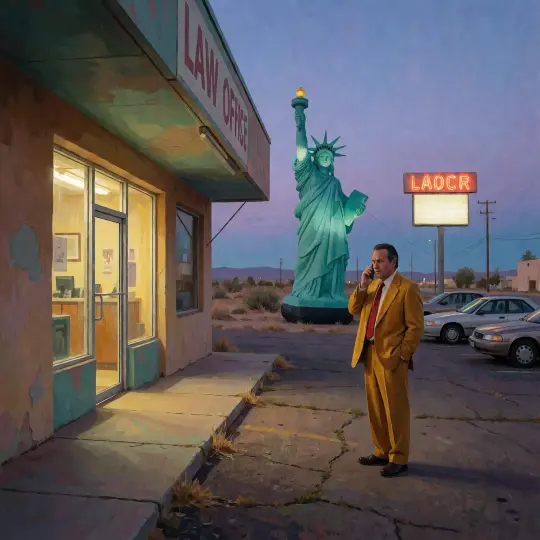
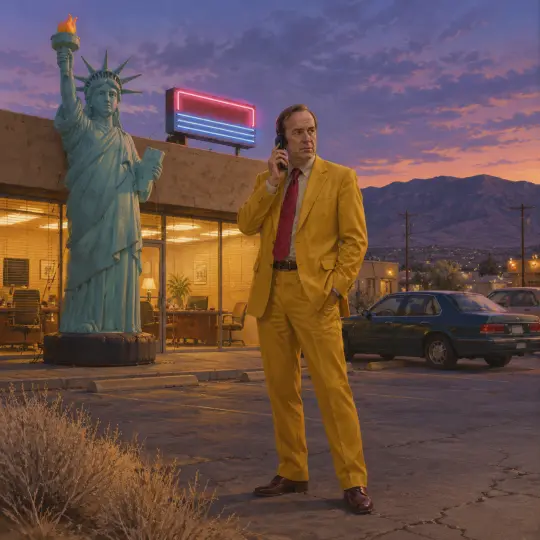
The cover is the entire thesis in a single image: a cheap storefront, a fake monument, a lawyer in a suit that is too bright for the parking lot, and a sky doing its best to look like a postcard. Nothing in the frame is powerful. The office is small, the car is old, the statue is inflatable. That is exactly the point. This world is not about an empire that owns the city; it is about a man who has convinced himself that the right performance can make the city belong to him.
The inflatable Liberty is the perfect object for the story. It is a symbol of law and freedom, sold at a discount, lit from below, and held down by a rubber base so the wind does not carry it away. Every character in this world has an equivalent object: a law degree, a family name, a coin collection, a promise to a granddaughter. The drama begins when one of them mistakes the object for the thing it represents.
The Business Behind the Law
Better Call Saul is often described as a show about a lawyer becoming a criminal. It is more accurate to call it a show about a service industry with no fixed price. Criminal defence is sold by the hour, by the case, by the favour, or by the story a client needs to hear at 2 a.m. Jimmy McGill is good at exactly one thing: he can find the version of the truth that a room is willing to buy. The tragedy is that the skill is real, and the market rewards the worst version of it.
That is why the world is so generative. A writer does not need to invent a conspiracy. They only need to invent a client with a problem that is slightly too interesting: a will with two signatures, a nursing-home invoice, a bag of cash in the desert, a brother who cannot leave the house. The world supplies the pressure; the characters supply the paperwork.
“You don't need a criminal lawyer. You need a criminal lawyer.” — the sentence the world keeps rewriting and never improves
Cast of the Courthouse
Eight people stand inside the same small legal economy, and each one represents a different answer to the question of what the law is for. Jimmy wants to be seen. Kim wants to be excellent. Chuck wants the order preserved. Mike wants the job done cleanly. Nacho wants his father left alone. Lalo wants the story told his way. Howard wants the firm to survive its own partners. Gus wants a business that outlives the men in it. Put any two of them in a room and the scene writes itself.
Six Places That Hold the Story
The show is a masterclass in location as pressure. Every set answers a different production need: a stage for performance, a tower for legitimacy, a sealed house for control, a back room for hustle, a hallway for transactions and an empty horizon for consequences. Move a scene from one to another and the meaning changes without a line of dialogue.
The Powers of Albuquerque
Four organisations hold the map together. One is a law firm, one is a cartel, one is a fast-food franchise with a supply chain, and one is the informal network of people who actually keep the courthouse running. None of them is primarily interested in justice; they are interested in control of a docket, a route, a licence or a reputation. That is what makes the politics feel real.
The Timeline
Six events explain why the present is unstable. A stunt starts it, a diagnosis isolates it, a class action legitimises it, a name change completes it, a desert pickup weaponises it and a funeral ends it. Each event is a playable scenario and a prompt seed: one sentence that already contains a place, a cost and a person who has to decide.
The Rules of the Game
Three rules do most of the world-building. They are simple enough to explain in one sentence and cruel enough to generate unlimited scenes. If you fork this world, keep the rules and change the city; the rules are the engine.
The Core Conflict
Jimmy tells himself he is doing it for the client, and the world spends six seasons testing that sentence. Kim wants to be excellent without becoming the thing she defends. Chuck wants the law to mean something and cannot admit that his brother is better at it. Mike wants one clean job that keeps his family out of the business. Nacho wants out. Howard wants the firm to survive. Lalo wants the story. The conflict is not good against evil; it is six definitions of loyalty colliding in a corridor with no referee.
The real question is not whether Jimmy can get away with it. It is whether anyone in the room can be loved without being used.
The Look: Strip-Mall Noir
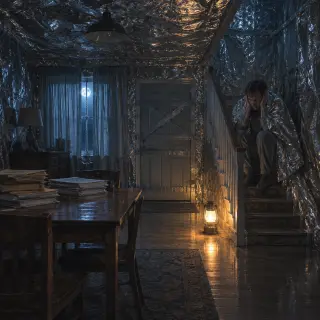
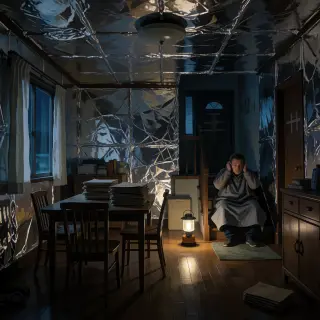
The visual target is not neon cyberpunk and not glossy legal television. It is strip-mall noir with a painterly finish: mustard suits against beige stucco, oxblood conference rooms, fluorescent courthouse hallways, silver foil, and a desert that is almost always too bright for what is happening underneath it. Colour does the moral work. The office is yellow and red. The firm is walnut and glass. Chuck's house is foil and blue moonlight. The desert is ochre and bone.
Model Comparison: Structure Against Atmosphere
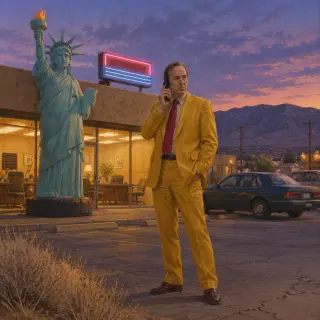
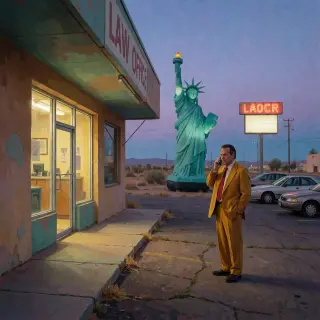
Both models were briefed from the same world atoms and the same two scene briefs, then asked for a key visual that could open a story page. GPT Image 2 resolves the world as a place: asphalt cracks, window reflections, foil creases, lantern light on varnished wood, legal files with individual pages. Krea 2 resolves it as a mood: compressed values, a wide poster composition, a lavender sky, a small yellow figure doing all the emotional work. Neither is the correct answer. The comparison is the product.
The Prompts Behind These Frames
Strip-mall brief. Semi-realistic painterly crime-drama key visual, cinematic wide shot: a cheap strip-mall law office at dusk in Albuquerque, New Mexico, a plate-glass window glowing warm yellow, a giant inflatable Statue of Liberty on the sidewalk, a middle-aged man with slicked-back dark hair in a loud mustard-yellow suit and a red tie standing on cracked asphalt with a flip phone at his ear, a low desert horizon and a violet-blue evening sky, a buzzing neon sign with no legible letters, parked sedans, dry scrub, muted ochre stucco and cold teal shadows, restrained film grain, no text, no logos.
Foil-house brief. Semi-realistic painterly crime-drama key visual, cinematic wide shot: the interior of a dark suburban house at night, every wall and ceiling panel lined with crumpled silver foil, a bare dining table stacked with paper files, a single camping lantern glowing on the floor, a thin middle-aged man in a grey space blanket sitting on the stairs with his hands over his ears, the front door sealed with tape, cold blue moonlight through a curtain gap against warm lantern light, deep one-point perspective, restrained film grain, no text, no logos.
Both prompts follow the same five-clause order: medium and genre, subject and costume, place and scale object, light and palette, and a negative clause that removes text and logos. That order is what makes the outputs comparable. If one prompt were written for GPT Image 2 and another for Krea 2, the comparison would measure the prompts instead of the models.
What You Can Build From These Atoms
A world is a kit, not a bible. The same twenty-six atoms support a visual novel about a marriage under cross-examination, a management game about keeping a strip-mall practice solvent, a short film about a fixer cleaning a motel room, or a branching story about a cartel courier trying to get his father out of Albuquerque. The atoms do not dictate the genre; they supply the pressure.
Visual novel
Play Kim Wexler in the week before a settlement meeting: every choice is a billable hour, and the partner dinner is the boss fight.
Management game
Run the strip-mall practice. Keep the lights on, the clients quiet and the sign bigger than the office while three organisations compete for your docket.
Short film
A fixer has one night to clean a motel room before the DEA arrives, and every object he removes is a person he knew.
Why This World Is Built for AI
This setting is unusually well suited to a world-grounded generation pipeline because its visual logic is a set of objects, not a mood board. A mustard suit is a colour block. An inflatable statue is a silhouette. A foil wall, a camping lantern, a flip phone and a plate-glass storefront are all concrete nouns that a model can render. There is no dragon to invent and no alien grammar to explain. The fantasy is that ordinary things become evidence.
Objects as prompts
A mustard suit, an inflatable Liberty, a foil wall and a lantern are enough to establish the entire genre without a single character name.
Palette as morality
Mustard and oxblood for the hustle, walnut and glass for the firm, foil and blue moonlight for the brother. Change the palette and you change whose story is being told.
Every frame is a scene
Because the world is built from locations with social rules, a still image can imply the negotiation that happened five minutes earlier.
From World Seed to Published Work
The pipeline is deliberately short: a world is a set of atoms, a work is a prompt pointed at those atoms, and a published work is a permanent share link attached to the world. That means lore and marketing are the same asset. The key visual is not decoration for the world page; it is an entry point into the world, with the prompt and the model recorded for anyone who wants to reproduce or fork it.
Fork the world → edit character, location and event cards → generate key visuals → publish as works → others fork your version
For this world, that loop produced four published frames in two passes. The first pass established the strip mall at human scale: a storefront, a statue, a lawyer, a phone. The second established the brother's house at psychological scale: foil, files, a lantern, a man on the stairs. Both passes used the same two briefs on both models, which is why the world page can show a genuine comparison instead of a curated highlight reel.
Choose the seed
Fork the Better Call Saul world, or write a one-sentence legal-crime brief about a person whose ordinary skill becomes a criminal advantage.
Pick the scene
The strip mall at dusk, the foil house at midnight, the courthouse hallway at noon, the desert at the worst possible hour.
Cast the subject
Name the lawyer, the partner, the fixer — and the object they are carrying that could end the story if it is found.
Render both models
Run the same brief through GPT Image 2 and Krea 2 and publish both as works of this world so they can be compared side by side.
Iterate in public
Compare, re-prompt or fork the world and start again — every published frame is a fork point for the next person.
Studio Workflow
The world lives in Neta Studio, where atoms are editable cards and works are published artefacts. You can fork the world, rewrite a character, add a location, generate a new frame and publish it without leaving the studio. The four works on this page are the proof: every image is a real router-files asset, every share link resolves, and every prompt is stored with the work.
Open the world
Start from the Better Call Saul studio and read the atoms before you write a prompt.
Edit an atom
Change a location's palette, a character's motive or the cost of a mistake. The world is a draft.
Generate a frame
Use the world brief as the first clause of the prompt, then add the scene and the subject.
Publish the work
Attach the frame to the world as a work, with its prompt and model recorded.
Fork and compare
Share the world, let someone else fork it, and keep the frames that survive the argument.
Explore the World
The world, its twenty-six atoms and its four published key visuals live on Neta Studio. Fork it, rewrite a character, add a location, or generate the next frame. If you only want to look, start with the strip-mall cover and then open the foil-house comparison — the two frames together explain the whole visual thesis.
Create from This World
Inherit a lawyer with a gift for the wrong story, a partner who is better than him and a city full of paperwork — then tell your own story inside the practice.