
BioShock: Rapture — The City at the Bottom of the Sea
Rapture rebuilt as an explorable AI world: eight characters, six districts, six events and four factions — plus four published key visuals from a GPT Image 2 vs Krea 2 comparison on identical prompts. No gods or kings, only man — and a market that sells his body back to him.
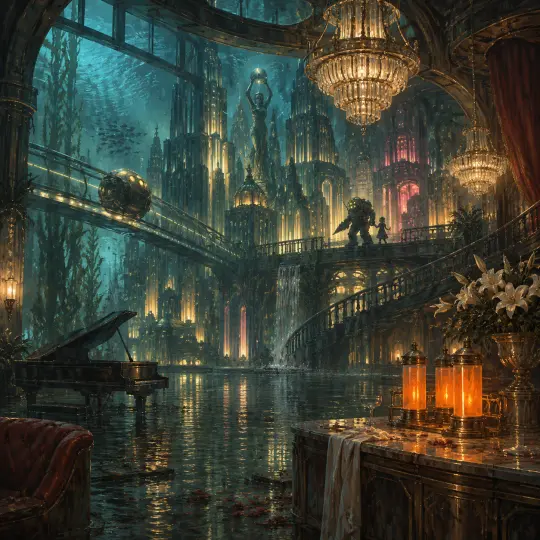
Rapture: A City Built to Escape the World
In 1946 the industrialist Andrew Ryan sank his fortune into the floor of the North Atlantic and called the result Rapture: an art-deco metropolis of brass, glass and neon, sealed against every king, god, tax collector and conscription office on the surface. For a decade it glittered. Then its scientists discovered ADAM, a stem-cell substance harvested from sea slugs that could rewrite the human body, and the free market did what free markets do with a miracle.
Rapture is not a haunted house. It is a business model with citizens inside it — and by 1960 the product has eaten the customers.
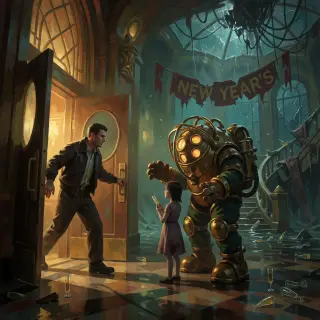
This world turns that premise into cards you can use: eight characters, six locations, six events, four factions and three laws, plus four published key visuals produced in a GPT Image 2 versus Krea 2 comparison on two identical prompts. Every image on this page comes from those renders.
The Worldview
Rapture was founded on a sentence: no gods or kings, only man. Every citizen was supposed to own his labour, his body and his property, and charity was treated as theft with better manners. The city worked exactly as designed. When ADAM made the body itself a commodity, the same logic that built the towers turned orphans into refineries and neighbours into customers. The tragedy is not that Rapture abandoned its principles. The tragedy is that it kept them.
The world is a pressure vessel in every sense. Water pushes on the glass from outside; the market pushes on the citizens from inside; and the founder pushes on both because he cannot imagine a law that is not his own.
No gods or kings, only man
The Timeline That Sinks the City
Six events are enough to carry a world. Each one is a consequence, not a set piece: somebody gains something, somebody pays for it, and the city becomes a little less able to pretend it is a utopia.
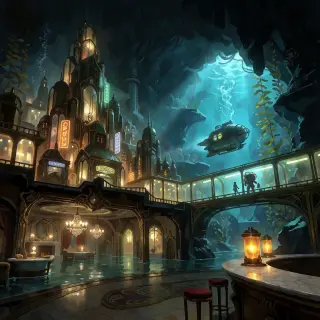
The Six Districts of Rapture
Rapture is a vertical city, and each district is an argument about what a person is for. The locations are written as playable spaces: a place to enter, a thing to want, and a reason the water is winning.
The Cast: Founders, Profiteers and the Ruined
Eight characters carry the world. Each one is written as a position in the argument, not a personality quiz: what they believe, what they sell, and what they refuse to see.
Factions: Who Owns the City
Four factions, four answers to the same question. The conflict is legible because every faction can describe what it wants in one sentence, and every sentence contradicts another.
ADAM: The Economy of the Body
Every good dystopia needs one physical substance that makes its metaphors literal. In Rapture that substance is ADAM. It is medicine, currency, weapon and class marker at once, and it is harvested from children because the market found that the cheapest source.
ADAM is the reason the world is not just a period piece. It turns the body into a balance sheet: how much of yourself are you willing to sell to become competitive? That question survives every change of setting.
The Visual Language
Rapture has a very specific look: art-deco geometry, brass and dark wood, teal water behind glass, warm amber practicals, and neon signage that promises pleasure in a building that is already drowning. The palette is deliberately split between the gold of the sale and the blue-green of the leak.
- Palette: brass, oxblood, ivory, deep teal, one sickly ADAM amber.
- Light: warm practicals inside, cold volumetric shafts through water outside.
- Materials: wet marble, riveted metal, cut glass, salt-stained fabric.
- Composition: a threshold in the foreground, a social space in the middle, the sea pressing at the edges.
- Avoid: clean cyberpunk neon, generic steampunk gears, dry rooms, readable brand logos.
Why This World Is Not Just a Mood Board
A mood board gives you a palette. A world gives you a decision. If you know that ADAM is scarce, that the bathyspheres are locked, and that Ryan believes charity is theft, you can predict what a character will do in a room you have not written yet. That is the test: can the cards generate a scene without you?
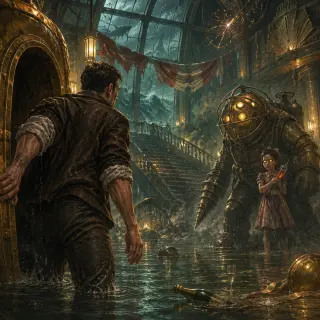
The four published renders on this page are the proof. They were produced from two prompts written directly from the cards: one city brief, one event brief. Nothing was copied from a screenshot, a poster or a game asset. The continuity comes from the world text, not from a reference image.
Rules for Rendering Rapture
These are the practical constraints that keep a render inside the world. They are written for image models, but they work for any visual pipeline: a coherent frame is a set of refusals as much as a set of instructions.
A Model Comparison on Identical Prompts
The comparison is deliberately simple: two briefs, two models, four published renders. GPT Image 2 tends to build a dense, tactile interior with believable material weight and a crowd of small correct details. Krea 2 tends to simplify the same brief into a clean, legible poster with a stronger silhouette and a faster read at thumbnail size.
Neither result is "better" in the abstract. GPT Image 2 is the better choice when the frame has to survive a close look: wet marble, rivets, reflections, the specific mess of a room after a party. Krea 2 is the better choice when the frame has to work as a cover, a card or a social image before anyone clicks it. The useful workflow is to run both on the same sentence and publish the pair, because the difference is the argument.
Both models were given the same six-clause prompt: subject, setting, consequence, one dominant light, palette and a negative list. No reference image was used for any of the four renders.
From City to Story
Once the city holds, it generates plot without prompting. A locked bathysphere becomes a class barrier. A Little Sister becomes a moral bill that someone has to pay. A ballroom becomes a battlefield because it is the one room everyone remembers being happy in. The world is a machine for producing consequences.
World → Key Visual
Pick one district and one law. Stage a character paying for the law inside the district. That is a key visual with a story in it.
World → Sequence
Run the fall in four frames: the dedication, the discovery, the massacre, the arrival. Same palette, four posters, one argument.
World → Asset Library
Each character yields a portrait, each location a plate, each faction a banner. The world becomes a reusable art department.
Who Should Build Here
Publishing and Remixing
This world is public and forkable. You can open it in the studio, change a card, and generate a new set of key visuals without rebuilding the premise. The four renders here are attached to this world, so a remix keeps the reference point instead of drifting into generic underwater sci-fi.
Collaborative workflow
Frequently Asked Questions
- Is this an official BioShock product? No. It is an AI world built around the tone, politics and visual language of Rapture, with original renders and original card text.
- Which model should I start with? GPT Image 2 for interiors and material detail; Krea 2 for covers and silhouettes. Run both on one prompt before you commit.
- Do I need a reference image? No. All four renders used text-only prompts; continuity came from the world cards.
- How many cards do I need? Six locations, four factions and three laws are enough to generate scenes. More cards make a wiki, not a world.
- Can I use the images commercially? Check the terms of the model and the platform you publish on; the world itself is public and forkable.
Create from This World
Take the brass, the pressure and the price of a body, and light one frame with it.
The four key visuals on this page are published from this world. Open the studio to fork the cards, or start a new world from the same anatomy: a sealed place, a scarce substance, and a founder who cannot admit the market is eating his citizens.