
Blade Runner AI World — The Empathy Test: Replicants, Rain, and the Question That Will Not Stay in the Chair
Four years of life, four fugitives, and a machine that can measure everything except why any of it matters.
Blade Runner: The Empathy Test — An AI World Where the Test Is the Story
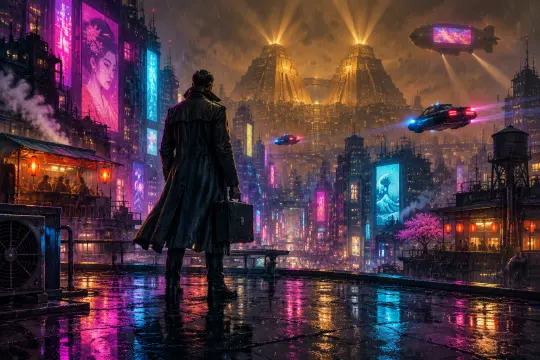
A blade runner stands on a roof in the rain with a briefcase full of questions. Below him the city sells artificial animals, artificial memories and tickets off-world. Above him two golden ziggurats belong to the company that manufactures people. Somewhere in the leaks between those layers, four escaped Nexus-6 units are counting down the last of a four-year life.
This world does not retell the film as a summary. It breaks the setting into 27 editable materials — 8 characters, 6 locations, 6 events, 4 factions and 3 rules — and then proves the material works by generating four published key visuals from two prompts with GPT Image 2 and Krea 2. Every card opens. Every description can be rewritten. Every image belongs to the world that produced it.
The test is not a lie detector. It is a machine for deciding who counts as a person — and the story is what happens when the machine starts asking the examiner the same question.
The Premise, Without the Spoilers
Los Angeles, November 2019. Earth is the place people leave. The sky is a brown smear, the rain falls warm and constant, and the streets below the blimp advertisements are lit by neon in languages nobody bothers to translate. The Tyrell Corporation builds the Nexus-6: a genetically engineered human, stronger and smarter than the model it replaces, indistinguishable from a person until you measure the one thing it cannot fake.
That thing is empathy. The Voight-Kampff machine reads capillary dilation, blush response and pupil flutter while asking questions about animals, pain and memory. A human hesitates. A replicant answers too fast, or too slowly, or with the wrong kind of care. The test is not perfect. It is bureaucratic, and that is the point: a border checkpoint dressed as a medical device.
When six Nexus-6 units hijack an off-world shuttle and crash back into the city that made them, the LAPD sends a burnt-out ex-cop named Rick Deckard to retire the four survivors. What follows is not a monster hunt. It is a countdown: four years of life, four fugitives, and a question that will not stay in the test chair.
The world runs on the labor of beings who are not legally people. The police, the corporation and the colonization ads all depend on that distinction holding. It does not hold. That is the story.
What Is Actually in This World
The world is not a mood board with a synopsis attached. It is a linked set of cards that a writer, a game designer or an image model can use as a stable brief. Characters know locations. Events depend on rules. Factions explain why the rules are enforced. If you change one card, the others still make sense — which is what makes it playable rather than decorative.
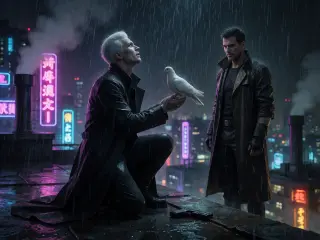
The four key visuals on this page were made from only two prompts. The first prompt describes the city as a place you could enter. The second describes the rooftop ending as a single beat. Both were sent unchanged to GPT Image 2 and Krea 2. The differences between the results are the most useful part of the page: they show where each model stops being a mood generator and starts being a scene builder.
Eight People Who Each Hold One Position
Every character exists to make a single argument unavoidable. Open a card and you get a costume, a prop, a physical tell and a pressure point — enough to write a scene without inventing a person from scratch.
Six Places That Decide How a Scene Feels
The locations are not backdrops. Each one has a different relationship to the rain, the light and the law, and that relationship tells you what kind of scene can happen there.
Six Turning Points You Can Build a Scene Around
The events are written as beats, not as plot summary. Each one has a pressure point you can play from either side: the cop, the replicant, the maker, the witness.
Four Institutions, Four Kinds of Loyalty
Factions are how the world distributes blame and affection. Each one has a uniform, a vocabulary and a reason to be afraid of the others.
The Three Rules That Make the World Behave
Rules are the most useful cards for generation and for play, because they tell you what cannot be changed without changing the story. These three are also three image instructions.
What the World Is Really About
The engine is not a fight between humans and machines. It is a fight between two kinds of evidence. The law has paperwork, tests, employment records and a definition of personhood. Roy has a poem, a dove, a hand that will not stop shaking and a memory of things he never saw. The world asks which kind of evidence should win, and refuses to answer cleanly.
That ambiguity is why the setting is good raw material for images and roleplay. It gives you built-in conflict without a built-in villain. Tyrell is not cruel; he is a businessman with a fail-safe. Deckard is not a hero; he is tired and employed. Roy is not a monster; he is dying and articulate. Every scene can be shot from at least two sides.
Two Models, One Brief: GPT Image 2 vs Krea 2
Both pairs on this page used identical prompts. Nothing was reworded between models, and neither image was retouched. The only variables were the model and its default rendering. That makes the comparison useful: it shows what each model does with the same set of facts.
- GPT Image 2 — depth and detailBuilds foreground, subject and background as separate planes. The rooftop has puddles and an air conditioner; the street has a noodle stall and a crowd; the skyline has two ziggurats and a blimp. Best when the image has to explain a place.
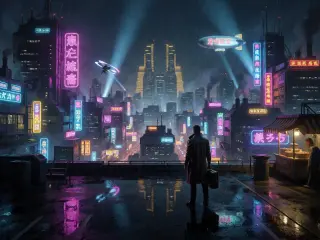
- Krea 2 — shape and speedCompresses the same city into graphic bands with clean silhouettes and a colder palette. Roughly five times cheaper per image and much faster. Best when the image has to read at thumbnail size or carry a title.
- Where they agreeBoth understand rain, neon, a trench coat and a vertical city. Both keep the figure small against the architecture when the prompt asks for scale. Neither invents a different genre.
- Where they splitGPT Image 2 adds texture and props; Krea 2 removes them. GPT explains; Krea advertises. The choice is not which is better, but which job the frame has to do.
How the Los Angeles World Key Visual Was Built
The prompt did not start from the film title. It started from the world overview: a rooftop, a city below, two corporate towers above, a blade runner with a briefcase, and rain that never stops. The film is the reference; the world cards are the brief.
Pick the argument
The image has to say: one person is small inside a city that was not built for people. That decides the camera height and the figure-to-tower ratio before any style words.
Choose the three planes
Foreground rooftop with puddles and a briefcase; middle ground street canyon with stalls and spinners; background ziggurats, smog and blimp. Write them in that order.
Name the light sources
Neon signage as the key, warm amber practicals from the noodle stall as the fill, searchlights as the vertical lines. Without named sources the model returns generic blue fog.
Fix the figure
Back to camera, long dark trench coat, briefcase in the right hand, still. A face would turn the image into a portrait and lose the city.
Generate on both models
GPT Image 2 at 1536×1024 and high quality for the hero; Krea 2 on the same text for the poster cut. Compare before writing another prompt.
How the Tears in the Rain Key Visual Was Built
The second prompt is harder because it contains two people, a prop, a wound and a specific emotional beat. It also has to survive being looked at for more than three seconds. The solution was to strip the scene to four facts and let the models fill the rain.
Reduce the beat to four facts
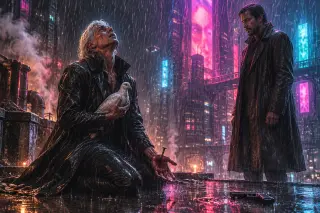
A dying replicant kneels. He holds a white dove. One hand is pierced by a nail. A blade runner watches, disarmed. Everything else is atmosphere.
Stage the gun
Put the pistol in a puddle between them. It explains the truce without a caption and gives the foreground a second focal point.
Keep the rain warm
Warm night rain against cold neon is the palette rule of the world. If the rain reads as cold or clean, the scene becomes a different film.
Protect the face
Scarred, pale, exhausted, looking up — not peaceful. The model will try to beautify him. Repeat “exhausted wonder, not serenity” and check at full resolution.
Use the same text on Krea 2
The Krea version is not a fallback. It is the stage-poster version of the same beat, and it makes the comparison honest.
Where the Two Models Actually Disagree
On the city, GPT Image 2 produced a lived-in street: a noodle stall with customers, laundry, an air-conditioning unit, wet reflections with colour separation. Krea 2 produced a cleaner poster: fewer props, a brighter cyan-magenta contrast, and a figure that reads as a silhouette rather than a person. Both are Los Angeles. One is a place; one is a cover.
On the rooftop, GPT Image 2 kept the rain, the nail, the blood, the dove’s weight and the abandoned gun. Krea 2 simplified the staging into a near-symmetrical two-shot and made the gun a clean graphic object. The GPT frame is better for a story page. The Krea frame is better for a thumbnail, a social card or a title screen.
The practical rule: use GPT Image 2 when the viewer has to understand what is happening and why. Use Krea 2 when the viewer only has half a second and needs to feel the mood. Use both when a world needs a hero image and a poster cut of the same scene.
Five Story Seeds You Can Play Tonight
These are not scenes from the film. They are situations the world’s rules produce on their own, written so you can start a session without preparation.
How to Start From This World
You do not have to rebuild Los Angeles to stand in it. The world is open, the cards are editable, and the four published works are already attached to it. Pick a card, change one detail, and the rest of the setting will hold.
Open the studio
Read the overview, then open one character and one location. Do not read all 27 cards first; the world is designed to be entered sideways.
Choose a side
Blade runner, replicant, corporate witness or market fixer. The side decides which rules matter and which locations you can enter without a lie.
Pick a countdown
The four-year lifespan is the clock. Decide how much time your character has left, then make every scene cost a little of it.
Generate one image
Use the world key visual prompt as a base and change one clause: the location, the weather or the figure. Compare GPT Image 2 and Krea 2 before you iterate.
Publish the scene
Attach the image to the card it came from. A viewer who can open the card and see the image understands why the world looks the way it does.
Questions People Ask Before Starting
Do I need to know the film? No. The world is written to be entered cold: every card carries the costume, the pressure and the rule you need. The film is a reference, not a prerequisite.
Is this a replica of the film?
No. It is a fan-built setting with its own editable materials. The characters, places and events are recognisable because the world is honest about its source, but the cards are written as playable material rather than canon. You can change Tyrell’s motive, move the rooftop to a different tower, or let Rachael pass the test.
Which model should I use first?
GPT Image 2 if you need a place, a costume or a prop explained. Krea 2 if you need a cover, a thumbnail or a fast variation. Start with the model that matches the job, not the one with the higher price.
Can I use the images commercially?
The images are generated assets published inside this world. Treat them as you would any fan-made work: check the rights position for the underlying IP, keep the non-affiliation note, and do not present generated frames as official stills.
Why are there only four works?
Because the page is a comparison, not a gallery. Two prompts, two models, four frames. That is enough to show how each model handles a city and a two-person scene, and it keeps the world from turning into a mood board.
Start From the World as It Stands
The rain is already falling. The test chair is already warm. The four published works are attached to the world, and every card behind them can be edited. Open the studio, pick a side, and give your character a countdown.
Enter the empathy test
The world is built: 27 materials, four published key visuals, and a question that does not stay in the chair. Start a scene — or open the studio and read the cards first.
Blade Runner is an independent, fan-built world in Neta Studio and is not affiliated with Alcon Entertainment, Warner Bros. or the rights holders of the film. Every character, place, event, faction and rule here is an editable world material rather than canonical text. The four key visuals on this page were generated inside this world with GPT Image 2 and Krea 2 from two identical prompts. Open the studio to read every card.