
Breaking Bad — An Albuquerque Crime-Drama World Built with AI
A complete Breaking Bad-inspired crime-drama canon rebuilt as an AI world: eight characters, six locations, six events and four factions, plus four published key visuals from a GPT Image 2 vs Krea 2 comparison. A chemistry teacher, an RV, a terminal diagnosis — and a desert that keeps every receipt.
Breaking Bad — Worldview
A high-school chemistry teacher in Albuquerque is diagnosed with inoperable lung cancer, does the arithmetic on his life insurance, and decides that the only rational move is to cook the purest methamphetamine the Southwest has ever seen. That is the premise. What the world actually becomes is a study in compounding interest: every lie requires a second lie, every dollar requires a laundering front, every partner requires a contingency, and every contingency eventually becomes a person who has to be dealt with in the desert.
A beige ranch house. A car wash. A fried-chicken franchise. A stainless-steel basement nobody is supposed to know about. The empire is built out of ordinary things, which is exactly why it is so hard to see until it is already too late.
The World in One Frame
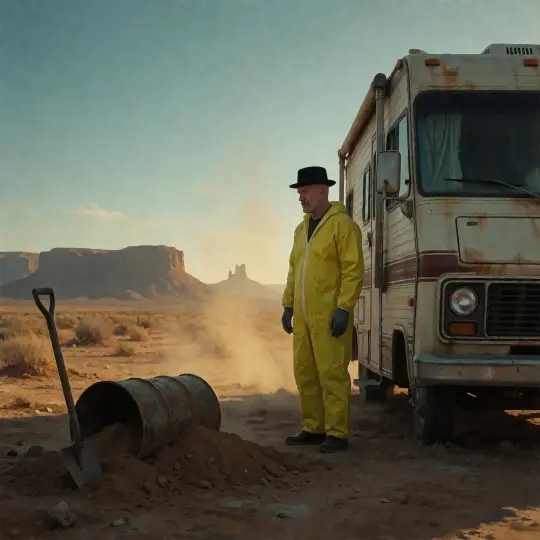
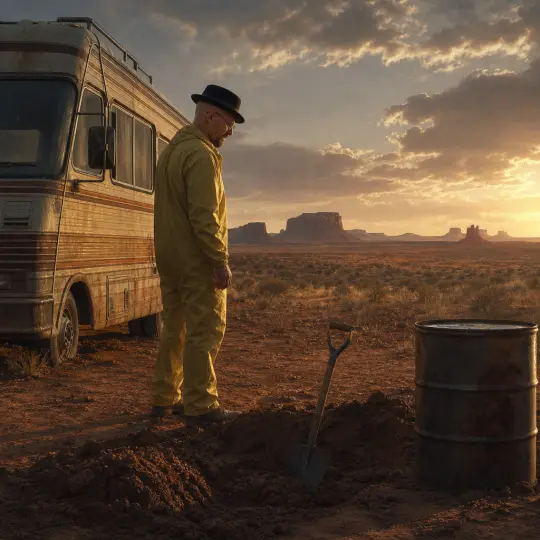
The cover is the whole argument in a single image: an ordinary vehicle, an ordinary tool, an ordinary man in work clothes, and a landscape large enough to hide anything. Nothing in the frame is fantastic. That is the point. The danger is not a monster or a spell; it is a person with a plan and a place empty enough to execute it. To'hajiilee does not decorate the story — it enables it. The desert is the only location in Albuquerque where a man can dig a hole at sunset and be certain that nobody will ask what it is for.
The Business Behind the Chemistry
Breaking Bad is often described as a show about drugs. It is more accurate to call it a show about small-business logistics conducted by people with no legitimate recourse. Distribution requires a distributor. Cash requires a front. A front requires an accountant. An accountant requires a story that survives an audit. The blue product is not a magic MacGuffin; it is a quality advantage that creates a supply problem, and the supply problem creates the entire plot.
That is why the world is so generative. A writer does not need to invent a villain. They only need to invent a bottleneck: a shipment that cannot move, a witness who cannot be paid, a family member who asks one question too many. The world supplies the pressure; the characters supply the mistakes.
“The product was never the point. The point was being the man who understood it.” — a line the world keeps proving and never says out loud
Cast of the Desert
Eight people stand inside the same collapsing business, and each one represents a different answer to the question of what the money is for. Walter wants recognition. Jesse wants absolution. Skyler wants the family to survive intact. Gus wants institutional permanence. Mike wants the job done properly. Saul wants everyone to remain technically free. Hank wants the truth, and Tuco wants respect. Put any two of them in a room and the scene writes itself.
Six Places That Hold the Story
The show is a masterclass in location as pressure. Every set answers a different production need: a family stage, a legitimate front, a legal office, an industrial secret, a domestic lie and an empty horizon. Move a scene from one to another and the meaning changes without a line of dialogue.
The Powers of Albuquerque
Four organisations hold the map together. Two are businesses, one is a family network and one is the state. None of them is primarily interested in drugs; they are interested in control of a route, a licence or a reputation. That is what makes the politics feel real.
The Timeline
Six events explain why the present is unstable. A diagnosis starts it, a first cook proves it, a deal goes wrong, a war ends, a death is permitted and a book inscription finishes it. Each event is a playable scenario and a prompt seed: one sentence that already contains a place, a cost and a person who has to decide.
The Rules of the Game
Three rules do most of the world-building. They are simple enough to explain in one sentence and cruel enough to generate unlimited scenes. If you fork this world, keep the rules and change the city; the rules are the engine.
The Core Conflict
Walt tells himself the money is for his family, and the world spends five seasons testing that sentence. Skyler wants the family to survive the money. Jesse wants to survive what the money cost. Hank wants the law to mean something. Gus wants an institution that outlives him. Mike wants the job done right. The conflict is not good against evil; it is six definitions of loyalty colliding in a market with no referee.
The real question is not whether Walt can keep the secret. It is whether a family can survive being the thing the secret is for.
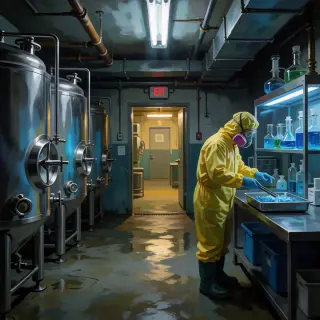
The Look: Sun-Bleached Crime Realism
The visual target is not neon noir and not glossy prestige television. It is sun-bleached realism with a painterly finish: beige stucco, dusty chrome, yellow coveralls, hospital fluorescence, and a sky that is almost always too bright for what is happening underneath it. Colour does the moral work. The desert is ochre and bone. The lab is cyan and steel. The family house is warm beige that slowly reads as camouflage.
Model Comparison: Structure Against Atmosphere
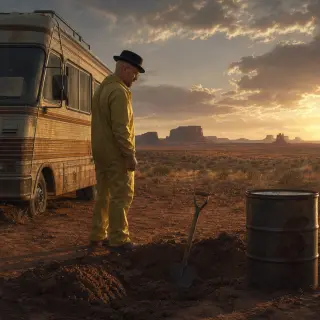
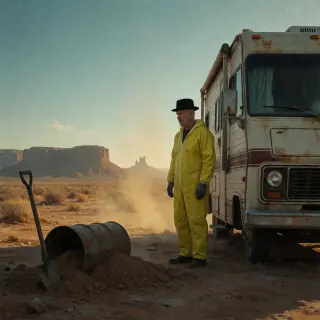
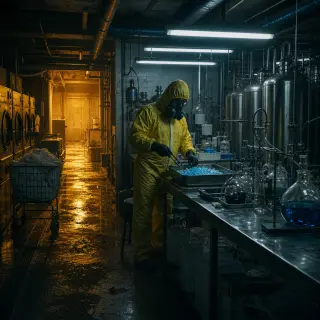
Both models were briefed from the same world atoms and the same two scene briefs, then asked for a key visual that could open a story page. GPT Image 2 resolves the world as a place: vehicle panels, fabric folds, plumbing, floor reflections, laundry machines behind a wall. Krea 2 resolves it as a mood: compressed values, graphic silhouettes, a sky that does the emotional work, and a palette that reads at thumbnail size. Neither is the correct answer. The comparison is the product.
The Prompts Behind These Frames
To'hajiilee brief. Semi-realistic painterly crime-drama key visual, cinematic wide shot: a bald middle-aged man in a black black fedora and a yellow work coverall beside a rusted 1980s recreational vehicle on red desert dirt at golden hour, flat-topped mesas, heat haze, an empty steel drum and a shovel on turned earth, muted ochre and cold teal, restrained film grain, no text.
Superlab brief. Semi-realistic painterly crime-drama key visual: an underground pharmaceutical-grade laboratory beneath an industrial laundry, stainless-steel tanks and blue-lit glassware, a figure in a yellow cleanroom coverall and respirator inspecting a steel tray of blue crystals with tongs, wet concrete, humming pipes, cold fluorescent light against warm sodium spill from a corridor, deep one-point perspective, no text.
Both prompts follow the same five-clause order: medium and genre, subject and costume, place and scale object, light and palette, and a negative clause that removes text and logos. That order is what makes the outputs comparable. If one prompt were written for GPT Image 2 and another for Krea 2, the comparison would measure the prompts instead of the models.
What You Can Build From These Atoms
A world is a kit, not a bible. The same twenty-four atoms support a visual novel about a marriage under audit, a management game about keeping a lab supplied, a short film about a fixer cleaning a room, or a branching story about a DEA agent who is one receipt away from the truth. The atoms do not dictate the genre; they supply the pressure.
Visual novel
Play Skyler White in the week before the audit: every choice is a ledger entry, and the family dinner is the boss fight.
Management game
Run the Superlab. Keep purity high, payroll quiet and the laundry profitable while three organisations compete for your route.
Short film
A fixer has one night to clean a motel room before the DEA arrives, and every object he removes is a person he knew.
Why This World Is Built for AI
This setting is unusually well suited to a world-grounded generation pipeline because its visual logic is a set of objects, not a mood board. A black fedora is a shape. A coverall is a colour block. An RV, a car wash bay, a fryer station and a stainless tank are all concrete nouns that a model can render. There is no dragon to invent and no alien grammar to explain. The fantasy is that ordinary things become evidence.
Objects as prompts
A hazmat suit, a barrel, a shovel and a mesa are enough to establish the entire genre without a single character name.
Palette as morality
Ochre desert, cyan lab, beige suburb. Change the palette and you change which part of the story the audience is watching.
Every frame is a scene
Because the world is built from locations with social rules, a still image can imply the argument that happened five minutes earlier.
From World Seed to Published Work
The pipeline is deliberately short: a world is a set of atoms, a work is a prompt pointed at those atoms, and a published work is a permanent share link attached to the world. That means lore and marketing are the same asset. The key visual is not decoration for the world page; it is an entry point into the world, with the prompt and the model recorded for anyone who wants to reproduce or fork it.
Fork the world → edit character, location and event cards → generate key visuals → publish as works → others fork your version
For this world, that loop produced four published frames in two passes. The first pass established the desert at human scale: an RV, a hole, a man. The second established the lab at industrial scale: tanks, glassware, a tray of blue crystal. Both passes used the same two briefs on both models, which is why the world page can show a genuine comparison instead of a curated highlight reel.
Choose the seed
Fork the Breaking Bad world, or write a one-sentence crime-drama brief about a person whose ordinary skill becomes a criminal advantage.
Pick the scene
To'hajiilee at sunset, the Superlab at shift change, the car wash after closing, the Pollos dining room at noon.
Cast the subject
Name the teacher, the partner, the fixer — and the object they are carrying that could end the story if it is found.
Render both models
Run the same brief through GPT Image 2 and Krea 2 and publish both as works of this world so they can be compared side by side.
Iterate in public
Compare, re-prompt or fork the world and start again — every published frame is a fork point for the next person.
Studio Workflow
The world lives in Neta Studio, where atoms are editable cards and works are published artefacts. You can fork the world, rewrite a character, add a location, generate a new frame and publish it without leaving the studio. The four works on this page are the proof: every image is a real router-files asset, every share link resolves, and every prompt is stored with the work.
Open the world
Start from the Breaking Bad studio and read the atoms before you write a prompt.
Edit an atom
Change a location's palette, a character's motive or the cost of a mistake. The world is a draft.
Generate a frame
Use the world brief as the first clause of the prompt, then add the scene and the subject.
Publish the work
Attach the frame to the world as a work, with its prompt and model recorded.
Fork and compare
Share the world, let someone else fork it, and keep the frames that survive the argument.
Explore the World
The world, its twenty-four atoms and its four published key visuals live on Neta Studio. Fork it, rewrite a character, add a location, or generate the next frame. If you only want to look, start with the To'hajiilee cover and then open the Superlab comparison — the two frames together explain the whole visual thesis.
Create from This World
Inherit a dying teacher, a loyal partner and a desert full of evidence — then tell your own story inside the business.