
Death Stranding — An AI World Where Connection Is the Only Defense Left
Thirty years after the Death Stranding, America is a scatter of walled Knot Cities joined by the footsteps of porters who walk between them. Eight characters, six locations, six events and four factions, plus four published key visuals from a GPT Image 2 vs Krea 2 comparison. A country rebuilt one knot at a time, a rain that ages everything it touches, and an invisible dead that will not stay buried.
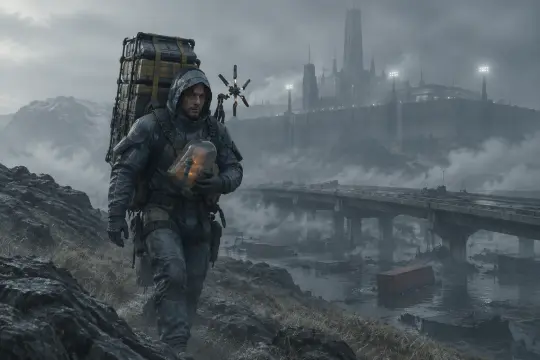
Death Stranding — An AI World Where Connection Is the Only Defense Left
The most dangerous thing in this world is not a monster. It is the distance between two people — the unfilled gap between a city and its neighbour, a father and a son, a president and the daughter she sent west. The Death Stranding broke the wall between the living and the dead, and the only response anyone has found is to walk across the wreckage and connect one place to the next by hand.
This is not a synopsis and it is not a wiki. It is a world board: eight characters, six locations, six events and four factions, each written as a card with a look, a position and a pressure point. There are four published key visuals inside it, generated from two identical prompts on two different models. Every card is editable, which means you can build a scene, a poster or a whole new chapter from the same atoms tonight.
A porter carries cargo across a country no one else will cross. The chiral network carries his voice back. But every strand that reconnects America also widens the Beach — the road the last extinction will travel.
The Premise, Without the Spoilers
Thirty years ago the dead stopped staying dead. Beached Things surfaced in every city on Earth at once, and where they touched the living, voidouts opened — not explosions but erasures, matter refusing to be. The first confirmed one took Manhattan. The country that survived did so behind walls, and the agency that runs those walls is called Bridges.
Bridges is rebuilding the United States one knot at a time. A porter walks a route no vehicle can cross, plugs a terminal in at the far end, and the chiral network extends a little further — carrying data, weather models and voices. The network only grows where a living person has physically walked. That single rule is the whole engine of the world: connection is not a signal, it is a footprint.
- 8 characters — from Sam Porter Bridges to Amelie, each holding one position in the argument about connection
- 6 locations — Capital Knot, Central Knot, Lake Knot, Mountain Knot, Edge Knot and the Beach itself
- 6 turning points — the Manhattan voidout, the Stranding, the network activation and the events that reset the map
- 4 factions — Bridges, Fragile Express, Homo Demens and the MULEs
- 4 rules — timefall, BTs and voidouts, DOOMS and repatriation, the chiral network and the Beach
- 28 editable atoms and 4 published key visuals made inside this world
Eight Porters and the Weight They Carry
Every character here exists to make one argument unavoidable: that a person is defined by what they are willing to carry for someone else. Open a card in the studio and you get the look, the history and the position — enough to write a prompt that produces a specific person rather than a generic survivor.
Six Knots, Six Kinds of Distance
The locations are not backdrops. Each one is an answer to the same question — how far can people be kept apart and still call themselves a country? — and each one fails in a different way, which is what makes them useful for composition: a ring of concrete, a crater still warm at the rim, a walled fortress, a port with weather, a city cut into a peak, and the shore on the other side of life.
Six Turning Points, and the Day the Dead Stopped Staying Dead
The events are written as beats, not plot summary. Each has a pressure point you can build a scene around — a city erased while a man is inside it, a network switched on by hand, a daughter walking west and not coming back the same. The chronology is deliberately simple, because every event is also a prompt seed.
Four Powers, Four Kinds of Connection
Factions are how this world distributes blame and affection. Each has a uniform, a method and a lie it tells itself, which is exactly what you need to dress a scene or write a briefing. One is a federal agency, one is a courier company, one is a death cult and one is a gang of former porters who lost the thread.
The Rules of the World: Timefall, BTs and the Beach
Four rules do most of the world-building, and all of them are physical before they are mystical. Rain ages what it touches. The dead are drawn to the living. Some people are born sensitive to the other side. And the network only extends where a living person has walked.
What the World Is Really About
The engine is not a fight between heroes and monsters. It is a contest between two kinds of distance: the distance institutions create to keep people manageable, and the distance people cross anyway because someone is waiting at the other end. Every wall in this world is an attempt to make connection safe. Every wall fails.
A porter is the most valuable worker in this world and the least protected person in it. The only thing that has ever resisted the extinction is one person deciding that another person is worth the walk — not the country, not the network, not the future. Just the delivery.
Two Models, One Brief: GPT Image 2 vs Krea 2
Both pairs of key visuals on this page used identical prompt text. Nothing was reworded between models, nothing was re-rolled for style. The only variables were the model and the aspect ratio its parameters allow. That makes the comparison useful rather than decorative.
- GPT Image 2 — depth and materialBuilds the ridge as separate planes: wet rock in the foreground, a drowned overpass in the middle ground, a walled city burning through fog behind. Keeps the odradek scanner, the container stacks, the floodlights and the baby pod's glow. Best when the image has to explain how a place works.
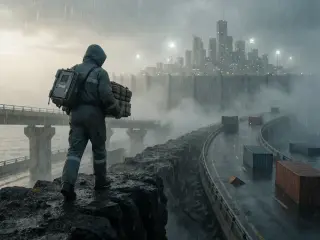
- Krea 2 — shape and speedCompresses the same brief into a cleaner poster: one courier, one curving road, one band of city light, a colder flatter palette. Roughly one-seventh the cost per image and much faster. Best when the image has to read at card size or carry a title.
- Where they agreeBoth understand a hooded courier, a cargo tower, a walled city and rain. Both keep the figure small against the landscape when the prompt asks for scale. Neither invents a different genre.
- Where they splitGPT Image 2 adds props, water and depth; Krea 2 removes them for clarity. GPT explains, Krea advertises. The choice is not which model is better — it is which job the frame has to do.
How the Porter Key Visual Was Built
The prompt did not start from a game title. It started from the world's core claim — one person is small against a country built to replace human contact — and then chose a camera position that could prove it in a single frame.
Pick the argument
One porter, one tower of cargo, one walled city, one rain. That decides camera height and the figure-to-wall ratio before any style words.
Choose the three planes
Black rock in the foreground; a drowned overpass and half-sunk containers in the middle ground; a walled Knot City with floodlights in the fog behind. Write them in that order.
Name the light sources
Flat cold overcast light from the left, sodium-orange terminal lamps, floodlights hazed by rain, a warm glow inside the baby pod. Unnamed light returns generic grey fog.
Fix the figure
Back three-quarters to camera, hood up, one hand steadying the cargo, the scanner folded on the shoulder. A clear face turns the image into a portrait and loses the landscape.
Render both models
GPT Image 2 at 1536×1024 and high quality for the hero; Krea 2 at 1024×768 on the same text for the poster cut. Compare before rewriting anything.
How the Beach Key Visual Was Built
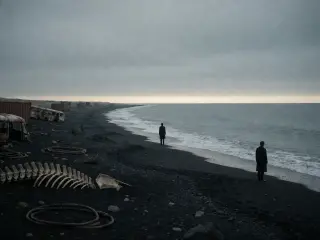
The second prompt is harder because it contains two people, a prop, a creature and a single flat shoreline — four things that can all collapse into a blur at once. The trick is to give each body a fixed relationship to the architecture of the shore.
Set the shore
A black volcanic beach, a pewter sky, one long curve of surf, wet reflective sand. One-point perspective down the shoreline, horizon low in the frame.
Place the two bodies
One figure in a dark coat at the water's edge in the middle ground, back to camera; a second figure far out on the tar, small and perfectly still, facing away. Distance is the whole point.
Add the evidence
A beached whale skeleton half-buried in the sand, rusted containers, a drowned bus, coils of umbilical cable. These props tell you the sea has been bringing things back.
Colour-code the seam
Charcoal and bone, with a thin seam of pale light along the horizon. Keep the palette desaturated so the two figures read as silhouettes rather than portraits.
Break the symmetry
Handheld documentary framing, shallow focus on the near figure, the far figure just soft enough to be uncertain. Perfect symmetry turns the Beach into a poster and kills the dread.
Where the Two Models Actually Disagree
On the ridge, GPT Image 2 produced a place with weather: rain on the rock, water in the drowned road, a city behind fog, reflections under the containers, a scanner with real hardware. Krea 2 produced a place with a composition: one courier on a clean cliff, one road curving away, one band of city light. If the page needs to explain a delivery route, GPT wins. If the page needs a thumbnail that survives a 120-pixel crop, Krea wins.
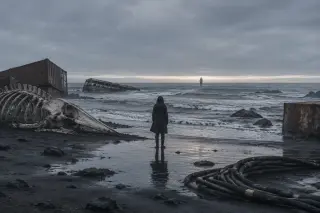
On the Beach, the gap is bigger. GPT Image 2 kept the two roles separate — one person at the surf, one impossibly far out — and used the skeleton, the containers and the cable to imply that the sea has been returning things. Krea 2 rendered a beautiful, legible emptiness, then placed both figures on the same plane, which flattens the whole point: one of them is not where a living person can stand.
The practical rule: use GPT Image 2 when the viewer has to understand what is happening, where they are and what it costs. Use Krea 2 when the viewer only needs to feel the genre in half a second — a poster, a card, a title frame — and accept that props and secondary bodies may simplify.
Five Story Seeds You Can Play Tonight
These are not scenes from the game. They are situations this world's rules produce the moment you put two of its cards together.
How to Start From This World
You do not have to rebuild a country to stand in it. The world is open, the cards are editable, and the four published works already carry their prompts — which means you can fork the exact brief instead of guessing at it.
Open the studio
Read the eight character cards, then pick the one whose position you want to argue with. That choice sets the palette more than any style keyword.
Pick one location
The drowned highway, the warm crater, Lake Knot's port, Mountain Knot's cliff, Edge Knot's fortress or the Beach. The location decides the light rig, and the light rig decides whether the frame feels like a thriller or a poster.
Write a six-clause prompt
Rendering system, place, subject, one wrong-physics detail, light and palette, negative clause. Keep the negative clause — it is what stops the model drifting into illustration.
Generate on both models
Same text, GPT Image 2 and Krea 2. Keep the one that answers the brief, not the one that looks most expensive.
Publish it into the world
A published work keeps the prompt, the model and the world together, so the next person can fork the brief rather than reverse-engineer the picture.
Questions People Ask Before Starting
Do I need to know the game? No. The world is written to be entered cold: every card explains the position it holds, the rules explain the physics, and the timeline reads as six pressure points rather than a continuity quiz.
Is this a copy of the game?
No. It is a fan-built setting with its own editable materials. Characters, places, events and factions are world cards written for generation and play, not canonical text, and the four images on this page were made inside this world rather than taken from it.
Which model should I use first?
GPT Image 2 if you need a room, a costume or a landscape explained. Krea 2 if you need a poster, a card or a title frame that reads at thumbnail size. The two comparisons on this page are the honest version of that advice.
Can I use the images commercially?
The images are generated assets published inside this world, so treat them the way you would treat any AI-generated asset you produced here: check the platform terms, keep the prompt with the file, and credit the world if you build on it.
Why are there only four works?
Because this page is a comparison, not a gallery. Two prompts, two models, four frames — enough to show a real difference in how each model handles rain, cargo, distance and two bodies on a shore.
Start From the World as It Stands
The rain is falling, the scanner is folded, and the four published works are already loadable with their prompts. Take the brief you like, change one card, and see what the machine does with it.
Enter the world of Death Stranding
A country rebuilt one knot at a time, a rain that ages everything it touches, and an invisible dead that will not stay buried. Start a scene — or open the studio and read the cards first.
Death Stranding is an independent, fan-built world in Neta Studio and is not affiliated with Kojima Productions or the rights holders of the series. Every character, place, event and faction here is an editable world material rather than canonical text. The four key visuals on this page were generated inside this world with GPT Image 2 and Krea 2 from two identical prompts. Open the studio to read every card.