Deltarune — Fountains of the Dark: Hometown, the Dark Worlds and the Knight Who Keeps Opening Doors
A complete Deltarune world built from a single sentence on Neta Studio — 27 atoms across Hometown and the Dark Worlds, plus four published key visuals from a GPT Image 2 vs Krea 2 comparison.
Worldview
Deltarune is a world with two floors. On the top floor is Hometown: a small American town of wet asphalt, porch lights and part-time jobs, where humans and monsters share a life that has quietly run out of future. On the floor below are the Dark Worlds — whole civilisations pooled under the town's forgotten rooms and objects, waiting for someone to switch them on. A school supply closet becomes a card kingdom. A library computer becomes a neon city. A television becomes a studio audience that never goes home.
This is Deltarune: Fountains of the Dark, rebuilt on Neta Studio as a playable world: 27 atoms — 8 characters, 6 locations, 5 events, 4 factions and 4 laws of the Dark — plus four published key visuals generated from the world itself in a GPT Image 2 vs Krea 2 comparison. The story engine is a single contradiction: every fountain the heroes seal saves a town that may not deserve saving.
Nothing here is a fixed bible. Every character, location, event and rule is an editable atom, so a fork can keep the Dark Worlds and rewrite who opened them, or keep the cast and move the whole story to a different town.
The Two Floors of the World
The Light World and the Dark World are not good and evil, and they are not dream and reality. They are two economies. Hometown runs on hours: school, shifts, hospital visits, a mother who will not get better. The Dark Worlds run on narrative: prophecy, courts, game shows, a fountain that must be sealed before the next one opens. Kris and Susie commute between them through a closet door, and every trip makes the top floor a little harder to take seriously.
That is the hinge the whole setting turns on. In the Dark World, Susie is a hero with an axe and a prophecy with her name in it. In Hometown she is a kid failing school who eats lunch alone. Kris is the only human in town, silent by choice, carrying a red SOUL that can save and load — and that does not entirely belong to them.
The Knight understands this better than the heroes do. Every new fountain is an argument: if the Light World has nothing to offer, why not live where the story is? Sealing a fountain wins the fight and loses the argument, every single time.
The Cast (8)
Eight characters carry the world: four Lightners, three Darkners and one salesman who is neither. Each one is an editable atom with a voice, a want and a contradiction — which is what makes them usable as prompts, not just as descriptions.
Locations (6)
Six places, and every one of them is an argument about what a world is for. Three are Dark Worlds grown out of ordinary objects; two are the town above them; one is the door nobody in Hometown talks about.
Events (5)
The timeline is five turns of the same screw. Each event opens a door, and each door makes the Light World slightly less survivable as a place to stay.
Factions (4)
Rules of the Dark (4)
Four laws hold the setting together. They are deliberately simple, because a rule you can state in one line is a rule a prompt can use.
Hometown: The Town That Has Already Lost
Hometown is drawn in flat greys and browns on purpose. The diner is open, the lake road is quiet, the school is underfunded, and the only growth industry is the hospital. This is the world the heroes are fighting to save, and the world the Knight is inviting them to leave. Every scene in Hometown should feel like the last hour of a Sunday.
The School Supply Closet: Where the Story Starts
The first Dark World is opened by accident, in the least dramatic room in town: a supply closet with a mop bucket and a shelf of cardboard boxes. That ordinariness is the point. The fountain does not need a temple or a ritual — it needs a floor and someone who wants a door.
Card Kingdom: The First Politics
Card Kingdom is a red plain ruled by a court that has already lost. The King is in exile, the Prince has defected, and the jester is in a cage — and the heroes arrive believing they are in a fairy tale. The world uses that expectation against them: a kingdom made of playing cards is a kingdom where everyone has a rank and no one chose it.
Cyber World: The Dark World That Watches Back
When a fountain opens inside a school computer, the Dark World that grows is a city of dashboards. Cyber World is where the setting is funniest and cruelest at once: neon storefronts, spam alleys, a queen who speaks in product language, and a mansion shaped like a motherboard. It is the only Dark World that feels like it was designed by a committee — because it was.
TV World: The Audience That Never Leaves
TV World is a studio the size of a city, and its villain is the most recognisable thing in Deltarune: a host who needs you to stay. Tenna does not want to destroy the heroes; he wants them booked. The Dark World here is not a kingdom or a city but a format — and a format is the hardest thing in the setting to escape, because it is made of your own desire to be watched.
The Prophecy and the Knight
The prophecy says three heroes will seal the fountains. The Knight keeps opening them. Both are answering the same question — what is a town for when it has nothing left to give? — and only one of them is honest about the answer. This is why the world does not resolve into a boss fight: the Knight is not standing in the way of the story, the Knight is the story's second draft.
Play it as a tragedy and the Knight is right. Play it as a comedy and the Knight is a vandal. Play it as a mystery and the question becomes: who in Hometown has been pressing their will into the ground, room by room, and why does the town keep letting them?
The world leaves that question open on purpose. A fork can name the Knight, redeem them, or make them the player.
The Core Conflict
Kris, Susie and Ralsei can close the Dark Fountains, but they cannot close the question underneath them: the Light World is dying by inches — a town with no future, a missing girl, a mother who will not get better — and the Knight opens each fountain as an answer. Every seal saves Hometown and proves the Knight right about it. That is the engine: a victory condition that is also a concession.
Works from This World
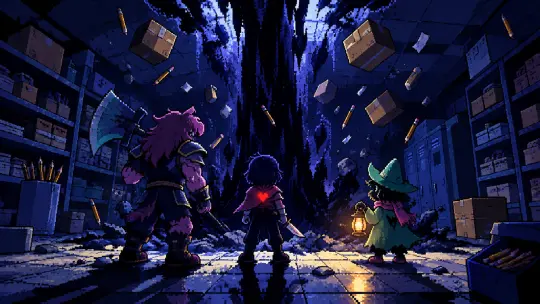
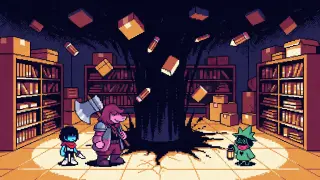
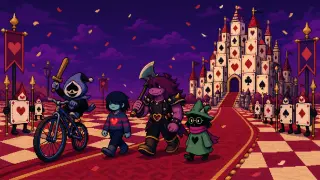
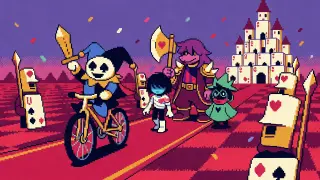
Four key visuals were generated from this world — two subjects, two models, one prompt each. They are published as works of Deltarune: Fountains of the Dark and share the same canon, palette and cast. The first pair is the fountain under the school; the second is the Card Kingdom parade.
Model Comparison: GPT Image 2 vs Krea 2
Both models received the same prompt, word for word, including the palette and the 16-bit constraints. GPT Image 2 builds the scene as architecture: a legible depth stack, props used as scale markers, and environmental detail that survives a crop to thumbnail. Krea 2 builds the scene as a poster: fewer values, flatter planes, stronger silhouette, and a colour temperature that reads instantly at small sizes. GPT is slower and costs more per image; Krea is fast and cheap enough to iterate. The practical answer for a world like this is to run both and keep the pair — one to establish the place, one to establish the mood.
The Fountain Visual, Examined
A fountain is a hard image because it has to be dark without being empty. GPT Image 2 solves it with texture: the column is black, but the room around it is full of things being pulled upward — boxes, pencils, paper — so the darkness has direction. Krea 2 solves it with contrast: the room is lit almost like daytime, and the fountain is a flat tear in the middle of it. Both read as the same event; they disagree about whether the room is losing or being revealed.
The Card Kingdom Visual, Examined
The parade image has a different job: it has to introduce five characters and a kingdom in one frame without turning into a lineup. GPT Image 2 stages it as a procession — Lancer ahead on the bicycle, the party in the middle, the castle behind — so the eye travels the same route the heroes do. Krea 2 stages it as a title screen: everyone on one plane, the castle as a silhouette, the colour doing the storytelling. The first is a scene; the second is a logo you could put on a cartridge.
Prompt Anatomy
Subject and beat → cast and their exact silhouettes → Dark World architecture → 16-bit constraints (palette, pixel edges, dithering) → the negative list (no text, no logo, no border). The cast and the architecture come from the world's atoms; only the beat changes between images.
From One Sentence to a Published Poster
Start from the world, not the prompt
Open Deltarune: Fountains of the Dark and read the four rules before writing anything. A fountain only opens where a Lightner's will has been pressed into the ground — that single rule tells you where the camera goes.
Pick a beat that has a before and after
The closet door, the parade, the broadcast, the bunker. A key visual needs a moment that is already changing, otherwise it is just a cast photo.
Write the style contract
"Authentic hand-placed 16-bit pixel art, limited 24-colour palette, crisp nearest-neighbour square pixels, three-step shadows, selective dithering" is the minimum. Without it, both models drift toward smooth digital painting.
Run both models on the same prompt
GPT Image 2 for depth and prop density, Krea 2 for flat poster colour. Keep both; the pair is more useful than either alone.
Publish into the world
Both renders become works of the world, so the next scene inherits the palette and the cast without a new briefing.
World, Not Work
A single image is a deliverable. A world is a production system. The difference shows up on the second image: with a world, the cast, the palette and the architecture are already decided, so a new scene costs a prompt instead of a briefing. Deltarune is unusually well suited to this because its own logic is world-shaped — the Dark Worlds are literally generated from ordinary objects, and every new room is a legitimate new kingdom.
That is why these four works share more than a style. They share a horizon logic, a colour temperature and a vocabulary of props: checkered fields, stacked cards, cardboard boxes, sharpened pencils, a red SOUL, a black column of light. Generate a fifth image tomorrow and it will belong to the same world without a single reference image.
A canon you can edit
27 atoms — 8 characters, 6 locations, 5 events, 4 factions and 4 rules — all editable, none of them scripture. Fork it and change who opened the first door.
A style that survives
16-bit pixel art with a 24-colour palette. Narrow on purpose, so every new image reads as the same world at thumbnail size.
A plot engine
Every fountain is a decision, every seal is a concession. The setting generates episodes without needing a new premise.
A comparison, published
Two subjects, two models, both kept as works — so the world documents its own range instead of arguing about it.
Who This World Is For
For fans of Deltarune who want to build inside the gap between chapters rather than wait for the next one. For pixel artists who need a coherent palette and cast to practise composition against. For writers who want a setting where the villain's argument is genuinely good. And for anyone who has ever wanted to see a Card Kingdom parade rendered twice and compared honestly.
Frequently Asked Questions
- What is Deltarune: Fountains of the Dark? An unofficial fan-built world on Neta Studio: Hometown above, the Dark Worlds below, and a Knight who keeps opening doors. 27 atoms, four published works.
- How many atoms does the world have? 27 — 8 characters, 6 locations, 5 events, 4 factions and 4 rules of the Dark, all editable.
- Which model made these images? Both. Each subject was rendered twice from the same prompt: GPT Image 2 for depth and detail, Krea 2 for flat poster colour and speed.
- Can I fork it? Yes. Keep the rules, change the cast, move the town, or make the Knight the protagonist.
- Is this an official Deltarune page? No. It is a fan-made world seed inspired by Deltarune, built and published on Neta Studio.
- What should I generate first? The fountain. It establishes the palette, the light direction and the scale of the cast in one frame.
Start Creating
Fork the world, open the studio board and generate from its own atoms. The cast, the map and the laws are already there; the next scene is a prompt away.
Create from This World
27 atoms, four published key visuals, two models compared — open a fountain of your own.